🚀 Zaprep: Your Socials on Steroids. Start free — automate 1,000 DMs/month & turn engagement into leads. with 1,000 automated DMs/month.


Is this your AI tool? Claim it today.
Verify ownership, manage your profile, and unlock growth features.
Agentation uniquely transforms UI annotations into structured context that AI coding agents can directly understand and act upon, streamlining communication between human feedback and AI-driven code generation. Ideal for developers, designers, and product teams, it enhances AI performance with intuitive visual feedback collection and seamless integration with popular AI tools like Claude Code and Codex.

Description
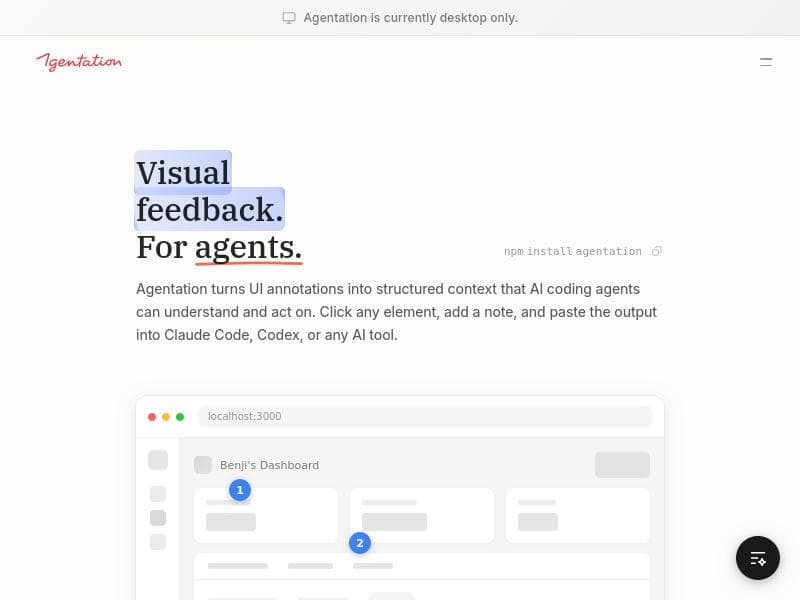
Agentation turns UI annotations into structured context that AI coding agents can understand and act on. Click any element, add a note, and paste the output into Claude Code, Codex, or any AI tool.
Detailed Description
Agentation is an innovative AI tool designed to bridge the gap between user interface (UI) elements and AI coding agents by transforming UI annotations into structured, actionable context. Its core purpose is to enable developers, designers, and product teams to communicate specific UI feedback and instructions directly to AI coding assistants such as Claude Code, Codex, or any other AI tool capable of processing structured input. By simply clicking any UI element, adding a note, and generating a structured output, Agentation streamlines the process of providing detailed context that AI agents can understand and act upon, significantly enhancing the efficiency and accuracy of AI-driven coding and automation workflows. One of the standout features of Agentation is its visual feedback collection capability. This allows users to annotate UI components visually, capturing precise feedback or instructions related to specific elements within an application or website. These annotations are then converted into a structured format that AI coding agents can interpret, enabling more nuanced and context-aware responses. Additionally, Agentation focuses on enhancing agent performance by providing richer, more detailed context, which helps AI models generate more accurate and relevant code or suggestions. The tool boasts an intuitive user interface that makes the annotation process straightforward and accessible, even for users without extensive technical expertise. This ease of use encourages broader adoption across teams and facilitates seamless collaboration between human users and AI agents. Agentation is particularly well-suited for software developers, UI/UX designers, product managers, and QA teams who need to communicate complex UI-related instructions or feedback to AI coding assistants. For example, a developer can annotate a button or form field with specific behavior instructions, which the AI agent can then use to generate or modify code accordingly. Similarly, product teams can use Agentation to collect and structure user feedback visually, feeding it into AI tools for automated analysis or implementation. This makes Agentation an invaluable asset in agile development environments, rapid prototyping, and iterative design processes where clear, contextual communication is crucial. Regarding pricing, Agentation offers a freemium model, allowing users to access core features at no cost while providing options for premium plans that may include advanced capabilities, higher usage limits, or enhanced support. This pricing structure makes it accessible to individual developers and small teams while scaling to meet the needs of larger organizations. Potential users can start with the free tier to evaluate the tool’s effectiveness before committing to a paid plan. Compared to alternatives, Agentation’s unique value lies in its ability to convert UI annotations directly into structured context tailored for AI coding agents. While other tools may offer UI feedback collection or AI-assisted coding separately, Agentation integrates these functions seamlessly, reducing friction and improving the quality of AI-generated outputs. Its compatibility with multiple AI coding platforms like Claude Code and Codex further distinguishes it by offering flexibility and broad applicability. However, users should consider that the tool’s effectiveness depends on the quality of annotations and the AI agent’s capabilities, meaning that complex or ambiguous notes may require additional refinement. In terms of limitations, Agentation’s reliance on user-generated annotations means that the accuracy and usefulness of the output are contingent upon clear and precise input. Users unfamiliar with best practices for UI annotation or AI interaction might face a learning curve. Additionally, since the tool acts as a bridge rather than a standalone AI coding solution, it requires integration with external AI agents, which may involve additional setup or subscription costs. Despite these considerations, Agentation offers a powerful, user-friendly approach to enhancing AI coding workflows through structured UI context, making it a valuable tool for teams seeking to leverage AI in software development and design.
Tool Features
- Visual feedback collection
- Agent performance enhancement
- Intuitive user interface
Description
Agentation uniquely transforms UI annotations into structured context that AI coding agents can directly understand and act upon, streamlining communication between human feedback and AI-driven code generation. Ideal for developers, designers, and product teams, it enhances AI performance with intuitive visual feedback collection and seamless integration with popular AI tools like Claude Code and Codex.
Agentation turns UI annotations into structured context that AI coding agents can understand and act on. Click any element, add a note, and paste the output into Claude Code, Codex, or any AI tool.
Detailed Description
Agentation is an innovative AI tool designed to bridge the gap between user interface (UI) elements and AI coding agents by transforming UI annotations into structured, actionable context. Its core purpose is to enable developers, designers, and product teams to communicate specific UI feedback and instructions directly to AI coding assistants such as Claude Code, Codex, or any other AI tool capable of processing structured input. By simply clicking any UI element, adding a note, and generating a structured output, Agentation streamlines the process of providing detailed context that AI agents can understand and act upon, significantly enhancing the efficiency and accuracy of AI-driven coding and automation workflows. One of the standout features of Agentation is its visual feedback collection capability. This allows users to annotate UI components visually, capturing precise feedback or instructions related to specific elements within an application or website. These annotations are then converted into a structured format that AI coding agents can interpret, enabling more nuanced and context-aware responses. Additionally, Agentation focuses on enhancing agent performance by providing richer, more detailed context, which helps AI models generate more accurate and relevant code or suggestions. The tool boasts an intuitive user interface that makes the annotation process straightforward and accessible, even for users without extensive technical expertise. This ease of use encourages broader adoption across teams and facilitates seamless collaboration between human users and AI agents. Agentation is particularly well-suited for software developers, UI/UX designers, product managers, and QA teams who need to communicate complex UI-related instructions or feedback to AI coding assistants. For example, a developer can annotate a button or form field with specific behavior instructions, which the AI agent can then use to generate or modify code accordingly. Similarly, product teams can use Agentation to collect and structure user feedback visually, feeding it into AI tools for automated analysis or implementation. This makes Agentation an invaluable asset in agile development environments, rapid prototyping, and iterative design processes where clear, contextual communication is crucial. Regarding pricing, Agentation offers a freemium model, allowing users to access core features at no cost while providing options for premium plans that may include advanced capabilities, higher usage limits, or enhanced support. This pricing structure makes it accessible to individual developers and small teams while scaling to meet the needs of larger organizations. Potential users can start with the free tier to evaluate the tool’s effectiveness before committing to a paid plan. Compared to alternatives, Agentation’s unique value lies in its ability to convert UI annotations directly into structured context tailored for AI coding agents. While other tools may offer UI feedback collection or AI-assisted coding separately, Agentation integrates these functions seamlessly, reducing friction and improving the quality of AI-generated outputs. Its compatibility with multiple AI coding platforms like Claude Code and Codex further distinguishes it by offering flexibility and broad applicability. However, users should consider that the tool’s effectiveness depends on the quality of annotations and the AI agent’s capabilities, meaning that complex or ambiguous notes may require additional refinement. In terms of limitations, Agentation’s reliance on user-generated annotations means that the accuracy and usefulness of the output are contingent upon clear and precise input. Users unfamiliar with best practices for UI annotation or AI interaction might face a learning curve. Additionally, since the tool acts as a bridge rather than a standalone AI coding solution, it requires integration with external AI agents, which may involve additional setup or subscription costs. Despite these considerations, Agentation offers a powerful, user-friendly approach to enhancing AI coding workflows through structured UI context, making it a valuable tool for teams seeking to leverage AI in software development and design.
Frequently Asked Questions
What is Agentation?
Agentation is an AI tool that converts user interface (UI) annotations into structured context that AI coding agents can understand and act on, enabling more precise and efficient AI-assisted coding and automation.
How much does Agentation cost?
Agentation offers a freemium pricing model, providing free access to core features with optional premium plans for advanced capabilities and higher usage limits.
Who is Agentation best for?
Agentation is best suited for software developers, UI/UX designers, product managers, and QA teams who need to communicate detailed UI feedback and instructions to AI coding assistants.
What are the main features of Agentation?
Key features include visual feedback collection through UI annotations, enhancement of AI agent performance by providing structured context, and an intuitive user interface for easy annotation and collaboration.
Does Agentation offer a free trial?
Yes, Agentation’s freemium model allows users to access its basic features for free, effectively serving as a free trial with the option to upgrade for additional functionality.
What integrations does Agentation support?
Agentation integrates with AI coding agents such as Claude Code, Codex, and other AI tools that can process structured context generated from UI annotations.
How does Agentation work?
Users click on any UI element to add notes or annotations, which Agentation then converts into structured context. This output can be pasted into AI coding agents like Claude Code or Codex, enabling them to understand and act on the feedback effectively.
Socials
Use ToolReviews
No reviews yet. Be the first to share your experience.
Sponsored Tools























Recommended Tools
Stay updated on latest Ai tools
Get the latest insights, Join our newsletter
Read and trusted by 50,000+ readers
Join the biggest AI Community
Our community and staff are here to help!
Your feedback will help Alice AI improve in future versions.








Submit your Tool


PoweredByAI.app is an AI Tools Directory helping individuals, businesses, and creators discover the best AI tools for writing, coding, design, productivity, and more.
© 2026 , Product of011BQ. All rights reserved.