🚀 Zaprep: Your Socials on Steroids. Start free — automate 1,000 DMs/month & turn engagement into leads. with 1,000 automated DMs/month.
BlogHow AI Is Changing the Way We Teach, Explain, and Share Knowledge
How AI Is Changing the Way We Teach, Explain, and Share Knowledge
 Shashank Jain
26 Sept 2026
6 min read
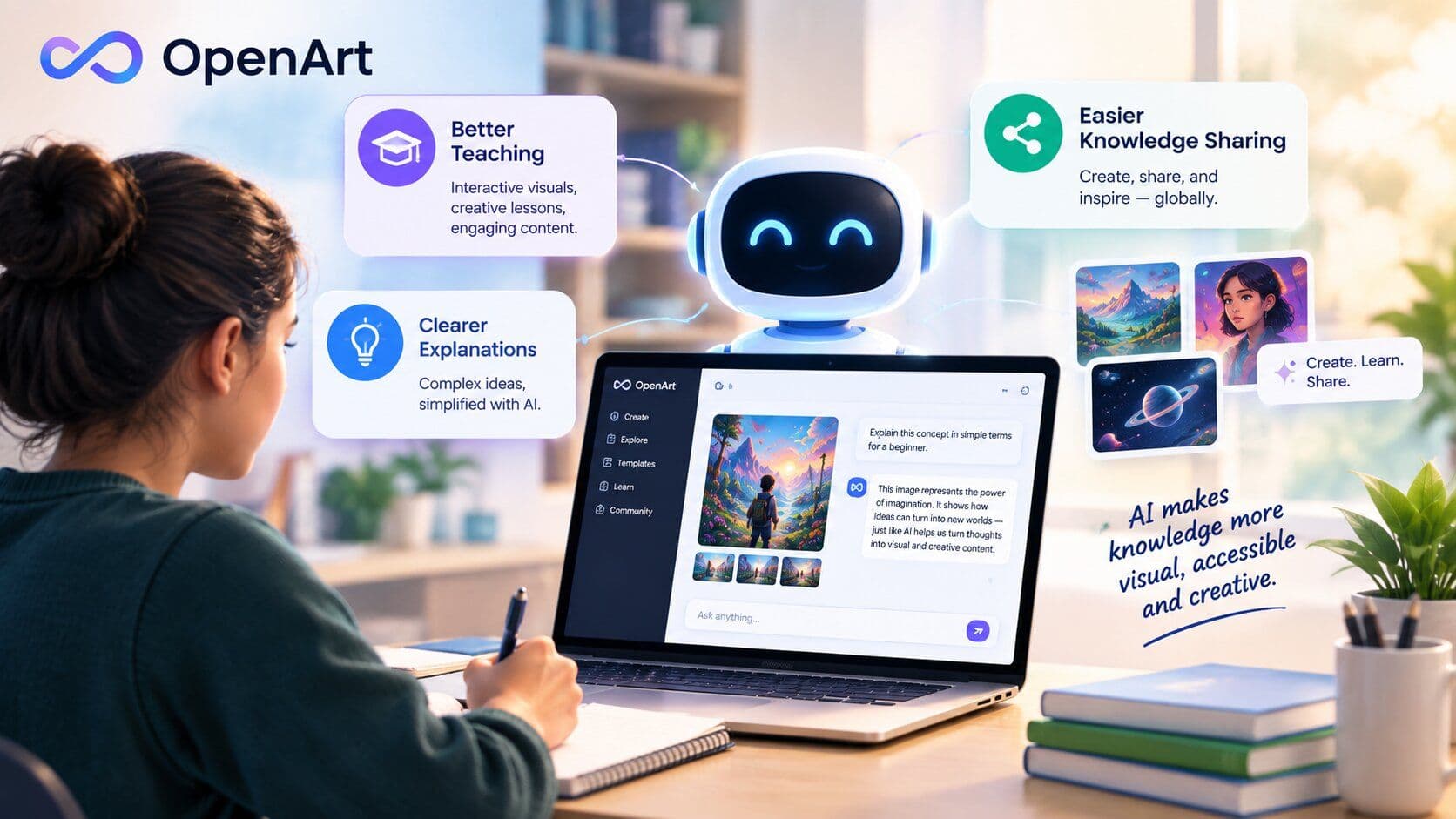
How AI Is Changing the Way We Teach, Explain, and Share Knowledge
Learning has always depended on communication.
A teacher explains an idea. A textbook provides context. A diagram simplifies something complicated. A video demonstrates a process that might be difficult to understand through words alone.
For decades, educational video production required cameras, presenters, animation software, editors, and considerable preparation.
Artificial intelligence is introducing another possibility: turning information into visual explanations with far less production overhead.
This doesn't mean every lesson needs to become an AI-generated video. Instead, AI gives educators, trainers, businesses, and independent creators another way to transform information into engaging learning material.
From Static Information to Visual Explanations
Consider a complicated concept such as how a solar panel produces electricity.
A paragraph can explain the process.
A diagram can show it.
But a short animated sequence can demonstrate the movement of energy from sunlight through the system.
This is where generative video can become useful.
Instead of treating video as entertainment alone, creators can use it as a visual explanation layer.
Turning a Lesson Into a Scene
One emerging approach is using an AI text to video generator to visualize concepts that begin as written explanations.
For example, a teacher could describe:
“Show the water cycle as water evaporates from the ocean, forms clouds, and eventually returns to the ground as rain.”
An AI system can attempt to turn that description into a visual sequence.
The result may not replace a professionally produced educational animation, but it can provide a starting point for explaining the concept.
This is particularly useful during early-stage lesson development, when teachers want to experiment with different ways of presenting the same subject.
Existing Images Can Become Animated Lessons
Not every educational project starts with text.
Teachers already use:
- Diagrams
- Maps
- Illustrations
- Historical photographs
- Scientific drawings
- Infographics
- Product diagrams
These assets can potentially become the foundation for moving content.
An AI image to video generator can take a static visual and introduce motion or camera movement, transforming an existing image into a more dynamic learning asset.
For example, a historical photograph could be given subtle camera movement for a presentation, while a scientific illustration could be animated to emphasize a particular part of a process.
The objective isn't necessarily to make the image look cinematic.
The objective is to make the information easier to understand.
AI Could Make Micro-Learning Easier
Modern audiences increasingly consume information in small pieces.
Instead of watching a 60-minute lecture, someone might prefer several short lessons covering individual concepts.
AI-generated video can support this format.
A single subject could be divided into:
Lesson 1: Introduction
Lesson 2: Key terminology
Lesson 3: Demonstration
Lesson 4: Common mistakes
Lesson 5: Practical example
Each lesson can have its own visual explanation.
This modular approach makes educational content easier to update and reorganize.
Corporate Training Is Another Major Use Case
Education isn't limited to schools and universities.
Companies constantly need to explain processes to employees.
Examples include:
- Software onboarding
- Workplace procedures
- Product training
- Customer-support workflows
- Compliance information
- Safety instructions
- Sales training
Traditionally, updating training videos can be expensive.
If a company's software interface changes, for example, an old training video may become outdated.
AI-assisted production could make it easier to create replacement sections or new explanatory material without rebuilding an entire course from scratch.
Making Complex Subjects More Accessible
Visual explanations can also help people who struggle with text-heavy learning material.
A complicated technical explanation can be presented through a combination of:
Narration + Visuals + Animation + Captions
This gives learners several ways to process the same information.
AI doesn't automatically make an explanation better, but it can make it easier to experiment with different presentation styles.
A concept that doesn't work as a static diagram might become clearer when animated.
Language Is Becoming Less of a Barrier
Another interesting development is the connection between AI video generation and multilingual education.
A training concept can potentially be adapted into different languages without recreating every visual element from scratch.
For global organizations, this could make educational content easier to localize.
However, translation still requires human review.
Technical terminology, cultural references, pronunciation, and context can all affect whether a translated lesson actually communicates the intended meaning.
AI-Generated Video Still Needs a Teacher
There is a temptation to think that AI could eventually automate the entire educational process.
But producing a video and teaching effectively are two different things.
A video can explain information.
A teacher understands whether students actually understand it.
That distinction matters.
AI can help create examples, visualizations, and supporting material, but educators remain responsible for deciding:
- What students need to learn
- Which examples are appropriate
- What information should be emphasized
- Whether the explanation is accurate
- How learning should be evaluated
The technology works best as an additional tool rather than an autonomous teacher.
Accuracy Becomes Especially Important
Educational content has a unique requirement: being visually convincing isn't enough.
An AI-generated scientific animation could look impressive while representing the underlying process incorrectly.
A historical reconstruction could contain details that never existed.
A technical demonstration could show an unsafe procedure.
This makes fact-checking essential.
The more authoritative the subject, the more important human verification becomes.
AI Can Help Create Different Explanations
One of the most promising applications isn't generating one perfect explanation.
It's generating multiple explanations of the same concept.
For example, a physics teacher might explain gravity using:
- A simple animation
- A real-world example
- A diagram
- A narrated experiment
- A short visual story
Different students may respond to different explanations.
AI can make producing these variations less time-consuming.
The Future Classroom Could Be More Visual
The classroom of the future probably won't consist entirely of AI-generated videos.
Instead, AI may become another layer within existing educational tools.
A teacher could combine:
Text → Explanation
Image → Diagram
Video → Demonstration
AI → Personalized examples
Human teacher → Context and judgment
This combination could make learning materials more flexible without removing the human element.
Knowledge Sharing Outside Traditional Education
The same technology is already relevant to creators who explain ideas online.
Tutorial creators, technical writers, consultants, researchers, and businesses can turn written knowledge into visual content.
A long article might become several short educational videos.
A technical diagram might become an animated explanation.
A presentation could become a narrated visual lesson.
This creates a bridge between written knowledge and visual communication.
What Changes for Content Creators?
The biggest shift may be that creators no longer need to choose between writing and video.
They can move between formats.
A single research document could produce:
- A blog post
- An infographic
- A short video
- A tutorial
- A presentation
- Social-media clips
AI can help transform the same underlying knowledge into different formats.
The creator's job becomes deciding how each format should communicate the information.
The Real Opportunity Is Better Communication
AI video generation shouldn't be measured only by how realistic its footage looks.
For education and knowledge sharing, a more important question is:
Does the video help someone understand something?
A spectacular visual that communicates nothing has limited educational value.
A simple animation that makes a difficult concept obvious can be far more useful.
That distinction will become increasingly important as AI-generated video becomes easier to produce.
Final Thoughts
AI is creating new ways to transform knowledge into visual experiences.
An AI text to video generator can help turn written concepts into visual starting points, while an AI image to video generator can add movement and context to existing diagrams, illustrations, and other static resources.
The technology won't eliminate teachers, trainers, or educational creators.
Instead, it can give them another way to explain difficult ideas, create learning variations, and adapt information for different audiences.
The most valuable AI-generated educational videos may ultimately be the ones that don't try to impress viewers with technology—but simply make a complicated idea easier to understand.
Related Tags
AI ToolsRelated Categories
AI ToolsGet your AI tool featured in articles like this
Reach users actively discovering AI tools on PoweredbyAI and build SEO backlinks that improve your visibility on Google.
Trusted by 10,000+ AI tools and growing startups
Get Your AI Tool Featured in High-Traffic Blogs & Articles
Get featured on PoweredByAI and reach users actively discovering tools like yours. Build powerful SEO backlinks that help you rank on Google and drive consistent organic traffic.
Sponsored blog features with targeted reach
Guest articles with do-follow backlinks
Contextual link placements for SEO boost
Trusted by 10,000+ AI tools and growing startups
Enjoyed this? Talk AI tools with other founders and builders.
Join our Slack communityRecent Blogs

Submit your Tool


PoweredByAI.app is an AI Tools Directory helping individuals, businesses, and creators discover the best AI tools for writing, coding, design, productivity, and more.
© 2026 , Product of011BQ. All rights reserved.