🚀 Zaprep: Your Socials on Steroids. Start free — automate 1,000 DMs/month & turn engagement into leads. with 1,000 automated DMs/month.
BlogAI in Vacation Rental Management: Trends, Tools & Use Cases for 2026
AI in Vacation Rental Management: Trends, Tools & Use Cases for 2026
 Shashank Jain
23 Sept 2026
11 min read
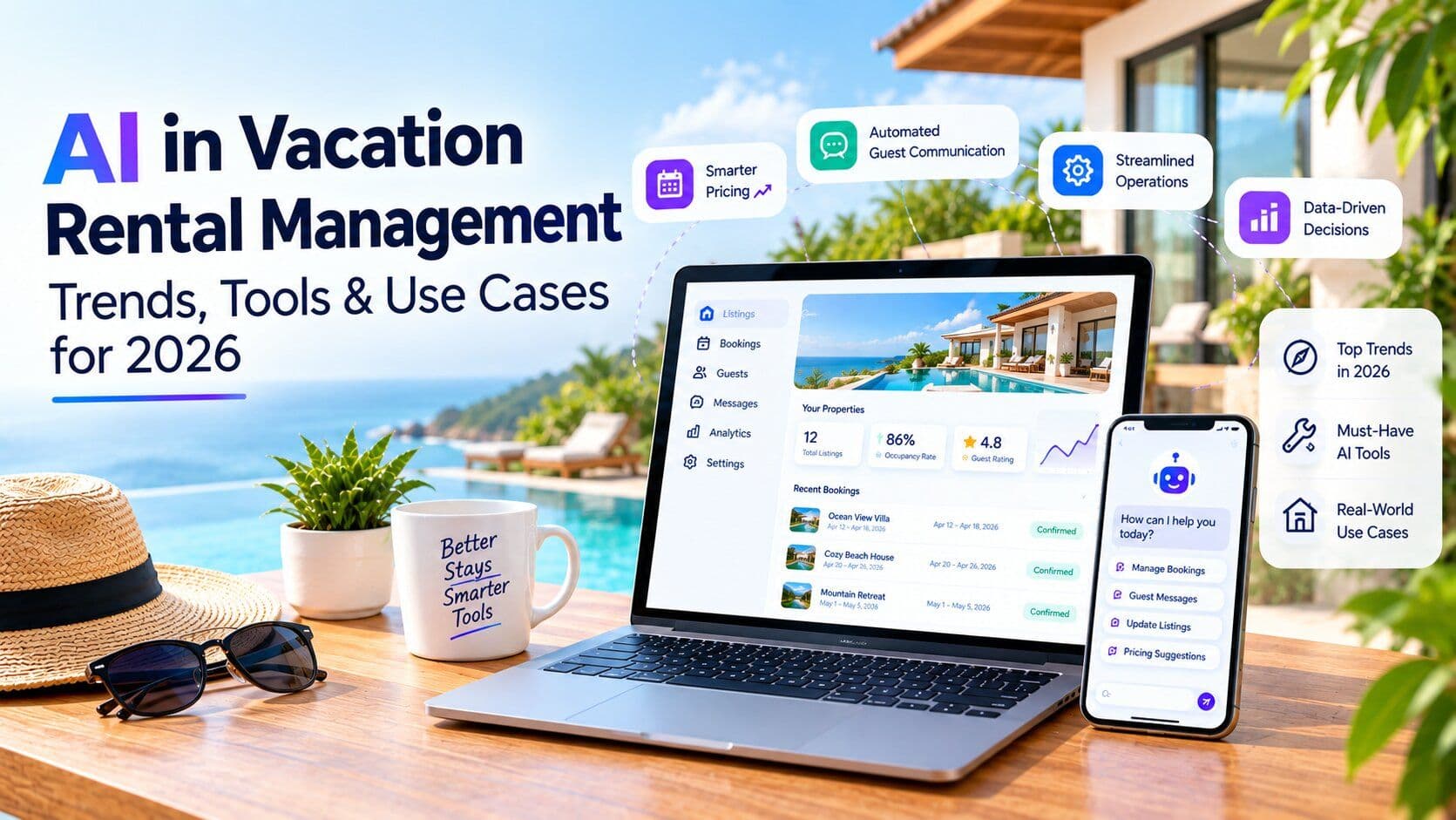
AI in Vacation Rental Management: Trends, Tools & Use Cases for 2026
Vacation rental management involves a growing number of recurring decisions across pricing, guest communication, property operations, maintenance, and marketing. As portfolios expand, these workflows generate large volumes of reservation, guest, and operational data that can support faster and more consistent decisions.
AI is increasingly being applied directly to these workflows. According to Guesty’s 2026 The AI Gap report, based on a global survey of 534 short-term rental operators, 81% already use AI operationally. Common applications include guest messaging, dynamic pricing, task routing, review analysis, visual inspections, marketing, and portfolio reporting.
For property managers, the practical value comes from turning existing data into useful actions and recommendations. Reliable inputs, clear operating rules, and defined human review points determine how effectively AI can support everyday vacation rental management.
What AI Trends Are Shaping Vacation Rental Management in 2026?
The strongest AI trends in 2026 center on deeper operational integration, richer property context, and systems that can turn information into defined actions. Property managers are applying AI to workflows that already contain structured business data.
- Embedded AI Workflows: AI functions increasingly operate alongside reservation, messaging, pricing, task, and reporting data inside property management technology.
- Property-Aware Intelligence: Systems can use approved house rules, amenity records, arrival details, property instructions, and reservation context when processing a request.
- Agentic Workflows: AI can move beyond generating a recommendation and complete approved steps such as classifying a message, creating a task, or flagging a calendar issue.
- Multimodal Analysis: Models that process images can support inspection workflows, listing-photo audits, visible damage review, and turnover checks.
- Portfolio Pattern Detection: AI can analyze large collections of reviews, messages, maintenance records, and performance data to identify recurring issues across properties.
- Structured Outputs: Operators increasingly need AI to return a category, task, priority, recommendation, or alert that another system can process.
- Defined Escalation: Automation rules can route cases to staff according to safety risk, financial impact, issue category, or internal approval requirements.
These developments make AI increasingly useful for repeatable workflows where the business already maintains reliable source data and clear operating rules.
Which AI Tools Have the Most Practical Value for Vacation Rental Management (With Use Cases)?
The best vacation rental AI tools connect directly with a defined management function and produce an output that staff can use or measure. Tool selection should start with the workflow, available data, required integrations, and the operational result the team expects. Several categories currently have clear applications in professional vacation rental management.
Guest Communication Systems
Communication-focused AI processes incoming messages using reservation and property context. Useful systems can identify the guest’s intent, retrieve approved information, generate a response, translate content, and assign an issue category.
Accuracy depends heavily on the knowledge available to the system. Property-specific parking details, access instructions, appliance guidance, house rules, and checkout procedures give the model a reliable information base. Escalation settings determine which requests move directly to staff.
Use case: HostBuddy focuses on AI guest messaging and inbox automation. It automates guest inquiries, support requests, and messaging workflows to reduce the amount of routine communication handled manually.
Revenue Management Systems
AI-assisted revenue tools process rate, availability, booking pace, lead-time, seasonal, and market signals. Their output can include rate recommendations, minimum-stay changes, or alerts for dates that require revenue-manager attention.
Practical controls matter as much as the recommendation itself. Minimum rates, maximum rates, owner requirements, booking-window rules, and event settings define the boundaries within which the system operates. Reporting then connects pricing actions with reservation results.
Use case: PriceLabs uses market data and demand forecasting for dynamic pricing. Its tools also support minimum-stay controls and market analysis, giving revenue teams additional inputs for rate and occupancy decisions.
Operations and Inspection Systems
Operational AI turns property events into structured work. Reservation changes, staff reports, guest messages, photos, and task records can supply the information needed to classify an issue or initiate an operational workflow.
Visual analysis adds another source of information. Standardized turnover images can help identify visible room conditions, missing items, setup differences, or potential damage that requires staff review. Property and reservation identifiers keep each finding connected with the correct stay.
Use case: RapidEye analyzes turnover photos and walkthrough videos for property-condition checks. Its AI can flag visible damage, missing items, staging changes, and cleanliness issues by comparing new media with room-level visual baselines.
Analytics and Marketing Intelligence
Analytical tools search large datasets for patterns that managers may struggle to identify manually. Reviews, booking history, guest questions, revenue records, and property performance can reveal recurring themes or unusual changes.
Marketing teams can use these findings to improve property content, audience selection, and campaign planning. Operations teams can use the same type of analysis to locate repeated service issues or properties that generate a particular category of complaint.
Use case: IntelliHost uses AI for performance and pricing intelligence. It provides OTA performance insights, listing benchmarks, pricing recommendations, conversion analytics, and ranking visibility to help operators identify opportunities across their properties.
Where Can AI Improve Day-to-Day Vacation Rental Operations?
Daily operations contain many small tasks that follow recognizable patterns. AI can process the initial information, apply predefined rules, and create a useful next action for staff or another connected system.
- Late-Night Guest Questions: A message about parking or appliance use can trigger retrieval of approved instructions connected with the booked property and current reservation.
- Access Request Classification: A system can identify a lock, code, or entry-related message and route it according to the operator’s security and verification rules.
- Maintenance Intake: A message such as “the air conditioner is leaking in the bedroom” can become an HVAC task with the room, property, reservation, and reported symptom attached.
- Turnover Exceptions: Standardized post-cleaning photos can trigger review when the system detects a visible room condition that falls outside the expected setup.
- Recurring Issue Detection: Repeated reports involving WiFi, hot water, locks, or HVAC at the same property can surface as a property-level maintenance pattern.
- Review Theme Extraction: Hundreds of reviews can be grouped into topics such as cleanliness, beds, noise, parking, check-in, location, and amenities.
- Listing Audits: Structured property records can be compared with guest-facing content to identify missing amenity details or inconsistencies that require editorial review.
- Multilingual Guest Support: Incoming messages can be interpreted in the guest’s language and matched with approved property information before a response enters the communication workflow.
Each use case needs a defined action after the AI output. A classification can create a task, a detected pattern can trigger an investigation, and a content issue can enter an editorial queue.
How Can AI Improve Vacation Rental Pricing?
AI can support pricing teams by continuously evaluating reservation and calendar signals across future dates. The best Airbnb pricing tools give revenue managers granular controls over rates, minimum stays, booking windows, and property-level pricing rules.
Three applications have particularly clear operational value.
1. Booking Pace Analysis
Booking pace shows how reservations accumulate as an arrival date approaches. AI can compare current pickup with an established forecast or historical pattern and flag dates that require attention.
For example, a July period may show weak pickup six weeks before arrival. The pricing workflow can identify the affected nights and produce a rate recommendation within the property’s approved limits. The revenue team can follow subsequent pickup, occupancy, ADR, and revenue for those dates.
2. Calendar Gap Management
Small openings between confirmed reservations can create difficult inventory patterns. A property with bookings from June 10–14 and June 17–22 leaves June 15–16 available as a two-night gap.
Pricing logic can detect the opening and apply the operator’s rules for short gaps, including an eligible minimum-stay adjustment. Once those nights receive a qualifying reservation, the normal calendar settings continue according to the existing pricing configuration.
3. Pricing Guardrails
Automated pricing needs a defined decision range. Minimum and maximum rates, minimum-stay rules, lead-time settings, owner requirements, and event controls can establish that range for every property.
Teams can also create approval thresholds for significant changes. A recommendation that crosses the selected threshold moves to a revenue manager for review before the new value reaches the booking channels.
Which Guest and Property Data Can AI Use?
AI produces stronger operational outputs when each workflow receives data that directly supports the task. Property managers should define the source and purpose of every field before connecting it with automated decisions.
- Reservation Status: Supplies the current booking stage, including confirmed, cancelled, checked in, and completed stays.
- Arrival and Departure Dates: Provide timing context for communication, operations, and revenue workflows.
- Property ID: Connects every action with the correct rental, building, or portfolio unit.
- Guest Messages: Supply intent, reported problems, requests, and communication history.
- Property Instructions: Provide approved information for access, parking, amenities, appliances, and house procedures.
- Rates and Availability: Give revenue systems the current calendar and pricing state.
- Booking Pace: Shows how future inventory is filling over time.
- Task Records: Supply cleaning, inspection, maintenance, and resolution history.
- Reviews: Provide structured material for topic and sentiment analysis.
- Photos and Videos: Supply visual evidence for inspection and property-condition workflows.
- Maintenance History: Helps identify recurring issues linked with equipment, rooms, or individual properties.
- Campaign Data: Connects marketing activity with guest engagement and resulting reservations.
Consistent identifiers allow these inputs to remain connected as information moves across systems. Clear data ownership also keeps each workflow tied to a current source.
How Can AI Support Risk and Insurance Workflows?
AI can support risk teams by converting incident information into organized records and routing cases according to predefined review rules. This has practical applications in damage management, safety documentation, operational incidents, and vacation rental insurance workflows. The technology is especially useful during the information-gathering stage.
Incident Classification
Incident reports often arrive as free-text guest messages, staff notes, maintenance records, or internal reports. AI can extract the property, reservation, event date, affected area, reported issue, and issue category into structured fields.
A standardized record gives the reviewing team a consistent starting point. The source material remains attached to the case so staff can verify the extracted information during investigation.
Evidence Organization
Photos, videos, repair records, guest messages, and staff notes can form part of the same incident. AI can categorize this material and connect individual items with rooms, objects, timestamps, or reported events.
This structure can simplify evidence review and case preparation. Staff responsible for liability, coverage, damage assessment, or financial decisions retain control over the final determination.
Case Prioritization
Triage rules can classify incidents according to urgency, safety indicators, financial exposure, or issue type. A routine missing-item report can enter a standard review queue, and a serious safety report can trigger the operator’s high-priority procedure.
The system can also track unresolved cases according to internal deadlines. This gives managers a clearer view of incidents that require immediate attention or additional documentation.
Which AI Decisions Need Human Review in Vacation Rental Management?
Human review is essential when an automated decision can materially affect safety, financial responsibility, property access, legal exposure, or a guest dispute. Operators should define these boundaries before activating the workflow.
- Safety Incidents: Fire, gas, electrical, medical, and security reports require established emergency procedures and responsible staff.
- Refunds and Compensation: Authorized employees should review financial exceptions, refunds, credits, and disputed charges.
- Damage Responsibility: Staff should assess the evidence, context, repair requirements, and responsibility before assigning a financial outcome.
- Insurance Decisions: Qualified reviewers should handle coverage, liability, claim eligibility, and settlement decisions.
- Access Exceptions: Requests involving locks, codes, identity verification, or unusual entry permissions need controlled review.
- Legal Questions: Regulatory, contractual, and compliance decisions require appropriate professional judgment.
- Major Rate Changes: Pricing recommendations outside approved boundaries should move to an authorized revenue manager.
- Guest Disputes: Complaints involving contested facts, responsibility, or significant service recovery require direct staff involvement.
Documented escalation rules keep these cases visible and assign responsibility to the appropriate role.
How Can Larger Portfolios Integrate AI With Existing Systems?
Large portfolios need consistent data connections between reservations, properties, guests, tasks, and AI workflows. Operators using resort management software or another centralized management platform can create shared identifiers that preserve context across the technology stack.
Three integration areas deserve particular attention.
1. Connect Reservation Events
Booking events can serve as reliable triggers for downstream workflows. A confirmed reservation, cancellation, arrival, departure, or stay-status change can send the reservation ID, property ID, dates, and current status to the relevant AI function.
This creates a consistent event structure across properties. Communication, operations, and reporting systems can then use the same booking context when processing their own tasks.
2. Keep Property Context Consistent
AI workflows need accurate property information to produce useful outputs. Property IDs, unit names, amenity records, instructions, market assignments, and operational settings should follow consistent naming rules across connected platforms.
A change in parking instructions or access procedures should reach every workflow that relies on that information. Clear source ownership gives teams one authoritative location for updating each property field.
3. Route Outputs Into Operations
An AI output gains operational value when it reaches the team or system responsible for the next step. A maintenance classification can create a work order, an inspection flag can enter a quality-control queue, and a pricing alert can reach a revenue manager.
The workflow should record the output, action, timestamp, and final resolution. These records create an audit trail and give management the data required to evaluate system accuracy over time.
What Should Operators Measure After AI Deployment?
AI performance should connect directly with the job assigned to each workflow. Baseline measurements taken before deployment give managers a useful reference for evaluating subsequent results.
- Resolution Accuracy: Measure how often guest or operational requests reach the correct outcome.
- Response Time: Track the interval between an incoming guest message and a completed response.
- Escalation Accuracy: Review whether cases sent to staff genuinely matched the defined escalation criteria.
- Task Routing Accuracy: Measure how often maintenance and operational issues reach the correct category or team on the first assignment.
- Resolution Time: Track the period between issue creation and operational closure.
- Confirmed Inspection Flags: Compare visual AI findings with conditions verified by staff.
- Pricing Outcomes: Monitor booking pace, ADR, occupancy, and revenue for dates affected by AI-assisted pricing decisions.
- Attributed Booking Revenue: Connect marketing recommendations or AI-supported campaigns with completed reservation value.
- Recurring Issue Frequency: Measure whether identified property problems continue after corrective action.
- Manual Processing Time: Record staff time spent on the workflow before and after implementation.
Regular quality sampling can reveal outdated source data, weak rules, classification errors, or integration problems. Each metric should stay connected with the specific AI function that generated the result.
Conclusion
AI in vacation rental management supports concrete work across guest communication, pricing, property operations, inspection, marketing analysis, risk management, and portfolio coordination. The most valuable applications turn reliable business data into a defined response, task, recommendation, classification, or alert.
Effective implementation depends on accurate source data, clear system ownership, measurable performance criteria, and documented human review rules. These foundations give property managers a practical framework for evaluating AI through real operational results across the portfolio.
Related Tags
AI ToolsRelated Categories
AI ToolsGet your AI tool featured in articles like this
Reach users actively discovering AI tools on PoweredbyAI and build SEO backlinks that improve your visibility on Google.
Trusted by 10,000+ AI tools and growing startups
Get Your AI Tool Featured in High-Traffic Blogs & Articles
Get featured on PoweredByAI and reach users actively discovering tools like yours. Build powerful SEO backlinks that help you rank on Google and drive consistent organic traffic.
Sponsored blog features with targeted reach
Guest articles with do-follow backlinks
Contextual link placements for SEO boost
Trusted by 10,000+ AI tools and growing startups
Enjoyed this? Talk AI tools with other founders and builders.
Join our Slack communityRecent Blogs

Submit your Tool


PoweredByAI.app is an AI Tools Directory helping individuals, businesses, and creators discover the best AI tools for writing, coding, design, productivity, and more.
© 2026 , Product of011BQ. All rights reserved.