🚀 Zaprep: Your Socials on Steroids. Start free — automate 1,000 DMs/month & turn engagement into leads. with 1,000 automated DMs/month.
BlogTop 5 Custom Agentic AI Development Companies in the USA
Top 5 Custom Agentic AI Development Companies in the USA
 Shashank Jain
22 Sept 2026
8 min read
Most enterprises that say they have adopted AI agents are still operating a pilot. The model works in a controlled demo, then encounters a CRM with years of custom fields, an undocumented data warehouse, and a compliance team that needs a usable audit trail.
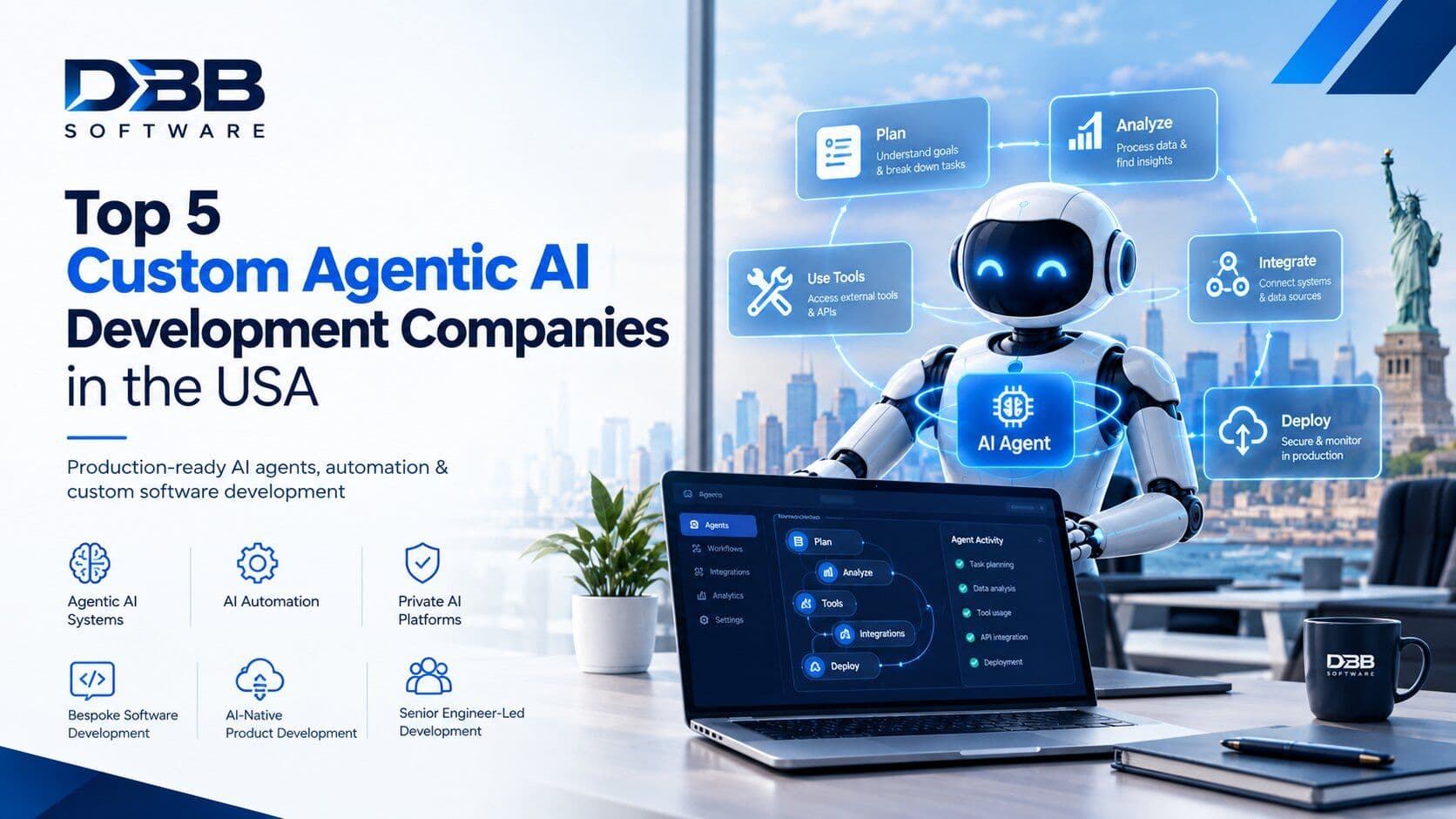
Top 5 Custom Agentic AI Development Companies in the USA
Most enterprises that say they have adopted AI agents are still operating a pilot. The model works in a controlled demo, then encounters a CRM with years of custom fields, an undocumented data warehouse, and a compliance team that needs a usable audit trail.
That is where agentic programs fail: at the system boundary. The decisive work is integration, identity, permissions, exception handling, observability, and ownership after launch. Choosing a partner therefore requires more than comparing model expertise or orchestration frameworks.
There is also a basic design choice to settle first. If the system should help a person research, decide, draft, or complete approved tasks while preserving human control, AI copilot development services may be a better fit than full autonomy. If the workflow should proceed unattended inside explicit limits, an agentic architecture is the relevant category.
Why Custom Development Matters for Complex Workflows
Packaged platforms work well when a workflow follows a common pattern and most of the required data already lives inside the vendor's ecosystem. Custom development becomes more valuable when the process spans several systems, relies on proprietary data structures, or contains decision rules that configuration cannot express safely.
A production-grade agent usually combines planning, persistent state, retrieval, tool access, identity controls, and orchestration. It also needs deterministic safeguards around probabilistic reasoning. Retries, stopping conditions, approval thresholds, rollback paths, and audit events matter more in production than the elegance of the prompt.
The distinction between an agent and a copilot is primarily authority, not technical sophistication. Both may use reasoning, memory, retrieval, and tools. A copilot keeps a person responsible for consequential actions. An agent proceeds autonomously within pre-agreed boundaries and escalates exceptions.
How These Five Were Selected
The shortlist favors service companies with a US headquarters or substantial US delivery presence, a clearly described custom development offering, and public evidence that goes beyond a generic chatbot demo. Production case studies, named architecture components, security controls, and post-launch operating models received the most weight.
The list is not a universal ranking. Each firm serves a different buying situation. Public case studies are also vendor-reported and should be validated through technical references, architecture reviews, and a scoped proof of value before contract signature.
Five Custom Agentic AI Development Companies
1. DBB Software
What they do: DBB Software designs custom copilots and agents that work inside existing products and business applications. Its architecture covers retrieval, context, integrations, permissions, interfaces, evaluation, and observability, with senior engineers reviewing AI-assisted development output.
Production evidence: For a self-hosted AI platform, DBB built a local-first runtime with authentication, an encrypted key vault, persistent memory, audit logging, supervised agent processes, and portable tool integrations. The platform went from zero to a working product in about four months with one senior engineer. For Plaace, DBB added an AI-powered assistant and editable insight workflows to a real-estate platform.
Why companies choose them: The delivery model emphasizes architect-led scoping, permission-aware retrieval, explicitly scoped tool calls, human confirmation for consequential writes, and measurable evaluation before launch. DBB states a planning target of a working proof of concept in one week and a functional MVP in one month, subject to scope and integration readiness.
Best for: Product and operations teams that need a custom assistant or bounded agent embedded in proprietary software, with auditability and provider portability designed in from the start.
2. HatchWorks AI
What they do: HatchWorks AI combines AI strategy, data work, and production delivery. Its agentic automation offering is supported by a reusable delivery methodology and teams working in overlapping US time zones.
Production evidence: For a national commercial real-estate firm, HatchWorks delivered a multi-agent intelligence platform on the client's Google Cloud environment. The system reads source systems in place, connects content, CRM, and productivity tools through secure integrations, and supports knowledge retrieval, broker document generation, and title and lease abstraction. The vendor reports more than 70 production users.
Why companies choose them: The case study shows production hardening across token management, role-based access, guardrails, tracing, observability, and phased rollout. The reusable platform approach is useful when a company expects several agent use cases but wants shared controls and integrations rather than disconnected pilots.
Best for: Mid-market and enterprise buyers that need strategy, data integration, and multiple production use cases delivered through one operating model.
3. Azumo
What they do: Azumo builds autonomous agents and AI applications using frameworks including LangGraph, CrewAI, and Microsoft AutoGen. Buyers can engage for discovery, a fixed-scope build, an embedded team, or senior technical leadership.
Production evidence: Azumo reports more than 300 AI deployments and describes production systems such as an autonomous sales development agent that researches prospects across external data sources and initiates outreach. Its service also covers agents connected to CRM, ERP, cloud, and collaboration platforms.
Why companies choose them: The company combines agent engineering with the data pipelines and system integration needed to support it. Its delivery model also gives US buyers nearshore time-zone overlap. Azumo states that enterprise production agents with integrations typically require two to six months, which is a more credible planning assumption than an instant deployment claim.
Best for: Organizations that need both AI and data engineering, especially when an embedded nearshore team is preferable to a fully outsourced project.
4. BlueLabel
What they do: BlueLabel develops AI-enabled products and operational systems, combining product strategy, experience design, data architecture, and engineering. Its work is relevant where the agent is part of a broader user-facing product rather than a standalone automation.
Production evidence: Published examples include an AI-assisted advisor workflow for B.O.S.S. that the company reports increased close rates by more than 5 percent, and MapLine.AI, which reduced real-estate due-diligence work from days to minutes. These examples demonstrate applied generative AI and workflow acceleration, although buyers should verify how much execution is autonomous in the specific reference architecture.
Why companies choose them: The firm is strongest when product design and adoption matter as much as model behavior. Its SPRINT approach is positioned around moving from opportunity definition to a pilot in four to eight weeks, with longer-term product evolution after validation.
Best for: Companies building a customer-facing or employee-facing AI product that needs strong UX, workflow design, and product management alongside AI engineering.
5. LeewayHertz
What they do: LeewayHertz offers a broad enterprise AI development practice covering use-case analysis, architecture, agent and multi-agent development, tool integration, guardrails, deployment, monitoring, and ongoing optimization.
Production evidence: Its public portfolio includes enterprise AI applications for manufacturing troubleshooting, compliance and security access, and other knowledge-intensive workflows. The technical offering is broad, but buyers should request a reference that matches the required autonomy level because several published examples are AI applications rather than clearly documented autonomous agents.
Why companies choose them: LeewayHertz supports a wide framework and cloud stack and describes governance, evaluation, observability, and AgentOps as part of the lifecycle. That breadth suits enterprises that want a vendor able to compare architectures rather than force every use case onto one platform.
Best for: Enterprises evaluating several frameworks or cloud environments and willing to conduct detailed reference checks for the exact workflow being proposed.
What to Verify Before Committing
Production reference: Ask for a comparable client that has operated the system for at least six months, then speak directly with the technical owner.
Action boundaries: List what the agent may read, draft, write, approve, and never do. Confirm which actions require human confirmation.
Failure behavior: Review retries, timeouts, idempotency, rollback, partial completion, and escalation when an API or model fails mid-task.
Identity and permissions: Confirm that the agent inherits least-privilege access and that retrieval is filtered before sensitive data reaches a model.
Evaluation: Require a representative test set, acceptance thresholds, regression testing, and a process for measuring production drift.
Auditability: Inspect the actual event schema for prompts, retrieved sources, tool calls, approvals, outputs, and errors. A dashboard screenshot is not enough.
Ownership: Settle rights to code, prompts, evaluation sets, orchestration logic, documentation, and deployment artifacts before work begins.
Realistic Cost and Timeline Expectations
Budget should follow integration risk, not the number of agents shown on an architecture diagram. A narrow proof of value may fit in the low tens of thousands of dollars. A production deployment with several integrations, identity controls, evaluation, and monitoring commonly moves into the mid five figures or higher. Multi-agent systems spanning business units can reach six figures and require several months.
Treat these as planning ranges, not market rates. The largest cost drivers are the number and condition of connected systems, data quality, security review, exception complexity, required uptime, and the evidence burden for regulated decisions. A fixed estimate is credible only after the vendor has inspected those constraints.
Where Most Programs Go Wrong
Selecting autonomy before mapping risk: A workflow should not become fully agentic simply because the technology can execute it. High-consequence actions often belong in a copilot model with explicit review.
Optimizing the demo instead of the exceptions: Happy-path accuracy hides the operational work. Production readiness is visible in failure handling, permissions, audit events, and recovery procedures.
Underestimating integration: Authentication, data transformation, API limits, stale records, and ambiguous ownership often consume more engineering effort than model orchestration.
Treating launch as the finish line: Models, prompts, APIs, and surrounding business systems change. Durable programs assign owners to evaluation, incidents, cost control, and improvement after release.
Buying on hourly rate alone: The relevant comparison is total cost to a stable production outcome. Cheap implementation can become expensive when the organization must rebuild permissions, observability, or integration logic later.
Final Thoughts
The best partner is not necessarily the largest firm or the one with the longest framework list. It is the company whose production evidence, delivery model, and risk controls match the workflow you are trying to operate.
Define the measurable outcome, the systems involved, and the permitted action boundary before comparing proposals. Then require each vendor to show how the same workflow behaves when data is missing, a tool call fails, a user lacks permission, or the model is uncertain. Those answers reveal far more than a polished demonstration.
Related Tags
AI ToolsRelated Categories
AI ToolsGet your AI tool featured in articles like this
Reach users actively discovering AI tools on PoweredbyAI and build SEO backlinks that improve your visibility on Google.
Trusted by 10,000+ AI tools and growing startups
Get Your AI Tool Featured in High-Traffic Blogs & Articles
Get featured on PoweredByAI and reach users actively discovering tools like yours. Build powerful SEO backlinks that help you rank on Google and drive consistent organic traffic.
Sponsored blog features with targeted reach
Guest articles with do-follow backlinks
Contextual link placements for SEO boost
Trusted by 10,000+ AI tools and growing startups
Enjoyed this? Talk AI tools with other founders and builders.
Join our Slack communityRecent Blogs
Submit your Tool


PoweredByAI.app is an AI Tools Directory helping individuals, businesses, and creators discover the best AI tools for writing, coding, design, productivity, and more.
© 2026 , Product of011BQ. All rights reserved.