🚀 Zaprep: Your Socials on Steroids. Start free — automate 1,000 DMs/month & turn engagement into leads. with 1,000 automated DMs/month.
Latest AI News

Wayve launches $85M employee tender offer at $8.5B valuation
Wayve, a UK-based self-driving tech startup, is allowing its employees to sell a portion of their vested equity. The $85 million tender offer — essentially a structured opportunity for employees to sell shares back to investors — is being led by the company’s existing and new investors at the company’s latest valuation of$8.5 billion. That valuation was set in February when the nine-year-old company raised a $1.2 billion Series D led by Eclipse, Balderton and SoftBank Vision Fund 2, and included participation from Ontario Teachers’ Pension Plan, Baillie Gifford, Microsoft, NVIDIA and Uber. This is Wayve’s second employee liquidity event. The company previously held a tender offer alongside its$1.05 billionSeries C funding round in May 2024. Wayve’s offering is part of agrowing trendof AI startups. Rather than waiting years for an exit, companies are using tender offers as a retention tool, giving employees a reason to stick around rather than jump to a competitor — or start their own shop — the moment their options vest. Other startups that have recently completed employee tender offers includeDecagon, which builds AI agents that handle customer service for enterprises like Duolingo and Hertz;ElevenLabs, the AI voice-generation company behind much of the internet’s synthetic speech and dubbing tools;Linear, a popular project-management platform built for software teams; andClay, a sales and marketing automation tool that helps companies research and reach prospects. (Clay has run two tenders in the last nine months alone.) These startups are able to provide employee liquidity primarily because investors are eager to buy more of the equity in these high-growth companies, even at a premium, betting the businesses will be worth even more down the line. Wayve uses a self-learning approach to its autonomous driving. Instead of relying on the pre-built, high-definition maps most self-driving programs use, its software is an end-to-end neural network that learns to drive purely from data — closer to how a human picks up driving through experience, its founders argue. In pursuit of a “general-purpose” AI driver — one that could, in theory, work across countries, cars, and road conditions — the company has more than doubled its headcount to 1,200 employees over the past year. Wayve is targeting robotaxi pilot launches in partnership with Uber later this year, while separately planning to integrate its AI software into Nissan’s next-generation driver-assist systems starting in 2027.
View
Trump drops restrictions on Anthropic’s Mythos and Fable models
The US has lifted a requirement that Anthropic obtain a license before exporting its Mythos and Fable models abroad, a requirement that effectively cut off public access to what are widely considered the most advanced AI models released to date. The AI lab said it would begin restoring access to the models on Wednesday, July 1. On June 12, the US government had added the products to its list of export-restricted technologies, meaning they could no longer be made available to foreign nationals without special approval. Complying with that rule proved impractical at scale, forcing Anthropic to end public access to the models altogether. Now, after weeks of talks, Secretary of Commerce Howard Lutnick said Anthropic “has agreed to proactively detect and address security risks associated with the models; to work diligently with the U.S. government on protocols and standards and releases for Mythos, Fable and future models; and to inform the US government of any malicious activity.” Anthropic had alreadypublicly pledgedto do much of this voluntarily, months before the export rule existed. That’s part of why cybersecurity experts wereskeptical of the restrictionsin the first place. To them, the ban looked less like a security fix and more like leverage, a way for the Trump administration to punish Anthropic for its executives’ public criticism of how the government, and the president’s political opponents, might use the technology. Mythos was originally made available to a select group of organizations beginning in April to allay concerns about its ability to identify and exploit vulnerabilities in software, while a version called Fable wasreleasedto the public in June with additional security guardrails. However, with Asian AI companiesbeginning to releasetheir own AI models approaching Mythos-level capabilities — among them Fugu and Tulonfeng — the US government was under pressure to ease its restrictions on Anthropic to ensure that American AI could compete globally. Last week, Lutnick cleared Mythos to be released to select customers approved by the White House. OpenAI’s latest modelswere also releasedto a group of organizations approved by the Trump team, instead of the public. The Trump administration’s erratic approach to AI policymaking has left companies across the industry with little clarity about what will govern future model releases. An executive order issued in June that signaled a desire to review models ahead of release wascriticizedby influential analysts like Dean W. Ball, who recently started a policy position at OpenAI.
View

Google introduces a faster, cheaper image generator with Nano Banana 2 Lite
Google on TuesdayreleasedNano Banana 2 Lite, the newest version of its in-house AI video and image generator. This version is significantly faster and more affordable than its previous release, the company claims. The model has much lower latency and can produce images in four seconds, which makes it a good option if you need to workshop images and produce a large number of them in quick succession, Google says. It costs $0.034 per 1,000 images, which makes it quite affordable for people looking to draft and perfect their content at scale. The release follows last summer’s launch of the original Nano Banana, powered by Gemini 3.1 Flash, and the February release ofNano Banana 2. The latter introduced new powers for the generator, including the ability to create more realistic images. The company also offers Nano Banana Pro, which is described as a more powerful (and more expensive) model for advanced use cases. While Nano Banana 2 is referred to as a “generalist workhorse,” Banana 2 Lite is optimized for high-volume workflows that need to occur at a rapid pace, Google claims. Despite consumer backlash overso-called AI slopcreated by image models, companies continue toinvest heavilyin AI tools that can generate imagery and videos. However, Google often markets its models as convenient tools that can assist with the creation of advertisements. That said, the ties between Hollywood and AI companies continue to tighten — much to the consternation of some creative communities and audiences. Indeed, Googlejust struck a $75 million dealwith the much-beloved indie studio A24 — a partnership that has sufferedsignificantcriticismfrom fans. Nano Banana 2 Lite is now available through Google AI Studio and the Gemini API, as well as Google’s Gemini Enterprise Agent Platform. Google says it serves as a replacement for Nano Banana, which the company now refers to as its “legacy model.” Also on Tuesday, Google announced a wider release of Gemini Omni Flash, which wasinitially introducedat Google I/O earlier this year. Flash costs $0.10 per second of video output. Plus, Google showed off a new demo app, Omni Product Studio, which it says can take static images generated by Omni and transform them into “cinematic e-commerce videos.” “Building with generative media is often about creative iteration,” the company saidin a blog. “With these two models, developers can build comprehensive, end-to-end multimedia experiences that connect rapid image generation with video creation and editing.”
View
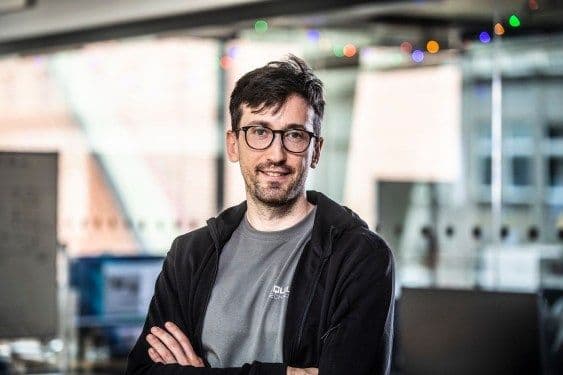
The DeepMind trio who built a poker AI are now making money for quant hedge funds
Three former DeepMind researchers who created an AIthat beat humans at pokerhave now applied the same technology to trading stocks — and the bet appears to be paying off. Their Prague-based AI lab,EquiLibre Technologies, is now valued at $500 million after raising an undisclosed-sum Series A, TechCrunch learned. The round was led by Creandum, and, although the VC also declined to disclose the size of the round, vice president Cameron Sellers confirmed that it was the largest single investment the firm “has ever made in one go into a company,” he told TechCrunch.The common denominator between poker and Wall Street is that they are well suited forreinforcement learning, an AI training technique where self-learning models are incentivized by rewards. According to Martin Schmid, EquiLibre CEO, “The nice thing about trading and markets is that the scoring is super simple: how much money did the agent make?” This isn’t just game money. In partnershipwith quant firm Tower Research Capital, EquiLibre’s algorithms have been trading billions in daily volume across the S&P 500 and Nasdaq. The startup claims its agents have been doing well since their rollout on crypto markets in 2025, and now on stock exchanges, with “a perfect record of zero negative months since inception,” meaning they have finished each month with their investments up overall. By applying its AI to quant hedge funds, the startup is in a field where automation is commonplace and, if successful, improvements can quickly turn into cash. That made the startup appealing to Creandum, Sellers said.“The potential total addressable market of trading in the financial markets is one of the biggest on earth, and there are countless funds over the years that have generated quantums of profit that make most venture-backed successes look small,” Sellers said. But he noted that EquiLibre explicitly defines itself as “a lab first, not a finance firm.”Schmid and his two founders — CTO Rudolf Kadlec and CSO Matej Moravcik — don’t have a background in finance, and it is not what drives them, he told TechCrunch. “I’m not doing this because I’m excited about making markets efficient. I’m doing this because we are all excited about building new things that have never been built before, and this is a lot of fun to build,” Schmid said. The prospect of frontier AI by by DeepMind alumni is an area of hot pursuit by VCs as well. Another recent such example is Ineffable Intelligence,which recently raised 1.1 billion. Most of these are based in the U.K., but there arenotable exceptions, including EquiLibre. In the case of EquiLibre’s founding trio, they were visiting PhD students at the Google-owned company’sfirst international AI research office in Edmonton, Alberta, Canada(which Alphabetshut downin 2023.) While there, they builtDeepStack, the first AI program to defeat pro players at no-limit poker, also known asTexas hold ’em. They also worked with professors who are now part of the startup’s high-profile advisory board — including Rich Sutton, who went on to receive theTuring award in 2024for his work on reinforcement learning.To build their startup, EquiLibre’s founders decided to move back to their home country, Czechia. “This is where we had a lot of people we had worked with, and there was a large Czech diaspora at Google and other places,” Schmid said. “These were our friends, so we told them, ‘Hey, guys, we are moving back to Prague, do you want to join us?’”That helped EquiLibre build its initial team back in 2022 and reach its current headcount of 25 people; but according to Schmid, that choice of location keeps paying dividends. Compared to San Francisco, “It’s much easier to keep the good people here, because there’s not a new sexy AI thing happening every two months.” Not that EquiLibre is the only hot AI startup in town.BottleCap AIis based in the same building. Still, this is one of the more notable AI companies in the region for talent. It next plans to scale its compute infrastructure, bringing online what it expects will be one of the largest compute clusters in Central and Eastern Europe (CEE). While the startup also declined to disclose its total funding to date, Schmid said it previously raised two other funding rounds, with pre-seed backers including CEE-focused VC firm Credo, which also backed ElevenLabs and UiPath. According toDealroom data, EquiLibre’s $10 million seed round was led by Blossom Capital at a $140 million valuation. Sellers confirmed that the Series A $500 million valuation was a big jump. But it also comes after the winds have changed favorably for reinforcement learning (RL), including in trading. “When we started, people were skeptical,” said Schmid. But now RL is the standard. “Because we started four years back, we believe we are ahead.” Still, there is a risk that the startup will get leapfrogged by competitors. Trading giant Jane Street, for instance,states it already uses RLwith LLMs, “or whatever else we need to train good models.” It also claims it has “tens of thousands of high-end GPUs,” while EquiLibre is seeking to squeeze more compute out of way fewer chips and “get more from less,” Schmid said. Consideringhow profitable Jane Street is, EquiLibre will have to play its cards well in order to reach its goal to be known as “theAI lab in trading.” But this isn’t poker, and there might be no losers. Says Schmid: “This is not a winner-takes-all market.”
View
OpenClaw is finally available on Android and iOS
The automation crustacean is crawling to a mobile device near you. By that I mean, OpenClaw — the free, open source AI agent that captivated the internet earlier this year — is finally available as an app on iOS and Android. OpenClawannouncedthe news on X on Tuesday. On both platforms, you can pair your phone with the OpenClaw Gateway, a kind of routing layer that connects your requests to AI agents and the tools and skills those agents draw on to get things done. The takeaway is that you’ll be able to run your OpenClaw agents from your pocket and, if you’ve programmed them correctly, they may be pretty helpful at getting things done. OpenClaw users haveput it to workin everything from coding to meal planning, although somehave reportedless-than-desirable results. OpenClawwent viralearlier this year around the launch of MoltBook, a social media site purportedly populated entirely by agents. In February, OpenClaw’s creator, Peter Steinberger,announcedthat he had joined OpenAI. The MoltBook spectacle was later revealed to have been partially the work of humans impersonating agents,according to researchers, effective theater that doubled as marketing for OpenClaw (whatever its credibility cost). Still, the stunt pointed toward the agentic future, which has since kept expanding. Agents are now embedded across the AI landscape and are showing up inmore places by the day, including your phone.
View
Amazon launches new $1 billion FDE org, following OpenAI and Anthropic
As companies struggle to integrate AI, they’re increasingly ready to bring in outside help — and service providers are launching new purpose-built groups to make sure they get it. On Tuesday, Amazon Web Services (AWS)launcheda new internal organization for AI-focused forward-deployed engineers. Engineers on the new team will embed within companies to deploy purpose-built agents, focusing on fast engagements and customer self-sufficiency. In a post announcing the new org, AWS VP of Frontier AI Francessca Vasquez emphasized that the org would do more than build and maintain requested systems. “Customers leave AWS FDE deployments with both new solutions and new engineering capabilities,” the announcement reads. “Along with agentic systems running in their own AWS environment, they gain lasting AI skills, workflows, and patterns they can use to innovate independently.” Amazon says $1 billion will be committed to the new org, although the figure represents internal Amazon resources rather than a joint venture or conventional investment. Pioneered by Palantir, the forward-deployed engineer (FDE) model has become increasingly popular as a way to manage AI deployments. In a typical FDE system, an engineer from the contracting company (in this case, AWS) works for the client temporarily while the system is being established, allowing them to respond directly as internal opportunities or challenges emerge. In the FDE model, much of the relevant technology can be reused between deployments, while still being tailored to the specifics of each company’s needs and workflows. It also gives the client company an influx of expertise and puts primary responsibility for the deployment in the hands of the contractor. The biggest downside is the labor involved, since it means maintaining a full corps of FDE engineers to install and maintain the company’s technology. Both OpenAI and Anthropichave launched their own FDE joint ventures in recent months, valued at $4 billion and $1.5 billion, respectively. In those two cases, the AI labs were paired with private equity firms, which provided both the capital to launch and connections with client corporations in their portfolios.
View
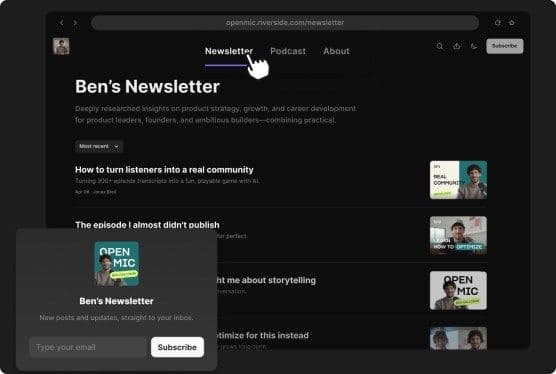
Podcasting platform Riverside enters the newsletter publishing game
Video and podcast recording tool makerRiversideis giving its users a new way to reach their audiences: newsletters. Riverside isn’t aiming to directly take on established newsletter platforms like Mailchimp, Substack, Beehiiv, or Ghost, however. Instead, recognizing that its userbase already generates a lot of content, the company is giving the users of its recording tools an AI tool to turn their existing videos and podcasts into newsletters, and send them directly from within its app. Users can also create and send newsletters from scratch without using the AI conversion feature. “Substack and Beehiiv start you at a blank page. But our creators and business customers are already producing rich, information-dense spoken content on Riverside. For most people, speaking is easier and more natural than writing from scratch, and the ideas are already there, in the conversation. So instead of asking them to start over in a separate tool, we help them turn a recording they’ve already made into newsletter-ready content with far less effort,” Riverside’s co-founder and CEO Nadav Keyson told TechCrunch. The company is also updating its recording suite to support multi-camera recording setups. It’s also giving users the ability to add remote guests to recordings. The update brings new AI features as well. Users can use AI to draft a first cut of a recording as soon as it’s finished, and the assistant can also create hooks and content for various social media platforms. The company is also adding an AI video enhancement feature, trained on conversational video podcasts, that it says can improve lighting, depth, and sharpness of recordings. Riverside,which has raised over $60 million in funding, joins a host of platforms that have been trying to enter alternative publishing avenues to either diversify or expand their revenue streams. For instance, Substack in March launcheda built-in recording studiothat competes directly with Riverside, and in April, newsletter platformBeehiiv ventured into podcastingas well. In June, social network Mastodon said that it will allow users topublish their posts as newsletters.
View

X now offers an MCP server to make its platform easier for AI tools to use
X is making it easier for AI assistants like Claude, Cursor, Grok Build, and other MCP-compatible apps to connect directly to the platform through a new hosted MCP server. On Monday, the Elon Musk-owned social networkunveiledahosted Model Context Protocol (MCP) serverthat lets AI tools communicate with the X API using a user’s own account permissions. MCP, for context, is an open standard that defines a common way for AI models to connect to external tools and services. Previously, if developers wanted an AI assistant like Claude or Cursor to access X, they would have to build their own MCP server, host it, connect to the X API, and handle the authentication. Now, X hosts the MCP, and users authenticate with their own X account’s permissions. This allows developers to save the time spent on integration work to focus on whatever it is they’re actually building. Developers have long been able to search X, read posts, look up users, analyze conversations and trends, and do more using the platform’s API. The hosted MCP doesn’t add new capabilities on that front; it just makes them easier to expose to AI applications. By doing so, X can position itself as an information network filled with real-time data to retrieve and analyze, rather than just a social hangout. The move sees X joining a growing number of companies that now offer their own official MCP servers or endpoints, likeGitHub,Slack,Notion,Stripe, andSalesforce. Of course, there’s always concern that by removing an infrastructure hurdle, X is opening itself up to more automated posting or spam. However, X clarified to TechCrunch that the MCP tool is not compatible with X’s Write API endpoints, so it’s not possible to use it to post autonomously (or at all) on X. It’s also worth noting that the hosted MCP isn’t bypassing X’s API rules, whichcontinue to restrict its useif the company detects spammy behavior. X also updated itsAPI v2 earlier this yearto address the issue of AI-generated spam, particularly programmatic replies to conversations. Plus, it recently updated its API pricing,increasing the cost for publishing poststo $0.015, and posting linksto $0.20. The price increases were designed to “curb vectors of misuse,” X said at the time — meaning it’s at least getting more expensive to spam X. Updated after publication to include information that the MCP tool will not provide“Write” access, after confirmation from X.
View

Anthropic’s Claude Science bets on workflow, not a new model, to win over scientists
Anthropic introduced Claude Science on Tuesday, an AI workbench that gives scientists one environment to do computational research, sparing them the hassle of bouncing between databases, pipelines, and tools. To be clear, Anthropic says Claude Science is “not a new AI model and not a more capable model for biology. It runs the same Claude models already available to everyone today (including Claude Opus 4.8), with no special access and no gating.” The workbench builds on Anthropic’s October 2025 launch ofClaude for Life Sciences, which essentially augmented the Claude chatbot by making it better at life sciences tasks. Claude Science is a dedicated place to do that work. The launch, announced Tuesday at an AI for Science briefing, fits into Anthropic’s broader push to be more than a model provider and to further own the operating layer for specific industries, the way Claude Code has become the operating layer for software development. Anthropic is increasingly betting its growth on vertical, workflow-level products rather than just raw model capability (which could shape how it competes, and prices, against rivals). Here’s how it works: One main AI assistant acts as a kind of project manager for scientists. It connects to more than 60 scientific databases and comes with prebuilt toolkits for specific fields, like genomics, protein structure, and chemistry. That assistant can then create sub-assistants to help split up the work, like a project lead delegating tasks to specialists, or hand work off to a custom “expert” assistant that the user has built for their own research. A separate fact-checker AI then double-checks the citations and calculations before anything goes to publication. That fact-check step matters, as more AI-assisted writing leads to fabricated citations and unverifiable stats slipping into papers. That said, it’s still the same underlying model checking itself, not an independent source of truth. Claude Science has other ways of ensuring reproducibility, Anthropic says. For example, the workbench can generate figures like 3D protein structures and chemistry drawers alongside the code that made them. Each figure includes the “exact code and environment that produced it, a plain-language description of how it was created, and the full message history,” according to the company. The process also saves scientists time by allowing them to edit figures in plain language, prompting the agent to edit its own underlying code. Another way Claude Science can save scientists time is by running on the lab’s own infrastructure setup rather than sending data off to Anthropic’s servers. Early users say they’re already putting this to work. Allen Institute neuroscientist Jérôme Lecoq used the tool to build a multi-agent computational review pipeline. Stephen Francis’s group at the UCSF Brain Tumor Center relied on Claude Science to speed up comprehensive germline analysis of glioma to a sliver of the time it previously required, with results independently validated. The Claude Science launch comes a couple of months after OpenAI approached the same problem from a different side. In April,OpenAI released GPT-Rosalind, a specialized model that is fine-tuned for biological reasoning. The difference between the two approaches isn’t only about whether a specialized model is necessary — it also comes down to who gets access, and how fast. Rosalind launched as a research preview limited to qualified enterprise customers in the U.S., gated behind a qualification and safety review. Partners like Amgen, Allen Institute, Moderna, Thermo Fisher, and Novo Nordisk got early access. And then there’s Google DeepMind, which is playing a different game entirely. DeepMind actually owns foundational science models like AlphaFold and AlphaGenome, which the other two can only call into as tools. Its Gemini for Science platform also bundles those plus more than 30 life science databases into one skill set. The net effect is that three very different distribution strategies are now competing for the same scientific research market: Anthropic is going wide with broad subscription access, OpenAI is going narrow and enterprise-gated, and Google is leaning on owned, proprietary models nobody else has. How that plays out could be an early signal for how AI vendors compete in other specialized verticals like law, finance, and engineering, down the line. Claude Science is available in beta to anyone on Pro, Max, Team, and Enterprise subscriptions. Anthropic also named Novo Nordisk and Allen Institute as customer case studies, suggesting pharma organizations are already working with multiple AI vendors. Anthropic will also support up to 50 Claude Science projects, providing up to $30,000 in credits: “We are looking for postdoctoral and graduate projects that span domains and explore the boundaries of science, with an early focus on fields across biomedical research. Applications are open through July 15, 2026, with award notifications sent out by July 31. Projects will run from September 1 to December 1, 2026.”
View

Acti puts AI agents directly into your smartphone keyboard
A new startup wants to bring AI to the software you use the most: your smartphone’s keyboard. On Tuesday, Singapore-basedActi(short for “action”) launched an agentic keyboard foriOSandAndroid, one that doesn’t just suggest your next word but can also take actions on your behalf, bringing AI tools directly into the apps you already use, including email, messaging, social media, and more. According to Young Wang, Acti founder and CEO, this solves a problem familiar to anyone juggling multiple apps; users have to constantly switch between different apps just to get an AI’s help. “Today’s AI agents are fundamentally limited because user context stays fragmented across separate apps,” Wang told TechCrunch in an email interview (due to time zone differences). Acti “sits across all of them, which is why we can build a context layer that genuinely belongs to the user instead of the platform,” he said. “That is the foundation the entire AI-agent era will be built on.” The launch reflects a different idea about how consumers will ultimately embrace AI. Rather than asking users to open various AI chatbots, Acti showcases how AI can be embedded into the interfaces we already use. For instance, if a friend wanted to know where to eat nearby, Acti could drop in a local recommendation. Or if someone mentioned a stock in your conversation, Acti could be used to share the live price right there in the chat. Today, you’d have to switch to a search engine or other AI app to get this sort of information, then return to the app where the conversation occurred, which takes time. Under the hood, Acti is powered by Google’s Gemini models, which Wang said were chosen for their balance of intelligence, speed, reliability, multilingual performance, and cost-efficiency. Gemini is also well-suited for one of Acti’s key features, called Skills, which work like custom shortcuts: Users can program a single key on their keyboard to trigger a multistep task automatically — for instance, translating a message or instantly sharing a meeting link (see examples below). Importantly, Acti is built around a local-first model, which means users’ personal context stays on their device by default for privacy’s sake. The company says the app does not access or store private messages, conversations, or personal context unless the user explicitly invokes a feature that requires external processing. Wang says he was encouraged to work on a new keyboard for the AI era after previously spending a decade at Baidu, growing its Facemoji Keyboard to over 300 million daily active users. “When LLMs arrived, I realized something fundamental had changed,” Wang said. “Text was no longer just something people typed; it had become a carrier of intent. And in many everyday contexts, that intent can now be directly translated into action.” “That made me believe it was time to reinvent one of the most basic and universal products people use every day: the keyboard. For me, the opportunity to rebuild such a foundational surface for the AI era is deeply exciting,” he added. Acti’s business model is still taking shape, but the company plans to generate revenue via subscriptions that offer users more advanced AI models, higher daily usage limits, and other premium features. The app ships with some built-in Skills already, like “T,” which allows you to translate a message to another language by long-pressing the letter on your keyboard. Another Skill, “C,” will fire off a meeting link. Users don’t have to know how to code to create a Skill, the company points out. Instead, you can just describe what you want in plain language, and Acti builds it. Ahead of launch, early access testers built over 1,000 Skills in less than two weeks. These Skills can be either private for your own use or shared publicly to a Skills marketplace, where you can find those that people already built, like Skills for accessing real-time World Cup data or Polymarket links, among others. In the future, this Skill Hub could also offer additional monetization opportunities. The company also shared with TechCrunch exclusively that it has just closed on $5.3 million in seed funding, in a round led by BITKRAFT Ventures. “We backed Acti because this team has a real shot at owning the next phase of human-computer interaction,” said Jonathan Huang, partner at BITKRAFT Ventures, about the firm’s investment. The Acti team also includes CTO Mike Sun, who was the founding technical lead behind Yike Album, Baidu’s cloud-photo platform, which scaled to over 10 million daily active users. Also at Acti is CSO Junbo Yang, who joined from HashKey Capital, where Yang led dozens of consumer investments.
View

Anthropic launches Claude Sonnet 5 as a cheaper way to run agents
As shipping agentic capabilities becomes table stakes among foundation model companies, Anthropic is releasing Claude Sonnet 5, a more powerful and agentic version of the lab’s midsize model. “It can make plans, use tools like browsers and terminals, and run autonomously at a level that, just a few months ago, required larger and more expensive models,” Anthropic said in ablog post. That framing mirrors what OpenAI and Google have said about their own recent releases.OpenAI’s GPT-5.6 Solwas launched in preview last week, and it is also the firm’s most agentic model yet, allowing users to split work across subagents for longer autonomous tasks.Google’s Gemini 3.5 Flash, which launched in May, was pitched as a shift from a conversational chatbot to an agentic tool that plans, builds, and iterates on real work with minimal human input. Sonnet 5’s pitch is confirmation that agentic capability is the new baseline expectation at every price tier. Now the differentiator isn’t going to be who can do agentic work best, but how cheaply they can do it and how reliably without human oversight. Sonnet 5 promises performance close to that ofOpus 4.8, but for much lower costs. Starting Tuesday, Claude Sonnet 5 will be the default model for free and Pro plans and is available for every subscription. At launch, Sonnet 5 is priced at $2 per million input tokens and $10 per million output tokens through August 31, after which the price will jump to $3 per million input tokens and $10 per million output tokens. That makes Sonnet 5 cheaper than Opus 4.8, as well as OpenAI’s GPT-5.5 and Google’s Gemini 3.1 Pro. (It’s still more expensive than Gemini 3.5 Flash.) The new model also demonstrates significant improvements over its predecessor Sonnet 4.6,released in February, on agentic performance like reasoning, tool use, software coding, and knowledge work, according to Anthropic. For example, on one benchmark, Sonnet 5 scores a 63.2% on agentic coding, compared to Opus 4.8’s 69.2% and Sonnet 4.6’s 58.1%. On a knowledge work benchmark, Sonnet 5 actually slightly outperforms Opus 4.8, which is known for winning on solving the hardest problems like making subtle judgment calls and deep research. “Opus 4.8 is still the model of choice for higher accuracy on these tasks, but Sonnet 5 provides developers with lower-priced options that are of much higher quality than what was previously available,” Anthropic says. “Between Sonnet 5 and Opus 4.8, users can adjust the effort level to find the right balance of cost and performance.” According to testers cited in the blog post, Sonnet 5 also excels at finishing complex tasks where previous model versions would have stopped short and “checks its own output without explicitly being asked.” “We handed Claude Sonnet 5 a two-part job — update Salesforce account tiers, send a launch announcement to enterprise contacts — and it finished end to end,” Daniel Shepard, a senior engineer at Zapier, said in a statement. “That used to stall halfway. For day-to-day automation, it’s a no-brainer. ” On safety, Sonnet 5 also demonstrates a lower rate of “undesirable behaviors” like cooperation with misuse and deception than its predecessor, making it safer to use in agentic contexts. It’s better at refusing malicious requests and sidestepping hijack attempts in prompt-injection attacks. It also hallucinates and engages in sycophantic behavior at a lower rate than Sonnet 4.6. That said, it’s not on the same level as Opus 4.8 and Claude Mythos Preview when it comes to misaligned behavior. “Evaluations also show that it has a much lower ability to perform dangerous cybersecurity tasks than our current Opus models,” reads the blog post. Lovable co-founder Fabian Hedin said in a statement that Claude Sonnet 5 “refuses unsafe requests cleanly and consistently.” “At Lovable, we’re putting powerful tools in the hands of millions of builders,” Hedin said. “A model that knows when to say no is just as important as one that knows how to build.”
View

Nvidia competitor Etched hits $5B valuation, $1B in sales for AI chip
Nvidia AI chip competitorEtchedissued a progress report on Tuesday, after TSMC successfully manufactured its chip earlier this year. Thestartup saysit has already booked $1 billion in contract orders for its product: full systems powered by those chips. Etched is currently in the process of testing that first product with customers. It calls these systems “frontier inference clusters,” bundles that include the chips along with custom-designed racks and software, all built to help frontier models run inference faster, more cheaply, and with better power efficiency than rivals, Etched claims. (Inference is what happens after a user submits a prompt — it’s currently the biggest bottleneck, and the biggest cost center for AI companies trying to serve customers at scale, which is exactly why investors are paying attention to anyone promising to solve it.) Etched, founded in 2022, also revealed that it has now raised a total of $800 million to date. The most recent tranche was an unannounced $500 million round closed in December at a $5 billion post-money valuation, the company said. The startup has attracted a notable group of investors, too, including VentureTech Alliance, Jane Street, Hudson River Trading, Two Sigma, and Ribbit Capital. It has also secured angel investment from AI heavyweights including Andrej Karpathy, Geoffrey Hinton, Fei-Fei Li, Arthur Mensch, and Scott Wu. The cap table also includes billionaires Stanley Druckenmiller and Peter Thiel. Although the startup’s press release frames Tuesday’s announcement as Etched “coming out of stealth,” co-founders — CEO Gavin Uberti and president Robert Wachen — have actually beentalking to TechCrunchabout their chip plans since 2024. Both dropped out of Harvard and became Thiel fellows to found Etched, as Uberti told TechCrunch at the time. By 2024, Etched was already on investors’ radar, having raised more than $125 million. But on Patrick O’Shaughnessy’s “Invest Like the Best” podcast, the founders said that back in 2023, they struggled to get investors interested — even with a 30-page memo arguing that AI would eventually need specialized chips, not just general-purpose GPUs. Every major investor they pitched passed. The company was reportedly operating month-to-month, close to running out of cash, in those early days. Today’s funding environment looks like a different planet by comparison. Investors are chasing everything AI-related, especially chip technology that speeds up inference. Competitor Cerebras had thefirst breakout IPOof the year, while AI chip maker Groqjust raised $650 million. Hyperscalers Amazon, Google, and Microsoft all build their own in-house AI chips. Even OpenAI just announced itsfirst custom chip, built by Broadcom.
View
Submit your Tool


PoweredByAI.app is an AI Tools Directory helping individuals, businesses, and creators discover the best AI tools for writing, coding, design, productivity, and more.
© 2026 , Product of011BQ. All rights reserved.