AI NewsWhy Tokyo is the most important tech destination of 2026

Why Tokyo is the most important tech destination of 2026

10:13 PM IST · April 25, 2026
Why Tokyo is the most important tech destination of 2026

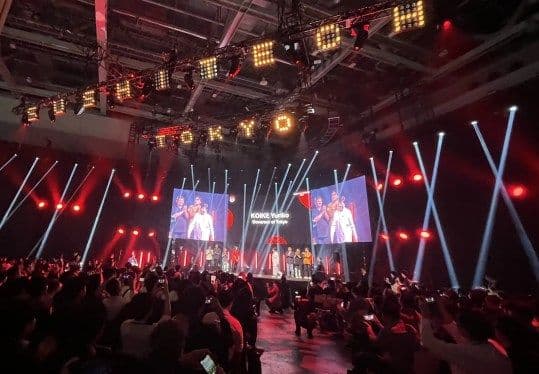
Every major tech conference has themes. Most are vague enough to mean everything and nothing at the same time.SusHi Tech Tokyo 2026is doing something different — four tightly defined technology domains, each backed by live demonstrations, dedicated exhibit floors, and sessions featuring the people actually building and funding these technologies globally. TechCrunch is partnering with SusHi Tech Tokyo 2026 as an official media partner, and our Startup Battlefield team will be on the ground selecting one standout semifinalist from the SusHi Tech Challenge to advance to the TechCrunch Disrupt Startup Battlefield 200 — one of the most prestigious launchpads in tech. Here’s what’s on the floor. Sessions featuring Howard Wright (Nvidia), Rob Chu (AWS), and Eric Benhamou (Benhamou Global Ventures) cut through the noise to examine where AI is genuinely deployed at scale and where the real risks lie. On the floor, AI-themed university startups pitch alongside global players, and the AI Film Festival Japan, a partner event at Tokyo Innovation Base in Yurakucho, explores how artificial intelligence is reshaping culture in real time. The robots at SusHi Tech aren’t behind glass — they’re on the floor and interactive. Onstage, Nissan, Isuzu, and Applied Intuition’s Qasar Younis examine how software-defined vehicles are reshaping transportation. Physical AI isn’t a future trend. It’s in Tokyo on April 27. Eva Chen (Trend Micro) and NEC’s Noboru Nakatani tackle cyber defense, while top climate tech VCs from Breakthrough Energy and Cleantech Group examine where global investment is flowing. A VR disaster simulator and site-visit tours of Tokyo’s underground flood-control infrastructure make the stakes viscerally real. Sessions with the CEOs of Production I.G, MAPPA, and CoMix Wave Films tackle what it takes for Tokyo to become the Hollywood of animation. On the floor, startups are using AI to translate manga globally, generate music from text prompts, and bring Japanese IP to life as anime — delivered worldwide. Missing SusHi Tech Tokyo doesn’t have to mean missing out. Remote participants get more than a livestream — on-site staff will walk the floor on your behalf, carrying a device that displays your face so you can interact with attendees and exhibitors in real time, face-to-face. It’s the closest thing to actually being there. Note: Please note that some sessions may not be available for viewing. Apply for remote participation with on-site staff support here. Can’t swing that either? Ticket holders can stream sessions online and tap into the programming from wherever they are.Browse the full session list here. In conjunction with the startup event, the Tokyo Metropolitan Government also hosts a meeting of leaders from 55 cities across five continents. They will discuss the theme of “A New Urban Future Built on Climate and Disaster Resilience.” The city leaders’ summit is part of G-NETS (Global City Network for Sustainability), organized by the Tokyo Metropolitan Government since 2022 as a multicity forum to discuss how to solve common challenges with a focus now on resilience to urban climate disasters and the well-being of citizens. The summit can be observed by general audiences on YouTube in real time and after the event. G-NETS official website G-NETS YouTube Channel SusHi Tech Tokyo 2026 runs April 27–29 at Tokyo Big Sight. Business days are April 27–28; public day (free admission) is April 29.Register here.

read more


Latest AI News

View All News →
The $100,000 Experiment: What Happens When an AI Agent Manages a Store with Its Own Credit Card?

The $100,000 Experiment: What Happens When an AI Agent Manages a Store with Its Own Credit Card?

The world's first artificial intelligence (AI) store, which is entirely designed, managed, and run by an AI agent, is here. Even five years ago, the previous sentence would have sounded like it was taken from science fiction; however, today it is reality. A San Francisco-based startup, Andon Labs, designed an AI agent with all the necessary tools required to run a physical store, and gave it the keys to a retail store and a corporate credit card with $100,000 (roughly Rs. 94.25 lakh) in the bank.

2 hours ago

View

Meta AI Business Assistant Expanded to Global Markets, to Let Advertisers Optimise Marketing Campaigns

Meta AI Business Assistant Expanded to Global Markets, to Let Advertisers Optimise Marketing Campaigns

Meta is now expanding its artificial intelligence (AI) tool for marketing campaigns to major global markets. Dubbed the Meta AI Business Assistant, it is a conversational AI platform designed to help advertisers optimise marketing campaigns, resolve account issues, and manage customer interactions across Meta's platforms. It was first introduced last year and was limited to select advertisers in the US. The Menlo Park-based tech giant is now widely rolling out the AI tool globally across its key markets.

2 hours ago

View

Meta inks deal for solar power at night, beamed from space

Meta inks deal for solar power at night, beamed from space

The race to secure electricity for AI models has reached new heights: Meta has signed an agreement with the startup Overview Energy that could see a thousand satellites beam infrared light to solar farms that power data centers at night. In 2024, Meta’s data centers used more than 18,000 gigawatt-hours of electricity—roughly enough to power more than1.7 million American homesfor a year—and its need for compute power is only increasing. The company has committed to building 30 gigawatts of renewable power sources, with a focus on industrial-scale solar power plants. Typically, data centers turning to solar power must either invest in battery storage or rely on other generation sources to operate at night. Overview, a four-year-old, Ashburn, Virginia, outfit thatemerged from stealthin December, has a different solution: The company is developing spacecraft that collect plentiful solar power in space. It then plans to convert that energy to near-infrared light and beam it at sufficiently large solar farms—on the order of hundreds of megawatts—which can convert that light to electricity. By using a wide, infrared beam to power existing terrestrial solar infrastructure, Overview thinks it can sidestep the technological challenges and safety and regulatory issues that bedevil plans to transmit power to Earth through high-power lasers or microwave beams. CEO Marc Berte says you’ll be able to stare right into his satellite’s beam with no ill effects. The technology would increase the return on investment from building solar farms and reduce reliance on fossil fuels — if it can be deployed at scale. Overview says it has already demonstrated power transmission to the ground from an aircraft, and is planning to launch a satellite to low Earth orbit in January 2028 to perform its first power transmission from space. In today’s announcement, Meta said it signed the first capacity reservation agreement with Overview to receive up to 1 gigawatt of power from the company’s spacecraft, although it’s not clear if any money changed hands. Overview developed a new metric for this contract, megawatt photons, which is the amount of light required to generate a megawatt of electricity. Berte expects to begin launching the satellites that would fulfill that commitment in 2030, with a goal of flying 1,000 spacecraft in geosynchronous orbit, a high orbit in which each satellite remains fixed above the same point on Earth. He expects each of the company’s spacecraft to provide power from space for more than 10 years. Once in space, Berte says the fleet of spacecraft will be able to cover about a third of the planet, with an initial deployment that will reach from the West Coast of the United States across to Western Europe. As the Earth rotates below and customer solar farms enter evening and night, Overview’s spacecraft should boost their electrical generation with additional light from space. Berte sees opportunity in combining both generation and transmission, with the flexibility to deliver power to solar farms wherever and whenever it is most valuable. “There’s a big difference between being in any one energy market, and being in all of the energy markets,” Berte told TechCrunch.

2 hours ago

View

TSMC Unveils A13 Node for AI Computing, But Production Begins in 2029. Why?

TSMC Unveils A13 Node for AI Computing, But Production Begins in 2029. Why?

This new process technology targets AI and high-performance computing workloads, with production planned for 2029.

2 hours ago

View