Want to get featured here? Explore premium visibility opportunities.

Contact us

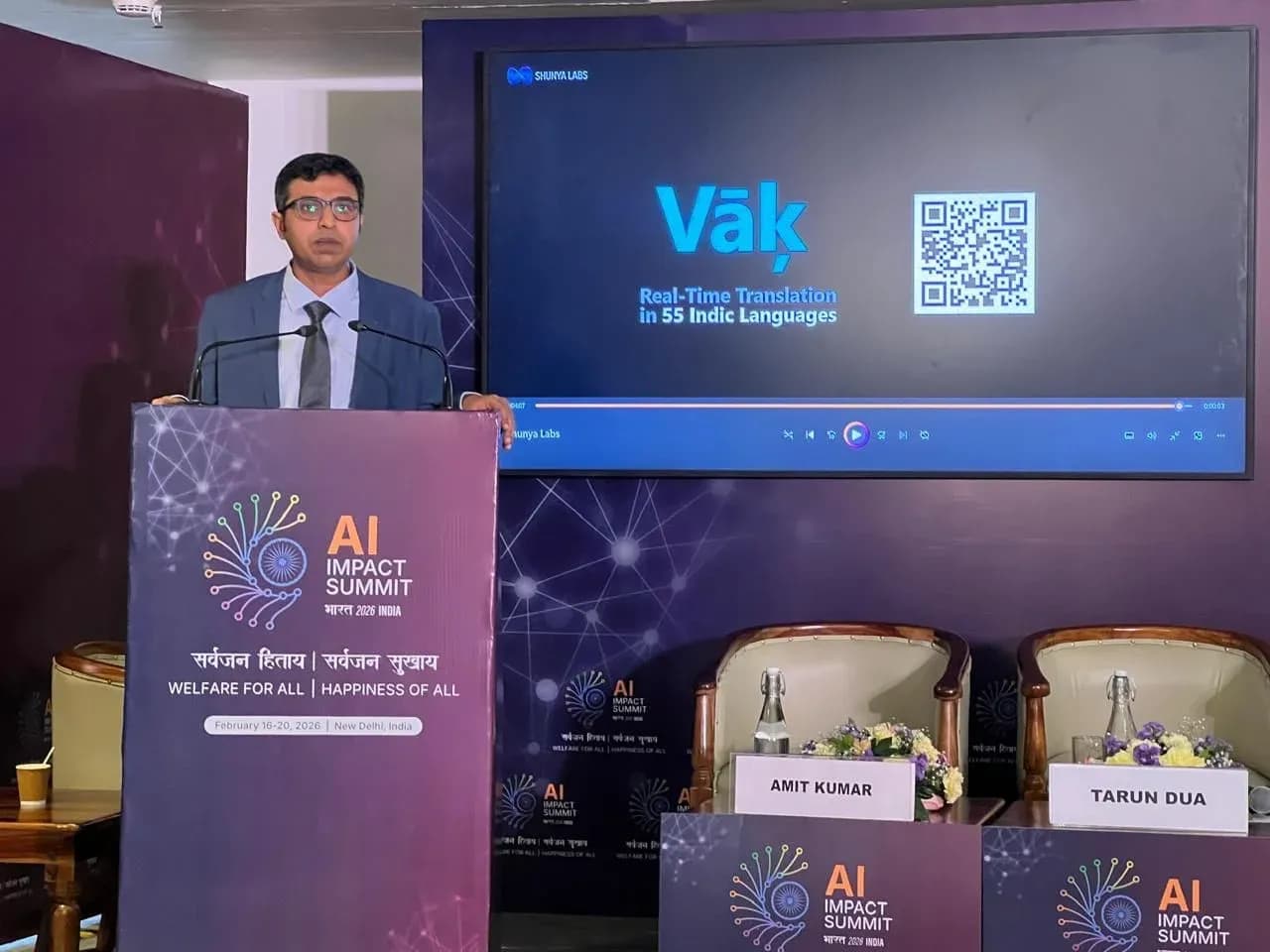
AI NewsShunya Labs Unveils Real-Time AI Translation Model for 55 Indian Languages

Shunya Labs Unveils Real-Time AI Translation Model for 55 Indian Languages

4:15 PM IST · February 18, 2026

Shunya Labs Unveils Real-Time AI Translation Model for 55 Indian Languages

The model was unveiled in partnership with Nasscom at the India AI Impact Summit 2026.

read more
Anthropic’s Cat Wu says that, in the future, AI will anticipate your needs before you know what they are

Anthropic’s Cat Wu says that, in the future, AI will anticipate your needs before you know what they are

With the tech industry singularly focused on AI models, Anthropic is having an exceptionally good year. The company may soon pull ahead of its main competitor, as it looks to raise tens of billions of dollars in a funding round that would put its valuationat some $950 billion(OpenAI wasvalued at $854 billionin its March round), and business customers increasingly express aprefererence for Claude over ChatGPT. A recent report showed Anthropicrecently outpaced OpenAI among business customers, quadrupling its market share since May 2025. Cat Wu, Anthropic’s head of product for Claude Code and Cowork, has been a key figure in that success. Since joining the company in August 2024, Wu has helped shepherd Claude through a critical phase, leveling it up from a purely informational chatbot to a coding tool and beyond. Wu, who oversees the development of new features, is frequently paired with Boris Cherny, a core member of Anthropic’s technical staff and the creator of Claude Code, leading the pair to becharacterized asAnthropic’s “Batman and Robin.” Wu sat down with me at last’s week’s second annual Code with Claude conference in San Francisco, where she discussed how she thinks about product strategy, and how she hopes the experience of using Claude will change in the future. This interview has been edited for length and clarity. When you’re looking at product strategy, how much of it is reactive to your peers or your competitors? Do you think about that at all? The main thing that we design for is staying on the exponential, so I think, across our team, we instill in everyone the lesson that AI will just continue to get better. For us, we just need to stay at this frontier. We don’t think about competitors. I think if you do think about competitors, you end up being, like, perpetually two weeks, or like, a month behind how fast you can execute. And so it’s normally not the best way to stay at the frontier. Anthropic released at least six models last year and has already released almost as many this year. Do you expect this pace of development to continue? Our hope is that it continues (laughing). I think the models are still improving at a very steady pace, and so we should be able to keep sharing those with our users. I think the deployments might look a bit different—like how we handled Glasswing, but as much as possible, we want this intelligence to benefit as many people as possible, and it has to be handled in a very safe way, which is why we handled Glasswing [in the way that we did]. [Glasswing is an initiative that Anthropiclaunched in Aprilthat invited a small consortium of partner organizations — including companies like Amazon, Apple, CrowdStrike, and Microsoft — to gain access to its new cybersecurity model, Mythos. Unlike many of Anthropic's other AI models, Mythos is not being given a general public release. The company has claimed that it fears the model — which is designed to scan codebases for software vulnerabilities — is too powerful, and could be weaponized by bad actors.] You said in a previous interview that the future of work is basically staff managing fleets of agents. It seems like that could eventually lead to a situation where the agents are better at the job, or know the job, better than the human. I think it is extremely hard to manage agents if you can't do the job yourself. I think the managers still need to be experts in their domain. It's a new skill set that a lot of people are going to have to learn, but managing agents is actually very similar to being a manager of people, in the sense that you have to understand, like, why did the agent make this mistake? Did it misinterpret my instruction? Was my request under-specified? You have to have the ability to debug it. It does seem like the long term goal is to cut down on team size, though. Because if you have agents doing a job, then you don't need an intern, right? Ideally, I think the idea is that everyone can get a lot more done. I think that, for everyone’s job, there's always this percentage of it that's really tedious. For me, it’s responding to emails. I think everyone has this part of their life...So my hope is that it [the AI agents] actually does that, and then everyone has, like, all these cool things that they will want to build [in their spare time]. What are you guys most excited about in the next six months? I think the next big thing is proactivity. Last year we were in this world of synchronous development. Right now, people are shifting to routines, so like automating, for example, responses to customer support tickets. And I think the next step is that Claude understands what you work on, and just sets up some of these automations for you.

1 hour ago

View

Musk’s xAI is running nearly 50 gas turbines unchecked at its Mississippi data center

Musk’s xAI is running nearly 50 gas turbines unchecked at its Mississippi data center

Elon Musk’s xAI is running nearly 50 natural gas turbines at its Mississippi data center, power plants that the state is currently not regulating thanks to a loophole. The power plants are considered “mobile” by the state of Mississippi because they are sitting on flatbed trailers, thus allowing them to dodge to air pollution regulations for one year. The NAACP, which has filed a lawsuit on behalf of residents in the area, says the unchecked emissions from the turbines is worsening air quality in an already polluted region. This week, it asked the court for aninjunctionagainst xAI. At issue is the “mobile” nature of the turbines. The Southern Environmental Law Center, which filed the lawsuit on behalf of the NAACP, says the turbines are being operated in violation of federal law, which says that power plants mounted on a trailer can still be considered stationary and subject to air pollution regulations. XAI has been granted permits for15 of its turbines. A Greater Memphis Chamber of Commerce press release previously said that “about half” of the 35 turbines in operation in May 2025 would remain on site. However, xAI has continued to install more. Currently, it’s operating 46, according to alocal news report.

1 hour ago

View

WhatsApp Introduces Incognito Chat With Meta AI for Private Conversations

WhatsApp Introduces Incognito Chat With Meta AI for Private Conversations

WhatsApp has announced Incognito Chat with Meta AI, a new feature that lets users have private, temporary conversations with the company's AI assistant. The feature is aimed at people who want to ask sensitive questions involving personal matters, finances, health, or work without keeping a lasting record of the interaction. Incognito Chat is built on Meta's Private Processing technology and will begin rolling out to WhatsApp and the Meta AI app over the next few months.

5 hours ago

View

Poppy debuts a proactive AI assistant to help organize your digital life

Poppy debuts a proactive AI assistant to help organize your digital life

Smartphones can be distracting with their dizzying array of apps and constant stream of notifications. A new app calledPoppyaims to organize the chaos by combining your calendar, email, messages and other sources into a single dashboard. The idea, per the company’s website, is that “Poppy pays attention so you don’t have to.” Users can connect various services to Poppy’s app, like their email, calendar, and, at a minimum, their location. Poppy then uses that data along with AI to guess what’s important to you right now based on what’s going on in your life. At a high level, this means you can open Poppy’s app or glance at its widgets to see the meetings or tasks you have on your plate. But Poppy’s most powerful feature is likely its proactive suggestions. For instance, if Poppy has access to your calendar and sees that you have a 30-minute gap while you’re near a park, it could suggest you take a break and go for a walk before your next appointment. And if you’re planning a brunch with a friend who mentioned their food preferences in a previous communication, it could factor in that information when suggesting restaurants. You can also message Poppy with questions or requests, almost as if you had a personal assistant working on your behalf. Poppy can track your flights and alert you to changes, or nudge you when it’s time to take your medication. Poppy’s maker,Sai Kambampati, says he’s always been fascinated by human-computer interaction, having earned his Master’s degree in Computer Science with a specialization in this area. Previously a software engineer at the AI hardware startup Humane, he said he has seen first-hand how people are trying to rethink how we engage with technology. "I've always been interested in challenging what computers are able to do, especially the idea of ambient computing and computers that can proactively sense what you need and anticipate your needs," Kambampati told TechCrunch. "That's something that I found very, very exciting. And I felt like with all the AI technology that we're seeing around us, it has never been more possible to embark on something like this." At launch, Poppy works with everyday apps like Apple Calendar, Google Calendar, Gmail, Outlook, iCloud Mail, Apple Health, Reminders, Contacts, iMessage, WhatsApp, and others. (It uses a Mac app to access iMessage, which could later be a problem as Apple generally doesn't allow third-party apps to access its messaging service.) It also works with apps like Uber and Instacart, and Kambampati plans to extend support to others over time. The company says users' data is encrypted when stored in its database, and it has a zero-retention policy enabled when it uses cloud-based LLMs for its suggestions. In time, however, Kambampati would like make the switch to using local, on-device AI models when technology advances. "My hope, my dream is — within two to three years from now, when our devices have much more powerful compute, and the models get much smaller, cheaper and more high quality — eventually we can have all of this running on our own devices, and there won't even be a need to hit the servers," he says. Poppy's San Francisco-based team of four is backed by $1.25 million in pre-seed funding led by Kindred Ventures, with various angels also participating, including DeepMind's Logan Kilpatrick.

5 hours ago

View