Want to get featured here? Explore premium visibility opportunities.

Contact us

AI NewsOpenAI says 18 to 24-year-olds account for nearly 50% of ChatGPT usage in India

OpenAI says 18 to 24-year-olds account for nearly 50% of ChatGPT usage in India

8:20 PM IST · February 20, 2026
OpenAI says 18 to 24-year-olds account for nearly 50% of ChatGPT usage in India

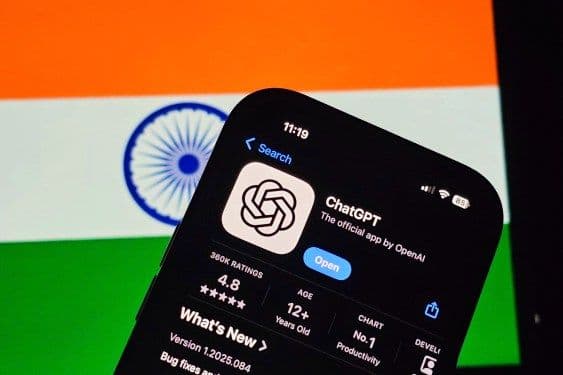
OpenAI seems to have found product-market fit with young Indians. The company said on Friday that users between 18 and 24 years of age accounted for nearly 50% of messages sent to ChatGPT in the country, and users under 30 accounted for 80%. The AI lab said Indians use ChatGPT mostly for work, with 35% of all messages relating to professional tasks, compared to 30% globally. In particular, the company’s coding assistant, Codex, is seeing strong traction: OpenAI said Indians use Codex three times more than the global median, and weekly usage has increased by four times since the toolgot a Mac apptwo weeks ago. Users in India are also asking three times as many coding-related questions as the median. This is in line with findings from Antropic, which earlier this week said45.2% of Claude’s tasks map to software-related use casesin India. OpenAI said outside of work tasks, 35% of messages to ChatGPT from Indians requested guidance, 20% concerned questions about general information, and 20% were requests for the bot to produce or help with writing. India is OpenAI’s second-largest market with more than 100 million weekly users, and the company has been actively trying to court Indians for its AI tools and services. The company offersa sub-$5 subscription tierin the country, and last year evenran promotional campaignsto spur adoption. “AI adoption is moving faster than our ability to measure it – and that’s a challenge for anyone trying to make smart decisions. Signals is our way of putting real-world evidence on the table, so India’s AI debate can be grounded in facts, not hype,” OpenAI’s chief economist Ronnie Chatterji said in a statement. OpenAI has had a busy few days in India, which is hosting a majorAI Impact Summitin New Delhi this week. The company is opening new offices in Mumbai and Bengaluru this year, and has signed a major partnership with conglomerate Tata Group tosecure 100 megawatts worth of AI compute capacityand distribute ChatGPT Enterprise within Tata’s IT services subsidiary, TCS. The AI lab has signed agreements withfintech Pine Labs, travel platforms Ixigo and Makemytrip, and food and grocery delivery company Eternal. It has also partnered with educational institutes to distribute its toolsto more than 100,000 students over the next six years.

read more

Latest AI News

View All News →
Adaption aims big with AutoScientist, an AI tool that helps models train themselves

Adaption aims big with AutoScientist, an AI tool that helps models train themselves

For years, AI researchers have anticipated the moment when AI systems will be able to improve themselves better than humans could. With investors pouring money into a new generation of research-driven AI labs, there are more resources than ever available to pursue the goal. Now, one of those neolabs has taken a major step towards making it real. On Wednesday,Adaptionintroduced a new product calledAutoScientistthat helps models learn specific capabilities quickly by using an automated approach to conventional fine-tuning. The techniques are applicable to a wide range of fields, but the Adaptation team is particularly focused on the potential for speeding up and easing the process of training and fine-tuning a frontier-level AI model. According to co-founder and CEO Sara Hooker, who previously worked as VP of AI research at Cohere, AutoScientist represents a new way to approach the AI training process. “What’s super exciting about it is that it co-optimizes both the data and the model, and learns the best way to basically learn any capability,” Hooker told TechCrunch. “It suggests we can finally allow for successful frontier AI trainings outside of these labs” AutoScientist builds on the company’s existing data offering,Adaptive Data, which aims to make it easier to build high-quality datasets over time. AutoScientist, meanwhile, is designed to turn those continuously improving datasets into continuously improving AI models. “Our view at Adaption is that the whole stack should be completely adaptable, and should basically optimize on the fly to whatever task you have,” Hooker says. Of course, that approach will only be as good as the results. In its launch materials, Adaption boasts that AutoScientist has more than doubled win-rates across different models — impressive numbers, but difficult to put into context. Since the system is built to adapt models to specific tasks, conventional benchmarks like SWE-Bench or ARC-AGI aren’t applicable. Still, Adaption is confident that users will see the difference once they try AutoScientist out — so confident that the lab is making the tool free to use for the first 30 days after its release. “The same way that code generation unlocked a lot of tasks, this is going to unlock a lot of innovation at the frontier of different fields,” Hooker says.

2 hours ago

View

Zoho Commits ₹70 Crore to ONDC to Empower MSMEs with Accessible Sovereign Tech

Zoho Commits ₹70 Crore to ONDC to Empower MSMEs with Accessible Sovereign Tech

With this investment, Zoho seeks to support MSMEs in their digital transformation and contribute to India's economic growth.

2 hours ago

View

 Proximal Cloud, NxtGen Partner to Enable Sovereign AI Deployments in India

Proximal Cloud, NxtGen Partner to Enable Sovereign AI Deployments in India

The partnership targets regulated sectors with compliant, private AI infrastructure and local data control.

2 hours ago

View

AIM Launches ‘Best Firm for GCC Talent’ Certification

AIM Launches ‘Best Firm for GCC Talent’ Certification

The new certification programme focuses on culture, learning, and retention across India’s various Global Capability Centres.

2 hours ago

View