Want to get featured here? Explore premium visibility opportunities.

Contact us

AI NewsFreeform raises $67M Series B to scale up laser AI manufacturing

Freeform raises $67M Series B to scale up laser AI manufacturing

8:18 PM IST · February 19, 2026
Freeform raises $67M Series B to scale up laser AI manufacturing

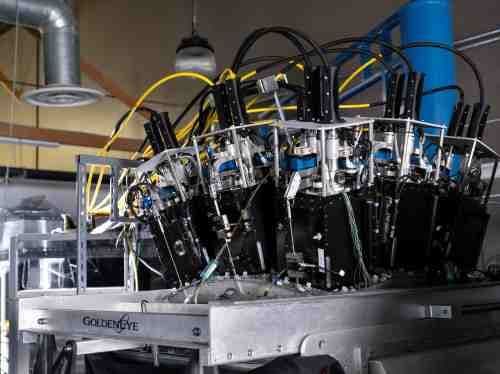
Tech investors haven’t given up on the dream of making physical products with the same speed and ease as coding software. Executives atFreeform, a startup developing a novel 3D printing system for metal components, told TechCrunch that the company raised a $67 million Series B to expand its manufacturing platform. Investors include Apandion, AE Ventures, Founders Fund, Linse Capital, NVidia’s NVentures , Threshold Ventures, and Two Sigma Ventures. FreeForm declined to disclose the company’s post-financing valuation, which Pitchbook cites as $179 million. CEO and cofounder Erik Palitsch said the funding would allow the company to upgrade its current GoldenEye printing system, which uses 18 lasers to fuse metal powders into precision components, to a new version. Dubbed Skyfall, the next iteration of the platform would use hundreds of lasers to produce thousands of kilograms of metal parts each day. That’s the culmination of a vision Palitsch and co-founder/president Thomas Ronacher launched in 2018. The two met while developing rocket engines at SpaceX, where they found that industrial machines for printing metal components are expensive, finicky, and not well designed for mass manufacturing. Their new company would build its platform from the ground up to achieve higher throughput and flexibility, with an emphasis on active software controls. Palitsch says Freeform’s platform is “AI native,” noting apartnership with Nvidiathat allows the company to access advanced GPUs. “I think we’re the only quote-unquote manufacturing company out there that has H200 clusters in a data center on site,” Paltisch told TechCrunch. “What are they doing? We’re running real-time physics-based simulations and learning all the different aspects of the end to end manufacturing workflow.” The data collected by sensors in the company’s manufacturing platform and during the simulations allows Freeform to rapidly improve production quality and quantity. “We have more meaningful data on the physics of the metal-printing process than any company in the world,” head of talent Cameron Kay said. While Palitsch said he could not disclose any customers, he said the company is already delivering hundreds of “mission-critical” parts to buyers. Now, the company wants to hire as many as 100 new employees and expand its facility to start executing on its contract backlog. Manufacturing-as-a-service has grown as a category as venture investors have taken a greater interest in building vehicles, robots, and energy production systems. For example, Hadrian recently earneda $1.6B valuationfrom its investors while developingautomated productionfor defense, and VulcanForms and Divergent have raised hundreds of millions to develop metal-printing services of their own.

read more

Latest AI News

View All News →
WhatsApp Introduces Incognito Chat With Meta AI for Private Conversations

WhatsApp Introduces Incognito Chat With Meta AI for Private Conversations

WhatsApp has announced Incognito Chat with Meta AI, a new feature that lets users have private, temporary conversations with the company's AI assistant. The feature is aimed at people who want to ask sensitive questions involving personal matters, finances, health, or work without keeping a lasting record of the interaction. Incognito Chat is built on Meta's Private Processing technology and will begin rolling out to WhatsApp and the Meta AI app over the next few months.

28 minutes ago

View

Poppy debuts a proactive AI assistant to help organize your digital life

Poppy debuts a proactive AI assistant to help organize your digital life

Smartphones can be distracting with their dizzying array of apps and constant stream of notifications. A new app calledPoppyaims to organize the chaos by combining your calendar, email, messages and other sources into a single dashboard. The idea, per the company’s website, is that “Poppy pays attention so you don’t have to.” Users can connect various services to Poppy’s app, like their email, calendar, and, at a minimum, their location. Poppy then uses that data along with AI to guess what’s important to you right now based on what’s going on in your life. At a high level, this means you can open Poppy’s app or glance at its widgets to see the meetings or tasks you have on your plate. But Poppy’s most powerful feature is likely its proactive suggestions. For instance, if Poppy has access to your calendar and sees that you have a 30-minute gap while you’re near a park, it could suggest you take a break and go for a walk before your next appointment. And if you’re planning a brunch with a friend who mentioned their food preferences in a previous communication, it could factor in that information when suggesting restaurants. You can also message Poppy with questions or requests, almost as if you had a personal assistant working on your behalf. Poppy can track your flights and alert you to changes, or nudge you when it’s time to take your medication. Poppy’s maker,Sai Kambampati, says he’s always been fascinated by human-computer interaction, having earned his Master’s degree in Computer Science with a specialization in this area. Previously a software engineer at the AI hardware startup Humane, he said he has seen first-hand how people are trying to rethink how we engage with technology. "I've always been interested in challenging what computers are able to do, especially the idea of ambient computing and computers that can proactively sense what you need and anticipate your needs," Kambampati told TechCrunch. "That's something that I found very, very exciting. And I felt like with all the AI technology that we're seeing around us, it has never been more possible to embark on something like this." At launch, Poppy works with everyday apps like Apple Calendar, Google Calendar, Gmail, Outlook, iCloud Mail, Apple Health, Reminders, Contacts, iMessage, WhatsApp, and others. (It uses a Mac app to access iMessage, which could later be a problem as Apple generally doesn't allow third-party apps to access its messaging service.) It also works with apps like Uber and Instacart, and Kambampati plans to extend support to others over time. The company says users' data is encrypted when stored in its database, and it has a zero-retention policy enabled when it uses cloud-based LLMs for its suggestions. In time, however, Kambampati would like make the switch to using local, on-device AI models when technology advances. "My hope, my dream is — within two to three years from now, when our devices have much more powerful compute, and the models get much smaller, cheaper and more high quality — eventually we can have all of this running on our own devices, and there won't even be a need to hit the servers," he says. Poppy's San Francisco-based team of four is backed by $1.25 million in pre-seed funding led by Kindred Ventures, with various angels also participating, including DeepMind's Logan Kilpatrick.

28 minutes ago

View

Anthropic now has more business customers than OpenAI, according to Ramp data

Anthropic now has more business customers than OpenAI, according to Ramp data

For the first time, Anthropic has more verified business customers than OpenAI, according tothis month’s AI Indexfrom the fintech firm Ramp. The survey, compiled from Ramp’s clients’ expense data, shows 34.4% of participating businesses are paying for Anthropic services, more than any other AI lab, while only 32.3% pay for OpenAI. It is the first time Anthropic has held the top position. “Anthropic has already been in the lead amongst the high adoption groups like finance, tech, professional services,” Ramp economist Ara Kharazian told TechCrunch. “It’s across the other firms where OpenAI still has a lead, but that has been shrinking over the past couple of months.” Because the index only represents companies that use Ramp, it’s not a perfect proxy for the marketplace at large. Still, the sample includes more than 50,000 companies, making it both broad and diverse enough to carry weight. More importantly, the general trend can be seen across the industry. OnOpenRouter’s leaderboard, which samples a different portion of users, OpenAI last ranked above Anthropic in December 2025. According to Ramp’s figures, the past 12 months have been particularly transformative for Anthropic. In May 2025, a mere 9% of businesses were paying for Anthropic products, a figure that climbed 26% in the following 12 months. Over the same period, OpenAI’s share declined by 1%, and the overall share of businesses using some kind of AI product increased by 9%. Kharazian is skeptical about whether this advantage will last, for reasons he explained in a blog post, but said the success of the past year was proof that Anthropic had chosen a good strategy. “What Anthropic did worked really well,” Kharazian told TechCrunch, “which was — start with a very technical customer base, focus on their needs, really succeed in execution and then start broadening out through tools like Cowork.”

28 minutes ago

View

WhatsApp adds an incognito mode in Meta AI chats

WhatsApp adds an incognito mode in Meta AI chats

Meta on Wednesday said it is adding the ability to start “incognito” conversations with its Meta AI chatbot within WhatsApp. These conversations, the company said, will be processed in a secure environment and can’t be seen by anyone. Users can start an incognito session by tapping on a new icon in one-on-one chats with Meta AI. The company said the feature will also be available on the standalone Meta AI app as well. Incognito chats will roll out to WhatsApp and the Meta AI app over the next few months. Loading the player… Meta said these incognito conversations are not saved, and messages will disappear by default once you close the chat. The session will also end if you close the app or lock your phone, and Meta AI will lose the context of that particular conversation, the company said. “People are starting to use AI for everything, including some of their most private thoughts, whether that’s tackling financial or health questions, or for advice on how to respond to a tricky message from a friend or a colleague. We think it’s really important to give people the ability to ask these questions as privately as possible,” Alice Newton-Rex, VP of Product at WhatsApp, told TechCrunch over a call. The company has been laying down the groundwork for secure AI chats on WhatsApp for a while now. Last year, it detailed its private processing infrastructure that would let it build AI features withoutbreaking end-to-end encryption. Since then, WhatsApp has added features likeAI-powered summaries of messagesthat use this architecture. Newton-Rex said Meta used smaller models to power its previous features, but the new incognito chat uses itslatest Muse Spark model, which was released last month. The company is already working on its next feature that taps its private processing infra. Called Side Chat, it will let users invoke Meta AI within chats to ask questions and get answers privately without notifying or showing it to other people in the chat. Currently, you need to tag a message and ask a question to the AI assistant to get an answer that other participants in the chat can see. If you privately need to ask a question, you have to paste the text in a separate chat window. ChatGPT and Claude offer incognito modes, too, and companies likeDuckDuckGoandProtonhave launched their own privacy-first chatbots. Meta's move towards private AI chats comes at a key time. Last month, Reuters cited lawyers who opined that users'conversations with an AI chatbot could be used against themin litigation.

28 minutes ago

View