AI NewsDeepSeek previews new AI model that ‘closes the gap’ with frontier models

DeepSeek previews new AI model that ‘closes the gap’ with frontier models

10:12 PM IST · April 24, 2026
DeepSeek previews new AI model that ‘closes the gap’ with frontier models

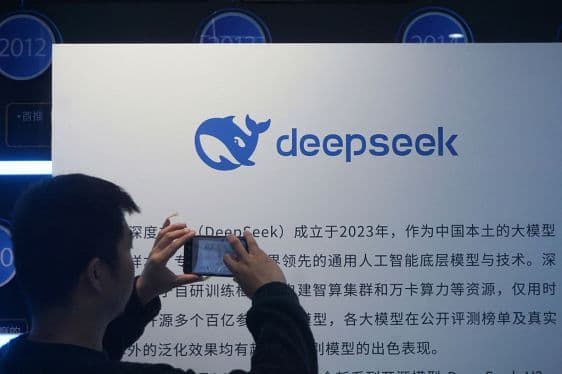
Chinese AI lab DeepSeek has launched two preview versions of its newest large language model,DeepSeek V4, a much-awaited update to last year’s V3.2 model and the accompanyingR1 reasoning modelthat took theAI world by storm. The company says both DeepSeek V4 Flash and V4 Pro are mixture-of-experts models with context windows of 1 million tokens each — enough to allow large codebases or documents to be used in prompts. The mixture-of-experts approach involves activating only a certain number of parameters per task to lower inference costs. The Pro model has a total of 1.6 trillion parameters (49 billion active), which makes it the biggest open-weight model available, outstripping Moonshot AI’s Kimi K 2.6 (1.1 trillion), MiniMax’s M1 (456 billion), and more than double DeepSeek V3.2 (671 billion). The smaller, V4 Flash has 284 billion parameters (13 billion active). DeepSeek says both models are more efficient and performant than DeepSeek V3.2 due to architectural improvements, and have almost “closed the gap” with current leading models, both open and closed, on reasoning benchmarks. The company claims its new V4-Pro-Max model outperforms its opensource peers across reasoning benchmarks, and outstrips OpenAI’s GPT-5.2 and Gemini 3.0 Pro on some tasks. In coding competition benchmarks, DeepSeek said both V4 models’ performance is “comparable to GPT-5.4.” However, the models seem to fall slightly behind frontier models in knowledge tests, specifically OpenAI’s GPT-5.4 and Google’s latest Gemini 3.1 Pro. This lag suggests a “developmental trajectory that trails state-of-the-art frontier models by approximately 3 to 6 months,” the lab wrote. Both V4 Flash and V4 Pro support text only, unlike many of its closed-source peers, which offer support for understanding and generating audio, video, and images. Notably, DeepSeek V4 is much more affordable than any frontier model available today. The smaller V4 Flash model costs $0.14 per million input tokens and $0.28 per million output tokens, undercutting GPT-5.4 Nano, Gemini 3.1 Flash, GPT-5.4 Mini, and Claude Haiku 4.5. The larger V4 Pro model, meanwhile, costs $0.145 per million input tokens and $3.48 per million output tokens, also undercutting Gemini 3.1 Pro, GPT-5.5, Claude Opus 4.7, and GPT-5.4. The launch comes a day after the U.S.accusedChina of stealing American AI labs’ IP on an industrial scale using thousands of proxy accounts. DeepSeek itself has been accused by Anthropic and OpenAI of “distilling,” essentially copying, their AI models.

read more


Latest AI News

View All News →
From Corner Office to a Co-Working Desk: Why Jagdish Mitra Chose to Restart After 30 Years

From Corner Office to a Co-Working Desk: Why Jagdish Mitra Chose to Restart After 30 Years

At 55, a veteran of Indian IT chose uncertainty over comfort, driven by one idea, a broken services model, and the belief that India must build deep-tech products, not just deliver them.

11 hours ago

View

Maine’s governor vetoes data center moratorium

Maine’s governor vetoes data center moratorium

Maine Governor Janet Mills has vetoed a bill that would have temporarily brought permits for new data centers to a halt. If it had become law,L.D. 307would have imposed the country’s first statewide moratorium on new data centers — lasting, in this case, until November 1, 2027. The bill also called for the creation of a 13-person council to study and make recommendations on data center construction. Withpublic opposition to data centersrising, other statesincluding New Yorkhave considered similar moratoriums. Ina letterto the state legislature, Mills — a Democrat currently running for the U.S. Senate — said that pausing new data centers would be “appropriate given the impacts of massive data centers in other states on the environment and on electricity rates” and that she “would have signed this bill” if it had included an exemption for a data center project in the Town of Jay. That project, Mills said, “enjoys strong local support from its host community and region.” Melanie Sachs, a Democratic state representative who sponsored the bill,said Mills’ veto“poses significant potential consequences for all ratepayers, our electric grid, our environment, and our shared energy future.”

15 hours ago

View

Anthropic created a test marketplace for agent-on-agent commerce

Anthropic created a test marketplace for agent-on-agent commerce

In a recent experiment, Anthropic created a classified marketplace where AI agents represented both buyers and sellers, striking real deals for real goods and real money. The company admittedthis test — which it called Project Deal — was only “a pilot experiment with a self-selected participant pool” of 69 Anthropic employees who were given a budget of $100 (paid out via gift cards) to buy stuff from their coworkers. Nonetheless, Anthropic said it was “struck by how well Project Deal worked,” with 186 deals made, totaling more than $4,000 in value. The company said it actually ran four separate marketplaces with different models — one that was “real” (where everyone was represented by the company’s most-advanced model, and with deals actually honored after the experiment) and another three for study. Apparently, when users are represented by more advanced models, they get “objectively better outcomes,” Anthropic said. But users didn’t seem to notice the disparity, raising the possibility of “‘agent quality’ gaps” where “people on the losing end might not realize they’re worse off.” Also, the initial instructions given to the agents didn’t appear to affect sale likelihood or the negotiated prices.

15 hours ago

View

OpenAI CEO apologizes to Tumbler Ridge community

OpenAI CEO apologizes to Tumbler Ridge community

In a letter to the residents of Tumbler Ridge, Canada, OpenAI CEO Sam Altman said he is “deeply sorry” that his company failed to alert law enforcement about the suspect in a recent mass shooting. After police identified 18-year-old Jesse Van Rootselaar as a suspected shooter who allegedly killed eight people,the Wall Street Journal reportedthat OpenAI had flagged and banned Van Rootselaar’s ChatGPT account in June 2025 for describing scenarios involving gun violence. The company’s staff debated alerting police butultimately decided against it, eventually reaching out to Canadian authorities after the shooting. OpenAI has since said that it isimproving safety protocols, for example by putting more flexible criteria in place to determine when accounts get referred to authorities, and by establishing direct points of contact with Canadian law enforcement. In Altman’s letter, which wasfirst published in the local newspaper Tumbler RidgeLines, the CEO said he’d discussed the shooting with Tumbler Ridge Mayor Darryl Krakowka and British Columbia Premier David Eby, and they’d all agreed “a public apology was necessary,” but “time was also needed to respect the community as you grieved.” “I am deeply sorry that we did not alert law enforcement to the account that was banned in June,” Altman said. “While I know words can never be enough, I believe an apology is necessary to recognize the harm and irreversible loss your community has suffered.” Altman also said that OpenAI’s focus will “continue to be on working with all levels of government to help ensure nothing happens like this again.” Ina post on X, Eby said Altman’s apology is “necessary, and yet grossly insufficient for the devastation done to the families of Tumbler Ridge.” Canadian officials have said they areconsidering new regulations on artificial intelligencebut have not made any final decisions.

19 hours ago

View