AI NewsColby Adcock’s Scout AI raises $100M to train its models for war. We visited its bootcamp

Colby Adcock’s Scout AI raises $100M to train its models for war. We visited its bootcamp

6:18 PM IST · April 29, 2026
Colby Adcock’s Scout AI raises $100M to train its models for war. We visited its bootcamp

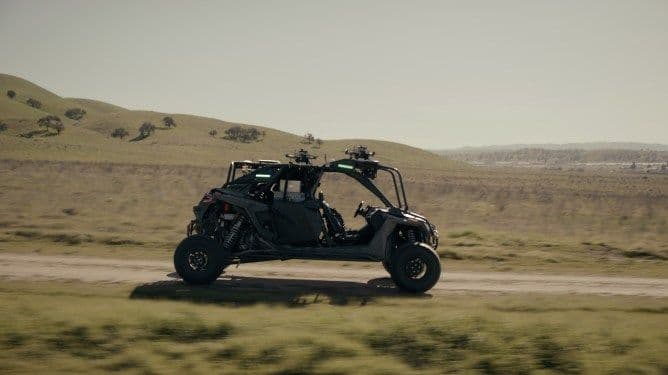
At a U.S. military base in central California, four-seater all-terrain vehicles roam hillside trails. This is a training exercise, but not for the people in the vehicles: It’s an effort to train AI models to enter conflict zones. The autonomous military ATVs are operated by Scout AI, a startup founded in 2024 by Colby Adcock and Collin Otis, that calls itself a “frontier lab for defense.” The company said on Wednesday that it has raised $100 million in a Series A round led by Align Ventures and Draper Associates, following its $15 million seed round in January 2025. Scout invited TechCrunch for an exclusive tour of its training operations at a military base it asked us not to name. The company is building an AI model it calls “Fury” to operate and command military assets, first for logistical support, but soon for autonomous weapons. CTO Collin Otis compares this work, which builds on existing LLMs, to training soldiers. “[Soldiers] start when they’re 18 years old, and sometimes they even start after college, so you want to start with that base level of intelligence,” Otis told TechCrunch. “It’s useful to start with someone who’s already made an investment and then say, ‘Hey, what do I have to do to teach this thing to be an incredible military AGI, versus just being a broadly intelligent AGI?’” Scout has secured military technology development contracts totaling $11 million from organizations like DARPA, the Army Applications Laboratory, and other Department of Defense customers. It is one of 20 autonomy companies whose technology is being used by the U.S. Army’s 1st Cavalry Division during its regular training cycle at Fort Hood in Texas, with the expectation that the unit will bring along products that prove themselves when it next deploys in 2027. For Scout’s internal testing, the rubber meets the dirt in the base’s hilly terrain, where the company’s operations team, led by former soldiers, is putting the vehicles through their paces on simulated missions. Autonomous cars are starting to be seen in more cities around the world, but they operate in more structured environments with rules. Operating autonomously on unmarked trails or off-road is another challenge entirely. Otis, who previously worked at autonomous trucking company Kodiak, said he was motivated to start Scout when he realized the system he helped build there wasn’t intelligent enough to operate in an unpredictable war zone. Scout is turning to a newer autonomy technology: Vision Language Action models, or VLAs, that are based on LLMs and used to control robots. First released by Google DeepMind in 2023, the technology seeded robotics startups likePhysical Intelligenceand Figure.AI, the humanoid robot company led by Adcock’s brother, Brett. Colby Adcock is on Figure’s board, and he says that experience convinced him of the opportunity to bring broader intelligence to the military’s growing fleet of autonomous vehicles. His brother introduced him to Otis, who was advising Figure, and they set about applying the latest in AI to military solutions. “If I handed you the controller of a drone right now and I strapped a headset on you, you could learn to fly that thing in minutes,” Otis said. “You’re actually just learning how to connect your prior knowledge to these couple little joysticks. It’s not a big leap. That’s the way to think about VLAs and why they’re such an unlock.” Indeed, I got a chance to drive one of Scout’s ATVs around the rutty trails, and the terrain was challenging: steep hills, loose sand on turns, disappearing tracks, confusing intersections. I’m not an experienced ATV driver, but made a fair go on my first attempt (if I say so myself). That’s the kind of general intelligence the company wants in its models, which it has been training using these ATVs for just six weeks — it started off using civilian ATVs. I also rode in the ATV under autonomous control, and could feel the difference — it accelerates faster than a human who might be thinking about a passenger’s comfort. The operations team pointed out how the vehicles hug the right on wider trails, but stay in the middle of narrow ones, like their training drivers. They also, when confused, suddenly slow down to think over their next move, which happened a few times as the ATV carried us on a 6.5 km loop before returning to base. Though the VLAs are new enough that they are yet to be deployed by any company in an operational setting, “the technology is good enough to be doing that experimentation in the field with soldiers to figure out how to most be effective to U.S. forces,” said Stuart Young, a former DARPA program manager who worked on ground vehicle autonomy. And like other autonomy companies, Scout’s full stack also includes deterministic systems and other flavors of AI to round out its agents’ capabilities. Young left DARPA this month to join Field after managing a program calledRACERthat asked companies to create high-speed, autonomous off-road vehicles, helpingseed this spacethe same way that the organization’s Grand Challenge boosted self-driving cars. Two competitors in this space, Field AI and Overland AI, were spun out of that program, and Scout also participated later. The first applications of ground autonomy, according to Scout executives and military technologists, will be automated resupply: Carrying water or ammunition to distant observation posts, or in a convoy where a crewed truck might be followed by six to ten autonomous vehicles, saving precious human labor for more important tasks. Brian Mathwich, an active duty infantry officer doing a stint as a military fellow at Scout, recalled a recent exercise in Alaska where he led a resupply convoy in total darkness and wished for autonomous vehicles to help him out. Scout sees itself primarily as a software company building an intelligence layer for military machines. It doesn’t intend to make the autonomous vehicles themselves, but instead build atop them. Adcock expects the startup’s first product to be widely adopted will be one called “Ox,” a command and control software bundled with hardened computer hardware like GPUs, communications and cameras. It’s intended to allow individual soldiers to orchestrate multiple drones and autonomous ground vehicles using prompts such as, “Go to this waypoint and watch for enemy forces.” However, making that software work requires training on real vehicles, which is why it has set up Foundry, its training range at the military base. There, drivers spend eight-hour shifts putting the ATVs through their paces, then work through a reinforcement learning system to log where they had to take over, which is used to improve the model. The base commander has even asked the company’s ATV to take a turn with security patrols. One hypothesis Scout is testing is that VLAs will enable this relatively limited data set, alongside training data in simulations, to deliver a fully capable driving agent. While the vehicle seems comfortable on trails, for example, it isn’t ready to operate fully off-road. Scout is also practicing with drones for reconnaissance and defense, giving them intelligence with vision language models. The startup is working on a system that would see groups of munition drones fly with a larger “quarterback” platform that provides more compute resources to command them. For example, the drones could search a geographic area for hidden enemy tanks and attack them, possibly without human intervention. Otis contends that the alternative approach in such a scenario might be indirect artillery fire, which is imprecise compared to drone strikes. While autonomous weapons are a flash point in the politics of defense tech, experts note the concept is old: Heat-seeking missiles and mines have been used in warfare for decades. The question for technologists is how the weapons are controlled, according to Jay Adams, a retired U.S. Army Captain who leads Scout’s operations team. Adams notes the company’s munitions drones can be programmed to only attack threats in a specific geographic area, or only following human confirmation. He also says autonomous weapons platforms are unlikely to fire because they are scared, the way an 18-year-old soldier might be. VLAs, too, hold promise for improving targeting. Scout says its models are pre-trained on a specific set of military data to prepare them for, say, running into an enemy tank while on a resupply mission. Lt. Col. Nick Rinaldi, who supervises Scout’s work for the Army Applications Laboratory, says that while automated targeting is hard and unlikely to be used outside of constrained environments in the near term, the potential of VLAs to reason about threats make them a promising technology to investigate. Adams says the promise of drones that can identify their own targets is key to warfare in the future. While Russia’s invasion of Ukraine has generated intense interest in drone warfare, he believes that humans operating individual UAVs doesn’t scale well enough for the U.S. to face a large number of low-cost unmanned systems should they threaten U.S. forces. Like many defense startups, Scout wears its mission on its sleeve, and its executives will freely criticize companies that are reluctant to hand their technology over to the government. Google, for example,reportedlypulled out of a Pentagon contest to develop control systems for autonomous drone swarms, a capability Scout is also working on. “The AI people don’t want to work with the military,” Otis told TechCrunch,referencing Anthropic’s spatwith the Pentagon over its terms of service. “None of them are open to running agents on one-way attack drones, or running agents on missile systems.” Nevertheless, Scout is using existing LLMs as the base to build its agents, though it declined to say which ones. Otis says it has agreements with “very well-known hyperscalers” to provide the pre-trained intelligence for Scout’s foundation model. He also declined to say if the company uses open-weight models, such as those offered by Chinese companies. Many companies reliant on AI inference build on top of open-weight models because they are cheaper compared to offerings from frontier labs like Anthropic or OpenAI. Scout expects to address this by building its own model from the ground up in the years ahead, and the founders say much of its capital will go into those training and compute costs. Indeed, Otis wonders if Scout will beat the existing leaders to AGI because its model will be constantly interacting with the real world. “There’s an argument in the AGI community along the lines that you can only get so intelligent by reading the internet, and most intelligence comes with interacting in the world,” Otis said. Does that mean Adcock is competing with his brother’s army of humanoid robots at Figure? No, Otis says, but “we can get to scale much faster because our customer has assets,” he said, referring to the Pentagon.

read more


Latest AI News

View All News →
Laid-off Oracle workers tried to negotiate better severance. Oracle said no.

Laid-off Oracle workers tried to negotiate better severance. Oracle said no.

As was widely reported, Oracleaxed an estimated 20,000 to 30,000 peoplevia email on March 31. One of the employees cut that day told TechCrunch about the experience: “I had, like, this weird feeling in my stomach. I went to go sign into the VPN, and the VPN was like, ‘this user doesn’t exist anymore.’ Then I called my friend, and I was like, ‘Hey, can you see me in Slack?’ And she said, ‘No, your account’s been deactivated.’” The person soon received an email stating their role was terminated immediately. The severance offer arrived a few days later. But Oracle’s terms would quickly become a point of contention — and some laid-off employees would push back. Oracle offered fairly standard Corporate America terms to laid off employees. In exchange for signing a release waiving their right to sue, employees received four weeks of pay for the first year, plus one additional week per year of service, capped at 26 weeks. The company was also paying for one month of COBRA insurance. The catch: Although stock compensation often makes up a good chunk of a tech worker’s pay, particularly at Oracle, the company did not accelerate soon-to-vest RSUs. Any shares that hadn’t vested by the termination date were forfeited. That held true even for stock granted as retention incentives or in place of salary increases tied to promotions. One long-tenured employee lost $1 million in stock that was just four months from vesting; RSUs made up about 70% of his compensation,Time reported. Some employees also discovered that if they were classified as remote workers by the company, and didn’t work in a state with stronger worker provisions like California or New York, the company said they didn’t qualify for WARN Act protections. TheWARN Act is a lawthat requires companies conducting mass layoffs to give employees two months notice prior to letting them go. It’s triggered when 50 or more people are impacted at one location. By classifying employees as remote workers, the minimum location requirements can be sidestepped. Some people were unaware they were classified as remote workers, because they were near an office and worked on a hybrid schedule. Even if they were covered by the WARN Act, this did not necessarily extend severance, the former Oracle employee said. That’s because Oracle included the two-months’ WARN notice pay in its existing calculation of four-weeks, plus one week per year. For a short time, a group of employees tried to negotiate en masse with Oracle, according to a letter seen by TechCrunch. At least90 people signed a public petitionurging the database and cloud computing giant to match the terms of other big tech companies conducting mass layoffs in the name of AI. For instance, Meta’s severance package, according to an email published by Business Insider, started at 16 weeks of base pay, plus two weeks for every year of employment and covered COBRA for 18 months. Microsoft, which extended voluntary retirement offers to long-serving employees, provided accelerated stock vesting, a minimum of eight weeks’ pay, and an additional one to two weeks for every six months of service, depending on rank, theSeattle Times reported. And Cloudflare, which just cut 20% of its employees,offered lump sum severancethat was the equivalent of base pay through the end of 2026, plus healthcare coverage through the end of the year, and accelerated vesting of stock through August 15. So if an employee was close to obtaining another tranche, they will get it. Oracle declined to negotiate, according to an email seen by TechCrunch. It was a take-it-or-leave scenario, the employee said. When asked about its severance terms, classifying employees as remote, and the failed attempt by employees to negotiate more, Oracle declined to comment. Such a reaction from the company isn’t a surprise, not even to those who hoped to negotiate. But it does underscore that for all the theoretical high pay (often via stocks) and perks that tech workers enjoy when it’s an employees’ market, they have very few protections in place when it isn’t.

1 hour ago

View

Cloudflare says AI made 1,100 jobs obsolete, even as revenue hit a record high

Cloudflare says AI made 1,100 jobs obsolete, even as revenue hit a record high

Cloudflare on Thursday joined a growing list of tech companies — including Meta, Microsoft, and Amazon — that have reported increased revenue alongside massive layoffs, attributing both trends to their use of AI. Cloudflare, which provides internet security and performance services to millions of websites worldwide, announced it was cutting its workforce by approximately 20%, which equates to 1,100 people, it said as part of its first quarter 2026 earnings report on Thursday. “We’ve never done something like this in Cloudflare’s history,” co-founder and CEO Matthew PrincesaidThursday on the quarterly conference call, marking the first mass layoff in the company’s 16-year history. The company is cutting people from all teams and geographies except for salespeople who carry revenue quotas, CFO Thomas Seifert detailed on the call. The news of the workforce cuts came as the companyreportedquarterly revenues of $639.8 million, a 34% year-over-year increase and the highest single quarter in the company’s history. However, this was coupled with a loss of $62.0 million compared with losing $53.2 million in the year-ago quarter. That widening loss, even as revenue surged, highlights a familiar paradox in Cloudflare’s story: the company is growing fast but has yet to turn a consistent profit. But the loss was a smaller percentage of revenue, and the quarter was coupled with a lot of other positive indicators. For instance, Cloudflare reported that it had over $2.5 billion in “remaining performance obligations,” a year-over-year growth of 34%. RPO is the favorite metric these days to indicate revenue under contract but not yet delivered. Hence, Prince insisted, the 20% cuts were not to reduce expenses but were strictly because of its use of AI. “Today’s actions are not a cost-cutting exercise or an assessment of individuals’ performance; they are about Cloudflare defining how a world-class, high-growth company operates and creates value in the agentic AI era,” Prince and Cloudflare co-founder and president, Michelle Zatlyn,wrotein a related blog post about the layoffs. Prince acknowledged on the call that even though Cloudflare has been selling AI-powered products, it was at first cautious about adopting AI itself. “Internally, the tipping point was last November. At that point, across our teams, we began to see massive productivity gains, team members that were two, 10, even 100 times more productive than they had been before. It was like going from a manual to an electric screwdriver,” he described. “Cloudflare’s usage of AI has increased by more than 600% in the last three months alone,” he added. Prince highlighted the internal use of AI coding, saying that virtually the entire R&D team is now using the company’s own Workers platform — a tool that lets developers build and run software directly on Cloudflare’s global network — including its vibe coding feature. He also noted that 100% of the code produced this way and deployed for use in Cloudflare’s products is “now reviewed by autonomous AI agents.” But it’s not just developers who are using AI internally, he said. “Employees across the company from engineering to HR to finance to marketing run thousands of AI agent sessions each day to get their work done.” As a result, these highly productive, AI-powered employees require fewer support staff, he argued. “A lot of the support people that provide support behind them, those roles aren’t going to be the roles that, you know, drive companies going forward,” Prince said. Interestingly, Prince says that Cloudflare “will continue to hire people, and we’ll continue to invest in them because the people that are embracing these tools are just so much more productive than we’d ever seen before. I would guess that in 2027 we’ll have more employees than we did at any point in 2026.” Cloudflare said it ended its first quarter before layoffs with a headcount of about 5,500. The pattern Prince described — deploying AI gains as justification for workforce reductions even during a period of strong revenue growth — is fast becoming a familiar script across the tech industry. Whether it reflects true structural transformation or acts as convenient cover for cost discipline is a question that investors and employees will be wrestling with for some time to come. When asked by an analyst on the call why the company needed to cut so deeply after such a good quarter, Prince said, “Just because you’re fit doesn’t mean you can’t get fitter.”

5 hours ago

View

Intel’s comeback story is even wilder than it seems

Intel’s comeback story is even wilder than it seems

Bloomberg has adeep divethis week into how Intel CEO Lip-Bu Tan is trying to rescue one of Silicon Valley’s most storied, and stumbling, chipmakers. It’s worth a read, but it actually undersells the most jaw-dropping part of the story: Intel’s stock has risen a stunning 490% over the past year, a bet by Wall Street that may be running well ahead of the company’s actual turnaround. Tan, who took over inMarch of last year, has spent much of his first year schmoozing rather than restructuring — locking in asweetheart dealwith the U.S. government (now Intel’s third-largest shareholder), cozying up to Elon Musk on afactory partnership, and reportedly landing preliminary manufacturing agreements with both Apple and Tesla. The fundamentals are still messy. Intel’s chip yields lag well behind industry leader TSMC, and employees tell Bloomberg that Tan has been light on specifics internally, with some teams adjusting missed deadlines rather than recovering from them. But investors are betting big on the bigger picture. Whether the execution follows is the multi-billion-dollar question.

5 hours ago

View

Last 24 hours to get 50% off a second pass to TechCrunch Disrupt 2026

Last 24 hours to get 50% off a second pass to TechCrunch Disrupt 2026

Today is the last day. At 11:59 p.m. PT, the 50% off second pass offer forTechCrunch Disrupt 2026ends. After that, prices go up, and the option to bring a partner, co-founder, or colleague with you at half the cost disappears. Register now to lock in your savings.Save up to $410 on your pass and get 50% on a second pass. Disruptisn’t a single-track experience. It’s multiple conversations happening at once. Sessions overlap. Introductions lead to something else an hour later. Patterns only become clear after you’ve seen the same idea from different angles. When you go alone, you see only part of it. When you bring someone, you see more, and more importantly, you understand more. You compare notes in real time, challenge assumptions, and make decisions while the context is still fresh.Get a discounted second pass now. You and your plus-one will have access to: That’s not a small difference. It’s the difference between leaving with ideas and leaving with direction for your next steps. And after tonight, that second perspective costs more. This is your last day to save 50% on a second pass.Choose your tickets. From October 13–15 in San Francisco atDisrupt,the startup world will be in the same place at the same time, turning conversations into capital, ideas into companies, and connections into trajectories. They’ll be trading signals, testing assumptions, and deciding what matters based on what they’re seeing in real time. When you act now to secure your pass —and a second at 50% off— you’ll be in the room while those decisions (and discussions) are taking shape. Across 250+ sessions, you’ll explore real-world playbooks (not theory), covering: Those conversations don’t pause when the event ends. They carry forward into follow-ups, deals, partnerships, and decisions made in the weeks that follow. If you’re not there, you’re not just missing the event. You’re reacting later to conclusions other people reached sooner.Buy a pass to Disrupt today and get a second one for 50%off to be a part of the conversations. Knowing you have a strong idea isn’t enough. You need clarity on where to take it, who to partner with, and how to fund it. Without that clarity, decisions stall. Roadmaps stretch. Opportunities sit just long enough to lose momentum. Disruptcompresses that uncertainty. You see how decisions get made — onstage, in roundtables, and in conversations that build on each other over three days. Better outcomes come from: Miss that window, and you’re back to piecing together secondhand insight, slower feedback loops, and decisions made without the same level of context. This is your final day to get a second pass for 50% off.Register now before prices increase at 11:59 p.m. ET tonight. After tonight, you can still attendDisrupt. But you’re more likely to go alone — and that changes the experience. It means choosing between sessions instead of covering more ground. Processing everything yourself instead of testing it in real time. Following up later instead of leaving with shared clarity. That’s the real cost. Not just paying more, but also getting less out of being there.Lock in your 50% savings on a second ticketto show up more intentionally. Only hours remain to buy a pass toDisruptand get a second for 50% off. The offer ends tonight at 11:59 p.m. PT. Right now, you can still: After today, that advantage is gone. Buy one pass to Disrupt andget 50% off the second of the same ticket type. Decide who you’re bringing — and secure your passes before midnight tonight. Because missing this isn’t just about price. It’s about showing up with less context, less coverage, and less clarity than the people who didn’t wait.

9 hours ago

View