AI NewsAnthropic launches code review tool to check flood of AI-generated code

Anthropic launches code review tool to check flood of AI-generated code

4:54 AM IST · March 10, 2026
Anthropic launches code review tool to check flood of AI-generated code

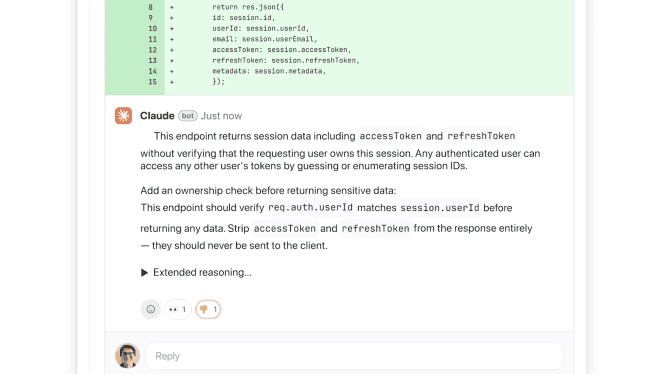
When it comes to coding, peer feedback is crucial for catching bugs early, maintaining consistency across a codebase, and improving overall software quality. The rise of “vibe coding” — using AI tools that take instructions given in plain language and quickly generate large amounts of code — has changed how developers work. While these tools have sped up development, they have also introduced new bugs, security risks, and poorly understood code. Anthropic’s solution is an AI reviewer designed to catch bugs before they make it into the software’s codebase. The new product, called Code Review, launched Monday inClaude Code. “We’ve seen a lot of growth in Claude Code, especially within the enterprise, and one of the questions that we keep getting from enterprise leaders is: Now that Claude Code is putting up a bunch of pull requests, how do I make sure that those get reviewed in an efficient manner?” Cat Wu, Anthropic’s head of product, told TechCrunch. Pull requests are a mechanism that developers use to submit code changes for review before those changes make it into the software. Wu saidClaude Codehas dramatically increased code output, which has increased pull request reviews that have caused a bottleneck to shipping code. “Code Review is our answer to that,” Wu said. Anthropic’s launch of Code Review — arriving first to Claude for Teams and Claude for Enterprise customers in research preview — comes at a pivotal moment for the company. On Monday, Anthropicfiled two lawsuitsagainst the Department of Defense in response to the agency’s designation of Anthropic as a supply chain risk. The dispute will likely see Anthropic leaning more heavily on its booming enterprise business, which has seen subscriptions quadruple since the start of the year.Claude Code’s run-rate revenue has surpassed $2.5 billion since launch, according to the company. “This product is very much targeted towards our larger scale enterprise users, so companies like Uber, Salesforce, Accenture, who already use Claude Code and now want help with the sheer amount of [pull requests] that it’s helping produce,” Wu said. She added that developer leads can turn on Code Review to run on default for every engineer on the team. Once enabled, it integrates with GitHub and automatically analyzes pull requests, leaving comments directly on the code explaining potential issues and suggested fixes. The focus is on fixing logical errors over style, Wu said. “This is really important because a lot of developers have seen AI automated feedback before, and they get annoyed when it’s not immediately actionable,” Wu said. “We decided we’re going to focus purely on logic errors. This way we’re catching the highest priority things to fix.” The AI explains its reasoning step by step, outlining what it thinks the issue is, why it might be problematic, and how it can potentially be fixed. The system will label the severity of issues using colors: red for highest severity, yellow for potential problems worth reviewing, and purple for issues tied to preexisting code or historical bugs. Wu said it does this quickly and efficiently by relying on multiple agents working in parallel, with each agent examining the codebase from a different perspective or dimension. A final agent aggregates and ranks the findings, removing duplicates and prioritizing what’s most important. The tool provides a lightsecurity analysis, and engineering leads can customize additional checks based on internal best practices. Wu said Anthropic’s more recently launchedClaude Code Securityprovides a deeper security analysis. The multi-agent architecture means this can be a resource-intensive product, Wu said. Similar to other AI services, pricing is token-based, and the cost varies depending on code complexity — though Wu estimated each review would cost $15 to $25 on average. She added that it’s a premium experience, and a necessary one as AI tools generate more and more code. “[Code Review] is something that’s coming from an insane amount of market pull,” Wu said. “As engineers develop with Claude Code, they’re seeing the friction to creating a new feature [decrease], and they’re seeing a much higher demand for code review. So we’re hopeful that with this, we’ll enable enterprises to build faster than they ever could before, and with much fewer bugs than they ever had before.”

read more

Latest AI News

View All News →
The Android Show I/O Edition: Google Showcases Gemini Intelligence on Android With New AI-Backed Widget Creation Tool

The Android Show I/O Edition: Google Showcases Gemini Intelligence on Android With New AI-Backed Widget Creation Tool

Google is bringing Gemini Intelligence to Android, its new suite of AI-powered tools for its operating system, the Mountain View-based tech giant announced during the Android Show I/O Edition event. The company hosted the event as part of Google I/O, which is scheduled to take place from May 19 to May 20. Slated to roll out to select Android devices soon, Gemini Intelligence will expand Google's multistep task automation feature beyond the Samsung Galaxy S26 series and Pixel 10 lineup. Moreover, the company has announced that it is also integrating Gemini into Chrome on Android, similar to the browser's desktop version.

1 hour ago

View

Threads tests a Meta AI integration that works similarly to Grok

Threads tests a Meta AI integration that works similarly to Grok

Threads is testing a Meta AI integration that works similarly to X’s Grok. Users with a public account will be able to mention Meta AI in a post or a reply to get more context. The feature is currenty in beta testing in Malaysia, Saudi Arabia, Mexico, Argentina, and Singapore. Meta told TechCrunch in an email that the feature is designed to help people get real-time context about trends and breaking stories, as well as receive recommendations, all within conversations. Now, users can mention Meta AI to ask questions like, “why are people talking about the World Cup this month?, “whose Met Gala looks are trending right now?” or “how are the Knicks doing in the playoffs?” Meta AI will then process the invocation and respond as a public reply authored by the @meta.ai account. Meta AI will respond in the language used in the post it was mentioned in. By integrating Meta AI into its platform, Threads is positioning itself as not just a destination for chatting about news and trends, but also a place where you can get information and recommendations without having to leave the app. The idea is similar to Grok’s role on X, which is filled with posts of users asking the AI chatbot questions like “is this real?” or “explain this.” Of course, giving an AI chatbot this level of visibility carries risks, as seen on X whenGrok generated postspraising Hitler. Still, Meta AI notably has stronger safeguards in place than Grok, though it remains to be seen whether it will be prone to similar issues. Meta notes that if you want to see fewer Meta AI replies in your feed, you can mute @meta.ai, use the “Not interested” option on any Meta AI post, or hide a Meta AI reply that appears directly on your post. The company says it plans to learn from early feedback and will continue improving the experience before expanding it to more people.

1 hour ago

View

Google’s ‘Create My Widget’ feature will let you vibe code your own widgets

Google’s ‘Create My Widget’ feature will let you vibe code your own widgets

Google on Tuesday unveiled a new “Create My Widget” feature for Android that allows users to vibe code their own custom widgets. The feature will first launch on the latest Samsung Galaxy and Google Pixel phones this summer. To create a widget, users will be able to describe what they want using natural language. For example, you could ask the feature to “suggest three high-protein meal prep recipes every week” in order to get a custom dashboard that you can add and resize on your home screen. Or, if you’re a cyclist who only cares about wind speed and rain, you can create a weather widget that just surfaces those exact stats on your home screen. Gemini can also pull information from the web and connect with Google apps like Gmail and Calendar to build a single, personalized dashboard. For instance, if you’re planning a family reunion in Berlin, it can gather your flight and hotel details, surface restaurant reservations, and even add a countdown. The feature signals Google’s latest push to bring generative AI deeper into the Android experience, as tech companies race to make customization tools more accessible to everyday users. “This is like you asking your personal assistant a question, and having them just bring you the answer on repeat,” said Ben Greenwood, Director, PM, Android Core Experiences, during a briefing with reporters. “So think of it as asking Gemini things about the world, things about its knowledge of what’s going on and events, as well as things about your personal data. Those are sort of the two areas that unlock an enormous number of use cases that we’re super excited about.” The company announced the new feature alongside the unveiling of Gemini Intelligence, which will bring additional features like advanced autofill, an AI-powered voice dictation feature for Gboard, and more.

1 hour ago

View

The AI legal services industry is heating up. Anthropic is getting in on the action.

The AI legal services industry is heating up. Anthropic is getting in on the action.

Anthropic announced Tuesday that it is launching a host of new chatbot features designed to provide automated assistance to law firms. The new features expand Claude for Legal — the law-focused offering thatlaunched earlier this year— offering users a new set of legal plugins and MCP connectors designed for specific areas of law. The new tools come amid hot competition in the legal AI space. In March, the AI law startup Harvey, which uses agentic AI to automate legal workflows,raised $200 millionat a valuation of $11 billion. Last month, a rival startup, Legora,raised a $600 millionseries D, and launcheda high-profile ad campaignfeaturing Jude Law. Legora offers similar services to Harvey — automated solutions built to simplify the often byzantine law processes that have traditionally involved entire teams of humans. Anthropic’s new tools are designed to help law firms automate specific clerical functions — things like document search and review, case law resources, deposition prep, document drafting, and other related areas. The plugins — which represent a bundle of functions and automated tools — are designed to work across legal fields like commercial, privacy, corporate, employment, product, and AI governance, Anthropic says. Anthropic is also offering a number of model context protocol connectors. MCPs connect specific data sources and third-party systems to AI models, allowing the models to interact with them directly. In this case, the new MCP connectors integrate Claude into a variety of software applications that are already routinely used by law firms — applications for document management like DocuSign and file search platforms like Box. Legal research sites like Thomson Reuters (which operates Westlaw) can also be connected. The new connectors and plugins are being made available to all paying Claude customers, the company said. The new features also build upon other plugins designed for the legal industrythat the company launchedin February. “The legal sector is facing mounting pressure to adopt AI, and the firms and in-house teams that move are pulling ahead fast,” a spokesperson for the company said. “Claude is making a deeper push into knowledge work, with the legal sector emerging as one of its most significant and fastest-growing industries.” As AI companies have sought to court law firms, AI-related failures have caused real problems in court. Dozens of lawyershave been caughtusing AI to generate error-ridden legal documents, as has at least onemajor law firm. Last year, Californiaissued a first-of-its-kind fineagainst an attorney who had used ChatGPT to draft an appeal riddled with fake quotes. Federal judgeshave also been caughtusing it to draft rulings, a trend thatdrew the scrutinyof Congressional leaders last year. Meanwhile,AI-generated lawsuitsare said to be clogging the arteries of justice — overwhelming courts with stacks of bizarrely argued legal “slop.”

1 hour ago

View