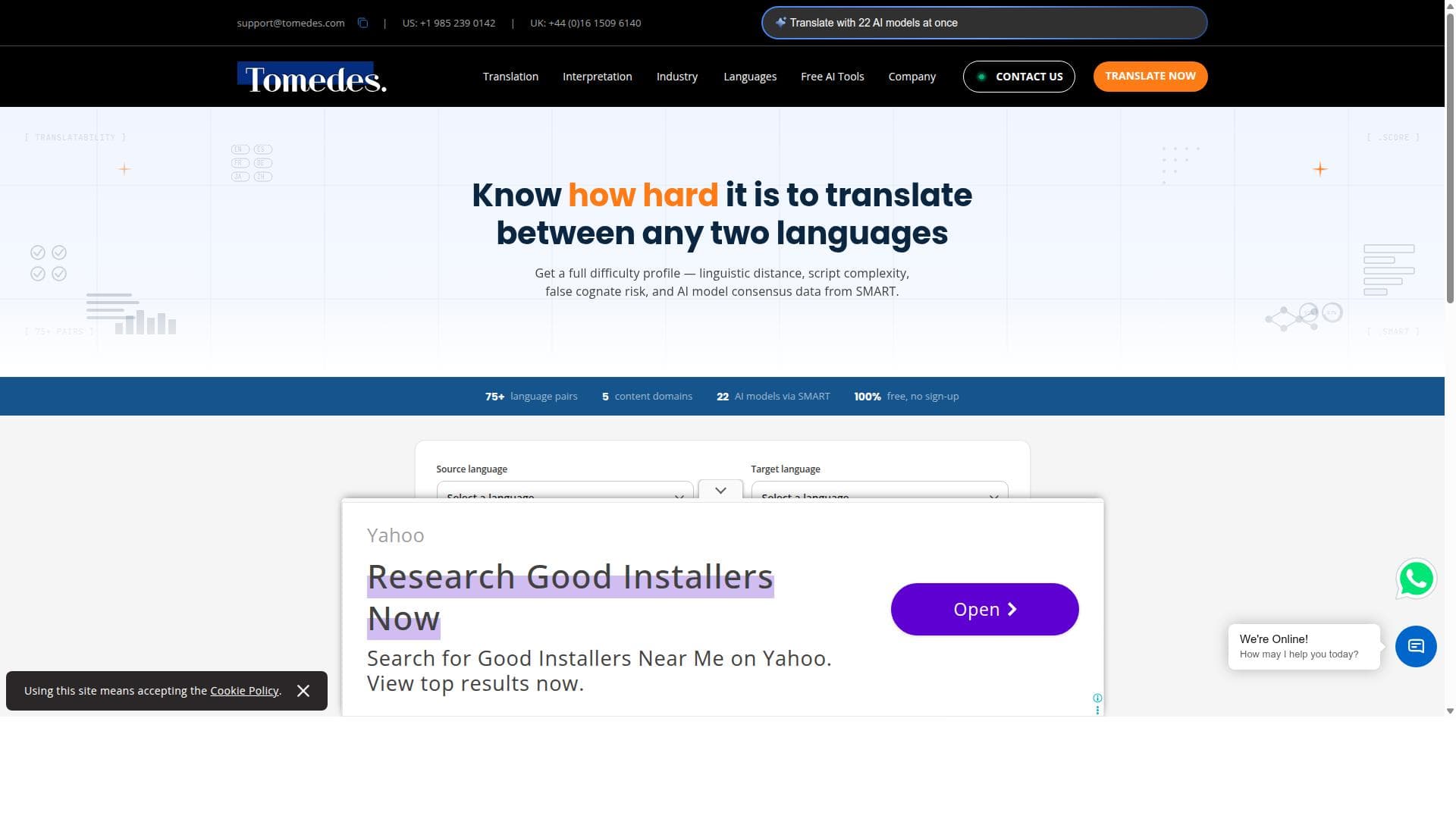


Translatability Checker uniquely evaluates the complexity of translating between over 75 language pairs by analyzing grammar, script compatibility, and AI translation accuracy across multiple content types. It is ideal for translators, localization experts, and businesses seeking deep insights to optimize their multilingual projects.

描述
Translatability Checker allows users to evaluate how easy or difficult it is to translate between any two languages. It compares grammar, script, and AI accuracy across more than 75 language pairs and 5 different content types, providing valuable insights for translation projects.
详细描述
Translatability Checker is a specialized AI-driven tool designed to assess the ease or difficulty of translating content between any two languages. Its core purpose is to provide detailed insights into the linguistic and technical challenges that may arise during translation projects, helping translators, localization experts, and content creators make informed decisions. By analyzing grammar structures, script compatibility, and AI translation accuracy, it offers a comprehensive evaluation that goes beyond simple word-for-word translation metrics. This makes it an invaluable resource for anyone involved in multilingual communication or translation management. At the heart of Translatability Checker are its key features that enable a nuanced comparison across more than 75 language pairs and five distinct content types. Users can check how grammar differences between languages impact translation complexity, which is crucial for maintaining meaning and tone in the target language. The tool also analyzes script compatibility, identifying potential issues when translating between languages with different writing systems, such as Latin to Cyrillic or Arabic to Chinese scripts. Additionally, it evaluates AI translation accuracy, providing a benchmark for machine translation quality and highlighting areas where human intervention may be necessary. Supporting a wide range of languages and content types, including technical documents, marketing materials, legal texts, casual communication, and more, it caters to diverse translation needs. Translatability Checker is best suited for professional translators, localization managers, content strategists, and businesses operating in global markets. For translation agencies, it streamlines project planning by identifying potential linguistic hurdles early, allowing for better resource allocation and quality control. Content creators and marketers benefit by understanding how their messages will adapt across languages, ensuring cultural and contextual appropriateness. Educational institutions and language researchers can also leverage its detailed grammatical and script analyses for academic purposes. Use cases range from preparing multilingual marketing campaigns and localizing software interfaces to translating legal contracts and technical manuals. Regarding pricing and plans, Translatability Checker offers flexible options tailored to different user needs, though specific pricing details are typically available upon inquiry through their website. Some users may access limited free trials or demo versions to evaluate the tool’s capabilities before committing to a subscription. Enterprise-level plans often include additional support, customization, and integration options to fit complex workflows. When compared to alternative translation evaluation tools, Translatability Checker stands out due to its multi-dimensional approach combining grammar, script, and AI accuracy assessments. Many competitors focus solely on machine translation quality or glossary management, whereas this tool provides a holistic view of translation feasibility. Its extensive language pair coverage and support for multiple content types further enhance its versatility. However, unlike some fully integrated CAT (Computer-Assisted Translation) tools, it does not directly handle translation memory or project management functions, positioning it more as an analytical supplement rather than a full translation platform. Notable limitations include the reliance on AI-generated data for accuracy evaluation, which may vary depending on the underlying machine translation engines used. While it supports a broad spectrum of languages, extremely rare or newly developed languages might not be covered. Additionally, the tool’s insights are analytical and do not replace the nuanced judgment of experienced human translators. Users should consider it as a decision-support tool rather than a standalone solution. Overall, Translatability Checker offers a powerful, data-driven approach to understanding translation challenges, making it an essential asset for anyone aiming to optimize multilingual content quality and workflow efficiency.
工具功能
- Check ease or difficulty of translation between any two languages
- Compare grammar differences across language pairs
- Analyze script compatibility for translation
- Evaluate AI translation accuracy
- Supports 75+ language pairs
- Supports 5 different content types
描述
Translatability Checker uniquely evaluates the complexity of translating between over 75 language pairs by analyzing grammar, script compatibility, and AI translation accuracy across multiple content types. It is ideal for translators, localization experts, and businesses seeking deep insights to optimize their multilingual projects.
Translatability Checker allows users to evaluate how easy or difficult it is to translate between any two languages. It compares grammar, script, and AI accuracy across more than 75 language pairs and 5 different content types, providing valuable insights for translation projects.
详细描述
Translatability Checker is a specialized AI-driven tool designed to assess the ease or difficulty of translating content between any two languages. Its core purpose is to provide detailed insights into the linguistic and technical challenges that may arise during translation projects, helping translators, localization experts, and content creators make informed decisions. By analyzing grammar structures, script compatibility, and AI translation accuracy, it offers a comprehensive evaluation that goes beyond simple word-for-word translation metrics. This makes it an invaluable resource for anyone involved in multilingual communication or translation management. At the heart of Translatability Checker are its key features that enable a nuanced comparison across more than 75 language pairs and five distinct content types. Users can check how grammar differences between languages impact translation complexity, which is crucial for maintaining meaning and tone in the target language. The tool also analyzes script compatibility, identifying potential issues when translating between languages with different writing systems, such as Latin to Cyrillic or Arabic to Chinese scripts. Additionally, it evaluates AI translation accuracy, providing a benchmark for machine translation quality and highlighting areas where human intervention may be necessary. Supporting a wide range of languages and content types, including technical documents, marketing materials, legal texts, casual communication, and more, it caters to diverse translation needs. Translatability Checker is best suited for professional translators, localization managers, content strategists, and businesses operating in global markets. For translation agencies, it streamlines project planning by identifying potential linguistic hurdles early, allowing for better resource allocation and quality control. Content creators and marketers benefit by understanding how their messages will adapt across languages, ensuring cultural and contextual appropriateness. Educational institutions and language researchers can also leverage its detailed grammatical and script analyses for academic purposes. Use cases range from preparing multilingual marketing campaigns and localizing software interfaces to translating legal contracts and technical manuals. Regarding pricing and plans, Translatability Checker offers flexible options tailored to different user needs, though specific pricing details are typically available upon inquiry through their website. Some users may access limited free trials or demo versions to evaluate the tool’s capabilities before committing to a subscription. Enterprise-level plans often include additional support, customization, and integration options to fit complex workflows. When compared to alternative translation evaluation tools, Translatability Checker stands out due to its multi-dimensional approach combining grammar, script, and AI accuracy assessments. Many competitors focus solely on machine translation quality or glossary management, whereas this tool provides a holistic view of translation feasibility. Its extensive language pair coverage and support for multiple content types further enhance its versatility. However, unlike some fully integrated CAT (Computer-Assisted Translation) tools, it does not directly handle translation memory or project management functions, positioning it more as an analytical supplement rather than a full translation platform. Notable limitations include the reliance on AI-generated data for accuracy evaluation, which may vary depending on the underlying machine translation engines used. While it supports a broad spectrum of languages, extremely rare or newly developed languages might not be covered. Additionally, the tool’s insights are analytical and do not replace the nuanced judgment of experienced human translators. Users should consider it as a decision-support tool rather than a standalone solution. Overall, Translatability Checker offers a powerful, data-driven approach to understanding translation challenges, making it an essential asset for anyone aiming to optimize multilingual content quality and workflow efficiency.
常见问题
What is Translatability Checker?
Translatability Checker is an AI-powered tool that assesses how easy or difficult it is to translate content between any two languages by comparing grammar, script, and AI translation accuracy across more than 75 language pairs and five content types.
How much does Translatability Checker cost?
Pricing details for Translatability Checker are available upon request via their website. They may offer different subscription plans tailored to individual or enterprise needs, and sometimes limited free trials or demos.
Who is Translatability Checker best for?
The tool is best suited for professional translators, localization managers, content creators, marketers, and businesses involved in multilingual communication and translation projects.
What are the main features of Translatability Checker?
Key features include evaluating translation ease between languages, comparing grammar differences, analyzing script compatibility, assessing AI translation accuracy, and supporting over 75 language pairs and five different content types.
Does Translatability Checker offer a free trial?
Translatability Checker may offer limited free trials or demo versions to allow users to explore its features before purchasing, but specific availability should be confirmed on their website.
What integrations does Translatability Checker support?
While primarily an analytical tool, Translatability Checker may offer integration options for enterprise users; however, it does not function as a full CAT tool and focuses on translation evaluation rather than project management.
How does Translatability Checker work?
The tool analyzes linguistic elements such as grammar and script differences between two selected languages, evaluates AI translation accuracy using machine translation benchmarks, and provides detailed reports on translation difficulty across various content types.
社交媒体
使用工具评价
暂无评价。成为第一个分享使用体验的人。