

这是您的 AI 工具吗?立即认领。
验证所有权、管理资料,并解锁增长功能。
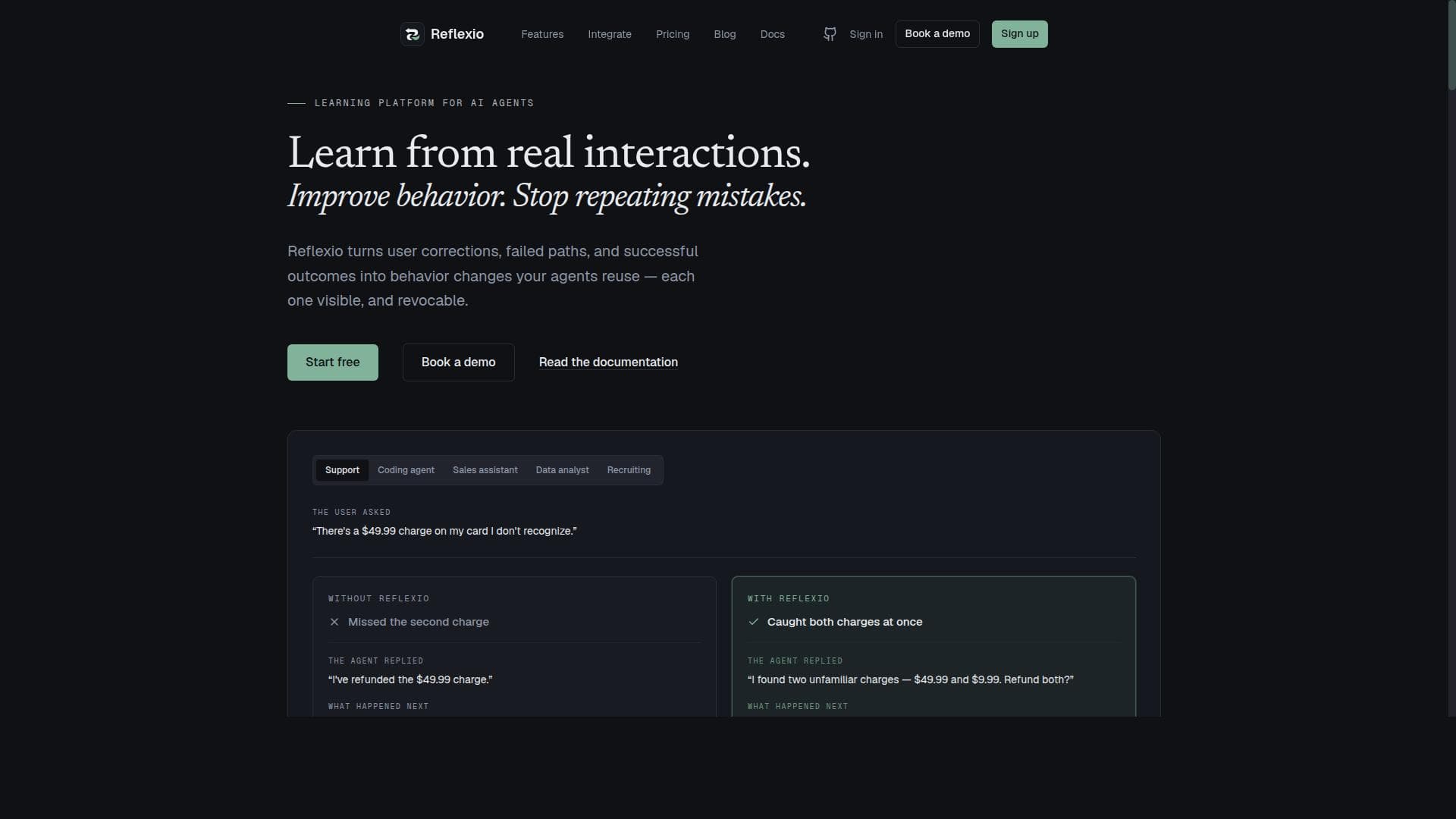
Reflexio revolutionizes AI agent development by enabling autonomous reflection, mistake correction, and continuous learning from user feedback. Ideal for developers and enterprises seeking self-improving AI systems, it transforms static agents into adaptive, transparent, and personalized assistants that evolve with every interaction.

描述
Reflexio makes AI agents better with every interaction. When users correct an agent, a path fails, or something works particularly well, Reflexio turns that experience into behavior the agent can reuse next time. Instead of leaving valuable lessons buried in logs, your agent continuously learns what to repeat and what to avoid — with every learning visible, testable, and reversible. Reduce task failure rate by more than 30%, while saving tokens by more than 60%.
详细描述
Reflexio is an innovative learning platform specifically designed to transform static AI agents into dynamic, self-improving systems. Its core purpose is to enable AI agents to autonomously reflect on their interactions, identify and correct mistakes, and continuously learn new skills based on user feedback. This approach allows AI agents to evolve over time, improving their performance and adaptability without requiring constant manual intervention. Reflexio leverages advanced mechanisms such as agent memory and feedback loops to maintain a persistent learning process, making it a powerful tool for organizations and developers aiming to deploy intelligent, evolving AI agents. One of the standout features of Reflexio is its autonomous reflection capability. Unlike traditional AI agents that operate in a fixed manner, Reflexio’s agents actively analyze their past interactions to detect errors or suboptimal behaviors. This self-assessment enables them to make corrections independently, fostering a cycle of continuous improvement. Additionally, Reflexio integrates user feedback directly into the learning process, allowing agents to acquire new skills and adapt to user preferences seamlessly. This feedback loop is supported by robust agent memory, which stores interaction histories and learning outcomes to inform future decisions. Reflexio also offers LLM observability, providing transparency into the decision-making processes of large language models powering the agents. This feature is crucial for developers and users who require insight into how AI agents arrive at their conclusions, enhancing trust and facilitating debugging or optimization. Furthermore, the platform supports integration of user preferences, ensuring that AI agents can tailor their responses and actions to individual needs or organizational guidelines. The platform is best suited for AI developers, product teams, and enterprises looking to deploy intelligent agents that improve autonomously over time. Use cases include customer support bots that learn from interactions to provide better assistance, virtual assistants that adapt to user habits, and AI-driven automation tools that refine their workflows based on operational feedback. Reflexio’s continuous learning model reduces the need for frequent manual updates, making it ideal for scalable AI deployments where ongoing adaptation is critical. Regarding pricing, Reflexio’s website does not publicly disclose detailed plans, suggesting a tailored pricing model likely based on usage, scale, and feature requirements. Interested users are encouraged to contact Reflexio directly for customized quotes and potential trial options. Compared to alternatives, Reflexio stands out by focusing on autonomous agent self-improvement rather than static AI deployments. While many platforms offer AI agent creation, Reflexio’s emphasis on reflection, mistake correction, and continuous skill acquisition provides a unique value proposition. Its LLM observability and user preference integration further differentiate it by enhancing transparency and personalization. However, potential users should consider that Reflexio’s advanced capabilities may require a learning curve and integration effort, especially for teams new to autonomous AI systems. Notable limitations include the current lack of publicly available pricing details and potential dependency on the quality of user feedback for effective learning. Additionally, as a specialized platform, Reflexio may not be suitable for simple AI agent needs or projects with limited resources for integration and ongoing management. Prospective users should evaluate their technical capacity and project requirements to ensure alignment with Reflexio’s sophisticated learning framework. In summary, Reflexio offers a cutting-edge solution for evolving AI agents through autonomous reflection and continuous learning. Its rich feature set and focus on adaptability make it a compelling choice for organizations seeking intelligent, self-improving AI systems, while its pricing and complexity considerations warrant careful assessment prior to adoption.
工具功能
- Autonomous reflection on interactions
- Correction of mistakes by AI agents
- Learning new skills from user feedback
- Continuous learning and adaptation
- Agent memory and feedback loop
- LLM observability
- User preferences integration
描述
Reflexio revolutionizes AI agent development by enabling autonomous reflection, mistake correction, and continuous learning from user feedback. Ideal for developers and enterprises seeking self-improving AI systems, it transforms static agents into adaptive, transparent, and personalized assistants that evolve with every interaction.
Reflexio makes AI agents better with every interaction. When users correct an agent, a path fails, or something works particularly well, Reflexio turns that experience into behavior the agent can reuse next time. Instead of leaving valuable lessons buried in logs, your agent continuously learns what to repeat and what to avoid — with every learning visible, testable, and reversible. Reduce task failure rate by more than 30%, while saving tokens by more than 60%.
详细描述
Reflexio is an innovative learning platform specifically designed to transform static AI agents into dynamic, self-improving systems. Its core purpose is to enable AI agents to autonomously reflect on their interactions, identify and correct mistakes, and continuously learn new skills based on user feedback. This approach allows AI agents to evolve over time, improving their performance and adaptability without requiring constant manual intervention. Reflexio leverages advanced mechanisms such as agent memory and feedback loops to maintain a persistent learning process, making it a powerful tool for organizations and developers aiming to deploy intelligent, evolving AI agents. One of the standout features of Reflexio is its autonomous reflection capability. Unlike traditional AI agents that operate in a fixed manner, Reflexio’s agents actively analyze their past interactions to detect errors or suboptimal behaviors. This self-assessment enables them to make corrections independently, fostering a cycle of continuous improvement. Additionally, Reflexio integrates user feedback directly into the learning process, allowing agents to acquire new skills and adapt to user preferences seamlessly. This feedback loop is supported by robust agent memory, which stores interaction histories and learning outcomes to inform future decisions. Reflexio also offers LLM observability, providing transparency into the decision-making processes of large language models powering the agents. This feature is crucial for developers and users who require insight into how AI agents arrive at their conclusions, enhancing trust and facilitating debugging or optimization. Furthermore, the platform supports integration of user preferences, ensuring that AI agents can tailor their responses and actions to individual needs or organizational guidelines. The platform is best suited for AI developers, product teams, and enterprises looking to deploy intelligent agents that improve autonomously over time. Use cases include customer support bots that learn from interactions to provide better assistance, virtual assistants that adapt to user habits, and AI-driven automation tools that refine their workflows based on operational feedback. Reflexio’s continuous learning model reduces the need for frequent manual updates, making it ideal for scalable AI deployments where ongoing adaptation is critical. Regarding pricing, Reflexio’s website does not publicly disclose detailed plans, suggesting a tailored pricing model likely based on usage, scale, and feature requirements. Interested users are encouraged to contact Reflexio directly for customized quotes and potential trial options. Compared to alternatives, Reflexio stands out by focusing on autonomous agent self-improvement rather than static AI deployments. While many platforms offer AI agent creation, Reflexio’s emphasis on reflection, mistake correction, and continuous skill acquisition provides a unique value proposition. Its LLM observability and user preference integration further differentiate it by enhancing transparency and personalization. However, potential users should consider that Reflexio’s advanced capabilities may require a learning curve and integration effort, especially for teams new to autonomous AI systems. Notable limitations include the current lack of publicly available pricing details and potential dependency on the quality of user feedback for effective learning. Additionally, as a specialized platform, Reflexio may not be suitable for simple AI agent needs or projects with limited resources for integration and ongoing management. Prospective users should evaluate their technical capacity and project requirements to ensure alignment with Reflexio’s sophisticated learning framework. In summary, Reflexio offers a cutting-edge solution for evolving AI agents through autonomous reflection and continuous learning. Its rich feature set and focus on adaptability make it a compelling choice for organizations seeking intelligent, self-improving AI systems, while its pricing and complexity considerations warrant careful assessment prior to adoption.
常见问题
What is Reflexio?
Reflexio is a learning platform designed to transform static AI agents into self-improving systems by enabling them to autonomously reflect on interactions, correct mistakes, and learn new skills from user feedback.
How much does Reflexio cost?
Reflexio does not publicly list pricing details on its website. Pricing is likely customized based on usage and feature requirements. Interested users should contact Reflexio directly for specific pricing information.
Who is Reflexio best for?
Reflexio is best suited for AI developers, product teams, and enterprises looking to deploy intelligent agents that continuously improve and adapt over time, such as customer support bots, virtual assistants, and AI-driven automation tools.
What are the main features of Reflexio?
Key features include autonomous reflection on interactions, correction of AI agent mistakes, learning new skills from user feedback, continuous learning and adaptation, agent memory and feedback loops, LLM observability, and integration of user preferences.
Does Reflexio offer a free trial?
There is no explicit mention of a free trial on Reflexio’s website. Prospective users should contact the Reflexio team directly to inquire about trial options or demos.
What integrations does Reflexio support?
While specific integrations are not detailed publicly, Reflexio supports integration of user preferences and is designed to work with large language models, suggesting compatibility with common AI and data platforms. For detailed integration capabilities, contacting Reflexio is recommended.
How does Reflexio work?
Reflexio works by enabling AI agents to autonomously reflect on their past interactions, identify and correct mistakes, and incorporate user feedback to learn new skills. This continuous feedback loop, supported by agent memory and LLM observability, allows agents to improve and adapt over time without manual reprogramming.
社交媒体
使用工具评价
暂无评价。成为第一个分享使用体验的人。