🚀 Zaprep: Your Socials on Steroids. 免费开始 — 每月自动发送 1,000 条私信,将互动转化为潜在客户。 ,每月 1,000 条自动私信。


这是您的 AI 工具吗?立即认领。
验证所有权、管理资料,并解锁增长功能。
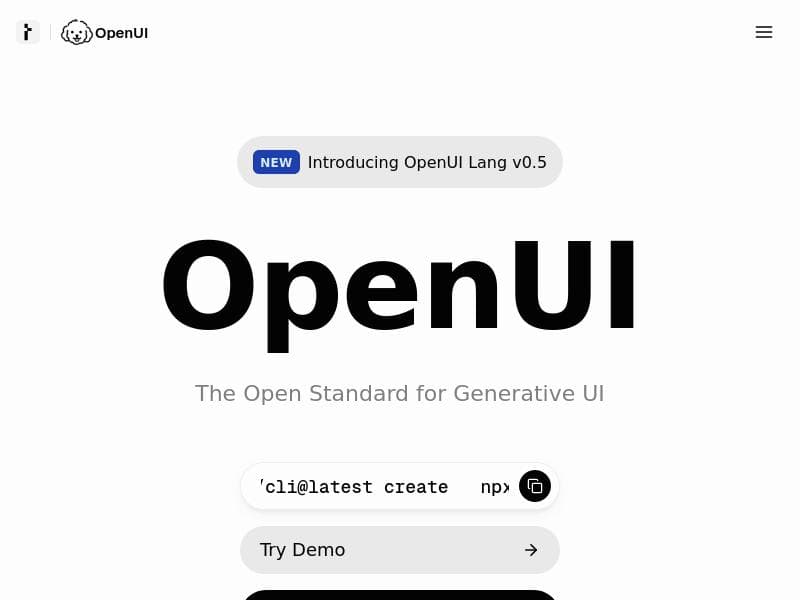
OpenUI is a cutting-edge open standard that enables AI applications to generate interactive UI components like cards, tables, and charts instead of plain text, dramatically enhancing user engagement. Ideal for developers building conversational agents and dashboards, it offers token-efficient streaming, a React runtime, and broad AI model compatibility—all for free.

描述
The Open Standard for Generative UIMake your AI apps respond with interactive UI components like cards, tables, forms and charts instead of text. Streaming-native, token-efficient, and works with any AI model (GPT,Claude,M2.5) and agent framework like ai-sdk, Google ADK
详细描述
OpenUI is an innovative open standard designed to revolutionize the way AI applications generate user interfaces. Unlike traditional AI models that primarily respond with plain text, OpenUI enables developers to create AI apps that respond with rich, interactive UI components such as cards, tables, forms, and charts. This approach transforms the user experience by making AI outputs more dynamic, engaging, and actionable. The core purpose of OpenUI is to bridge the gap between AI-generated content and user interface elements, allowing seamless integration of AI responses directly into functional UI components. This makes it ideal for building conversational agents, dashboards, and interactive applications that require more than just textual responses. One of the standout features of OpenUI is its compact, streaming-first language designed specifically for UI generation. This language is optimized for token efficiency, using up to 67% fewer tokens than traditional JSON formats, which is crucial for reducing latency and cost when working with large language models. OpenUI also includes a React runtime with built-in components, enabling developers to render AI-generated UI elements natively within React applications. Additionally, it offers ready-to-use chat interfaces that can be easily integrated into existing projects, accelerating development time. OpenUI is streaming-native, meaning it supports real-time UI updates as the AI generates content, enhancing the responsiveness and interactivity of applications. It is compatible with any AI model, including popular ones like GPT, Claude, and M2.5, and supports integration with agent frameworks such as ai-sdk and Google ADK, providing flexibility across different AI ecosystems. OpenUI is best suited for developers, product teams, and AI practitioners who want to build sophisticated AI-powered applications with interactive user interfaces. It is particularly valuable for use cases involving conversational AI, customer support bots, data visualization dashboards, and any scenario where users benefit from interactive elements rather than static text. For example, a customer service chatbot can use OpenUI to present users with forms to fill out, tables summarizing account information, or charts illustrating usage data, all generated dynamically by the AI. This capability enhances user engagement and streamlines workflows by embedding actionable UI components directly within AI responses. Regarding pricing, OpenUI is offered for free, making it accessible to developers and organizations of all sizes. This free access encourages experimentation and adoption without upfront costs, fostering a community around the open standard. The open nature of the project also means it can be extended and customized to fit specific needs, providing long-term flexibility. When compared to alternative approaches, OpenUI stands out due to its token efficiency and streaming-first design. Traditional methods often rely on verbose JSON structures that increase token usage and latency, whereas OpenUI’s compact language minimizes these issues. Its built-in React runtime and ready-made chat interfaces reduce the complexity of integrating AI-generated UI components, unlike other solutions that require extensive manual UI coding. Furthermore, its compatibility with multiple AI models and agent frameworks offers greater versatility than tools tied to a single AI provider. However, there are some considerations to keep in mind. As an open standard still evolving, OpenUI may have limitations in terms of ecosystem maturity and third-party tooling compared to more established proprietary platforms. Developers may need to invest time in learning the streaming-first language and adapting their workflows. Additionally, while the React runtime is powerful, it may not cover all UI frameworks, potentially requiring additional integration work for non-React environments. Despite these factors, OpenUI’s benefits in creating interactive, token-efficient AI interfaces make it a compelling choice for forward-thinking AI developers.
工具功能
- Compact streaming-first language
- React runtime with built-in components
- Ready-to-use chat interfaces
- Uses up to 67% fewer tokens than JSON
描述
OpenUI is a cutting-edge open standard that enables AI applications to generate interactive UI components like cards, tables, and charts instead of plain text, dramatically enhancing user engagement. Ideal for developers building conversational agents and dashboards, it offers token-efficient streaming, a React runtime, and broad AI model compatibility—all for free.
The Open Standard for Generative UIMake your AI apps respond with interactive UI components like cards, tables, forms and charts instead of text. Streaming-native, token-efficient, and works with any AI model (GPT,Claude,M2.5) and agent framework like ai-sdk, Google ADK
详细描述
OpenUI is an innovative open standard designed to revolutionize the way AI applications generate user interfaces. Unlike traditional AI models that primarily respond with plain text, OpenUI enables developers to create AI apps that respond with rich, interactive UI components such as cards, tables, forms, and charts. This approach transforms the user experience by making AI outputs more dynamic, engaging, and actionable. The core purpose of OpenUI is to bridge the gap between AI-generated content and user interface elements, allowing seamless integration of AI responses directly into functional UI components. This makes it ideal for building conversational agents, dashboards, and interactive applications that require more than just textual responses. One of the standout features of OpenUI is its compact, streaming-first language designed specifically for UI generation. This language is optimized for token efficiency, using up to 67% fewer tokens than traditional JSON formats, which is crucial for reducing latency and cost when working with large language models. OpenUI also includes a React runtime with built-in components, enabling developers to render AI-generated UI elements natively within React applications. Additionally, it offers ready-to-use chat interfaces that can be easily integrated into existing projects, accelerating development time. OpenUI is streaming-native, meaning it supports real-time UI updates as the AI generates content, enhancing the responsiveness and interactivity of applications. It is compatible with any AI model, including popular ones like GPT, Claude, and M2.5, and supports integration with agent frameworks such as ai-sdk and Google ADK, providing flexibility across different AI ecosystems. OpenUI is best suited for developers, product teams, and AI practitioners who want to build sophisticated AI-powered applications with interactive user interfaces. It is particularly valuable for use cases involving conversational AI, customer support bots, data visualization dashboards, and any scenario where users benefit from interactive elements rather than static text. For example, a customer service chatbot can use OpenUI to present users with forms to fill out, tables summarizing account information, or charts illustrating usage data, all generated dynamically by the AI. This capability enhances user engagement and streamlines workflows by embedding actionable UI components directly within AI responses. Regarding pricing, OpenUI is offered for free, making it accessible to developers and organizations of all sizes. This free access encourages experimentation and adoption without upfront costs, fostering a community around the open standard. The open nature of the project also means it can be extended and customized to fit specific needs, providing long-term flexibility. When compared to alternative approaches, OpenUI stands out due to its token efficiency and streaming-first design. Traditional methods often rely on verbose JSON structures that increase token usage and latency, whereas OpenUI’s compact language minimizes these issues. Its built-in React runtime and ready-made chat interfaces reduce the complexity of integrating AI-generated UI components, unlike other solutions that require extensive manual UI coding. Furthermore, its compatibility with multiple AI models and agent frameworks offers greater versatility than tools tied to a single AI provider. However, there are some considerations to keep in mind. As an open standard still evolving, OpenUI may have limitations in terms of ecosystem maturity and third-party tooling compared to more established proprietary platforms. Developers may need to invest time in learning the streaming-first language and adapting their workflows. Additionally, while the React runtime is powerful, it may not cover all UI frameworks, potentially requiring additional integration work for non-React environments. Despite these factors, OpenUI’s benefits in creating interactive, token-efficient AI interfaces make it a compelling choice for forward-thinking AI developers.
常见问题
What is OpenUI?
OpenUI is an open standard designed to enable AI applications to generate interactive user interface components such as cards, tables, forms, and charts, rather than just plain text. It facilitates streaming-native, token-efficient UI generation compatible with various AI models and frameworks.
How much does OpenUI cost?
OpenUI is available for free, allowing developers and organizations to use its features without any upfront costs.
Who is OpenUI best for?
OpenUI is best suited for developers, product teams, and AI practitioners who want to build AI-powered applications with rich, interactive user interfaces, including conversational agents, customer support bots, and data visualization dashboards.
What are the main features of OpenUI?
Key features include a compact streaming-first language optimized for token efficiency, a React runtime with built-in UI components, ready-to-use chat interfaces, streaming-native capabilities for real-time UI updates, and compatibility with multiple AI models and agent frameworks.
Does OpenUI offer a free trial?
OpenUI is completely free to use, so there is no need for a separate free trial.
What integrations does OpenUI support?
OpenUI supports integration with any AI model such as GPT, Claude, and M2.5, as well as agent frameworks like ai-sdk and Google ADK, providing flexibility across various AI ecosystems.
How does OpenUI work?
OpenUI works by using a compact, streaming-first language to generate UI components that are rendered via a React runtime. It streams AI-generated UI elements in real time, enabling interactive and token-efficient user interfaces that can be integrated with various AI models and frameworks.
社交媒体
使用工具评价
暂无评价。成为第一个分享使用体验的人。
赞助工具






















推荐工具
及时了解最新 AI 工具
获取最新资讯,订阅我们的新闻通讯
已有 50,000+ 位读者阅读并信赖
加入最大的 AI 社区
我们的社区和团队随时为您提供帮助!
您的反馈将帮助 Alice AI 在未来版本中不断改进。