OpenAI Open Models


这是您的 AI 工具吗?立即认领。
验证所有权、管理资料,并解锁增长功能。
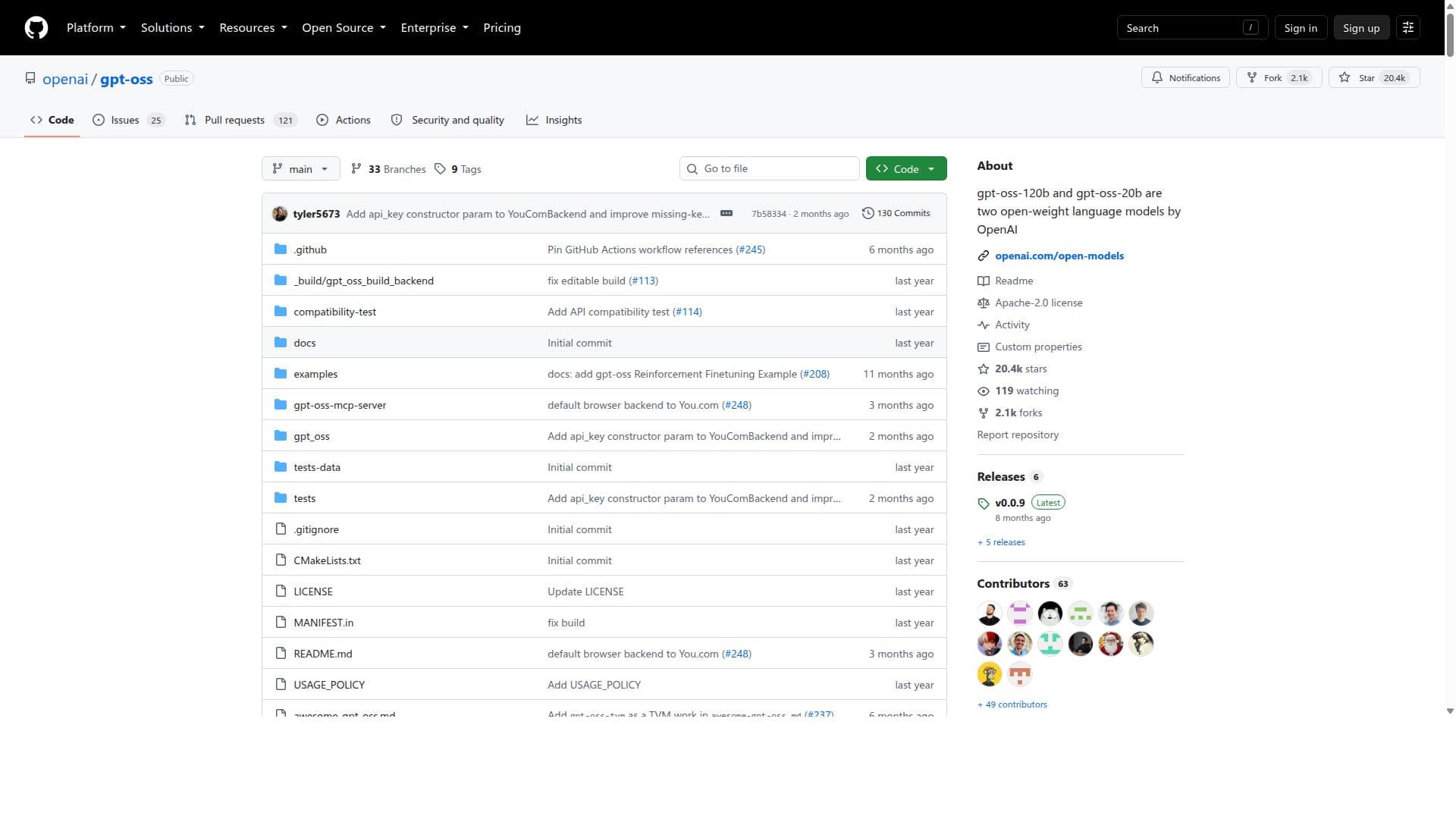
gpt-oss offers open-weight large language models from OpenAI, providing unparalleled transparency and flexibility for researchers and developers. With two powerful model sizes available on GitHub, it enables advanced NLP experimentation and custom application development without the constraints of proprietary systems.

描述
Apache 2.0 licensed open-weight models designed for powerful reasoning, agentic tasks, and versatile developer use cases.
详细描述
gpt-oss is an open-weight language model project developed by OpenAI, designed to provide researchers, developers, and AI enthusiasts with accessible, large-scale language models for experimentation and application development. The project features two distinct model sizes: gpt-oss-120b, with 120 billion parameters, and gpt-oss-20b, with 20 billion parameters. These models are made openly available on GitHub, allowing users to download, inspect, and integrate them into their own natural language processing (NLP) workflows without the restrictions typically associated with proprietary AI models. The core purpose of gpt-oss is to democratize access to powerful language models, fostering innovation and research in the AI community by providing high-capacity models that can be fine-tuned or used as-is for various NLP tasks. Key features of gpt-oss include its open-weight architecture, which means that the full model weights are publicly accessible, enabling complete transparency and flexibility for users. The availability of two model sizes caters to different computational capabilities and project requirements: the 120 billion parameter model offers state-of-the-art performance suitable for complex language understanding and generation tasks, while the 20 billion parameter model provides a more resource-efficient alternative that still delivers strong NLP capabilities. Being hosted on GitHub, gpt-oss benefits from version control, community contributions, and easy integration with existing development pipelines. The models support a wide range of NLP applications such as text generation, summarization, translation, question answering, and more, making them versatile tools for both academic research and commercial product development. gpt-oss is best suited for AI researchers, data scientists, and developers who require access to large-scale language models without the constraints of closed-source systems. It is particularly valuable for those who want to experiment with model architectures, conduct fine-tuning on domain-specific data, or build custom NLP applications that demand high performance and flexibility. Use cases include developing chatbots, creating content generation tools, performing advanced text analytics, and exploring novel AI research directions. The open nature of gpt-oss also makes it ideal for educational purposes, enabling students and educators to study and understand large language models in depth. Regarding pricing, gpt-oss is freely available as an open-source project on GitHub. There are no direct costs associated with accessing or using the models themselves. However, users should consider the computational resources required to run these large models, which can be significant, especially for the 120 billion parameter variant. Costs related to cloud compute, GPUs, or specialized hardware for inference and training will depend on the user's infrastructure choices. Compared to proprietary language models offered by commercial AI providers, gpt-oss stands out by offering full transparency and control over the model weights and architecture. While commercial models often provide user-friendly APIs and managed services, they typically restrict access to the underlying model and may involve usage fees. gpt-oss empowers users to deploy and modify the models according to their needs, though this requires more technical expertise and infrastructure. It is a strong alternative for organizations and individuals prioritizing openness, customization, and research freedom. Notable limitations of gpt-oss include the high computational demands for running and fine-tuning the models, which may be prohibitive for users without access to powerful hardware. Additionally, as an open-source project, ongoing maintenance, updates, and support rely heavily on community contributions and OpenAI's commitment to the repository. Users should also be aware that while the models are powerful, they may require significant effort to optimize for specific tasks and to ensure ethical and responsible use. Documentation and user support might not be as comprehensive as commercial offerings, so a degree of AI and machine learning expertise is recommended to leverage gpt-oss effectively.
工具功能
- Open-weight language models
- Two model sizes: 120 billion and 20 billion parameters
- Available on GitHub for open access
- Supports research and development in natural language processing
- Enables experimentation with large-scale language models
描述
gpt-oss offers open-weight large language models from OpenAI, providing unparalleled transparency and flexibility for researchers and developers. With two powerful model sizes available on GitHub, it enables advanced NLP experimentation and custom application development without the constraints of proprietary systems.
Apache 2.0 licensed open-weight models designed for powerful reasoning, agentic tasks, and versatile developer use cases.
详细描述
gpt-oss is an open-weight language model project developed by OpenAI, designed to provide researchers, developers, and AI enthusiasts with accessible, large-scale language models for experimentation and application development. The project features two distinct model sizes: gpt-oss-120b, with 120 billion parameters, and gpt-oss-20b, with 20 billion parameters. These models are made openly available on GitHub, allowing users to download, inspect, and integrate them into their own natural language processing (NLP) workflows without the restrictions typically associated with proprietary AI models. The core purpose of gpt-oss is to democratize access to powerful language models, fostering innovation and research in the AI community by providing high-capacity models that can be fine-tuned or used as-is for various NLP tasks. Key features of gpt-oss include its open-weight architecture, which means that the full model weights are publicly accessible, enabling complete transparency and flexibility for users. The availability of two model sizes caters to different computational capabilities and project requirements: the 120 billion parameter model offers state-of-the-art performance suitable for complex language understanding and generation tasks, while the 20 billion parameter model provides a more resource-efficient alternative that still delivers strong NLP capabilities. Being hosted on GitHub, gpt-oss benefits from version control, community contributions, and easy integration with existing development pipelines. The models support a wide range of NLP applications such as text generation, summarization, translation, question answering, and more, making them versatile tools for both academic research and commercial product development. gpt-oss is best suited for AI researchers, data scientists, and developers who require access to large-scale language models without the constraints of closed-source systems. It is particularly valuable for those who want to experiment with model architectures, conduct fine-tuning on domain-specific data, or build custom NLP applications that demand high performance and flexibility. Use cases include developing chatbots, creating content generation tools, performing advanced text analytics, and exploring novel AI research directions. The open nature of gpt-oss also makes it ideal for educational purposes, enabling students and educators to study and understand large language models in depth. Regarding pricing, gpt-oss is freely available as an open-source project on GitHub. There are no direct costs associated with accessing or using the models themselves. However, users should consider the computational resources required to run these large models, which can be significant, especially for the 120 billion parameter variant. Costs related to cloud compute, GPUs, or specialized hardware for inference and training will depend on the user's infrastructure choices. Compared to proprietary language models offered by commercial AI providers, gpt-oss stands out by offering full transparency and control over the model weights and architecture. While commercial models often provide user-friendly APIs and managed services, they typically restrict access to the underlying model and may involve usage fees. gpt-oss empowers users to deploy and modify the models according to their needs, though this requires more technical expertise and infrastructure. It is a strong alternative for organizations and individuals prioritizing openness, customization, and research freedom. Notable limitations of gpt-oss include the high computational demands for running and fine-tuning the models, which may be prohibitive for users without access to powerful hardware. Additionally, as an open-source project, ongoing maintenance, updates, and support rely heavily on community contributions and OpenAI's commitment to the repository. Users should also be aware that while the models are powerful, they may require significant effort to optimize for specific tasks and to ensure ethical and responsible use. Documentation and user support might not be as comprehensive as commercial offerings, so a degree of AI and machine learning expertise is recommended to leverage gpt-oss effectively.
常见问题
What is gpt-oss?
gpt-oss is an open-source project by OpenAI that provides two large-scale open-weight language models, gpt-oss-120b and gpt-oss-20b, available on GitHub for research and development in natural language processing.
How much does gpt-oss cost?
gpt-oss is free to access and use as it is an open-source project. However, users need to consider the costs of the computational resources required to run and fine-tune the models.
Who is gpt-oss best for?
It is best suited for AI researchers, developers, and data scientists who want open access to powerful language models for experimentation, fine-tuning, and building custom NLP applications.
What are the main features of gpt-oss?
The main features include open-weight models, two sizes (120 billion and 20 billion parameters), availability on GitHub, support for a wide range of NLP tasks, and suitability for research and development.
Does gpt-oss offer a free trial?
Since gpt-oss is open-source and freely available on GitHub, there is no need for a free trial; users can download and use the models directly.
What integrations does gpt-oss support?
gpt-oss can be integrated into various NLP pipelines and applications through custom code. Being open-source, it supports flexible integration with frameworks and tools preferred by developers.
How does gpt-oss work?
gpt-oss provides pre-trained large language models with open weights that users can download and run locally or on cloud infrastructure, enabling them to perform tasks like text generation, summarization, and more.
社交媒体
使用工具评价
暂无评价。成为第一个分享使用体验的人。