🚀 Zaprep: Your Socials on Steroids. 免费开始 — 每月自动发送 1,000 条私信,将互动转化为潜在客户。 ,每月 1,000 条自动私信。


这是您的 AI 工具吗?立即认领。
验证所有权、管理资料,并解锁增长功能。
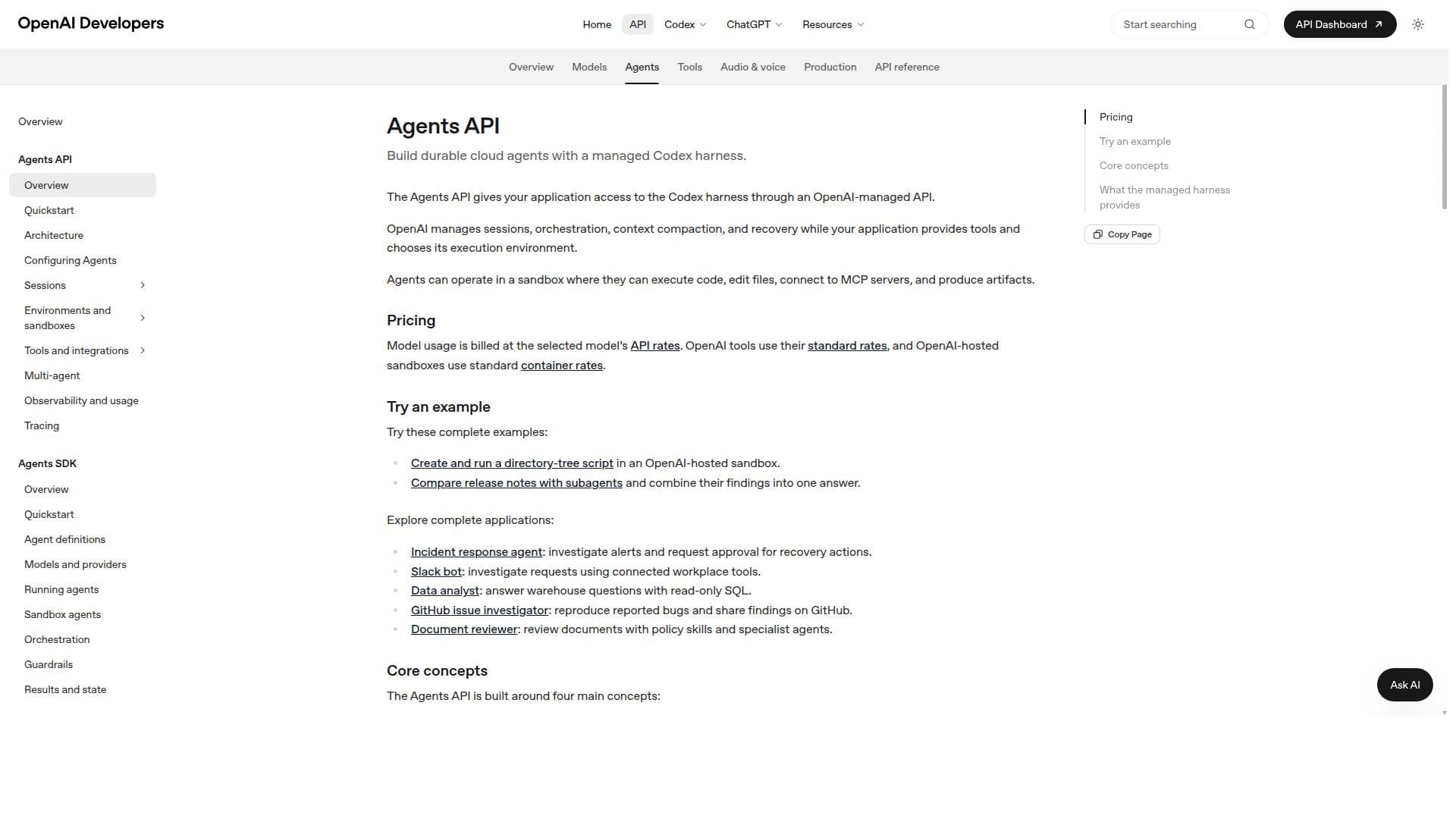
Agents API by OpenAI empowers developers to create durable, autonomous cloud agents using a managed Codex harness, enabling intelligent task execution and seamless system interaction. Ideal for automating complex workflows, it combines AI-driven code generation with persistent agent capabilities to deliver flexible, scalable automation solutions.

描述
OpenAI's managed version of the Codex harness to build cloud agents with one API call instead of your own orchestration. Handles long sessions, smart tool use, and subagents working in parallel. Runs on OpenAI or partner sandboxes. No extra fees beyond token and tool usage. Open source harness, public beta now.
详细描述
The Agents API by OpenAI is a powerful platform designed to enable developers to build durable, intelligent cloud agents that operate autonomously. At its core, the API provides a managed Codex harness, which is a specialized environment that leverages OpenAI's Codex models to interpret and execute code-based instructions. This allows developers to create agents capable of performing complex tasks without continuous human intervention, making it ideal for automating workflows and integrating AI-driven decision-making into cloud applications. The API is designed to facilitate programmatic interaction with various systems, enabling agents to communicate, manipulate data, and trigger actions across different platforms seamlessly. One of the standout features of the Agents API is its durability. Unlike transient scripts or ephemeral bots, agents built with this API are persistent and can maintain state over time, allowing for long-running processes and continuous task execution. The managed Codex harness abstracts away much of the complexity involved in running and scaling AI-powered agents, providing a robust infrastructure that handles execution, monitoring, and error recovery. This ensures that agents remain reliable and responsive even under varying workloads. The API supports autonomous task execution, meaning agents can independently decide the sequence of actions needed to complete a given objective. This capability is enhanced by Codex's deep understanding of programming languages and logical workflows, enabling agents to generate, modify, and execute code dynamically. Additionally, the API offers tools for programmatic system interaction, allowing agents to interface with APIs, databases, and other services to gather information, perform transactions, or trigger external processes. Agents API is particularly well-suited for developers and organizations looking to automate complex, multi-step workflows that require adaptability and persistence. Use cases include automating customer support tasks, managing cloud infrastructure, orchestrating data pipelines, and building intelligent assistants that can operate independently within enterprise environments. Its ability to maintain context and state over time makes it valuable for scenarios where ongoing monitoring and iterative problem-solving are required. Regarding pricing and plans, OpenAI typically offers tiered pricing models based on usage, including the number of API calls, compute time, or agent instances deployed. While specific pricing details for the Agents API can be found on the official OpenAI developers site, it is common for such services to include a free tier or trial period to allow developers to experiment before committing to paid plans. Enterprise options may also be available for large-scale deployments requiring dedicated support and custom SLAs. Compared to alternatives, the Agents API stands out due to its integration with OpenAI's Codex, which provides a sophisticated understanding of code and logic, enabling more intelligent and flexible agent behavior. Many other automation or agent platforms rely on predefined scripts or rule-based systems, whereas the Agents API leverages AI to dynamically generate and adapt code, offering greater versatility. However, this also means that users need some familiarity with programming concepts and API integration to fully harness its capabilities. Notable limitations include the potential complexity of designing autonomous agents that behave as intended, which may require iterative development and testing. Additionally, as with any AI-driven system, there are considerations around reliability, security, and ethical use, especially when agents interact with sensitive data or critical systems. Developers should also be mindful of API usage costs and monitor agent performance to avoid unexpected expenses. Overall, the Agents API offers a cutting-edge solution for building intelligent, durable cloud agents but requires thoughtful implementation to maximize its benefits.
工具功能
- Build durable cloud agents
- Managed Codex harness
- Autonomous task execution
- Programmatic system interaction
描述
Agents API by OpenAI empowers developers to create durable, autonomous cloud agents using a managed Codex harness, enabling intelligent task execution and seamless system interaction. Ideal for automating complex workflows, it combines AI-driven code generation with persistent agent capabilities to deliver flexible, scalable automation solutions.
OpenAI's managed version of the Codex harness to build cloud agents with one API call instead of your own orchestration. Handles long sessions, smart tool use, and subagents working in parallel. Runs on OpenAI or partner sandboxes. No extra fees beyond token and tool usage. Open source harness, public beta now.
详细描述
The Agents API by OpenAI is a powerful platform designed to enable developers to build durable, intelligent cloud agents that operate autonomously. At its core, the API provides a managed Codex harness, which is a specialized environment that leverages OpenAI's Codex models to interpret and execute code-based instructions. This allows developers to create agents capable of performing complex tasks without continuous human intervention, making it ideal for automating workflows and integrating AI-driven decision-making into cloud applications. The API is designed to facilitate programmatic interaction with various systems, enabling agents to communicate, manipulate data, and trigger actions across different platforms seamlessly. One of the standout features of the Agents API is its durability. Unlike transient scripts or ephemeral bots, agents built with this API are persistent and can maintain state over time, allowing for long-running processes and continuous task execution. The managed Codex harness abstracts away much of the complexity involved in running and scaling AI-powered agents, providing a robust infrastructure that handles execution, monitoring, and error recovery. This ensures that agents remain reliable and responsive even under varying workloads. The API supports autonomous task execution, meaning agents can independently decide the sequence of actions needed to complete a given objective. This capability is enhanced by Codex's deep understanding of programming languages and logical workflows, enabling agents to generate, modify, and execute code dynamically. Additionally, the API offers tools for programmatic system interaction, allowing agents to interface with APIs, databases, and other services to gather information, perform transactions, or trigger external processes. Agents API is particularly well-suited for developers and organizations looking to automate complex, multi-step workflows that require adaptability and persistence. Use cases include automating customer support tasks, managing cloud infrastructure, orchestrating data pipelines, and building intelligent assistants that can operate independently within enterprise environments. Its ability to maintain context and state over time makes it valuable for scenarios where ongoing monitoring and iterative problem-solving are required. Regarding pricing and plans, OpenAI typically offers tiered pricing models based on usage, including the number of API calls, compute time, or agent instances deployed. While specific pricing details for the Agents API can be found on the official OpenAI developers site, it is common for such services to include a free tier or trial period to allow developers to experiment before committing to paid plans. Enterprise options may also be available for large-scale deployments requiring dedicated support and custom SLAs. Compared to alternatives, the Agents API stands out due to its integration with OpenAI's Codex, which provides a sophisticated understanding of code and logic, enabling more intelligent and flexible agent behavior. Many other automation or agent platforms rely on predefined scripts or rule-based systems, whereas the Agents API leverages AI to dynamically generate and adapt code, offering greater versatility. However, this also means that users need some familiarity with programming concepts and API integration to fully harness its capabilities. Notable limitations include the potential complexity of designing autonomous agents that behave as intended, which may require iterative development and testing. Additionally, as with any AI-driven system, there are considerations around reliability, security, and ethical use, especially when agents interact with sensitive data or critical systems. Developers should also be mindful of API usage costs and monitor agent performance to avoid unexpected expenses. Overall, the Agents API offers a cutting-edge solution for building intelligent, durable cloud agents but requires thoughtful implementation to maximize its benefits.
常见问题
What is Agents API?
Agents API is a platform by OpenAI that enables developers to build durable, autonomous cloud agents using a managed Codex harness. These agents can perform tasks independently, interact programmatically with various systems, and maintain state over time for long-running processes.
How much does Agents API cost?
Pricing for Agents API is usage-based and typically depends on factors such as the number of API calls, compute time, and agent instances. OpenAI provides detailed pricing information on their developers website, often including free tiers or trial periods for initial experimentation.
Who is Agents API best for?
Agents API is best suited for developers and organizations seeking to automate complex, multi-step workflows that require autonomous decision-making and persistence. It is ideal for building intelligent assistants, automating cloud infrastructure, managing data pipelines, and other scenarios needing durable AI agents.
What are the main features of Agents API?
Key features include the ability to build durable cloud agents, a managed Codex harness for AI-driven code execution, autonomous task execution capabilities, and programmatic interaction with external systems and APIs.
Does Agents API offer a free trial?
OpenAI typically offers free tiers or trial periods for its APIs, including the Agents API, allowing developers to test and build prototypes before committing to paid plans. Specific details can be found on the OpenAI developers website.
What integrations does Agents API support?
Agents API supports programmatic interaction with a wide range of systems via APIs, databases, and other services. Developers can integrate agents with cloud platforms, third-party APIs, and internal tools to automate workflows and data exchanges.
How does Agents API work?
Agents API works by providing a managed Codex environment where AI models interpret and execute code instructions autonomously. Developers define tasks and workflows, and the agents use Codex's programming understanding to perform actions, maintain state, and interact with external systems programmatically.
社交媒体
使用工具评价
暂无评价。成为第一个分享使用体验的人。
赞助工具



























推荐工具
及时了解最新 AI 工具
获取最新资讯,订阅我们的新闻通讯
已有 50,000+ 位读者阅读并信赖
加入最大的 AI 社区
我们的社区和团队随时为您提供帮助!
您的反馈将帮助 Alice AI 在未来版本中不断改进。