🚀 Zaprep: Your Socials on Steroids. 免费开始 — 每月自动发送 1,000 条私信,将互动转化为潜在客户。 ,每月 1,000 条自动私信。


这是您的 AI 工具吗?立即认领。
验证所有权、管理资料,并解锁增长功能。
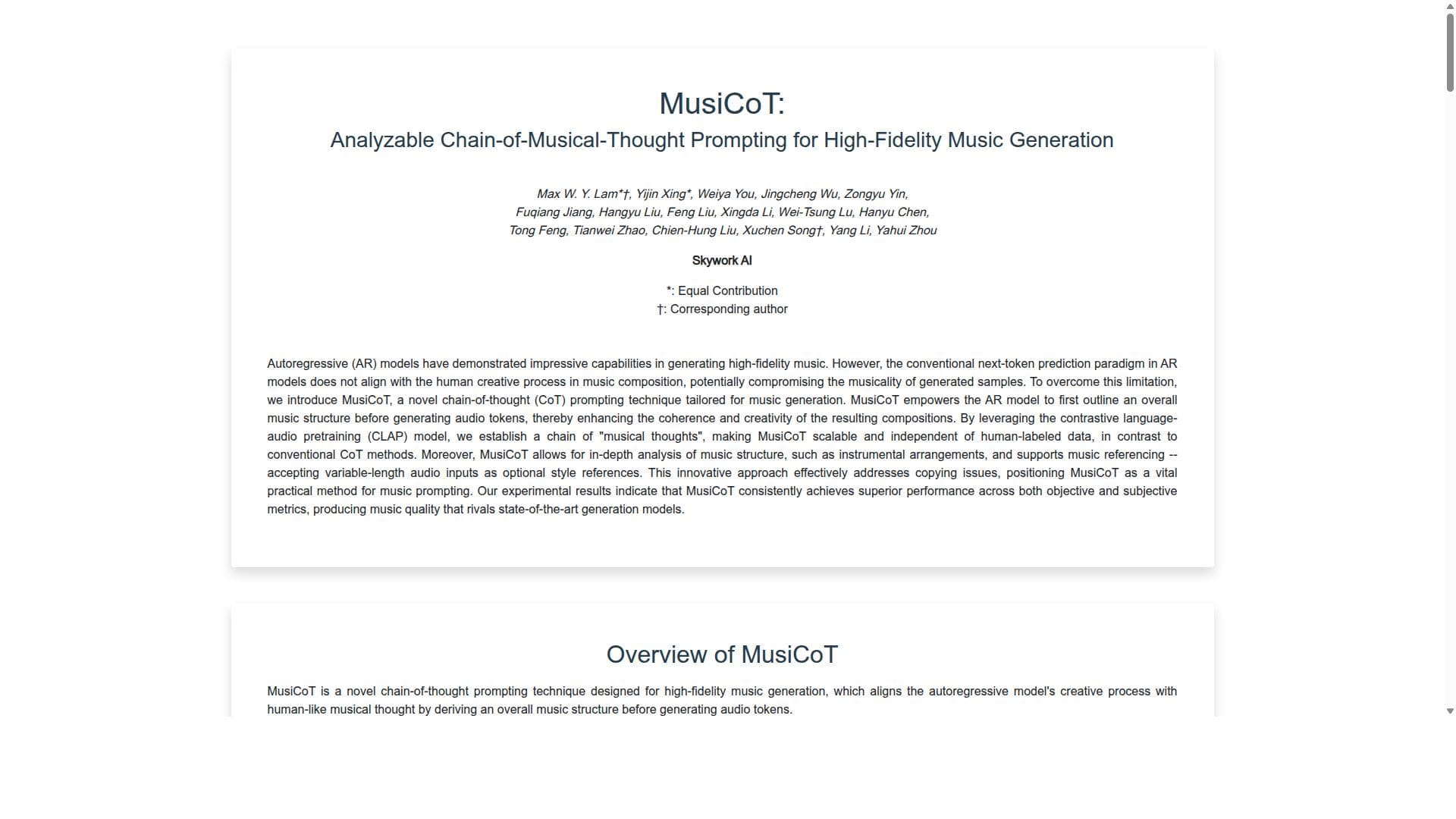
MusiCoT revolutionizes AI music generation by mimicking human compositional thought—first outlining music structure before generating audio—resulting in highly coherent and creative compositions. Ideal for composers and researchers seeking deep structural control and style referencing, MusiCoT outperforms traditional models by leveraging the CLAP model for superior musicality and analyzability.

描述
Meet Mureka O1, it uses Chain-of-Thought (CoT) for structured AI music, claiming superior quality to Suno. Offers 10 languages, voice cloning, API & unique model fine-tuning.
详细描述
MusiCoT is an advanced AI-driven music generation tool that introduces a novel chain-of-thought prompting technique specifically designed to produce high-fidelity music. Unlike traditional autoregressive (AR) models that generate music token-by-token without an overarching plan, MusiCoT aligns the model's creative process with human-like musical thinking. It achieves this by first outlining the overall music structure—such as instrumental arrangements and thematic progression—before generating the actual audio tokens. This structured approach enhances the coherence, creativity, and musicality of the generated compositions, addressing common issues like incoherence and repetitive copying seen in conventional music generation models. At its core, MusiCoT leverages the contrastive language-audio pretraining (CLAP) model, which enables it to understand and analyze music structure deeply. This integration allows MusiCoT to support music referencing by accepting variable-length audio inputs as style guides, enabling users to influence the generated music's style and arrangement effectively. Additionally, MusiCoT is scalable and does not rely on human-labeled data, making it a practical and efficient solution for generating diverse music styles without extensive manual annotation. Key features include its chain-of-thought prompting technique tailored for music, which mimics the human compositional process by first conceptualizing the music's structure. This leads to improved structural analyzability, allowing users and researchers to inspect and understand the instrumental and thematic layout of generated pieces. The music referencing capability is particularly powerful, enabling users to input style references of varying lengths to guide the generation process, thus producing music that aligns closely with desired genres or moods. MusiCoT's independence from human-labeled data and its scalability make it suitable for a wide range of applications, from research to commercial music production. MusiCoT is ideal for music producers, composers, researchers, and AI enthusiasts who seek a tool that not only generates high-quality music but also offers transparency and control over the compositional process. It is particularly useful for those interested in exploring AI-assisted music creation with a focus on structural coherence and creativity. Use cases include generating background scores, creating style-consistent music pieces, and experimenting with novel musical ideas without the need for extensive manual input. Regarding pricing, the available information does not specify commercial plans or subscription models, suggesting that MusiCoT may currently be offered primarily for research and demonstration purposes. Interested users should visit the official website for the latest updates on accessibility and licensing. Compared to other music generation models like YuE, Suno V4, Udio V1.5, and Mureka V5.5, MusiCoT stands out due to its unique chain-of-thought prompting approach and integration with CLAP. These innovations result in superior performance on both objective and subjective metrics, producing music that is more coherent, creative, and structurally analyzable. While many models focus solely on token prediction, MusiCoT’s emphasis on outlining musical structure first provides a significant qualitative advantage. However, potential users should consider that as a cutting-edge research tool, MusiCoT might have limitations in terms of user interface polish, commercial support, or integration with existing digital audio workstations (DAWs). Additionally, the reliance on autoregressive models means generation times and computational resource requirements may be higher compared to simpler models. Users should also note that detailed pricing and commercial availability are not clearly stated, which may affect adoption for commercial projects. In summary, MusiCoT represents a significant advancement in AI music generation by incorporating human-like compositional thinking and leveraging powerful pretrained models to produce high-quality, structurally coherent music. It is best suited for users who value creativity, structural insight, and the ability to guide music generation through referencing, making it a valuable tool for both research and creative music production.
工具功能
- Chain-of-thought prompting technique tailored for music generation
- Outlines overall music structure before generating audio tokens
- Leverages contrastive language-audio pretraining (CLAP) model
- Enables in-depth analysis of music structure such as instrumental arrangements
- Supports music referencing with variable-length audio inputs as style references
- Scalable and independent of human-labeled data
- Produces music quality rivaling state-of-the-art generation models
描述
MusiCoT revolutionizes AI music generation by mimicking human compositional thought—first outlining music structure before generating audio—resulting in highly coherent and creative compositions. Ideal for composers and researchers seeking deep structural control and style referencing, MusiCoT outperforms traditional models by leveraging the CLAP model for superior musicality and analyzability.
Meet Mureka O1, it uses Chain-of-Thought (CoT) for structured AI music, claiming superior quality to Suno. Offers 10 languages, voice cloning, API & unique model fine-tuning.
详细描述
MusiCoT is an advanced AI-driven music generation tool that introduces a novel chain-of-thought prompting technique specifically designed to produce high-fidelity music. Unlike traditional autoregressive (AR) models that generate music token-by-token without an overarching plan, MusiCoT aligns the model's creative process with human-like musical thinking. It achieves this by first outlining the overall music structure—such as instrumental arrangements and thematic progression—before generating the actual audio tokens. This structured approach enhances the coherence, creativity, and musicality of the generated compositions, addressing common issues like incoherence and repetitive copying seen in conventional music generation models. At its core, MusiCoT leverages the contrastive language-audio pretraining (CLAP) model, which enables it to understand and analyze music structure deeply. This integration allows MusiCoT to support music referencing by accepting variable-length audio inputs as style guides, enabling users to influence the generated music's style and arrangement effectively. Additionally, MusiCoT is scalable and does not rely on human-labeled data, making it a practical and efficient solution for generating diverse music styles without extensive manual annotation. Key features include its chain-of-thought prompting technique tailored for music, which mimics the human compositional process by first conceptualizing the music's structure. This leads to improved structural analyzability, allowing users and researchers to inspect and understand the instrumental and thematic layout of generated pieces. The music referencing capability is particularly powerful, enabling users to input style references of varying lengths to guide the generation process, thus producing music that aligns closely with desired genres or moods. MusiCoT's independence from human-labeled data and its scalability make it suitable for a wide range of applications, from research to commercial music production. MusiCoT is ideal for music producers, composers, researchers, and AI enthusiasts who seek a tool that not only generates high-quality music but also offers transparency and control over the compositional process. It is particularly useful for those interested in exploring AI-assisted music creation with a focus on structural coherence and creativity. Use cases include generating background scores, creating style-consistent music pieces, and experimenting with novel musical ideas without the need for extensive manual input. Regarding pricing, the available information does not specify commercial plans or subscription models, suggesting that MusiCoT may currently be offered primarily for research and demonstration purposes. Interested users should visit the official website for the latest updates on accessibility and licensing. Compared to other music generation models like YuE, Suno V4, Udio V1.5, and Mureka V5.5, MusiCoT stands out due to its unique chain-of-thought prompting approach and integration with CLAP. These innovations result in superior performance on both objective and subjective metrics, producing music that is more coherent, creative, and structurally analyzable. While many models focus solely on token prediction, MusiCoT’s emphasis on outlining musical structure first provides a significant qualitative advantage. However, potential users should consider that as a cutting-edge research tool, MusiCoT might have limitations in terms of user interface polish, commercial support, or integration with existing digital audio workstations (DAWs). Additionally, the reliance on autoregressive models means generation times and computational resource requirements may be higher compared to simpler models. Users should also note that detailed pricing and commercial availability are not clearly stated, which may affect adoption for commercial projects. In summary, MusiCoT represents a significant advancement in AI music generation by incorporating human-like compositional thinking and leveraging powerful pretrained models to produce high-quality, structurally coherent music. It is best suited for users who value creativity, structural insight, and the ability to guide music generation through referencing, making it a valuable tool for both research and creative music production.
常见问题
What is MusiCoT?
MusiCoT is an AI music generation tool that uses a novel chain-of-thought prompting technique to first outline the overall music structure before generating audio tokens, producing high-fidelity, coherent, and creative music.
How much does MusiCoT cost?
Currently, there is no publicly available information regarding MusiCoT's pricing or subscription plans. It appears to be offered primarily for research and demonstration purposes.
Who is MusiCoT best for?
MusiCoT is best suited for music producers, composers, AI researchers, and enthusiasts who want to generate high-quality music with structural coherence and have the ability to guide style through music referencing.
What are the main features of MusiCoT?
Key features include a chain-of-thought prompting technique tailored for music, structural analyzability of compositions, leveraging the CLAP model, support for variable-length audio style referencing, scalability without human-labeled data, and music quality competitive with state-of-the-art models.
Does MusiCoT offer a free trial?
There is no explicit information about a free trial on the official website. Since it is primarily a research demonstration, access may be limited or free for research purposes.
What integrations does MusiCoT support?
The available information does not specify integrations with external platforms or digital audio workstations. MusiCoT focuses on music generation via its chain-of-thought prompting and CLAP model integration.
How does MusiCoT work?
MusiCoT works by first prompting the autoregressive model to outline the overall music structure, such as instrumental arrangements, before generating audio tokens. It leverages the contrastive language-audio pretraining (CLAP) model to enhance structural understanding and supports style referencing through variable-length audio inputs.
评价
暂无评价。成为第一个分享使用体验的人。
赞助工具





































推荐工具
及时了解最新 AI 工具
获取最新资讯,订阅我们的新闻通讯
已有 50,000+ 位读者阅读并信赖
加入最大的 AI 社区
我们的社区和团队随时为您提供帮助!
您的反馈将帮助 Alice AI 在未来版本中不断改进。