

这是您的 AI 工具吗?立即认领。
验证所有权、管理资料,并解锁增长功能。
Microduck is a compact 25 cm biped robot packed with 15 motors, a camera, LiDAR, and a grasping beak, designed for hands-on robotics education and experimentation. Its open-source software stack allows users to train behaviors in simulation and deploy them on the robot, making it ideal for educators, hobbyists, and developers eager to explore bipedal robotics and AI-driven behaviors.

描述
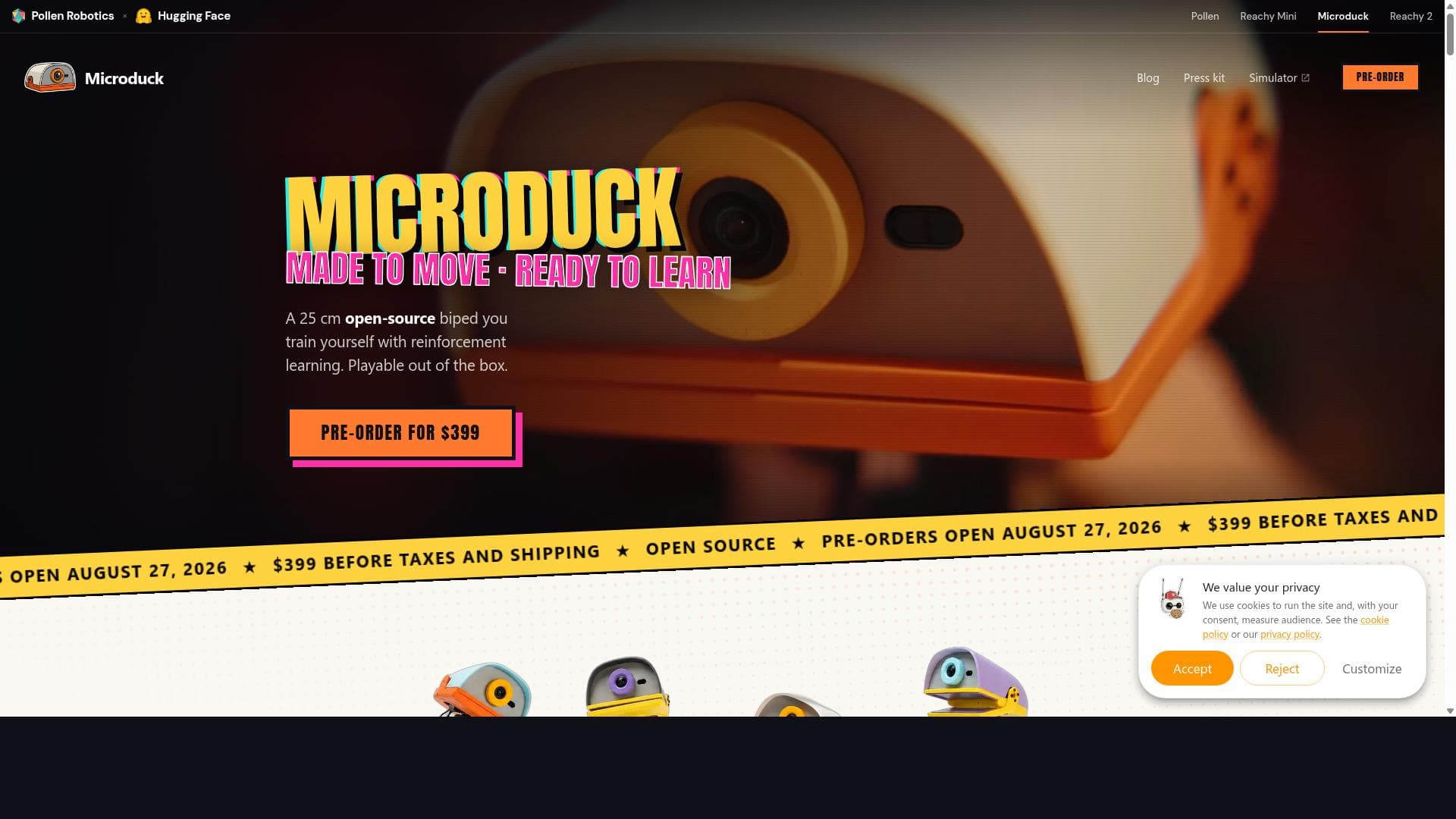
Microduck is a 25cm, $399 open-source bipedal robot built by Hugging Face and Pollen Robotics. It’s designed for sim-to-real reinforcement learning. It ships with 7 pre-trained behaviors and an Apache 2.0 software stack you can clone, modify, and retrain.
详细描述
Microduck is an innovative, compact bipedal robot designed to bring robotics experimentation and education into an accessible, hands-on format. Standing just 25 centimeters tall, Microduck is equipped with 15 motors that provide a wide range of articulated movements, allowing it to walk, balance, and perform complex motions with remarkable fluidity for its size. Its hardware is complemented by a suite of sensors, including a camera and LiDAR, which enable environmental perception and interaction. A unique feature is its grasping beak, which allows Microduck to manipulate small objects, adding an interactive dimension to its capabilities. The robot is playable right out of the box, making it immediately engaging for users without requiring extensive setup or prior robotics experience. At the core of Microduck's appeal is its open-source software stack, which empowers users to train new behaviors in simulation before deploying them on the physical robot. This feature is particularly valuable for educators, researchers, and hobbyists who want to experiment with robotics algorithms, machine learning, or behavior programming without risking damage to the hardware. The simulation environment provides a safe and flexible platform to iterate on robot behaviors, while the seamless transfer to the real robot ensures practical application and testing. The software stack supports customization and extension, encouraging a community-driven approach to robotics development. Microduck is ideally suited for educational institutions, robotics enthusiasts, and developers interested in exploring bipedal locomotion, sensor integration, and robotic manipulation. Its size and capabilities make it an excellent tool for teaching robotics concepts in classrooms or workshops, as well as for prototyping new algorithms in research settings. The robot's playful design and interactive features also make it appealing for creative projects and demonstrations. Use cases include teaching fundamentals of robotics and control systems, experimenting with AI-driven behaviors, and exploring sensor fusion techniques using its camera and LiDAR data. Pricing for Microduck is set at $399, positioning it as an affordable yet sophisticated option in the educational and hobbyist robotics market. This price point reflects the advanced hardware and open-source software ecosystem it offers, making it accessible to a broad audience without compromising on quality or functionality. The product is available for pre-order through Pollen Robotics' official website, with details on shipping and availability provided by the manufacturer. Compared to other small-scale bipedal robots, Microduck stands out due to its combination of high motor count, sensor suite, and open-source software that supports simulation-based training. Many alternatives either lack the comprehensive sensor integration or do not provide an open development environment, limiting customization and experimentation. Microduck's grasping beak adds a unique interactive element that is uncommon in similarly sized robots. However, while it excels in educational and experimental contexts, it may not be suitable for industrial or heavy-duty applications where larger, more robust robots are required. Potential limitations include its relatively small size, which constrains payload capacity and the complexity of tasks it can perform physically. Additionally, while the open-source software stack is a major advantage, it may require users to have some programming knowledge to fully leverage its capabilities. The reliance on simulation for behavior training also means that users must be comfortable working within that environment to maximize the robot's potential. Nonetheless, these considerations are balanced by the robot's affordability, versatility, and the rich learning experience it provides. In summary, Microduck is a cutting-edge, compact bipedal robot that combines advanced hardware with an open-source software ecosystem to deliver a powerful platform for robotics education and experimentation. Its playful design, sensor integration, and simulation-based training capabilities make it a standout choice for anyone looking to explore the fascinating world of bipedal robotics in an accessible and engaging way.
工具功能
- 25 cm biped robot
- 15 motors for movement
- Equipped with a camera
- Includes LiDAR sensor
- Grasping beak for interaction
- Playable out of the box
- Open-source software stack
- Train new behaviors in simulation
描述
Microduck is a compact 25 cm biped robot packed with 15 motors, a camera, LiDAR, and a grasping beak, designed for hands-on robotics education and experimentation. Its open-source software stack allows users to train behaviors in simulation and deploy them on the robot, making it ideal for educators, hobbyists, and developers eager to explore bipedal robotics and AI-driven behaviors.
Microduck is a 25cm, $399 open-source bipedal robot built by Hugging Face and Pollen Robotics. It’s designed for sim-to-real reinforcement learning. It ships with 7 pre-trained behaviors and an Apache 2.0 software stack you can clone, modify, and retrain.
详细描述
Microduck is an innovative, compact bipedal robot designed to bring robotics experimentation and education into an accessible, hands-on format. Standing just 25 centimeters tall, Microduck is equipped with 15 motors that provide a wide range of articulated movements, allowing it to walk, balance, and perform complex motions with remarkable fluidity for its size. Its hardware is complemented by a suite of sensors, including a camera and LiDAR, which enable environmental perception and interaction. A unique feature is its grasping beak, which allows Microduck to manipulate small objects, adding an interactive dimension to its capabilities. The robot is playable right out of the box, making it immediately engaging for users without requiring extensive setup or prior robotics experience. At the core of Microduck's appeal is its open-source software stack, which empowers users to train new behaviors in simulation before deploying them on the physical robot. This feature is particularly valuable for educators, researchers, and hobbyists who want to experiment with robotics algorithms, machine learning, or behavior programming without risking damage to the hardware. The simulation environment provides a safe and flexible platform to iterate on robot behaviors, while the seamless transfer to the real robot ensures practical application and testing. The software stack supports customization and extension, encouraging a community-driven approach to robotics development. Microduck is ideally suited for educational institutions, robotics enthusiasts, and developers interested in exploring bipedal locomotion, sensor integration, and robotic manipulation. Its size and capabilities make it an excellent tool for teaching robotics concepts in classrooms or workshops, as well as for prototyping new algorithms in research settings. The robot's playful design and interactive features also make it appealing for creative projects and demonstrations. Use cases include teaching fundamentals of robotics and control systems, experimenting with AI-driven behaviors, and exploring sensor fusion techniques using its camera and LiDAR data. Pricing for Microduck is set at $399, positioning it as an affordable yet sophisticated option in the educational and hobbyist robotics market. This price point reflects the advanced hardware and open-source software ecosystem it offers, making it accessible to a broad audience without compromising on quality or functionality. The product is available for pre-order through Pollen Robotics' official website, with details on shipping and availability provided by the manufacturer. Compared to other small-scale bipedal robots, Microduck stands out due to its combination of high motor count, sensor suite, and open-source software that supports simulation-based training. Many alternatives either lack the comprehensive sensor integration or do not provide an open development environment, limiting customization and experimentation. Microduck's grasping beak adds a unique interactive element that is uncommon in similarly sized robots. However, while it excels in educational and experimental contexts, it may not be suitable for industrial or heavy-duty applications where larger, more robust robots are required. Potential limitations include its relatively small size, which constrains payload capacity and the complexity of tasks it can perform physically. Additionally, while the open-source software stack is a major advantage, it may require users to have some programming knowledge to fully leverage its capabilities. The reliance on simulation for behavior training also means that users must be comfortable working within that environment to maximize the robot's potential. Nonetheless, these considerations are balanced by the robot's affordability, versatility, and the rich learning experience it provides. In summary, Microduck is a cutting-edge, compact bipedal robot that combines advanced hardware with an open-source software ecosystem to deliver a powerful platform for robotics education and experimentation. Its playful design, sensor integration, and simulation-based training capabilities make it a standout choice for anyone looking to explore the fascinating world of bipedal robotics in an accessible and engaging way.
常见问题
What is Microduck?
Microduck is a small, 25 cm tall bipedal robot equipped with 15 motors, a camera, LiDAR sensor, and a grasping beak. It is designed for robotics education and experimentation, allowing users to train new behaviors in simulation and deploy them on the physical robot.
How much does Microduck cost?
Microduck is priced at $399 and is available for pre-order through Pollen Robotics' official website.
Who is Microduck best for?
Microduck is ideal for educators, robotics enthusiasts, researchers, and developers who want a hands-on platform for learning and experimenting with bipedal locomotion, sensor integration, and robotic manipulation.
What are the main features of Microduck?
Key features include its 25 cm bipedal design with 15 motors for versatile movement, a camera and LiDAR for environmental sensing, a grasping beak for object interaction, out-of-the-box playability, and an open-source software stack that supports behavior training in simulation.
Does Microduck offer a free trial?
There is no information indicating that Microduck offers a free trial. However, its open-source software stack allows users to experiment with simulation environments before deploying behaviors on the robot.
What integrations does Microduck support?
Microduck supports integration through its open-source software stack, enabling users to connect and program it with various robotics frameworks and simulation tools, although specific third-party integrations are not explicitly detailed.
How does Microduck work?
Microduck operates through a combination of hardware and software: its 15 motors enable bipedal movement, while its camera and LiDAR sensors provide environmental data. Users can train new behaviors in a simulation environment using the open-source software stack and then deploy those behaviors to the physical robot for real-world interaction.
社交媒体
使用工具评价
暂无评价。成为第一个分享使用体验的人。