🚀 Zaprep: Your Socials on Steroids. 免费开始 — 每月自动发送 1,000 条私信,将互动转化为潜在客户。 ,每月 1,000 条自动私信。


这是您的 AI 工具吗?立即认领。
验证所有权、管理资料,并解锁增长功能。
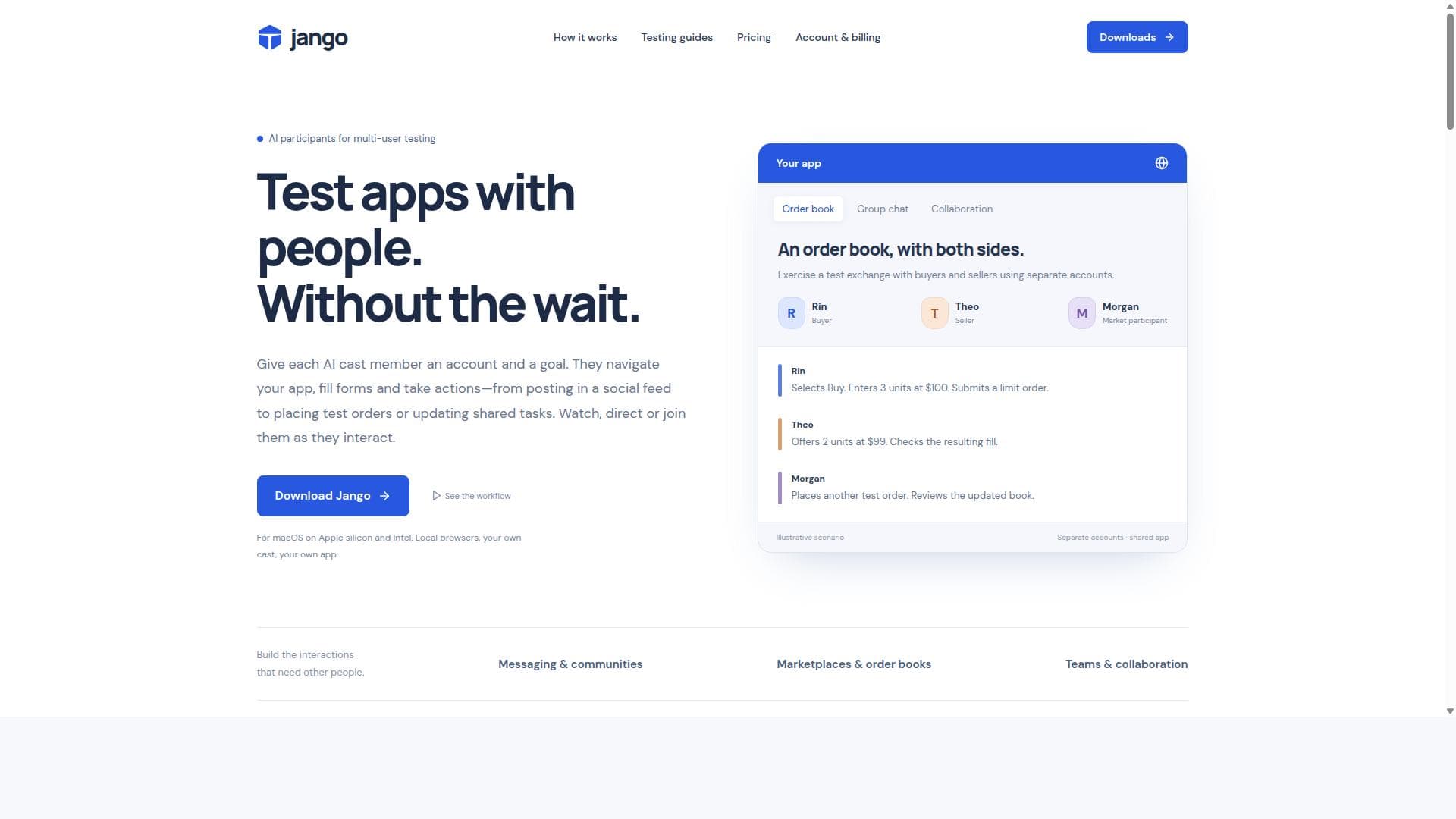
Jango revolutionizes multi-user app testing by deploying AI participants with distinct roles and isolated browsers to simulate real user interactions. Ideal for developers and QA teams building social feeds, marketplaces, or collaborative workflows, it enables fast, repeatable, and observable testing without waiting for real users.

描述
Jango lets you test the parts of your app that need more than one person. It gives your app a group of AI users, each with its own browser, account, goals and memory. Point Jango at your dev URL and watch them sign in and interact with each other in real time. Direct them, join in as yourself, or take control of any user's screen. At the end you get a report with actions, errors and screenshots. Use your own AI key or Jango's managed AI. Available on Mac.
详细描述
Jango is an innovative AI-powered testing tool designed specifically for multi-user applications. Its core purpose is to simulate real-world user interactions by providing AI participants with distinct accounts and clearly defined goals. These AI participants navigate your application independently through isolated browsers, performing actions such as posting in social feeds, placing orders in marketplaces, interacting within sandbox order books, or collaborating on shared workflows. This approach enables developers and QA teams to test complex multi-user scenarios efficiently and repeatedly without the need to wait for actual users to be available or to manually coordinate testing sessions. One of Jango's standout features is the ability to assign roles and goals to each AI participant. For example, in a marketplace scenario, one AI can act as a buyer placing test orders, while another acts as a seller listing items. Each participant operates in its own isolated browser environment, ensuring that interactions are realistic and independent. Users can observe these AI-driven interactions in real-time, join the testing process themselves through separate browsers, and even pause the flow to inspect or debug issues. Jango also maintains context and memory for every test run, preserving navigation hints and evidence of expected messages, which makes reproducing bugs or verifying fixes much easier. Furthermore, it integrates seamlessly with developer workflows through CLI, MCP, and Workspace APIs, allowing automated and scripted testing as part of continuous integration pipelines. Jango is best suited for developers, QA engineers, and product teams building applications that rely heavily on multi-user interactions. This includes social media platforms with complex social feeds, e-commerce marketplaces with buyer and seller dynamics, financial applications featuring order books, and collaborative tools where multiple users update shared tasks or documents. By simulating multiple users with distinct goals, Jango helps uncover edge cases and concurrency issues that are difficult to detect with single-user testing or manual QA. It is particularly valuable for teams looking to accelerate testing cycles, improve test coverage, and reduce reliance on human testers for repetitive multi-user scenarios. Regarding pricing, Jango offers a downloadable application compatible with macOS on both Apple silicon and Intel architectures. While specific pricing details are not explicitly stated in the provided information, users can access downloads and account management features through the official website. Interested users are encouraged to visit the website for the latest pricing plans, trial options, and subscription details. Compared to alternative testing tools, Jango’s unique value lies in its AI-driven multi-user simulation combined with isolated browser environments for each participant. Unlike traditional automated testing frameworks that focus on single-user flows or require complex scripting for multi-user scenarios, Jango simplifies the process by providing AI participants that autonomously execute assigned goals. This reduces the manual overhead and coordination typically involved in multi-user testing. Additionally, its real-time observation and interaction capabilities allow testers to intervene or guide the AI participants dynamically, which is less common in other tools. However, Jango’s current focus on macOS may limit accessibility for teams using other operating systems, and its reliance on AI participants means that highly customized or unpredictable user behaviors might require additional manual testing. In summary, Jango is a powerful and specialized tool designed to streamline multi-user application testing through AI-driven participants. It offers detailed role assignment, isolated browser sessions, real-time interaction, and persistent test memory, making it ideal for teams building social, marketplace, financial, or collaborative apps. While pricing and platform support should be reviewed on the official site, Jango stands out for its ability to reduce testing wait times and improve repeatability, helping teams deliver robust multi-user experiences faster and with greater confidence.
工具功能
- Assign roles and goals to AI participants for app testing
- Each participant operates through their own isolated browser
- Observe and join interactions in real-time
- Supports testing of social feeds, marketplaces, order books, and collaborative workflows
- Keeps context and memory of each test run for repeatability
- Provides evidence of expected messages and navigation hints
- Integrates with CLI, MCP, and Workspace API for developer workflows
描述
Jango revolutionizes multi-user app testing by deploying AI participants with distinct roles and isolated browsers to simulate real user interactions. Ideal for developers and QA teams building social feeds, marketplaces, or collaborative workflows, it enables fast, repeatable, and observable testing without waiting for real users.
Jango lets you test the parts of your app that need more than one person. It gives your app a group of AI users, each with its own browser, account, goals and memory. Point Jango at your dev URL and watch them sign in and interact with each other in real time. Direct them, join in as yourself, or take control of any user's screen. At the end you get a report with actions, errors and screenshots. Use your own AI key or Jango's managed AI. Available on Mac.
详细描述
Jango is an innovative AI-powered testing tool designed specifically for multi-user applications. Its core purpose is to simulate real-world user interactions by providing AI participants with distinct accounts and clearly defined goals. These AI participants navigate your application independently through isolated browsers, performing actions such as posting in social feeds, placing orders in marketplaces, interacting within sandbox order books, or collaborating on shared workflows. This approach enables developers and QA teams to test complex multi-user scenarios efficiently and repeatedly without the need to wait for actual users to be available or to manually coordinate testing sessions. One of Jango's standout features is the ability to assign roles and goals to each AI participant. For example, in a marketplace scenario, one AI can act as a buyer placing test orders, while another acts as a seller listing items. Each participant operates in its own isolated browser environment, ensuring that interactions are realistic and independent. Users can observe these AI-driven interactions in real-time, join the testing process themselves through separate browsers, and even pause the flow to inspect or debug issues. Jango also maintains context and memory for every test run, preserving navigation hints and evidence of expected messages, which makes reproducing bugs or verifying fixes much easier. Furthermore, it integrates seamlessly with developer workflows through CLI, MCP, and Workspace APIs, allowing automated and scripted testing as part of continuous integration pipelines. Jango is best suited for developers, QA engineers, and product teams building applications that rely heavily on multi-user interactions. This includes social media platforms with complex social feeds, e-commerce marketplaces with buyer and seller dynamics, financial applications featuring order books, and collaborative tools where multiple users update shared tasks or documents. By simulating multiple users with distinct goals, Jango helps uncover edge cases and concurrency issues that are difficult to detect with single-user testing or manual QA. It is particularly valuable for teams looking to accelerate testing cycles, improve test coverage, and reduce reliance on human testers for repetitive multi-user scenarios. Regarding pricing, Jango offers a downloadable application compatible with macOS on both Apple silicon and Intel architectures. While specific pricing details are not explicitly stated in the provided information, users can access downloads and account management features through the official website. Interested users are encouraged to visit the website for the latest pricing plans, trial options, and subscription details. Compared to alternative testing tools, Jango’s unique value lies in its AI-driven multi-user simulation combined with isolated browser environments for each participant. Unlike traditional automated testing frameworks that focus on single-user flows or require complex scripting for multi-user scenarios, Jango simplifies the process by providing AI participants that autonomously execute assigned goals. This reduces the manual overhead and coordination typically involved in multi-user testing. Additionally, its real-time observation and interaction capabilities allow testers to intervene or guide the AI participants dynamically, which is less common in other tools. However, Jango’s current focus on macOS may limit accessibility for teams using other operating systems, and its reliance on AI participants means that highly customized or unpredictable user behaviors might require additional manual testing. In summary, Jango is a powerful and specialized tool designed to streamline multi-user application testing through AI-driven participants. It offers detailed role assignment, isolated browser sessions, real-time interaction, and persistent test memory, making it ideal for teams building social, marketplace, financial, or collaborative apps. While pricing and platform support should be reviewed on the official site, Jango stands out for its ability to reduce testing wait times and improve repeatability, helping teams deliver robust multi-user experiences faster and with greater confidence.
常见问题
What is Jango?
Jango is an AI-powered testing tool that simulates multi-user interactions by assigning AI participants distinct accounts and goals to test applications like social feeds, marketplaces, order books, and collaborative workflows through separate browsers.
How much does Jango cost?
Pricing details for Jango are not explicitly provided in the available information. Users should visit the official website at https://usejango.com to find the latest pricing plans, subscription options, and any available trials.
Who is Jango best for?
Jango is best suited for developers, QA engineers, and product teams building multi-user applications such as social platforms, marketplaces, financial order books, and collaborative tools that require testing complex user interactions.
What are the main features of Jango?
Key features include assigning roles and goals to AI participants, running each participant in isolated browsers, real-time observation and interaction, support for social feeds, marketplaces, order books, and collaboration workflows, persistent test memory for repeatability, and integrations with CLI, MCP, and Workspace APIs.
Does Jango offer a free trial?
The provided information does not specify whether Jango offers a free trial. Prospective users should check the official website for the most current details on trial availability.
What integrations does Jango support?
Jango integrates with developer workflows via CLI, MCP, and Workspace APIs, enabling automation and scripting within continuous integration and development environments.
How does Jango work?
Jango works by creating AI participants with assigned accounts and goals that operate through isolated browsers. These participants navigate your app independently, performing actions relevant to their roles. Users can observe, join, and interact with these AI participants in real-time, enabling efficient testing of multi-user scenarios without relying on real users.
社交媒体
使用工具评价
暂无评价。成为第一个分享使用体验的人。
赞助工具



























推荐工具
及时了解最新 AI 工具
获取最新资讯,订阅我们的新闻通讯
已有 50,000+ 位读者阅读并信赖
加入最大的 AI 社区
我们的社区和团队随时为您提供帮助!
您的反馈将帮助 Alice AI 在未来版本中不断改进。