

这是您的 AI 工具吗?立即认领。
验证所有权、管理资料,并解锁增长功能。
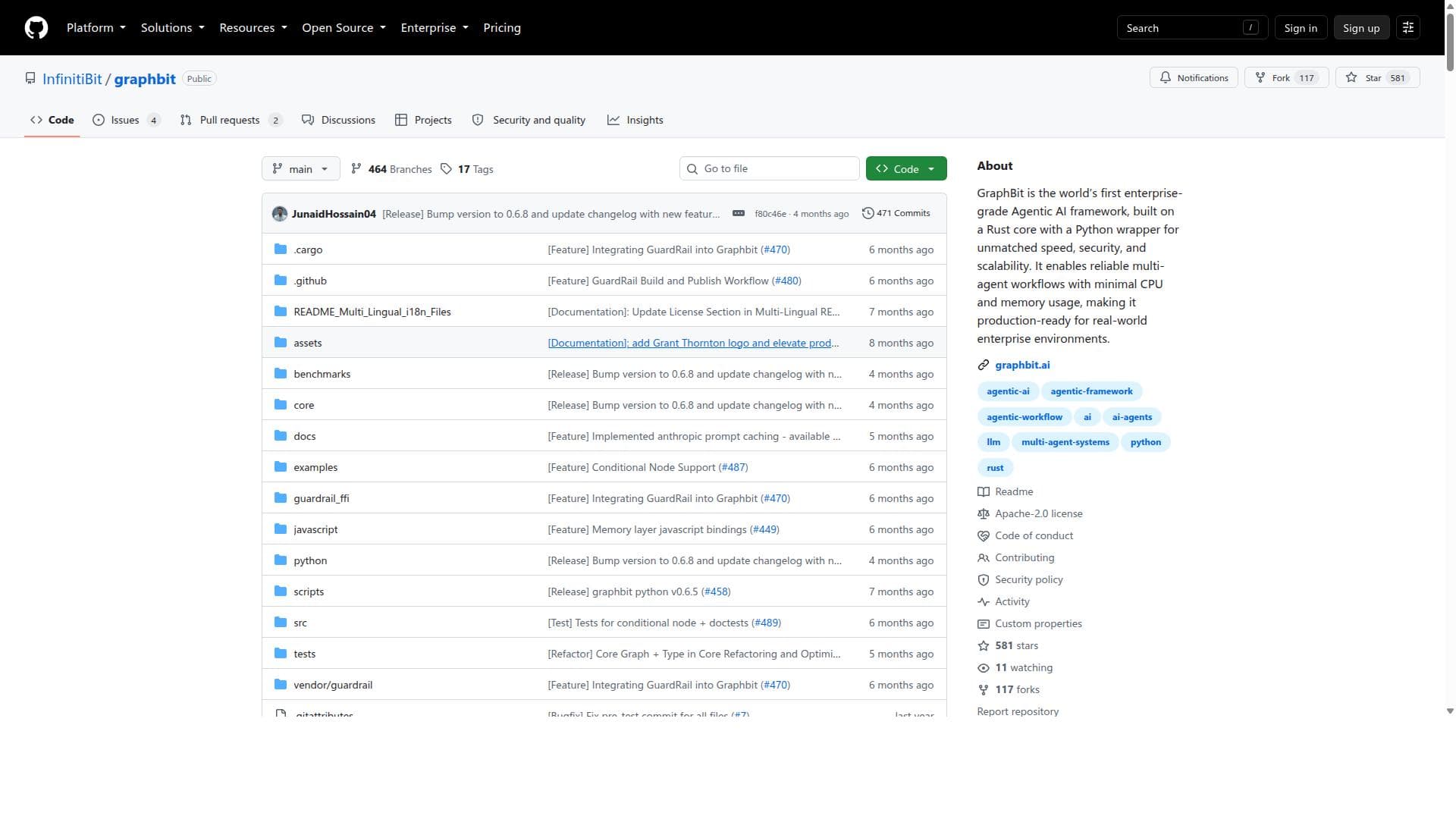
GraphBit is the world’s first enterprise-grade Agentic AI framework combining a Rust core with a Python wrapper to deliver unmatched speed, security, and scalability. Designed for reliable multi-agent workflows with minimal resource usage, it is ideal for enterprises seeking production-ready AI solutions that perform efficiently at scale.

描述
GraphBit is a high-performance AI agent framework with a Rust 🦀 core and seamless Python bindings. It combines Rust’s speed and reliability with Python’s simplicity, empowering developers to build intelligent, enterprise-grade agents with ease.
详细描述
GraphBit is an innovative enterprise-grade Agentic AI framework designed to revolutionize how organizations deploy and manage multi-agent AI workflows. At its core, GraphBit is built on a high-performance Rust engine, which ensures exceptional speed and security, while providing a Python wrapper to enable seamless integration and ease of use for developers familiar with Python. This unique combination allows GraphBit to deliver unmatched scalability and reliability, making it an ideal solution for production environments that demand both efficiency and robustness. The primary purpose of GraphBit is to facilitate the creation and orchestration of complex multi-agent AI systems that can operate concurrently with minimal resource consumption. Unlike traditional AI frameworks that often require significant CPU and memory overhead, GraphBit is optimized to run multi-agent workflows with minimal CPU and memory usage. This efficiency is critical for enterprises seeking to deploy AI solutions at scale without incurring prohibitive infrastructure costs or compromising performance. Key features of GraphBit include its enterprise-grade architecture that supports agentic AI workflows, enabling multiple AI agents to collaborate, communicate, and execute tasks reliably. The Rust core provides a secure and fast runtime environment, while the Python wrapper offers flexibility and accessibility for developers to build, customize, and extend AI agents easily. GraphBit’s design emphasizes scalability, allowing organizations to scale their AI operations seamlessly as demand grows. Additionally, its minimal resource footprint ensures that deployments remain cost-effective and sustainable in real-world enterprise settings. GraphBit is best suited for enterprises and organizations that require robust, scalable AI solutions capable of handling complex workflows involving multiple AI agents. Use cases include automated customer support systems, intelligent process automation, decision-making frameworks, and any scenario where coordinated AI agent collaboration is essential. Its production-ready nature makes it particularly valuable for industries such as finance, healthcare, logistics, and technology, where reliability, security, and performance are paramount. Regarding pricing and plans, GraphBit is an open-source project hosted on GitHub, which means it is freely available for use and modification. Enterprises can leverage the framework without licensing costs, though they may choose to invest in professional support or custom development services depending on their needs. This open-source model encourages community contributions and rapid innovation while providing organizations with the flexibility to tailor the framework to their specific requirements. When compared to alternatives, GraphBit stands out due to its unique combination of a Rust core and Python wrapper, delivering superior speed and security compared to frameworks built solely on higher-level languages. Many AI frameworks struggle with resource inefficiency or lack enterprise-grade features for multi-agent coordination; GraphBit addresses these gaps effectively. Its minimal CPU and memory usage also differentiate it from competitors, enabling deployment in resource-constrained environments without sacrificing performance. However, there are some considerations to keep in mind. As an open-source framework, GraphBit may require a higher level of technical expertise to implement and maintain compared to fully managed AI platforms. Enterprises without in-house Rust or Python development capabilities might face a steeper learning curve. Additionally, while the framework is production-ready, organizations should thoroughly test and validate their specific use cases to ensure optimal integration and performance. Finally, since it is relatively new, the ecosystem and community support may not be as extensive as more established AI frameworks, which could impact the availability of third-party tools and integrations. In summary, GraphBit offers a powerful, efficient, and secure solution for enterprises looking to harness the potential of multi-agent AI workflows. Its innovative architecture and open-source availability make it a compelling choice for organizations prioritizing speed, scalability, and resource efficiency in their AI deployments.
工具功能
- Enterprise-grade Agentic AI framework
- Built on a Rust core with a Python wrapper
- Unmatched speed, security, and scalability
- Enables reliable multi-agent workflows
- Minimal CPU and memory usage
- Production-ready for real-world enterprise environments
描述
GraphBit is the world’s first enterprise-grade Agentic AI framework combining a Rust core with a Python wrapper to deliver unmatched speed, security, and scalability. Designed for reliable multi-agent workflows with minimal resource usage, it is ideal for enterprises seeking production-ready AI solutions that perform efficiently at scale.
GraphBit is a high-performance AI agent framework with a Rust 🦀 core and seamless Python bindings. It combines Rust’s speed and reliability with Python’s simplicity, empowering developers to build intelligent, enterprise-grade agents with ease.
详细描述
GraphBit is an innovative enterprise-grade Agentic AI framework designed to revolutionize how organizations deploy and manage multi-agent AI workflows. At its core, GraphBit is built on a high-performance Rust engine, which ensures exceptional speed and security, while providing a Python wrapper to enable seamless integration and ease of use for developers familiar with Python. This unique combination allows GraphBit to deliver unmatched scalability and reliability, making it an ideal solution for production environments that demand both efficiency and robustness. The primary purpose of GraphBit is to facilitate the creation and orchestration of complex multi-agent AI systems that can operate concurrently with minimal resource consumption. Unlike traditional AI frameworks that often require significant CPU and memory overhead, GraphBit is optimized to run multi-agent workflows with minimal CPU and memory usage. This efficiency is critical for enterprises seeking to deploy AI solutions at scale without incurring prohibitive infrastructure costs or compromising performance. Key features of GraphBit include its enterprise-grade architecture that supports agentic AI workflows, enabling multiple AI agents to collaborate, communicate, and execute tasks reliably. The Rust core provides a secure and fast runtime environment, while the Python wrapper offers flexibility and accessibility for developers to build, customize, and extend AI agents easily. GraphBit’s design emphasizes scalability, allowing organizations to scale their AI operations seamlessly as demand grows. Additionally, its minimal resource footprint ensures that deployments remain cost-effective and sustainable in real-world enterprise settings. GraphBit is best suited for enterprises and organizations that require robust, scalable AI solutions capable of handling complex workflows involving multiple AI agents. Use cases include automated customer support systems, intelligent process automation, decision-making frameworks, and any scenario where coordinated AI agent collaboration is essential. Its production-ready nature makes it particularly valuable for industries such as finance, healthcare, logistics, and technology, where reliability, security, and performance are paramount. Regarding pricing and plans, GraphBit is an open-source project hosted on GitHub, which means it is freely available for use and modification. Enterprises can leverage the framework without licensing costs, though they may choose to invest in professional support or custom development services depending on their needs. This open-source model encourages community contributions and rapid innovation while providing organizations with the flexibility to tailor the framework to their specific requirements. When compared to alternatives, GraphBit stands out due to its unique combination of a Rust core and Python wrapper, delivering superior speed and security compared to frameworks built solely on higher-level languages. Many AI frameworks struggle with resource inefficiency or lack enterprise-grade features for multi-agent coordination; GraphBit addresses these gaps effectively. Its minimal CPU and memory usage also differentiate it from competitors, enabling deployment in resource-constrained environments without sacrificing performance. However, there are some considerations to keep in mind. As an open-source framework, GraphBit may require a higher level of technical expertise to implement and maintain compared to fully managed AI platforms. Enterprises without in-house Rust or Python development capabilities might face a steeper learning curve. Additionally, while the framework is production-ready, organizations should thoroughly test and validate their specific use cases to ensure optimal integration and performance. Finally, since it is relatively new, the ecosystem and community support may not be as extensive as more established AI frameworks, which could impact the availability of third-party tools and integrations. In summary, GraphBit offers a powerful, efficient, and secure solution for enterprises looking to harness the potential of multi-agent AI workflows. Its innovative architecture and open-source availability make it a compelling choice for organizations prioritizing speed, scalability, and resource efficiency in their AI deployments.
常见问题
What is GraphBit?
GraphBit is an enterprise-grade Agentic AI framework that enables the creation and management of reliable multi-agent AI workflows. It is built on a high-performance Rust core with a Python wrapper, designed to offer unmatched speed, security, and scalability for production environments.
How much does GraphBit cost?
GraphBit is an open-source project available for free on GitHub. There are no licensing fees to use the framework, though organizations may choose to invest in professional support or custom development services if needed.
Who is GraphBit best for?
GraphBit is best suited for enterprises and organizations that require scalable, secure, and efficient multi-agent AI workflows. It is ideal for industries such as finance, healthcare, logistics, and technology that demand production-ready AI solutions with minimal resource consumption.
What are the main features of GraphBit?
Key features include an enterprise-grade Agentic AI framework, a Rust core for speed and security, a Python wrapper for developer accessibility, support for reliable multi-agent workflows, minimal CPU and memory usage, and production readiness for real-world enterprise deployments.
Does GraphBit offer a free trial?
Since GraphBit is open-source and freely available on GitHub, there is no need for a free trial. Users can download, use, and modify the framework at no cost.
What integrations does GraphBit support?
GraphBit provides a Python wrapper that allows integration with Python-based tools and ecosystems. While specific third-party integrations depend on user implementation, its flexible architecture supports customization to connect with various enterprise systems and AI tools.
How does GraphBit work?
GraphBit operates by orchestrating multiple AI agents within a secure and efficient Rust runtime, while exposing a Python interface for ease of development. This setup enables concurrent execution of multi-agent workflows with minimal resource usage, ensuring scalability and reliability in production environments.
社交媒体
使用工具评价
暂无评价。成为第一个分享使用体验的人。