🚀 Zaprep: Your Socials on Steroids. 免费开始 — 每月自动发送 1,000 条私信,将互动转化为潜在客户。 ,每月 1,000 条自动私信。


这是您的 AI 工具吗?立即认领。
验证所有权、管理资料,并解锁增长功能。
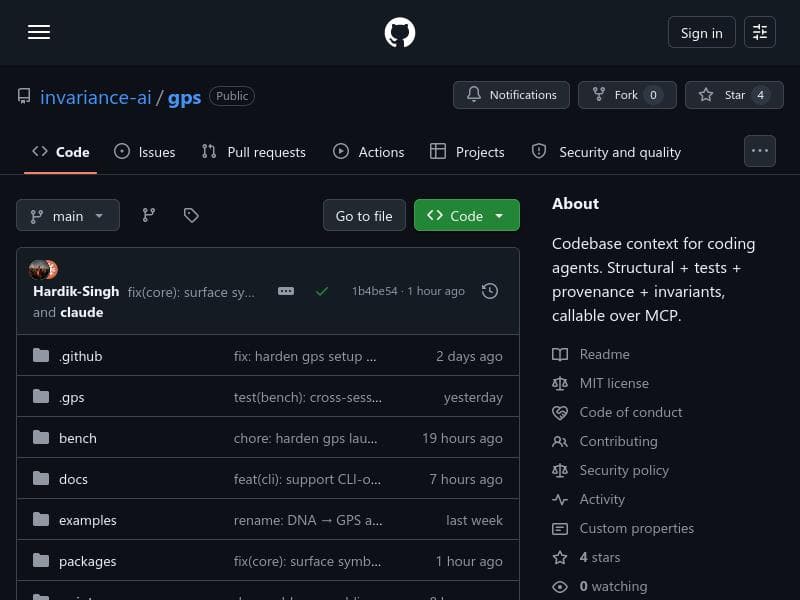
gps is a powerful codebase context tool designed to supercharge coding agents by providing detailed structural insights, test integration, provenance tracking, and invariant management. Ideal for AI-driven development teams, gps enables smarter, faster, and more reliable software creation through seamless MCP-based integration.

描述
Your coding agent forgets everything the second a session ends. GPS fixes that. It learns your repo's rules, decisions, gotchas, and test commands, then surfaces exactly what's relevant before any edit. No more "don't log PII here" corrections twice. No more repeating yourself every run. Memory anchored to symbols and files, not dumped into a bloated CLAUDE.md. Agents track their own failures and get smarter over time. Local-first, CLI-first, built for Claude Code, Codex, Cursor, and MCP.
详细描述
gps is an advanced codebase context tool specifically designed to enhance the capabilities of coding agents in software development environments. Its core purpose is to provide rich, structural information about codebases, enabling coding agents to understand, analyze, and interact with code more effectively. By delivering detailed context such as code structure, tests, provenance, and invariants, gps empowers automated coding agents to make more informed decisions, improve code quality, and accelerate development workflows. One of the standout features of gps is its comprehensive provision of codebase context. Unlike traditional tools that offer limited or superficial insights, gps dives deep into the architecture of the code, mapping out its structure in a way that coding agents can easily consume. This includes detailed metadata about files, functions, classes, and dependencies, which helps agents navigate complex codebases with precision. Additionally, gps supports tests integration, allowing agents to access and run tests directly, ensuring that any code modifications maintain or improve software reliability. Provenance tracking is another critical capability of gps. It records the origin and history of code changes, which is essential for auditing, debugging, and understanding the evolution of a project. This feature enables coding agents to trace back through the development lifecycle, providing transparency and accountability. Furthermore, gps manages invariants within codebases—conditions or properties that must always hold true—helping agents maintain code correctness and prevent regressions. A key technical advantage of gps is its ability to be called over MCP (Multi-Component Protocol). This allows seamless integration with various coding agents and systems, facilitating communication and data exchange across multiple components in a development ecosystem. This interoperability ensures that gps can fit into diverse workflows and toolchains without friction. gps is best suited for software development teams and organizations that leverage AI-powered coding agents or automated development assistants. It is particularly valuable for large-scale projects with complex codebases where understanding structural context and maintaining code integrity are challenging. Use cases include automated code review, intelligent code generation, continuous integration pipelines, and advanced debugging scenarios. By providing coding agents with deep contextual knowledge, gps helps reduce errors, improve code maintainability, and speed up development cycles. Regarding pricing and plans, specific details about gps’s cost structure are not publicly disclosed on its Product Hunt page. Interested users are encouraged to visit the official website or contact the developers directly for tailored pricing information and potential enterprise options. When compared to alternatives, gps stands out due to its focus on providing a rich, multi-dimensional context specifically designed for coding agents rather than general developers. While other tools might offer static code analysis or basic context, gps’s integration of structural information, tests, provenance, and invariants combined with MCP compatibility makes it uniquely powerful for AI-driven development workflows. However, it may require some setup and integration effort to fully leverage its capabilities within existing systems. Notable limitations include the potential learning curve for teams unfamiliar with MCP or advanced codebase context tools. Additionally, since gps is tailored for coding agents, developers seeking a traditional IDE plugin or standalone static analysis tool might find it less directly applicable. Finally, the lack of publicly available pricing and trial information could be a barrier for some prospective users wanting to evaluate the tool before committing. In summary, gps is a sophisticated tool that significantly enhances the functionality of coding agents by providing deep, actionable context about codebases. Its unique combination of features makes it an excellent choice for organizations aiming to integrate AI-driven automation into their software development lifecycle, especially where codebase complexity and quality assurance are paramount.
工具功能
- Provides codebase context for coding agents
- Includes structural information about code
- Supports tests and provenance tracking
- Manages invariants within codebases
- Callable over MCP (Multi-Component Protocol)
描述
gps is a powerful codebase context tool designed to supercharge coding agents by providing detailed structural insights, test integration, provenance tracking, and invariant management. Ideal for AI-driven development teams, gps enables smarter, faster, and more reliable software creation through seamless MCP-based integration.
Your coding agent forgets everything the second a session ends. GPS fixes that. It learns your repo's rules, decisions, gotchas, and test commands, then surfaces exactly what's relevant before any edit. No more "don't log PII here" corrections twice. No more repeating yourself every run. Memory anchored to symbols and files, not dumped into a bloated CLAUDE.md. Agents track their own failures and get smarter over time. Local-first, CLI-first, built for Claude Code, Codex, Cursor, and MCP.
详细描述
gps is an advanced codebase context tool specifically designed to enhance the capabilities of coding agents in software development environments. Its core purpose is to provide rich, structural information about codebases, enabling coding agents to understand, analyze, and interact with code more effectively. By delivering detailed context such as code structure, tests, provenance, and invariants, gps empowers automated coding agents to make more informed decisions, improve code quality, and accelerate development workflows. One of the standout features of gps is its comprehensive provision of codebase context. Unlike traditional tools that offer limited or superficial insights, gps dives deep into the architecture of the code, mapping out its structure in a way that coding agents can easily consume. This includes detailed metadata about files, functions, classes, and dependencies, which helps agents navigate complex codebases with precision. Additionally, gps supports tests integration, allowing agents to access and run tests directly, ensuring that any code modifications maintain or improve software reliability. Provenance tracking is another critical capability of gps. It records the origin and history of code changes, which is essential for auditing, debugging, and understanding the evolution of a project. This feature enables coding agents to trace back through the development lifecycle, providing transparency and accountability. Furthermore, gps manages invariants within codebases—conditions or properties that must always hold true—helping agents maintain code correctness and prevent regressions. A key technical advantage of gps is its ability to be called over MCP (Multi-Component Protocol). This allows seamless integration with various coding agents and systems, facilitating communication and data exchange across multiple components in a development ecosystem. This interoperability ensures that gps can fit into diverse workflows and toolchains without friction. gps is best suited for software development teams and organizations that leverage AI-powered coding agents or automated development assistants. It is particularly valuable for large-scale projects with complex codebases where understanding structural context and maintaining code integrity are challenging. Use cases include automated code review, intelligent code generation, continuous integration pipelines, and advanced debugging scenarios. By providing coding agents with deep contextual knowledge, gps helps reduce errors, improve code maintainability, and speed up development cycles. Regarding pricing and plans, specific details about gps’s cost structure are not publicly disclosed on its Product Hunt page. Interested users are encouraged to visit the official website or contact the developers directly for tailored pricing information and potential enterprise options. When compared to alternatives, gps stands out due to its focus on providing a rich, multi-dimensional context specifically designed for coding agents rather than general developers. While other tools might offer static code analysis or basic context, gps’s integration of structural information, tests, provenance, and invariants combined with MCP compatibility makes it uniquely powerful for AI-driven development workflows. However, it may require some setup and integration effort to fully leverage its capabilities within existing systems. Notable limitations include the potential learning curve for teams unfamiliar with MCP or advanced codebase context tools. Additionally, since gps is tailored for coding agents, developers seeking a traditional IDE plugin or standalone static analysis tool might find it less directly applicable. Finally, the lack of publicly available pricing and trial information could be a barrier for some prospective users wanting to evaluate the tool before committing. In summary, gps is a sophisticated tool that significantly enhances the functionality of coding agents by providing deep, actionable context about codebases. Its unique combination of features makes it an excellent choice for organizations aiming to integrate AI-driven automation into their software development lifecycle, especially where codebase complexity and quality assurance are paramount.
常见问题
What is gps?
gps is a codebase context tool designed to enhance coding agents by providing detailed structural information, tests, provenance, and invariants within software projects. It helps AI-powered coding agents understand and interact with codebases more effectively.
How much does gps cost?
Pricing details for gps are not publicly available. Interested users should visit the official website or contact the developers directly for information on plans and pricing.
Who is gps best for?
gps is best suited for software development teams and organizations that use AI-powered coding agents or automated development assistants, especially those working with complex or large-scale codebases.
What are the main features of gps?
The main features of gps include providing comprehensive codebase context, structural information about code, test support, provenance tracking, invariant management, and the ability to be called over the Multi-Component Protocol (MCP) for seamless integration.
Does gps offer a free trial?
There is no publicly available information about a free trial for gps. Prospective users should check the official website or contact the team for trial availability.
What integrations does gps support?
gps supports integration via the Multi-Component Protocol (MCP), allowing it to be called by various coding agents and development tools within a multi-component ecosystem.
How does gps work?
gps works by analyzing codebases to extract structural information, tests, provenance data, and invariants. It exposes this rich context to coding agents through MCP calls, enabling them to understand and manipulate code more intelligently and reliably.
社交媒体
使用工具评价
暂无评价。成为第一个分享使用体验的人。
赞助工具






























推荐工具
及时了解最新 AI 工具
获取最新资讯,订阅我们的新闻通讯
已有 50,000+ 位读者阅读并信赖
加入最大的 AI 社区
我们的社区和团队随时为您提供帮助!
您的反馈将帮助 Alice AI 在未来版本中不断改进。