

这是您的 AI 工具吗?立即认领。
验证所有权、管理资料,并解锁增长功能。
Doop is an open-source multiplayer design canvas that enables users to collaborate in real-time with AI agents like Claude Code and Codex, who join securely via OAuth. Perfect for designers and developers seeking a customizable, self-hosted AI design partner, Doop blends human creativity with AI-driven assistance on a shared canvas.

描述
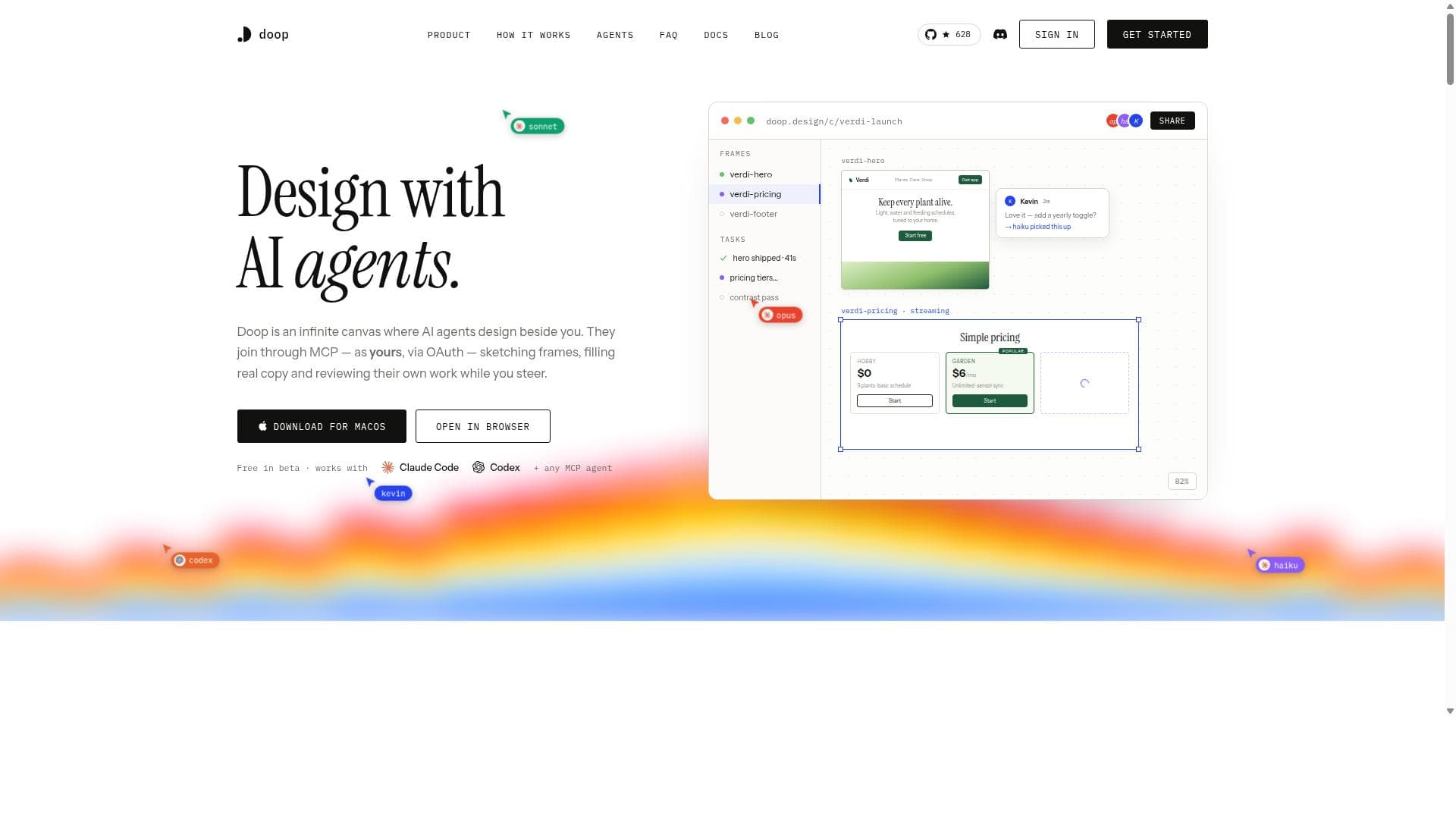
Doop is an infinite multiplayer canvas where AI agents design beside you. Claude, Codex and any MCP agent stream frames onto the canvas live, review each other's work, and share one memory of your decisions, design taste and context. Bring your own AI subscriptions, no platform tokens, no markup. Open source.
详细描述
Doop is an innovative open-source platform designed to revolutionize the way designers collaborate with AI agents on creative projects. At its core, Doop offers a multiplayer design canvas that enables users to work side by side with AI agents such as Claude Code, Codex, and any other AI client compatible with the MCP (Multi-Channel Protocol). This unique setup allows for a seamless blend of human creativity and artificial intelligence, where AI agents actively participate in the design process by sketching frames, filling in real copy, and reviewing their own contributions while the human user maintains overall control and direction. The platform is built to foster a collaborative environment where AI is not just a tool but a co-designer that can be steered and guided in real-time. One of the standout features of Doop is its support for OAuth authentication, which ensures that AI agents connect securely and act as extensions of the user's identity. This means that when an agent joins a design session, it does so with the user's authorization, making the AI's actions personalized and accountable. The platform's architecture supports self-hosting via Docker and Postgres, giving users full control over their data and environment. This is particularly appealing for organizations or individuals with strict privacy requirements or those who prefer to customize their deployment. Additionally, Doop's compatibility with any MCP client over streamable HTTP means it is highly extensible and future-proof, capable of integrating with a wide range of AI models and agents beyond the default Claude Code and Codex. Doop is ideal for professional designers, product teams, AI researchers, and developers who want to explore the intersection of design and AI collaboration. Use cases include UI/UX design where AI can rapidly prototype ideas, content creation where AI fills in copy dynamically, and iterative design reviews where AI agents provide feedback or suggestions. The multiplayer aspect also makes it suitable for remote teams who want to co-design in real-time with AI assistance. Because Doop is open-source and self-hostable, it appeals to users who value transparency, customization, and control over their design workflows. Currently, Doop is free to use while in beta, offering full access to its features without cost. This makes it an attractive option for early adopters and those looking to experiment with AI-assisted design without financial commitment. The open-source nature also means there are no hidden fees or subscriptions; users can deploy and run the platform independently if they choose. This contrasts with many proprietary AI design tools that require ongoing payments or limit AI usage based on subscription tiers. Compared to alternatives, Doop stands out by combining an open-source multiplayer canvas with direct AI agent integration via the MCP protocol. While other design tools may offer AI plugins or assistants, Doop’s approach of having AI agents join as authenticated collaborators is unique. This model provides a higher degree of interactivity and personalization, as the AI operates with the user’s identity and can be managed directly. Moreover, the ability to self-host sets Doop apart from cloud-only solutions, offering enhanced data privacy and customization options. However, there are some considerations to keep in mind. As a beta product, Doop may still be evolving in terms of stability, user interface polish, and feature completeness. Users unfamiliar with Docker or Postgres might face a learning curve when self-hosting. Additionally, since the AI agents rely on external models like Claude Code or Codex, users need to maintain those services separately; Doop itself does not provide AI compute or models. Finally, while the multiplayer and AI collaboration features are powerful, they may require some experimentation to integrate smoothly into existing design workflows. In summary, Doop is a forward-thinking platform that empowers users to co-create with AI agents in a secure, extensible, and collaborative environment. Its open-source foundation, support for multiple AI clients, and multiplayer design canvas make it a compelling choice for anyone looking to push the boundaries of AI-assisted design.
工具功能
- Open-source multiplayer design canvas
- Supports AI agents via MCP protocol
- Agents connect via OAuth and act as your own
- Design side by side with AI agents
- Self-hostable with Docker and Postgres
- Works with Claude Code, Codex, and any MCP client
- Free while in beta
描述
Doop is an open-source multiplayer design canvas that enables users to collaborate in real-time with AI agents like Claude Code and Codex, who join securely via OAuth. Perfect for designers and developers seeking a customizable, self-hosted AI design partner, Doop blends human creativity with AI-driven assistance on a shared canvas.
Doop is an infinite multiplayer canvas where AI agents design beside you. Claude, Codex and any MCP agent stream frames onto the canvas live, review each other's work, and share one memory of your decisions, design taste and context. Bring your own AI subscriptions, no platform tokens, no markup. Open source.
详细描述
Doop is an innovative open-source platform designed to revolutionize the way designers collaborate with AI agents on creative projects. At its core, Doop offers a multiplayer design canvas that enables users to work side by side with AI agents such as Claude Code, Codex, and any other AI client compatible with the MCP (Multi-Channel Protocol). This unique setup allows for a seamless blend of human creativity and artificial intelligence, where AI agents actively participate in the design process by sketching frames, filling in real copy, and reviewing their own contributions while the human user maintains overall control and direction. The platform is built to foster a collaborative environment where AI is not just a tool but a co-designer that can be steered and guided in real-time. One of the standout features of Doop is its support for OAuth authentication, which ensures that AI agents connect securely and act as extensions of the user's identity. This means that when an agent joins a design session, it does so with the user's authorization, making the AI's actions personalized and accountable. The platform's architecture supports self-hosting via Docker and Postgres, giving users full control over their data and environment. This is particularly appealing for organizations or individuals with strict privacy requirements or those who prefer to customize their deployment. Additionally, Doop's compatibility with any MCP client over streamable HTTP means it is highly extensible and future-proof, capable of integrating with a wide range of AI models and agents beyond the default Claude Code and Codex. Doop is ideal for professional designers, product teams, AI researchers, and developers who want to explore the intersection of design and AI collaboration. Use cases include UI/UX design where AI can rapidly prototype ideas, content creation where AI fills in copy dynamically, and iterative design reviews where AI agents provide feedback or suggestions. The multiplayer aspect also makes it suitable for remote teams who want to co-design in real-time with AI assistance. Because Doop is open-source and self-hostable, it appeals to users who value transparency, customization, and control over their design workflows. Currently, Doop is free to use while in beta, offering full access to its features without cost. This makes it an attractive option for early adopters and those looking to experiment with AI-assisted design without financial commitment. The open-source nature also means there are no hidden fees or subscriptions; users can deploy and run the platform independently if they choose. This contrasts with many proprietary AI design tools that require ongoing payments or limit AI usage based on subscription tiers. Compared to alternatives, Doop stands out by combining an open-source multiplayer canvas with direct AI agent integration via the MCP protocol. While other design tools may offer AI plugins or assistants, Doop’s approach of having AI agents join as authenticated collaborators is unique. This model provides a higher degree of interactivity and personalization, as the AI operates with the user’s identity and can be managed directly. Moreover, the ability to self-host sets Doop apart from cloud-only solutions, offering enhanced data privacy and customization options. However, there are some considerations to keep in mind. As a beta product, Doop may still be evolving in terms of stability, user interface polish, and feature completeness. Users unfamiliar with Docker or Postgres might face a learning curve when self-hosting. Additionally, since the AI agents rely on external models like Claude Code or Codex, users need to maintain those services separately; Doop itself does not provide AI compute or models. Finally, while the multiplayer and AI collaboration features are powerful, they may require some experimentation to integrate smoothly into existing design workflows. In summary, Doop is a forward-thinking platform that empowers users to co-create with AI agents in a secure, extensible, and collaborative environment. Its open-source foundation, support for multiple AI clients, and multiplayer design canvas make it a compelling choice for anyone looking to push the boundaries of AI-assisted design.
常见问题
What is Doop?
Doop is an open-source multiplayer design canvas and design MCP platform that allows users to collaborate side by side with AI agents such as Claude Code, Codex, and any AI client supporting the MCP protocol. It enables real-time co-design where AI agents can sketch, fill copy, and review work while the user guides the process.
How much does Doop cost?
Doop is currently free to use while in beta. As an open-source project, users can also self-host it at no cost beyond their own infrastructure expenses.
Who is Doop best for?
Doop is best suited for professional designers, product teams, AI researchers, and developers who want to integrate AI collaboration into their design workflows. It is ideal for those who value open-source software, self-hosting capabilities, and real-time multiplayer design with AI agents.
What are the main features of Doop?
Key features include an open-source multiplayer design canvas, support for AI agents via the MCP protocol, OAuth-based agent identity integration, the ability to design side by side with AI agents, self-hosting with Docker and Postgres, and compatibility with Claude Code, Codex, and any MCP client.
Does Doop offer a free trial?
Yes, Doop is free to use during its beta phase, allowing users to access all features without any trial limitations or fees.
What integrations does Doop support?
Doop supports integration with any AI agent that communicates over the MCP protocol using streamable HTTP and OAuth. Out of the box, it works with Claude Code and Codex, but it can connect to any MCP-compatible client pointed at the canvas's /mcp endpoint.
How does Doop work?
Doop operates as a multiplayer design canvas where AI agents join through the MCP protocol after OAuth authentication, acting as extensions of the user's identity. These agents collaborate by sketching, filling copy, and reviewing designs in real-time, while the user steers the creative process. The platform can be self-hosted using Docker and Postgres, giving users full control over their environment.
社交媒体
使用工具评价
暂无评价。成为第一个分享使用体验的人。