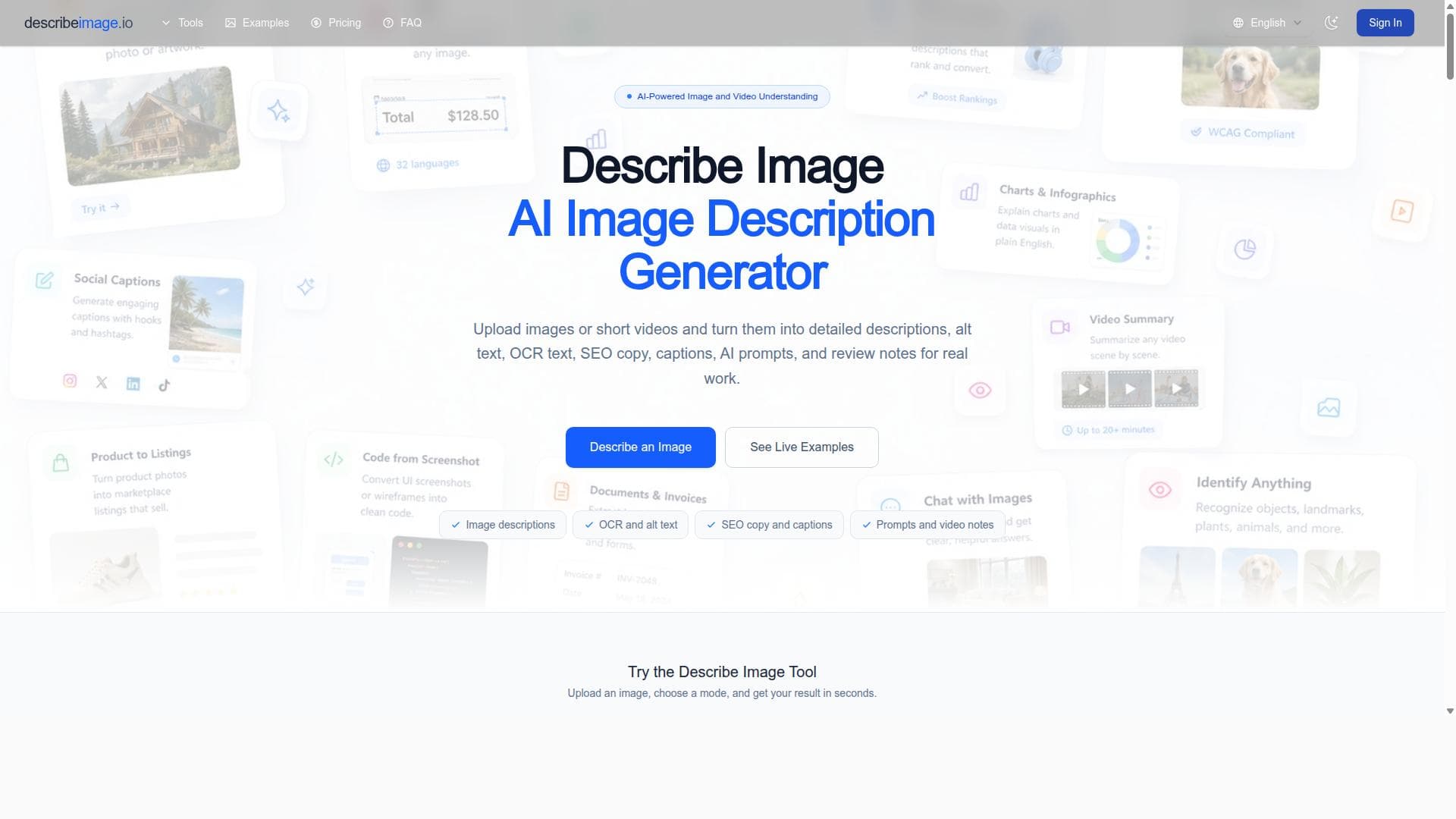


Describe Image is a versatile AI platform that transforms images and videos into detailed, structured text tailored for workflows like accessibility, SEO, ecommerce, and research. Its unique multi-output capabilities and interactive chat features make it ideal for professionals needing rich, context-aware visual analysis beyond simple recognition.

描述
Describe Image is an AI-powered image and video understanding platform that turns visual files into accurate, structured, and reusable text. Instead of providing only a generic caption or a list of detected objects, the platform offers task-specific workflows for people who need to understand, extract, document, publish, compare, or reuse information contained in images, screenshots, documents, product photos, charts, and videos. Users can upload a photo, screenshot, scan, illustration, design mockup, product image, receipt, invoice, chart, interface capture, or short video, select the output they need, and receive a result designed for that workflow. The platform can generate detailed image descriptions, concise summaries, accessibility-focused alt text, OCR text, SEO image copy, social captions, AI generation prompts, product descriptions, review notes, and timeline-based video analysis. The core Describe Image tool is designed for flexible visual understanding. It can identify the main subject, surrounding objects, visible text, composition, lighting, colors, visual style, spatial relationships, and important contextual details. Users can request a short description for quick reference or a more detailed analysis for research, documentation, creative planning, accessibility work, ecommerce, or content production. The goal is not simply to label what appears in an image, but to turn the visual evidence into text that can be edited, searched, shared, or used in another workflow. For accessibility teams, developers, publishers, and website owners, Describe Image can create alt text drafts that reflect the purpose and context of an image. The platform can produce concise alt text for standard web images, longer descriptions for complex visuals, and supporting notes that explain which details are important for a screen-reader user. This is useful for product pages, blogs, SaaS interfaces, educational content, public-sector websites, documentation, and other projects where images need meaningful text alternatives. AI-generated accessibility content should still be reviewed by a person who understands the page context, because the best alt text depends on why the image is being used. For SEO and content teams, the platform can turn an image into multiple pieces of search-ready metadata from one upload. Depending on the selected workflow, the output may include an SEO image title, alt text, a keyword-aware image description, a suggested filename, relevant image keywords, and a concise webpage caption. This helps teams write image copy based on what is actually visible instead of adding unrelated keywords or repeating the surrounding page text. The result can be adapted for blogs, landing pages, ecommerce stores, editorial websites, product catalogs, social posts, and image-heavy content libraries. The Screenshot to Text workflow is built for situations where useful information is trapped inside a screen capture. It can extract visible text from chats, slides, error messages, dashboards, code editors, forms, UI screens, support tickets, and other screenshots. Unlike basic character recognition that returns one unorganized block of text, the workflow is designed to preserve reading order, headings, lists, code structure, table-like sections, conversation context, and interface details when they are visible. The extracted result can then be copied into documentation, notes, emails, issue trackers, support replies, research files, or internal reports. The Image to Excel Converter focuses specifically on tables and structured data. Users can upload a screenshot, scan, or phone photo containing a table, review the detected rows, columns, headers, blank cells, and values in an editable spreadsheet preview, correct uncertain cells, and download the result as XLSX or CSV. It is useful for supplier price lists, inventory sheets, schedules, timesheets, order tables, invoices, account statements, archived business records, research tables, and other data that would otherwise need to be typed manually. When one image contains clearly separated tables, the converter can organize them into separate worksheet tabs. The tool prioritizes usable spreadsheet structure and visible values rather than trying to reproduce every font, border, color, formula, or hidden calculation from the original file. The Image to Prompt workflow helps creators and designers analyze a reference image before using it in an AI generation workflow. It can break down the subject, environment, composition, camera angle, lighting, color palette, visual style, mood, materials, and other visible characteristics, then turn those observations into a copy-ready prompt. This is useful for product visual planning, mood boards, concept development, social graphics, design references, creative briefs, and prompt research for image-generation platforms. The structured breakdown gives users a stronger starting point than a vague one-line prompt and makes it easier to decide which elements should be preserved, changed, or excluded. For ecommerce, catalog, and marketplace teams, the Product Image Description workflow can combine multiple views of the same item into one organized result. Users can upload up to several angles of a product, and the platform can consolidate visible evidence such as color, shape, components, controls, closures, texture, design details, included accessories, and other observable attributes. The result can be turned into a product title, descriptive copy, feature bullets, catalog notes, or a verification checklist. Importantly, the workflow separates details that are visible from claims that still require seller confirmation, such as exact material, dimensions, capacity, compatibility, ingredients, certifications, warranty, or performance. This helps teams create faster drafts without presenting visual guesses as verified specifications. Chat with Image adds a multi-turn conversation layer to visual analysis. After uploading a photo, screenshot, chart, receipt, document, product image, or design mockup, users can ask follow-up questions instead of accepting one fixed answer. They can request exact visible text, inspect a small area, ask about chart labels or trends, identify missing product details, compare sections of a screenshot, change the output format, create a summary, prepare a checklist, or turn the analysis into copy for another task. This progressive workflow is especially useful for dense visuals where the first answer provides an overview and later questions focus on the details that matter. Chat with Video applies the same idea to moving content, but organizes the analysis around time. Users can ask for a timestamped map of a clip, identify what happens first, review scene changes, inspect a specific moment, extract on-screen text, compare earlier and later scenes, follow an object or action, and convert the final conversation into notes, summaries, briefs, support documentation, training checklists, or review reports. A normal video summary compresses the entire clip into one answer; Chat with Video keeps the analysis open so users can move from a broad timeline to an exact scene, label, action, or transition. Describe Image is designed for a broad range of real working environments. Content creators can turn visuals into captions, summaries, and creative briefs. SEO professionals can prepare image metadata grounded in visible content. Ecommerce teams can review supplier photos and draft listings. Accessibility specialists can create and refine alt text. Developers and support teams can interpret interface screenshots and error states. Researchers can document reference images, charts, and scanned material. Educators can summarize slides and visual teaching resources. Marketing teams can review campaign assets. Operations teams can extract labels, tables, and inventory information. Designers can analyze composition and visual hierarchy before creating a new version. The platform is browser-based and supports common image workflows without requiring users to install a separate desktop application. A typical process is straightforward: upload or paste a visual file, choose the appropriate mode, review the generated result, refine it when necessary, and copy or export it into the next tool. Signed-in users can choose whether to save results for later access, while users should always review important outputs before publishing or making decisions. Describe Image is not intended to replace professional judgment. AI visual analysis can miss small text, misunderstand ambiguous objects, infer details that are not fully visible, or produce an incomplete interpretation. Technical documents, legal material, medical images, financial records, product specifications, charts, accessibility text, and spreadsheet conversions should be checked against the original source. The platform is most useful as a fast first-pass analysis and production assistant: it reduces repetitive visual inspection and manual transcription while keeping the user responsible for final verification. What distinguishes Describe Image from a simple image recognition tool is the combination of multiple task-specific outputs in one platform. A single visual file can become a description, OCR result, alt text draft, SEO package, product listing, AI prompt, spreadsheet, report note, or an interactive conversation. This makes the platform useful not only for understanding what an image contains, but also for converting visual information into practical content and structured data that can move directly into real workflows.
详细描述
However, users should be aware of limitations inherent to AI visual analysis. The platform may miss small or ambiguous text, misinterpret unclear objects, infer details not fully visible, or provide incomplete interpretations. Outputs related to technical, legal, medical, or financial content require careful human verification against original sources. Describe Image is best used as a fast first-pass analysis and productivity assistant that reduces manual inspection and transcription, while keeping users responsible for final validation. This balance ensures efficiency without compromising accuracy in critical applications. Overall, Describe Image offers a unique combination of multi-output AI-powered visual understanding workflows designed to convert images and videos into practical, structured, and actionable text content for diverse professional environments.
工具功能
- Upload any image and get detailed AI-powered descriptions instantly
- Identify objects, scenes, text, and colors in images
- Generate alt text for accessibility
- Perform OCR (Optical Character Recognition) on images
- Create SEO copy, captions, prompts, and scene notes
- Supports content creation, ecommerce, accessibility, and research
描述
Describe Image is a versatile AI platform that transforms images and videos into detailed, structured text tailored for workflows like accessibility, SEO, ecommerce, and research. Its unique multi-output capabilities and interactive chat features make it ideal for professionals needing rich, context-aware visual analysis beyond simple recognition.
Describe Image is an AI-powered image and video understanding platform that turns visual files into accurate, structured, and reusable text. Instead of providing only a generic caption or a list of detected objects, the platform offers task-specific workflows for people who need to understand, extract, document, publish, compare, or reuse information contained in images, screenshots, documents, product photos, charts, and videos. Users can upload a photo, screenshot, scan, illustration, design mockup, product image, receipt, invoice, chart, interface capture, or short video, select the output they need, and receive a result designed for that workflow. The platform can generate detailed image descriptions, concise summaries, accessibility-focused alt text, OCR text, SEO image copy, social captions, AI generation prompts, product descriptions, review notes, and timeline-based video analysis. The core Describe Image tool is designed for flexible visual understanding. It can identify the main subject, surrounding objects, visible text, composition, lighting, colors, visual style, spatial relationships, and important contextual details. Users can request a short description for quick reference or a more detailed analysis for research, documentation, creative planning, accessibility work, ecommerce, or content production. The goal is not simply to label what appears in an image, but to turn the visual evidence into text that can be edited, searched, shared, or used in another workflow. For accessibility teams, developers, publishers, and website owners, Describe Image can create alt text drafts that reflect the purpose and context of an image. The platform can produce concise alt text for standard web images, longer descriptions for complex visuals, and supporting notes that explain which details are important for a screen-reader user. This is useful for product pages, blogs, SaaS interfaces, educational content, public-sector websites, documentation, and other projects where images need meaningful text alternatives. AI-generated accessibility content should still be reviewed by a person who understands the page context, because the best alt text depends on why the image is being used. For SEO and content teams, the platform can turn an image into multiple pieces of search-ready metadata from one upload. Depending on the selected workflow, the output may include an SEO image title, alt text, a keyword-aware image description, a suggested filename, relevant image keywords, and a concise webpage caption. This helps teams write image copy based on what is actually visible instead of adding unrelated keywords or repeating the surrounding page text. The result can be adapted for blogs, landing pages, ecommerce stores, editorial websites, product catalogs, social posts, and image-heavy content libraries. The Screenshot to Text workflow is built for situations where useful information is trapped inside a screen capture. It can extract visible text from chats, slides, error messages, dashboards, code editors, forms, UI screens, support tickets, and other screenshots. Unlike basic character recognition that returns one unorganized block of text, the workflow is designed to preserve reading order, headings, lists, code structure, table-like sections, conversation context, and interface details when they are visible. The extracted result can then be copied into documentation, notes, emails, issue trackers, support replies, research files, or internal reports. The Image to Excel Converter focuses specifically on tables and structured data. Users can upload a screenshot, scan, or phone photo containing a table, review the detected rows, columns, headers, blank cells, and values in an editable spreadsheet preview, correct uncertain cells, and download the result as XLSX or CSV. It is useful for supplier price lists, inventory sheets, schedules, timesheets, order tables, invoices, account statements, archived business records, research tables, and other data that would otherwise need to be typed manually. When one image contains clearly separated tables, the converter can organize them into separate worksheet tabs. The tool prioritizes usable spreadsheet structure and visible values rather than trying to reproduce every font, border, color, formula, or hidden calculation from the original file. The Image to Prompt workflow helps creators and designers analyze a reference image before using it in an AI generation workflow. It can break down the subject, environment, composition, camera angle, lighting, color palette, visual style, mood, materials, and other visible characteristics, then turn those observations into a copy-ready prompt. This is useful for product visual planning, mood boards, concept development, social graphics, design references, creative briefs, and prompt research for image-generation platforms. The structured breakdown gives users a stronger starting point than a vague one-line prompt and makes it easier to decide which elements should be preserved, changed, or excluded. For ecommerce, catalog, and marketplace teams, the Product Image Description workflow can combine multiple views of the same item into one organized result. Users can upload up to several angles of a product, and the platform can consolidate visible evidence such as color, shape, components, controls, closures, texture, design details, included accessories, and other observable attributes. The result can be turned into a product title, descriptive copy, feature bullets, catalog notes, or a verification checklist. Importantly, the workflow separates details that are visible from claims that still require seller confirmation, such as exact material, dimensions, capacity, compatibility, ingredients, certifications, warranty, or performance. This helps teams create faster drafts without presenting visual guesses as verified specifications. Chat with Image adds a multi-turn conversation layer to visual analysis. After uploading a photo, screenshot, chart, receipt, document, product image, or design mockup, users can ask follow-up questions instead of accepting one fixed answer. They can request exact visible text, inspect a small area, ask about chart labels or trends, identify missing product details, compare sections of a screenshot, change the output format, create a summary, prepare a checklist, or turn the analysis into copy for another task. This progressive workflow is especially useful for dense visuals where the first answer provides an overview and later questions focus on the details that matter. Chat with Video applies the same idea to moving content, but organizes the analysis around time. Users can ask for a timestamped map of a clip, identify what happens first, review scene changes, inspect a specific moment, extract on-screen text, compare earlier and later scenes, follow an object or action, and convert the final conversation into notes, summaries, briefs, support documentation, training checklists, or review reports. A normal video summary compresses the entire clip into one answer; Chat with Video keeps the analysis open so users can move from a broad timeline to an exact scene, label, action, or transition. Describe Image is designed for a broad range of real working environments. Content creators can turn visuals into captions, summaries, and creative briefs. SEO professionals can prepare image metadata grounded in visible content. Ecommerce teams can review supplier photos and draft listings. Accessibility specialists can create and refine alt text. Developers and support teams can interpret interface screenshots and error states. Researchers can document reference images, charts, and scanned material. Educators can summarize slides and visual teaching resources. Marketing teams can review campaign assets. Operations teams can extract labels, tables, and inventory information. Designers can analyze composition and visual hierarchy before creating a new version. The platform is browser-based and supports common image workflows without requiring users to install a separate desktop application. A typical process is straightforward: upload or paste a visual file, choose the appropriate mode, review the generated result, refine it when necessary, and copy or export it into the next tool. Signed-in users can choose whether to save results for later access, while users should always review important outputs before publishing or making decisions. Describe Image is not intended to replace professional judgment. AI visual analysis can miss small text, misunderstand ambiguous objects, infer details that are not fully visible, or produce an incomplete interpretation. Technical documents, legal material, medical images, financial records, product specifications, charts, accessibility text, and spreadsheet conversions should be checked against the original source. The platform is most useful as a fast first-pass analysis and production assistant: it reduces repetitive visual inspection and manual transcription while keeping the user responsible for final verification. What distinguishes Describe Image from a simple image recognition tool is the combination of multiple task-specific outputs in one platform. A single visual file can become a description, OCR result, alt text draft, SEO package, product listing, AI prompt, spreadsheet, report note, or an interactive conversation. This makes the platform useful not only for understanding what an image contains, but also for converting visual information into practical content and structured data that can move directly into real workflows.
详细描述
However, users should be aware of limitations inherent to AI visual analysis. The platform may miss small or ambiguous text, misinterpret unclear objects, infer details not fully visible, or provide incomplete interpretations. Outputs related to technical, legal, medical, or financial content require careful human verification against original sources. Describe Image is best used as a fast first-pass analysis and productivity assistant that reduces manual inspection and transcription, while keeping users responsible for final validation. This balance ensures efficiency without compromising accuracy in critical applications. Overall, Describe Image offers a unique combination of multi-output AI-powered visual understanding workflows designed to convert images and videos into practical, structured, and actionable text content for diverse professional environments.
常见问题
What is Describe Image?
Describe Image is an AI-powered platform that converts images and videos into accurate, structured, and reusable text outputs. It offers task-specific workflows such as detailed descriptions, alt text generation, OCR extraction, SEO metadata creation, product descriptions, and interactive visual analysis to support diverse professional needs.
How much does Describe Image cost?
Describe Image operates as a browser-based platform with options for signed-in users to save results. Specific pricing details or subscription plans are not publicly listed and may require contacting the provider directly for information on enterprise or volume licensing.
Who is Describe Image best for?
Describe Image is ideal for content creators, SEO professionals, ecommerce teams, accessibility specialists, developers, researchers, educators, marketing and operations teams, and designers who need detailed, context-aware visual content analysis and structured text outputs for their workflows.
What are the main features of Describe Image?
Key features include AI-powered detailed image descriptions, alt text generation for accessibility, OCR text extraction preserving structure, SEO image metadata creation, product image description consolidation, image-to-excel table conversion, AI prompt generation from images, and interactive chat workflows for images and videos.
Does Describe Image offer a free trial?
The publicly available information does not specify a free trial. Users can access the browser-based platform directly, but for detailed trial or demo options, contacting the provider is recommended.
What integrations does Describe Image support?
Describe Image is primarily a browser-based tool focused on visual file uploads and exports. It does not list direct integrations with third-party platforms but supports exporting results for use in documentation, emails, issue trackers, ecommerce listings, and other workflows.
How does Describe Image work?
Users upload or paste an image or short video, select a workflow tailored to their needs (e.g., alt text, OCR, SEO copy, product description), and the AI analyzes visual content including objects, text, composition, and context. Outputs can be reviewed, refined, and exported. Interactive chat features allow multi-turn Q&A for deeper analysis.
评价
暂无评价。成为第一个分享使用体验的人。