AI Styling Studio — 只需一张照片即可生成无限头像造型。 立即体验.
Claude Code usage tracking by LangWatch
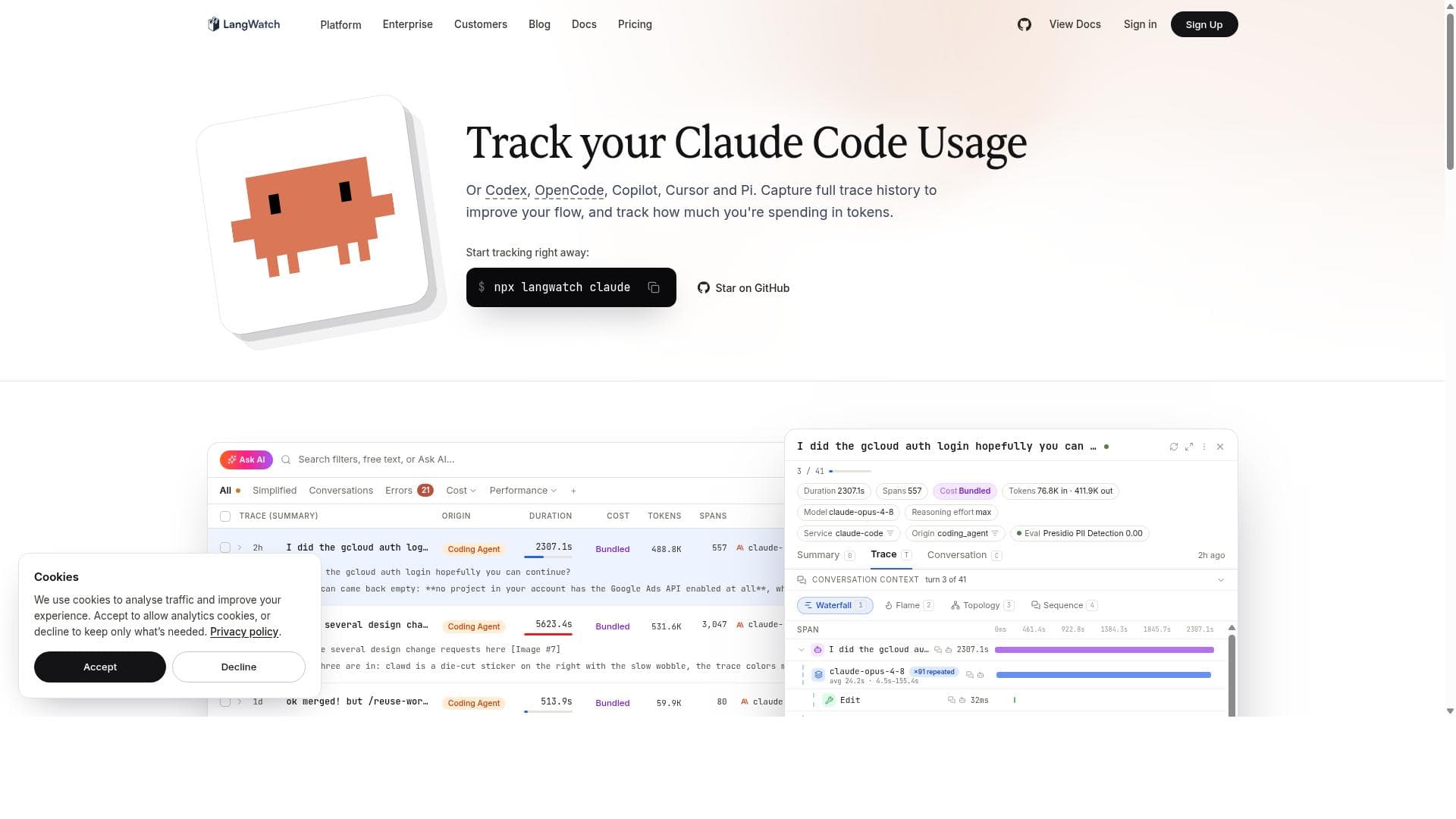


LangWatch Claude Code Usage offers detailed, multi-agent AI usage tracking with token-level granularity and cost estimation, making it ideal for developers and enterprises managing Claude Code and similar AI tools. Its automatic redaction of secrets and support for enterprise policies ensure secure, compliant monitoring across multiple machines and sessions.

描述
Track Claude Code usage: cost, cache, session replay. Run `npx langwatch claude` once. Every session gets cost with cache reads/writes as separate token classes, every bash and MCP call as a span, theoretical vs billed for your Max plan, and a full terminal replay in the UI. Works for Codex too.
详细描述
LangWatch Claude Code Usage is a sophisticated monitoring and analytics tool designed to provide comprehensive trace history and usage insights for Claude Code and a variety of other AI agents such as Codex, OpenCode, Copilot, Cursor, and Pi. Its core purpose is to enable developers, teams, and enterprises to track their AI interactions in detail, capturing token usage by class—including cache reads and writes—and calculating theoretical spending on bundled subscription plans. This level of detailed tracking helps users understand their AI consumption patterns and manage costs effectively, especially when operating across multiple machines and sessions. One of the standout features of LangWatch Claude Code Usage is its ability to deliver a full trace history for multiple AI agents through a unified OpenTelemetry (OTLP) endpoint. This means that all usage data from different agents funnels into a single store, allowing for consolidated monitoring and analysis. The tool meticulously tracks tokens by class, distinguishing between input tokens, output tokens, cache reads, and cache writes, each priced at their own rates. This granular token classification is critical because cache reads often constitute the majority of token volume in long agent sessions, and lumping them together with input tokens can lead to inaccurate cost assessments. LangWatch also calculates theoretical costs for sessions on bundled Claude subscriptions (Pro, Max, Team) by applying API list prices per token class, providing users with a clear understanding of what their usage would cost if billed per token. Security and privacy are paramount in LangWatch’s design. The platform automatically redacts API secrets and personally identifiable information (PII) from all traces, ensuring that sensitive data is never stored or exposed. For organizations requiring enhanced control, LangWatch supports enterprise policies and self-hosted setups, enabling tighter governance over data and compliance with internal security standards. LangWatch Claude Code Usage is best suited for developers, AI researchers, and organizations that rely heavily on Claude Code and other AI coding assistants. It is particularly valuable for teams managing multiple AI agents across various environments who need to consolidate usage data and optimize their subscription plans. Use cases include monitoring AI token consumption to avoid unexpected costs, auditing AI interactions for compliance, and analyzing agent behavior to improve development workflows. Regarding pricing, LangWatch offers insights into theoretical spending based on bundled subscription plans, but specific pricing details for LangWatch itself are not explicitly stated in the provided information. Potential users should consult the LangWatch website or contact their sales team for detailed pricing and plan options. Compared to alternatives, LangWatch stands out by supporting multiple AI agents through a single OTLP endpoint and providing token-level granularity, including cache operations, which many other tools overlook. Its automatic redaction of secrets and PII and support for enterprise-grade policies and self-hosted deployments further differentiate it from simpler usage trackers that may lack these security and compliance features. However, users should consider that LangWatch’s reliance on OpenTelemetry export means initial setup may require some technical configuration, which could be a barrier for less technical users. Additionally, while it tracks theoretical costs on bundled plans, actual billing may vary depending on subscription specifics, so users should interpret cost estimates accordingly. Finally, detailed pricing for LangWatch’s own service is not publicly detailed, which may require direct inquiry for budgeting purposes. In summary, LangWatch Claude Code Usage is a powerful, security-conscious AI usage monitoring tool tailored for developers and enterprises using Claude Code and other AI agents. Its detailed token tracking, cost estimation, and multi-agent support make it an essential tool for managing AI usage and expenses effectively across complex environments.
工具功能
- Full trace history for Claude Code and other AI agents
- Tracks tokens by class including cache reads and writes
- Calculates theoretical spend on bundled subscription plans
- Supports multiple agents exporting through the same OTLP endpoint
- Redacts API secrets and personal information automatically
- Supports enterprise policies and self-hosted setups for tighter control
描述
LangWatch Claude Code Usage offers detailed, multi-agent AI usage tracking with token-level granularity and cost estimation, making it ideal for developers and enterprises managing Claude Code and similar AI tools. Its automatic redaction of secrets and support for enterprise policies ensure secure, compliant monitoring across multiple machines and sessions.
Track Claude Code usage: cost, cache, session replay. Run `npx langwatch claude` once. Every session gets cost with cache reads/writes as separate token classes, every bash and MCP call as a span, theoretical vs billed for your Max plan, and a full terminal replay in the UI. Works for Codex too.
详细描述
LangWatch Claude Code Usage is a sophisticated monitoring and analytics tool designed to provide comprehensive trace history and usage insights for Claude Code and a variety of other AI agents such as Codex, OpenCode, Copilot, Cursor, and Pi. Its core purpose is to enable developers, teams, and enterprises to track their AI interactions in detail, capturing token usage by class—including cache reads and writes—and calculating theoretical spending on bundled subscription plans. This level of detailed tracking helps users understand their AI consumption patterns and manage costs effectively, especially when operating across multiple machines and sessions. One of the standout features of LangWatch Claude Code Usage is its ability to deliver a full trace history for multiple AI agents through a unified OpenTelemetry (OTLP) endpoint. This means that all usage data from different agents funnels into a single store, allowing for consolidated monitoring and analysis. The tool meticulously tracks tokens by class, distinguishing between input tokens, output tokens, cache reads, and cache writes, each priced at their own rates. This granular token classification is critical because cache reads often constitute the majority of token volume in long agent sessions, and lumping them together with input tokens can lead to inaccurate cost assessments. LangWatch also calculates theoretical costs for sessions on bundled Claude subscriptions (Pro, Max, Team) by applying API list prices per token class, providing users with a clear understanding of what their usage would cost if billed per token. Security and privacy are paramount in LangWatch’s design. The platform automatically redacts API secrets and personally identifiable information (PII) from all traces, ensuring that sensitive data is never stored or exposed. For organizations requiring enhanced control, LangWatch supports enterprise policies and self-hosted setups, enabling tighter governance over data and compliance with internal security standards. LangWatch Claude Code Usage is best suited for developers, AI researchers, and organizations that rely heavily on Claude Code and other AI coding assistants. It is particularly valuable for teams managing multiple AI agents across various environments who need to consolidate usage data and optimize their subscription plans. Use cases include monitoring AI token consumption to avoid unexpected costs, auditing AI interactions for compliance, and analyzing agent behavior to improve development workflows. Regarding pricing, LangWatch offers insights into theoretical spending based on bundled subscription plans, but specific pricing details for LangWatch itself are not explicitly stated in the provided information. Potential users should consult the LangWatch website or contact their sales team for detailed pricing and plan options. Compared to alternatives, LangWatch stands out by supporting multiple AI agents through a single OTLP endpoint and providing token-level granularity, including cache operations, which many other tools overlook. Its automatic redaction of secrets and PII and support for enterprise-grade policies and self-hosted deployments further differentiate it from simpler usage trackers that may lack these security and compliance features. However, users should consider that LangWatch’s reliance on OpenTelemetry export means initial setup may require some technical configuration, which could be a barrier for less technical users. Additionally, while it tracks theoretical costs on bundled plans, actual billing may vary depending on subscription specifics, so users should interpret cost estimates accordingly. Finally, detailed pricing for LangWatch’s own service is not publicly detailed, which may require direct inquiry for budgeting purposes. In summary, LangWatch Claude Code Usage is a powerful, security-conscious AI usage monitoring tool tailored for developers and enterprises using Claude Code and other AI agents. Its detailed token tracking, cost estimation, and multi-agent support make it an essential tool for managing AI usage and expenses effectively across complex environments.
常见问题
What is LangWatch Claude Code Usage?
LangWatch Claude Code Usage is a monitoring tool that provides a comprehensive trace history and token usage analytics for Claude Code and other AI agents like Codex, OpenCode, Copilot, Cursor, and Pi. It tracks tokens by class, including cache reads and writes, and calculates theoretical spending on bundled subscription plans to help users monitor AI usage and costs effectively.
How much does LangWatch Claude Code Usage cost?
Specific pricing details for LangWatch Claude Code Usage are not publicly provided. The tool calculates theoretical spending based on bundled Claude subscription plans, but for LangWatch’s own pricing and plans, users should visit the official website or contact LangWatch directly for detailed information.
Who is LangWatch Claude Code Usage best for?
LangWatch Claude Code Usage is best suited for developers, AI researchers, and organizations that use Claude Code and other AI coding assistants extensively. It is particularly useful for teams managing multiple AI agents across various environments who need detailed usage tracking, cost monitoring, and security compliance.
What are the main features of LangWatch Claude Code Usage?
Key features include full trace history for Claude Code and other AI agents, token tracking by class including cache reads and writes, theoretical cost calculation on bundled plans, support for multiple agents exporting through the same OTLP endpoint, automatic redaction of API secrets and personal information, and support for enterprise policies and self-hosted setups.
Does LangWatch Claude Code Usage offer a free trial?
The provided information does not specify whether LangWatch Claude Code Usage offers a free trial. Interested users should check the official LangWatch website or contact their support team to inquire about trial availability.
What integrations does LangWatch Claude Code Usage support?
LangWatch Claude Code Usage supports integration with multiple AI agents including Claude Code, Codex, OpenCode, Copilot, Cursor, and Pi, all exporting usage data through a common OpenTelemetry (OTLP) endpoint for unified tracking and analysis.
How does LangWatch Claude Code Usage work?
Users run a command (e.g., 'npx langwatch claude') to configure Claude Code’s native OpenTelemetry export to LangWatch. Each AI session generates a trace containing model turns, tool calls, token usage by class, and theoretical cost. The OTLP endpoint collects data from multiple agents and machines, allowing centralized monitoring that persists beyond local log cleanup.
社交媒体
使用工具评价
暂无评价。成为第一个分享使用体验的人。
赞助工具



















推荐工具
及时了解最新 AI 工具
获取最新资讯,订阅我们的新闻通讯
已有 50,000+ 位读者阅读并信赖
加入最大的 AI 社区
我们的社区和团队随时为您提供帮助!
您的反馈将帮助 Alice AI 在未来版本中不断改进。