🚀 Zaprep: Your Socials on Steroids. 免费开始 — 每月自动发送 1,000 条私信,将互动转化为潜在客户。 ,每月 1,000 条自动私信。


这是您的 AI 工具吗?立即认领。
验证所有权、管理资料,并解锁增长功能。
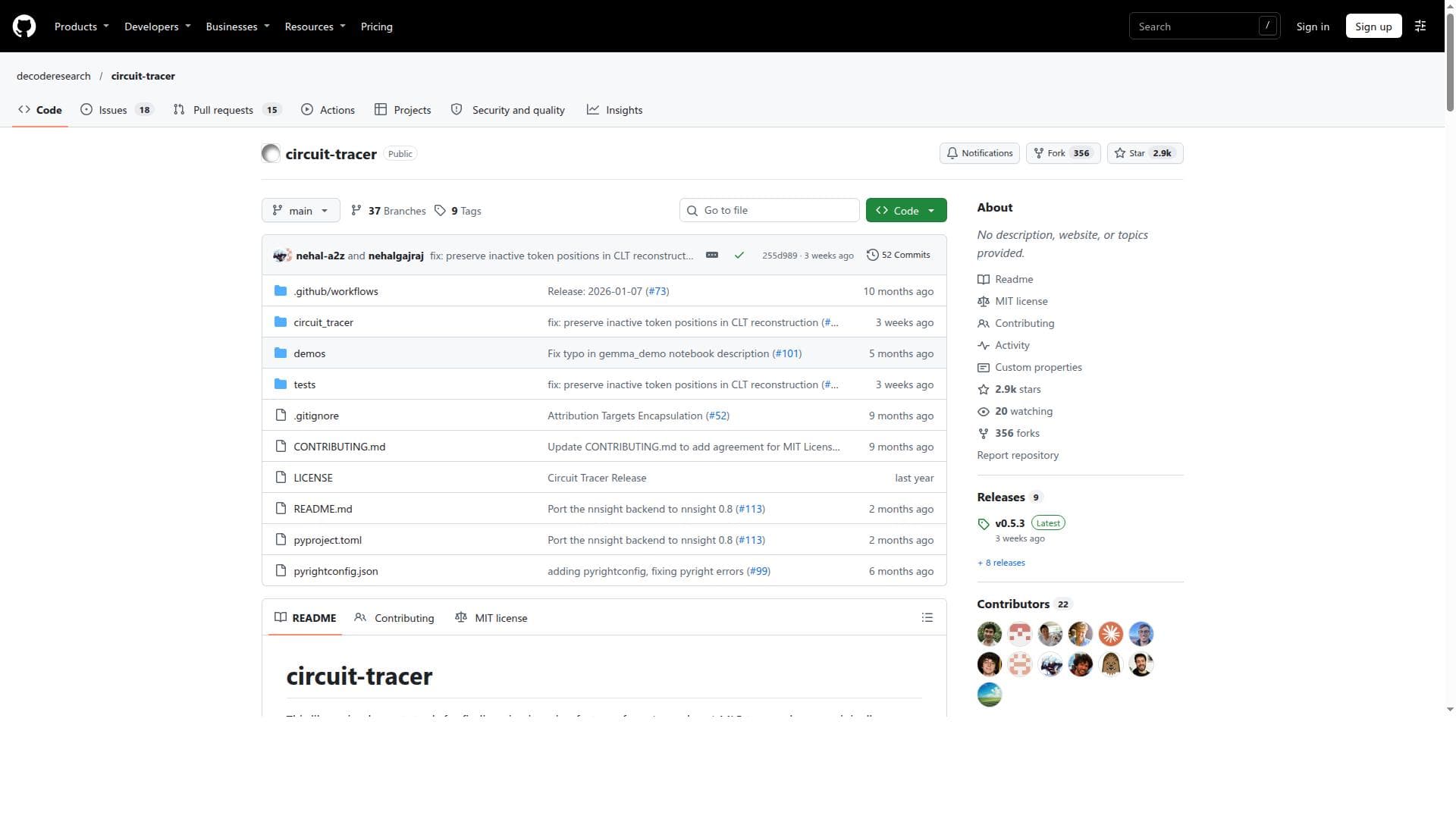
Circuit-tracer is a powerful open-source tool for tracing and visualizing electronic circuits, designed to help engineers and developers debug and analyze complex circuit layouts. Its community-driven development and GitHub hosting make it an ideal choice for those seeking a customizable and collaborative circuit analysis solution.

描述
Anthropic's open-source Circuit Tracer helps researchers understand LLMs by visualizing internal computations as attribution graphs. Explore on Neuronpedia or use the library. Aims for AI transparency.
详细描述
Circuit-tracer is an open-source software tool designed to facilitate the tracing, visualization, and analysis of electronic circuits. Its core purpose is to help developers, engineers, and hobbyists gain a deeper understanding of circuit layouts and connections by providing a comprehensive platform for circuit debugging and inspection. By enabling users to visually map out circuit components and their interconnections, circuit-tracer simplifies the process of diagnosing issues, optimizing designs, and verifying circuit functionality. Being hosted on GitHub, it encourages an active community of contributors to continuously improve its features and usability. One of the key features of circuit-tracer is its open-source nature, which allows users to access, modify, and extend the tool freely. This fosters collaborative development and ensures that the tool evolves in response to real-world user needs. The tool supports detailed visualization of electronic circuits, enabling users to see the layout and trace signal paths clearly. This visualization capability is crucial for debugging complex circuits where understanding the flow of current and signal integrity is essential. Additionally, circuit-tracer offers tools for analyzing circuit layouts, helping users identify potential design flaws or connectivity issues. The platform’s integration with GitHub provides robust version control and easy access to updates, bug fixes, and new features contributed by the community. Circuit-tracer is best suited for electrical engineers, hardware developers, electronics hobbyists, and educators who require a reliable tool to analyze and debug circuit designs. It is particularly useful in scenarios where understanding intricate circuit connections is necessary, such as in prototyping, troubleshooting hardware failures, or teaching circuit theory. The tool’s open-source model also makes it attractive for academic research and collaborative projects where customization and transparency are valued. As an open-source project, circuit-tracer is available free of charge, making it accessible to a wide range of users without financial barriers. There are no subscription fees or premium plans, which is a significant advantage for students and small teams working on limited budgets. Users can freely download the software from its GitHub repository, contribute to its development, and request features or report issues through the platform’s issue tracking system. Compared to proprietary circuit analysis tools, circuit-tracer offers a flexible and community-driven alternative. While commercial tools may provide more polished interfaces or advanced automated features, circuit-tracer’s open-source approach allows for greater customization and transparency. Users who prefer to tailor their tools to specific workflows or integrate them with other open-source projects will find circuit-tracer particularly valuable. However, unlike some commercial solutions, circuit-tracer may require a steeper learning curve and more hands-on involvement to maximize its potential. Notable limitations of circuit-tracer include its reliance on community contributions for feature enhancements and support, which may affect the speed of updates and the availability of comprehensive documentation. Additionally, as an open-source tool, it might lack some of the advanced simulation capabilities or user-friendly interfaces found in commercial circuit design software. Users should also consider that circuit-tracer primarily focuses on tracing and visualization rather than full-scale circuit simulation or automated design verification. Despite these considerations, circuit-tracer remains a powerful and accessible tool for those seeking an open, collaborative platform to analyze and debug electronic circuits.
工具功能
- Open-source circuit tracing tool
- Facilitates visualization of electronic circuits
- Supports debugging and analysis of circuit layouts
- Encourages community collaboration and contributions
- Hosted on GitHub for easy access and version control
描述
Circuit-tracer is a powerful open-source tool for tracing and visualizing electronic circuits, designed to help engineers and developers debug and analyze complex circuit layouts. Its community-driven development and GitHub hosting make it an ideal choice for those seeking a customizable and collaborative circuit analysis solution.
Anthropic's open-source Circuit Tracer helps researchers understand LLMs by visualizing internal computations as attribution graphs. Explore on Neuronpedia or use the library. Aims for AI transparency.
详细描述
Circuit-tracer is an open-source software tool designed to facilitate the tracing, visualization, and analysis of electronic circuits. Its core purpose is to help developers, engineers, and hobbyists gain a deeper understanding of circuit layouts and connections by providing a comprehensive platform for circuit debugging and inspection. By enabling users to visually map out circuit components and their interconnections, circuit-tracer simplifies the process of diagnosing issues, optimizing designs, and verifying circuit functionality. Being hosted on GitHub, it encourages an active community of contributors to continuously improve its features and usability. One of the key features of circuit-tracer is its open-source nature, which allows users to access, modify, and extend the tool freely. This fosters collaborative development and ensures that the tool evolves in response to real-world user needs. The tool supports detailed visualization of electronic circuits, enabling users to see the layout and trace signal paths clearly. This visualization capability is crucial for debugging complex circuits where understanding the flow of current and signal integrity is essential. Additionally, circuit-tracer offers tools for analyzing circuit layouts, helping users identify potential design flaws or connectivity issues. The platform’s integration with GitHub provides robust version control and easy access to updates, bug fixes, and new features contributed by the community. Circuit-tracer is best suited for electrical engineers, hardware developers, electronics hobbyists, and educators who require a reliable tool to analyze and debug circuit designs. It is particularly useful in scenarios where understanding intricate circuit connections is necessary, such as in prototyping, troubleshooting hardware failures, or teaching circuit theory. The tool’s open-source model also makes it attractive for academic research and collaborative projects where customization and transparency are valued. As an open-source project, circuit-tracer is available free of charge, making it accessible to a wide range of users without financial barriers. There are no subscription fees or premium plans, which is a significant advantage for students and small teams working on limited budgets. Users can freely download the software from its GitHub repository, contribute to its development, and request features or report issues through the platform’s issue tracking system. Compared to proprietary circuit analysis tools, circuit-tracer offers a flexible and community-driven alternative. While commercial tools may provide more polished interfaces or advanced automated features, circuit-tracer’s open-source approach allows for greater customization and transparency. Users who prefer to tailor their tools to specific workflows or integrate them with other open-source projects will find circuit-tracer particularly valuable. However, unlike some commercial solutions, circuit-tracer may require a steeper learning curve and more hands-on involvement to maximize its potential. Notable limitations of circuit-tracer include its reliance on community contributions for feature enhancements and support, which may affect the speed of updates and the availability of comprehensive documentation. Additionally, as an open-source tool, it might lack some of the advanced simulation capabilities or user-friendly interfaces found in commercial circuit design software. Users should also consider that circuit-tracer primarily focuses on tracing and visualization rather than full-scale circuit simulation or automated design verification. Despite these considerations, circuit-tracer remains a powerful and accessible tool for those seeking an open, collaborative platform to analyze and debug electronic circuits.
常见问题
What is circuit-tracer?
Circuit-tracer is an open-source software tool that enables users to trace, visualize, and analyze electronic circuits. It helps developers and engineers understand circuit layouts and connections for debugging and design optimization.
How much does circuit-tracer cost?
Circuit-tracer is completely free to use as it is an open-source project hosted on GitHub, with no subscription fees or paid plans.
Who is circuit-tracer best for?
Circuit-tracer is best suited for electrical engineers, hardware developers, electronics hobbyists, and educators who need to analyze and debug circuit designs effectively.
What are the main features of circuit-tracer?
Its main features include open-source access, detailed circuit visualization, debugging and analysis tools for circuit layouts, community collaboration, and GitHub-based version control.
Does circuit-tracer offer a free trial?
Since circuit-tracer is open-source and free to use, there is no need for a free trial; users can download and use it immediately from GitHub.
What integrations does circuit-tracer support?
Circuit-tracer is primarily hosted on GitHub, allowing integration with Git version control and collaboration tools. Specific integrations with other software depend on community contributions and user customization.
How does circuit-tracer work?
Circuit-tracer works by allowing users to input circuit designs and then visually trace the connections and layout of components. It provides tools to analyze and debug the circuit by mapping signal paths and identifying potential issues.
社交媒体
使用工具评价
暂无评价。成为第一个分享使用体验的人。
赞助工具










































推荐工具
及时了解最新 AI 工具
获取最新资讯,订阅我们的新闻通讯
已有 50,000+ 位读者阅读并信赖
加入最大的 AI 社区
我们的社区和团队随时为您提供帮助!
您的反馈将帮助 Alice AI 在未来版本中不断改进。