🚀 Zaprep: Your Socials on Steroids. 免费开始 — 每月自动发送 1,000 条私信,将互动转化为潜在客户。 ,每月 1,000 条自动私信。
博客What AI Gets Wrong About Academic Assignments - and How Students Can Catch It
What AI Gets Wrong About Academic Assignments - and How Students Can Catch It
 Shashank Jain
2026年9月16日
5 分钟阅读
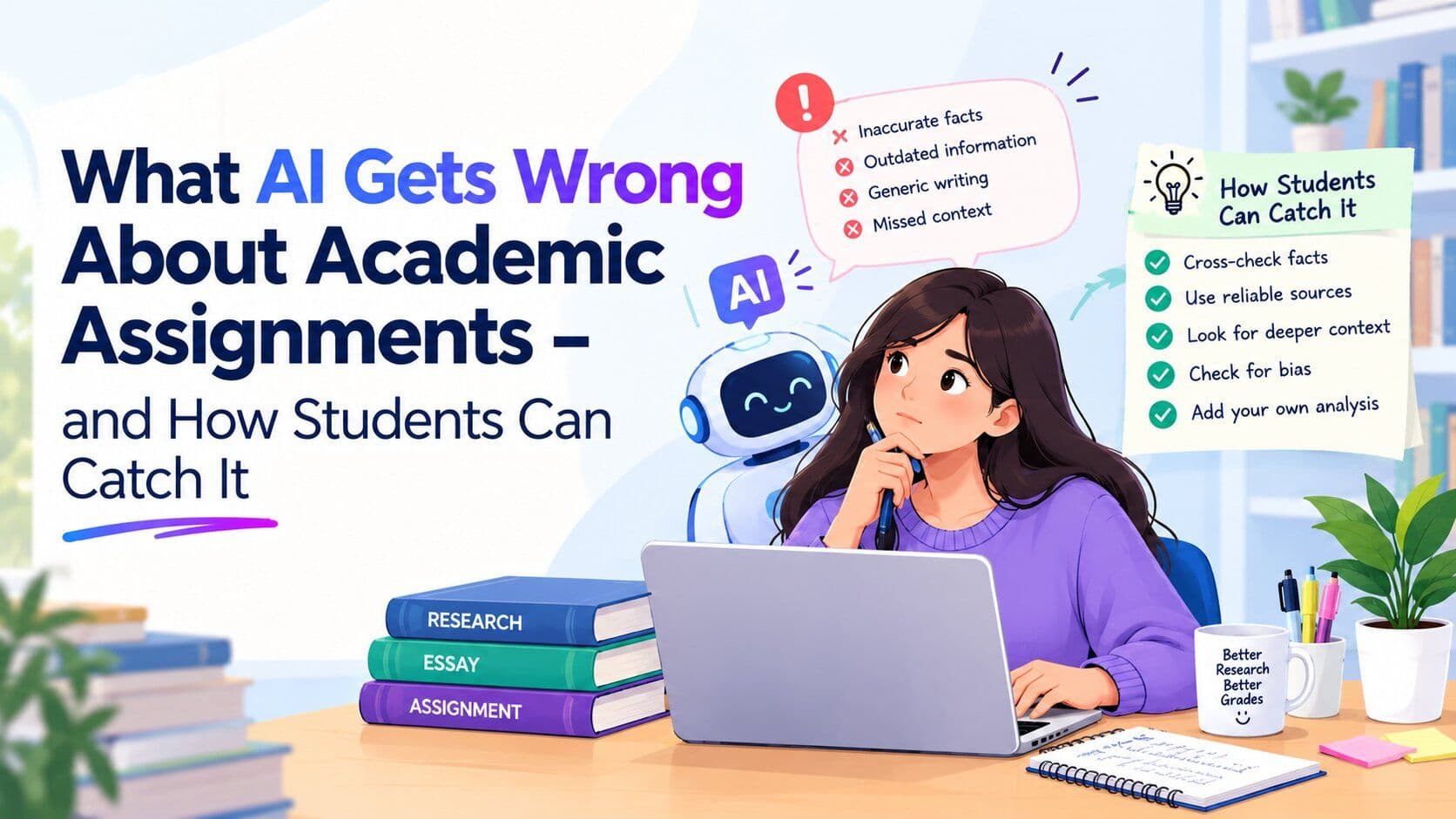
AI can be incredibly useful when you are working on an assignment, but its polished answers can hide some surprisingly basic mistakes. It may invent a source, misunderstand what your professor asked, mix up facts, or give you an explanation that sounds convincing without actually saying much. The good news is that most of these problems are easier to catch once you know what to look for.
What AI Gets Wrong About Academic Assignments - and How Students Can Catch It
AI can be incredibly useful when you are working on an assignment, but its polished answers can hide some surprisingly basic mistakes. It may invent a source, misunderstand what your professor asked, mix up facts, or give you an explanation that sounds convincing without actually saying much. The good news is that most of these problems are easier to catch once you know what to look for.
In the case of coursework, it can make a great difference. An imaginary source, a misinterpreted question, or even a mistake in facts will be enough to ruin an otherwise solid paper. You do not have to avoid using AI tools, though! You just need to learn how to verify the information you receive.
AI Can Be Confident of Something It Does Not Know
Perhaps the most bizarre aspect of AI generation is that sometimes it offers incorrect information without even giving any hints that something is wrong. The text can be flawless and even sound like it was taken out of a textbook with a false date, an imaginary statistic, or an incomplete explanation.
The problem becomes particularly relevant for topic-oriented tasks. For instance, when doing your assignment, you should consider such elements as clinical topics, research data, patient care, medical terminology, and assignment requirements altogether. Checking all these aspects becomes an additional responsibility in the process of writing.
In that situation, college essay service can provide academic writing support specifically for any-related work. With part of the writing pressure under control, you can spend more of your time checking evidence, reviewing course material, and learning why an answer is correct instead of simply accepting whatever AI produces.
AI Can Invent Sources – A Very Common Error To Make
One such error deserves particular emphasis due to the fact that it can be hard to notice it at all: invented sources. In addition to an academic title, author names, journal name, and even the year of publication, AI can also generate a DOI-like number. However, once you try to find such an article, you will see that there is no such paper at all.
Such a mistake is widely referred to as an AI "hallucination." The National Institute of Standards and Technology has investigated the problem and states that large language models can generate factually incorrect information and fabricated knowledge. This alone is enough reason not to put any reference suggested by AI into your bibliography immediately.
Always find the paper in question on Google Scholar, PubMed, your university's library website, or another database that is required for the course. Always check the author, title, year of publishing, and contents. Moreover, always make sure that the source is relevant to the sentence where it is used.
In Other Cases, AI Answers Another Question
AI doesn’t have to be mistaken about the topic. It can just be mistaken about the question.
Your professor has asked you to critique a theory. What you get is a nice summary of what the theory claims. This information can be all correct, yet the response won’t work since summarizing and critiquing are different activities.
Assignment instructions include a variety of keywords for a reason. “Explain,” “discuss,” “analyze,” “evaluate,” and “compare” cannot be used interchangeably. Always ask yourself one thing before submitting any AI content: Is this really doing what I was told to do?
Common AI Mistakes and How to Catch Them
You do not need to become an AI expert to notice trouble. Most problems leave clues once you know what to look for.
What AI may get wrong | Warning sign | What you should do |
Sources | You cannot find the article or the author | Search for the original publication |
Facts | A claim sounds unusually precise | Confirm it with a reliable source |
Assignment instructions | The answer describes instead of analyzing | Compare it with the marking criteria |
Quotes | The wording cannot be found in the source | Check the original text |
Subject terminology | A term seems slightly out of place | Compare it with your course materials |
Arguments | Every point sounds broad and safe | Add specific evidence and deeper analysis |
Citations | References look real, but details differ | Verify each reference individually |
The table also shows something important: catching AI mistakes usually involves going back to the original material. Your lecture notes, textbook, academic papers, assignment brief, and marking rubric should outrank an AI answer every time.
Beware of Texts Saying Much Without Meaning Anything
AI can generate excellent-sounding academic sentences. The trouble is that not all of those sentences have the same nutritive value as packing foam.
References to something being “important in today’s society,” having a “significant influence,” or performing a “crucial role” can be seen in texts quite often. These phrases are fine on their own. It becomes problematic when the paragraph fails to explain in which way and based on which evidence.
Mariam Navrozashvili, an author who provides guidelines on academic essay writing and other writing-related topics on EssayPro, would be a helpful person to quote here since academic writing relies on logical thinking and correct structure rather than formalism. She says that a paragraph has to make an argument further. If deleting three perfect sentences makes no difference whatsoever to your message, you can consider them unnecessary.
Conduct a Five-Step AI Test
Before adding any AI-generated content to your notes or using it for completing an assignment, do a short test:
- Go back to the original question. Ensure that the answer addresses the task.
- Identify any facts. Numbers, data, definitions, names, facts from medicine, science, and findings in research require double-checking.
- Find all citations. Do not assume that the source is legitimate just because it sounds convincing.
- Match the answer with the information provided in your course materials. For example, the lecturer might have used a particular framework or theory.
- Ask yourself what is missing in the answer. Academically, you often need to provide some nuance, contradict something, identify limitations, provide examples, etc.
It does not mean that you will have to check each individual word. Rather, concentrate your efforts on claims that affect your argument's validity. The more important a fact is to your writing, the more careful you should be about it.
AI Works Better When You Stop Treating It Like an Authority
There is nothing wrong with using AI to help you brainstorm questions, understand a difficult idea, explore possible outlines, or spot gaps you should investigate. Problems begin when a useful tool quietly becomes the final authority on what is true.
AI may be fast, polished, and impressively convincing, but you still have something it does not: responsibility for the final assignment. Keep your hands on the steering wheel, verify the important parts, and use AI as a helper rather than a shortcut to certainty. That is where it becomes genuinely useful.
在高流量博客与文章中展示您的 AI 工具
在 PoweredByAI 获得展示,触达正在发现与您类似工具的用户。建立强大的 SEO 外链,提升 Google 排名并带来持续自然流量。
定向触达的赞助博客展示
带 do-follow 外链的客座文章
提升 SEO 的上下文链接投放
深受 10,000+ 款 AI 工具及成长型初创公司信赖