🚀 Zaprep: Your Socials on Steroids. 免费开始 — 每月自动发送 1,000 条私信,将互动转化为潜在客户。 ,每月 1,000 条自动私信。
最新 AI 资讯

Should AI help you get away with killing your spouse?
Quick question: Do you want AI to be so well trained, it could help husbands (or wives, for that matter) plan the perfect murder of their spouses? Just as a gut reaction, that feels like a no for me. I wouldn’t even think it was a particularly hard question. But America contains many diverse perspectives, andone such perspectivewas shared by Comma AI founder and longtime jailbreaker George Hotz over the weekend. The post comes in response to a bunch of big-picture AI alignment plans, most recently theAI 2040: Plan Apolicy paper from the AI Futures Project. That paper envisions a world in which the world’s researchers collectively choose to slow down AI development for 14 years for the good of humanity. But of course, not everyone who read the paper agrees with its premises or conclusion. In fact, Hotz disagrees with the whole premise that AI progress should be managed for the collective good. In his post, he argues that the fast-takeoff scenario — the hypothetical where AI rapidly obtains superhuman abilities — doesn’t make a lot of sense. (I agree with a lot of what he says here!) For Hotz, the best approach to AI alignment and safety is to focus on locally controlled AI models that are closely aligned with the interests of their users. That’s a cool idea, particularly since it reminds me how much of current AI is built around centrally managed services like Claude and ChatGPT. There are infrastructure-related reasons why AI services developed this way: It’s expensive to host these large state-of-the-art models and most people aren’t using them enough throughout the day to justify truly personal AI. But those factors become less important as the technology develops. Part ofwhat was so exciting about OpenClawwas this experimental, DIY approach, and it would be great to see more AI products try to recapture that. But Hotz is a provocateur by nature, so he doesn’t stop there. He compares user-aligned AI to a gun(!), which does not complain if you use it to kill your stepmom. (I feel like there are other rules against this?) A truly aligned AI would be able to order meth-lab equipment from Amazon Prime and show you how to use it if that’s what you wanted and asked for, he says. (Again, I don’t think AI would be the limiting factor here.) Hotz even says he would die to defend this principle, although it’s hard to imagine the series of events that would lead to that. “We either live in a world with freedom or we don’t,” Hotz writes. If those are the options, the freedom world does sound better! Still, I don’t know. It’s not all about freedom, right? Any structure involving a lot of people (societies, marketplaces, corporations, etc.) requires balancing equities, binding individual needs into a network of interdependent preferences and systems of accountability. And anyone deploying mass-market tech products should probably think about that network as a whole, which means taking seriously the interests of the as-yet-unmurdered spouses and stepparents of the world. The freedom Hotz experiences is really a space of potential futures made possible by collective enterprise; those futures would disappear overnight if we all started behaving like little AI-powered Napoleons. Like the meme says, we live in a society. Having a local AI willing to take on the corporate world for my benefit does sound cool though! I can’t wait for a review unit.
View

Sam Altman’s space data center trash talk is what most experts already believe
Sam Altman and Elon Musk traded barbed social media posts over the weekend, drawing new attention to the gap between vision and reality for the space-compute business. Responding to Muskaccusing himof being a scammer, Altmansaid, “homeboy you’re the one sellling [sic] public market investors on short-term space datacenters.” Setting aside “homeboy,” Altman is saying what a lot of experts have concluded but public market investors seem to be ignoring: Space data centers are not going to be a serious business anytime soon. SpaceX’s plans to launch a fleet of orbital data centers to perform AI inference tasks are themain driverbehind the company’s 2-trillion-dollar valuation. Bullish analysts say that the potential for that processing power to fuel SpaceXAI’s models or act as an orbital neocloud are unprecedented in the AI boom. But when you talk to subject-matter experts — whether it’s theentrepreneursbehindother space data center startups, theteam at Googledeveloping that company’s orbital compute project, or engineers who havedone the numbersfor fun — you find the same answer: This isn’t going to make a big dent until we have much cheaper rockets and the ability to produce high-powered satellites at low cost, en masse. Musk’s answer to this is easy to predict: Starship, SpaceX’s huge new rocket, is expected to make its 13th test flight as soon as July 16. If Musk’s team can get that vehicle to the point where it flies again and again, the data center business case could close. But even if the company successfully recovers both stages of the rocket on this test flight, operational reusable flight will still likely be years away, and space data center launches will likely take a back seat to SpaceX’s commitments to NASA and to building out its own Starlink network. SpaceX also conceded during its IPO road show that Starshipmay not be fully reusablein the near-term and will need to throw each of its second stages during each launch, which would put a kibosh on economical space data centers. That’s why Musk’srejoinder— “We start flying them next year” — falls a bit flat. There’s no doubt that SpaceX could launch a satellite equipped for high-speed data processing next year, but the big question is when it will be able to launch and manufacture them at scale. And that’s likely a question for the 2030s.
View

The wildest allegations in Apple’s trade secrets lawsuit against OpenAI
Apple’strade secret lawsuit against OpenAIis packed with a number of extraordinary allegations that paint a picture of a coordinated effort to extract confidential information from current and former Apple employees. But what’s perhaps most striking is how casually the alleged misconduct is described, including one message that reads, “LOL, I found out I can access the [network storage], so funny.” The 41-pagecomplaint, which was filed on Friday, is filled with unusually detailed allegations, like this and others. Here are some that stood out the most to us: So far, OpenAI has only commented publicly via astatement shared on Xon Friday, which reads: “We have no interest in other companies’ trade secrets. We remain focused on building innovative technology that empowers people everywhere.”
View
Waze adds new AI-powered features and customization updates
Waze, the Google-owned navigation app, is getting newAI-powered features and customization updates, including the ability to report road updates conversationally and get personalized navigation. Some of the new features are powered by Google’s Gemini AI assistant, which reflects the tech giant’s broader push to integrate Gemini across its products while also better positioning Waze to compete with rival services such as Apple Maps. The app now suggests routes based on both a user’s trip history and its understanding of a city’s traffic patterns. For example, if a user prefers driving on highways over local streets, they will see those suggested first. If users don’t want personalized routes, they can choose alternate routes or turn off personalization altogether in their settings. Personalized navigation is rolling out now globally on Android and iOS. Users can now also use Gemini to find their destination through a quick chat when they know what they need but aren’t sure exactly where to go. Users can tap the search voice icon to ask questions like “Find me a coffee shop that’s open right now,” “Find me parking close to Grand Mall” or “Find me a gas station nearby with the lowest prices.” Waze will then respond with a list of options. The ability to find your destination with Gemini capabilities is rolling out now to the Waze beta community globally on Android and iOS. Additionally, Waze is introducing a new Motorcycle mode that uses AI to account for two-wheeler-specific shortcuts and road restrictions to help riders find the best route and receive more accurate ETAs. It also shows hazards that could be tricky for riders, like potholes, speed bumps, raised crosswalks, shoulder endings, and narrow bridges. Motorcycle mode is rolling out now in Argentina, Brazil, Colombia, Malaysia, Mexico, Peru and the Philippines on Android and iOS, with more countries on the way, Waze says. While Waze already lets users report traffic incidents, such as slowdowns, using natural speech, it now also allows them to suggest map updates the same way, including reporting road closures or outdated addresses. For example, you could say “The road is closed here,” and Waze will send these details to local map editors. The option to report road updates conversationally is rolling out now globally on Android and iOS. There’s also a new “less chatty” mode that features fewer interruptions on your drive when you want to focus on your music or a podcast. When you toggle on the setting, Waze minimizes the number of voice prompts and keeps them short. You’ll still be alerted to hazards and turns, but you’ll get them less frequently. Less chatty mode is rolling out now globally on Android and iOS.
View

How NTT DATA Plans to Generate $2 Bn from Agentic AI by 2027
The IT services giant is embedding AI across applications, BPO and data services as enterprise customers move beyond pilot projects.
View

TVH Expands Pune GCC, Increases Capacity by 150 Seats
The expansion provides room for 400 employees as TVH scales its technology, engineering, and digital operations from India.
View
ITC Infotech Leads Race for Majority Stake in Happiest Minds: Report
The proposed deal, if concluded, would mark another major consolidation move in India's IT services industry as companies pursue acquisitions to build scale and strengthen AI-led capabilities.
View

HCLTech's AI Revenue Surges 62% to $171 Mn as Automation Reshapes IT Services
The IT company reported a 20% rise in June-quarter profit, with AI revenues climbing to an annualised run rate of $688 million.
View

HCLTech Enter AI Infrastructure Biz with ₹3,500 Crore Investment in Data Centres
HCLTech said it plans to build a full-stack AI platform spanning AI data centres, GPU infrastructure, foundation models, enterprise applications and managed services.
View

TCS Wins Multi-Million, Multi-Year ABB Deal to Run Global AI-Powered Network Operations
The expanded partnership will see TCS build an AI-driven, secure and standardised digital infrastructure to power ABB's global network operations.
View
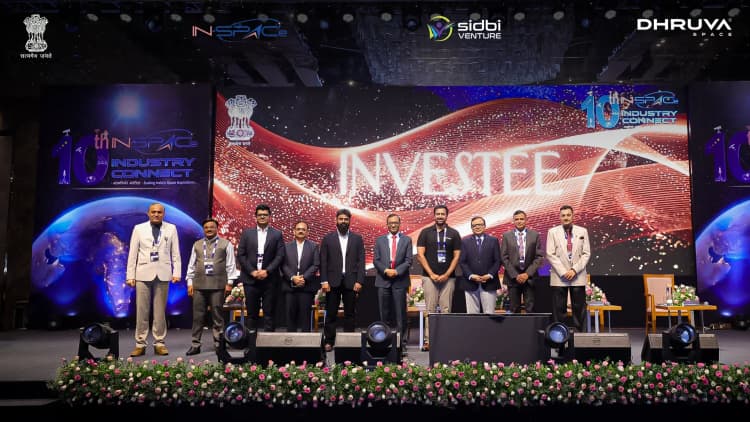
Dhruva Space Secures First Investment From India’s Antariksh Venture Fund
The Hyderabad-based startup receives ₹60 crore as the Antariksh Venture Capital Fund makes its debut investment.
View

LTM to Train 1,000 Claude Engineers Under Expanded Partnership With Anthropic
LTM will integrate Anthropic's Claude models into its BlueVerse AI platform, establish a Claude Centre of Excellence and expand its AI1000 programme.
View

