最新 AI 资讯

Malaysia’s AI agent-powered messaging app Respond.io raises $62.5M, eyes acquisitions
In 2017,Respond.ioset out to solve a simple problem: businesses couldn’t keep up with customers who had moved to messaging apps. Today Respond, with its customer conversation management software, has become one of the tech success stories of Malaysia. The startup, headquartered in Kuala Lumpur, has raised a $62.5 million Series B round led by Camber Partners, with participation from Endeavor Catalyst and existing investors. It last raiseda $7 million Series Ain 2022.The company has grown to $35 million in annual recurring revenue (ARR), growing 169% year-over-year, at a 30% profit margin, it tells TechCrunch. Co-founder and CEO Gerardo Salandra, who worked at IBM and Google before joiningRuntastic, a fitness tracking app that was sold to Adidas in 2015, founded Respond in Hong Kong in 2017 alongside Hassan Ahmed (CTO) and laroslav Kudritskiy (COO). The team relocated the business to Malaysia two years later. The platform helps mid- to large-sized B2C businesses drive revenue from customer conversations across multiple messaging channels including WhatsApp, Instagram, TikTok, Messenger, Line, Telegram, WeChat, voice calls and web chat. It also uses AI agents to automatically handle high volumes of customer inquiries, qualify leads and close sales without human intervention. Salandra described its core customers as “high-consideration” businesses, where customers need to talk to someone before buying, such as healthcare, automotive, retail, education and travel. “You don’t go to a website, put your credit card, and buy a car; you chat with someone, you ask a lot of questions,” he said. Its sweet spot is companies with 200 to 10,000 employees. The rise of AI has raised an obvious question for platforms like Respond: Can tools like ChatGPT simply replace what they’ve built? Salandra thinks his foothold is strong enough to stop such encroachment, should it come. The company is currently processing 2 billion messages per quarter. “If I just look at the numbers, every day that AI becomes more prominent, we grow faster,” he told TechCrunch. “We are not seeing what the public SaaS markets are seeing.” Part of that comes down to pricing, he said. Unlike enterprise software competitors that charge per seat, Respond charges based on the volume of customer conversations, meaning it doesn’t matter whether a human or an AI is answering. “When fewer humans use your product, they make less money,” he said. “But we don’t charge like that.” The incumbent platforms, particularly those dominant in North America and Europe, were built around email and phone calls. “The platforms that exist, they bolted on messaging as a second thought. They’re very email focused, they’re very call focused, but when it comes to messaging, it’s an afterthought,” Salandra said. That volume of message data creates a feedback loop, according to the CEO. More messages mean better AI. Better AI attracts more customers. More customers generate more messages. “This is what we call the data flywheel,” Salandra said. He added that the head start matters for any upstart AI company, as well. “Because we started so long ago and we have such a strong foundation, we can provide better AI compared to someone who just entered into the messaging space.” With the new capital, Salandra said the company plans to pursue hiring, organic growth and acquisitions. The CEO has two types of buying targets in mind: bolt-on technology that fits into its existing ecosystem, and established teams with strong customer bases in strategic markets like Europe and North America. “Imagine how many months I can save if I find the right company that maybe already has the clients and the team,” he said. “I can save myself six months to a year through an acquisition.” He confirmed the company is already in talks with a couple of potential targets. The geographic push makes strategic sense. Respond currently generates roughly 30% of its revenue from APAC, 30% from Latin America, and 20% from the Middle East and Africa, leaving North America and Western Europe at just 20%. But Salandra says those regions are now its fastest-growing. “They took longer to make the change, but now they’re moving very rapidly into messaging channels,” he said, adding that he expects both regions to become the company’s largest segment within two to three years. Despite the fresh injection of capital, Salandra is cautious about what comes next. “We don’t want to be a growth at all costs company,” he said. “Even with this money, we’re going to be very disciplined.” But Salandra has bigger plans in mind. “My favorite outcome?” he said. “Ringing the bell at Nasdaq.”
View

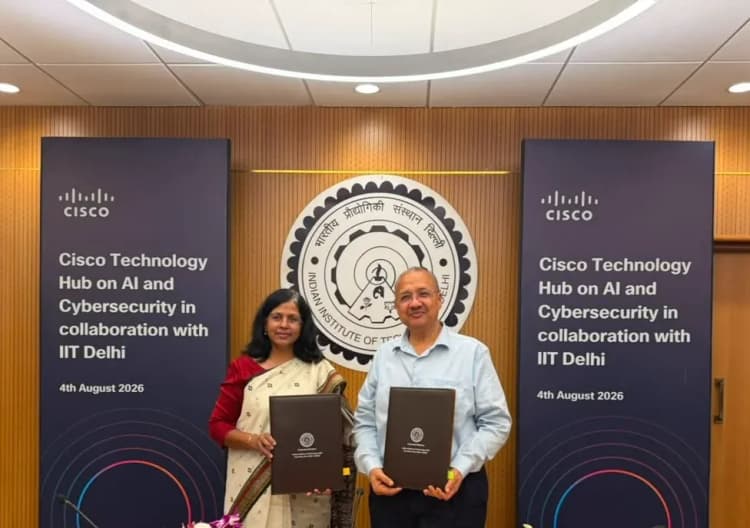
MeitY Urges IT Industry to Embrace AI Transformation, Focus on Reskilling Workforce
The consultation highlighted how client expectations are evolving from traditional process outsourcing to end-to-end digital transformation services powered by AI.
View

Govt Bets ₹25,530 Crore on AI to Fix India’s Broken Ration System
India’s PDS has been one of the world’s largest food security networks, serving more than 80 crore beneficiaries under the National Food Security Act.
View

Women-Led AI Hackathon WitchHunt 2026 Crowns Winners Across Health, Education, Climate & Smart Cities Segments
WitchHunt 2026 concluded in Bengaluru with 6,151 participants from 23 states, producing 373 working AI prototypes that tackle challenges across four impact sectors.
View

Applied Materials Launches 2 New Chipmaking Systems for 3D Scaling
The new deposition and etch systems want to push manufacturing limits in advanced AI chip production.
View

BHASHINI, GeM Join Hands to Make Public Procurement Accessible in 22 Indian Languages
Under the agreement, GeM and BHASHINI will jointly debelop multilingual digital resources through initiatives such as BHASHINI Udyat, Mitra, Appmitra, Sahyogi, and Pravakta.
View

Ahead of NEET Re-Exam, Centre Temporarily Blocks Telegram to Prevent Paper Leak
The National Testing Agency had highlighted a major concern of fraudsters attempting to deceive students.
View

How Sarvam AI Inspired Hoovu to Build HR Agent for Warehouse Workers
Hoovu’s Sarvam-powered HR assistant offers a glimpse into how Indian startups are deploying AI for real-world use cases.
View

Sundar Pichai faces boos, walkout at Stanford graduation ceremony over Google’s Israel, ICE ties
Over the weekend, Google CEO Sundar Pichai faced a small revolt when he delivered his commencement speech at Stanford University, where he earned his graduate degree in materials science and engineering. About 200 students from the graduating classreportedlywalked out, while others loudly booed the tech executive. The focus of the protest was Google’s defense ties — including Project Nimbus, the controversial $1.2 billion contract, shared with Amazon, to provide cloud and AI services to the Israeli military, as well asits relationshipwith the U.S. Immigration and Customs Enforcement agency. Student signs included phrases like “ICE SPIES WITH GOOGLE AI” and “GENOCIDE RUNS ON GOOGLE,” as well as “FREE FREE PALESTINE,” a press release associated with the protest notes. Students also waved Palestinian flags and shouted “free Palestine,”online videoof the protest shows. “We are walking out because we refuse to glorify the corporations that fuel this violence and exercise our power to choose differently,” a statement associated with the protest reads. The walkout was organized by a number of campus activist groups, including Stanford Students for Justice in Palestine, No Tech for Apartheid, and Tech for Liberation. TechCrunch reached out to Google for comment. As the war in Gaza has raged, Google’s participation in Nimbus has drawn protests from bothinsideand outside of the company. In 2024, Googlefired 28 workersfor protesting the contract, although it has continued tosuffer internal dissentover the issue since then. It was also recently criticized by the Electronic Frontier Foundation,which accused itand other companies of “choosing to look the other way” on Israel’s use of their services. Project Nimbus also enjoys support from Amazon. Microsoft has also been criticized for its support of the Israeli military, although the companyrestricted the Israeli government’s useof its technology afteran investigationfound that its cloud services were being used to mass-surveil Palestinians. The student protest also drew criticism from business leaders online. Vinod Khosla, the billionaire co-founder of Sun Microsystems and one of Silicon Valley’s most prominent venture capitalists,posted on Xthat the protest was “biased, idiotic, short-sighted and very selfish,” adding that it was selfish because the students “ignored the bottom 3 billion people on this planet that could benefit from AI and they are worried about their misinformed selfish self-interest.” Pichai’s appearance at Stanford is part of a broader pattern. Speakers at college graduation ceremonies around the countryhave faced booswhen they have attempted to get outgoing college students excited about AI. But rarely has student animus been as targeted as it was with Pichai, directed not at AI hype, but at the specific business decisions made by the company he leads. In general, young people seem to believe that AI isthreatening their employmentopportunities and may be ruining other parts of society as well.
View

SpaceX is public: Everything you need to know post-IPO
SpaceX has captured the attention of media, investors, and the public for years now — interest propelled by the company’s reusable rocket launches, the rise of its Starlink satellite network, and, of course, for its founder and CEO Elon Musk. But in its 24-year history, nothing quite compared to its initial public offering. Everyone seemed interested — perhaps because of the sheer size of the IPO. The company priced its 555.6 million shares at $135 each to raise $75 billion, making it the largest IPO in history and turning Musk into theworld’s first trillionaire. TechCrunch has followed SpaceX’s start, struggles, and successes from the early days. And we’re here for what happens next too. Here is your go-to landing page for all the relevant SpaceX IPO news, including notable updates now that the company is public. On its first full day of trading, SpaceX shares pushed even higher. As of 2:30 p.m. ET, SpaceX shares were up more than 15% to $186.15. SpaceX shares opened June 12 at $150 on the Nasdaq public exchange, an 11% pop for the most anticipated debut in history. And it has continued to rise. The shares kept rising too. In midday trading, SpaceX shares soared 30%. SpaceX shares closed at$160.95, up 19%. There has been heavy trading volume, as expected. Robinhood said it has seen“record-breaking trafficon its trading platform in the hours after SpaceX’s historic public markets debut. SpaceX COO Gwynne Shotwell was interviewed by CNBC on June 12 and among the many interesting comments she made, here is one that might get the attention of Tesla shareholders. At one point in the interview,Shotwell saida “merger between SpaceX and Tesla might make Elon’s life a little easier.” Among the winners are the banks, which have brought in about$500 millionin total fees. The big winners are Goldman Sachs and Morgan Stanley, per the WSJ. Musk took to X, the social media company he owns, to share his appreciation of SpaceX employees as the stock rose. “I love the incredible people of SpaceX beyond words,”he wrote Friday afternoon. He also reposted a number of SpaceX IPO related posts, including a photo of insiders allwearing green shoesin what appears to be a nod to “the green shoe option.” This is a provision in an IPO underwriting agreement that lets underwriters sell up to 15% more shares than originally planned if demand is strong. To get a deeper look into what happened, and all the far-ranging implications of SpaceX now being a publicly traded company,Senior Reporter Sean O’KaneandAI Editor Russell Brandomsat down for a special episode of our Equity podcast, whichyou can listen to right hereor via your podcast player of choice, orqueue it up on YouTube here. With an offering this large, there is a lot of financial machinery operating behind the scenes — so the first question is just when the stock makes it to the market to start trading. SpaceX is debuting on Nasdaq and you can see the official Nasdaq listinghere, which will have the price of record as soon as there is one. Nasdaq also has video of the SpaceX crewringing the bell, if that’s your thing. But the price is just part of the picture. For the most up-to-the-minute information, your best bet is still financial press outlets likeBloombergandCNBC, both of which have liveblogs running and will have close coverage of any hiccups that happen in getting the stock to market. Here we look at some of the bigger numbers, the consequential figures, and the eyewatering amounts that make up the company’s S-1 form. For instance, SpaceX lost $4.9 billion on revenues of over $18 billion in 2025. That’s only a fraction of the more than $37 billion lost since SpaceX’s inception. As CEO, Elon Musk holds about 85.1% of the company’s voting power. You can read more about that in the next section “Who wins and who doesn’t” — and we’ll continue to drop interesting numbers in here. Here is another figure that caught our attention… 4,400. That’s the number of SpaceX employees who could become millionaires,according to the NYT. Elon Musk can’t hear you over the sound of his $1.75 trillion IPO: The Equity podcast weighs in on the IPO. SpaceX is the world’s largest IPO in history and means a big payday for some investors, employees, and of course, Elon Musk. Elon Musk becomes the world’s first trillionaire after SpaceX’s historic IPO: The SpaceX IPO has boosted Musk’s paper wealth to more than $1,000,000,000,000 at a time when he is more hated — and powerful — than ever.How Elon Musk will increase his power through the SpaceX IPO: Musk, who will have more than 50% of the voting power, will have a monarchical grip over the publicly traded version of SpaceX — control that goes far beyond what other tech founders enjoy. Who will benefit most from SpaceX IPO? Mostly Elon — and a few from his inner circle: Elon Musk has the largest stake in SpaceX by billions of shares, but others also stand to win. Here’s the rundown of who owns what. SpaceX SPV investors won’t know their true holdings until post-IPO lock-ups lift: After SpaceX makes its public debut, lower-tier SPV investors face hidden fees, lengthy payout delays, and the risk of outright fraud. The S-1 registration documentgave the world an unprecedented look inside SpaceX, including its financials and its various businesses. The S-1 continued to be amended as the IPO date approached, and we were on it. Here is what we found. The SpaceX IPO filing is filled with AI bets, Starship dreams, and Elon Musk at the center:The contents of the SpaceX IPO details a business dominated by its Starlink satellite internet offering, more than $37 billion in losses, and future business prospects through its xAI division. Starship’s path to reusability looks murky after SpaceX’s S-1: SpaceX’s IPO and Starship rocket test flight delivered two big data points that offer a realistic vision for the coming years — and one that may disappoint both the company’s boosters and its critics. SpaceX warns investors of future dilution, adding fuel to Tesla merger rumors: The company added new language to its S-1, a warning to prospective investors that a major dilution could be in the cards after it goes public. Leading up to the IPO, SpaceX locked in a string of deals, mostly selling off compute to improve its balance sheet. Anthropic will pay xAI $1.25B per month for compute: Initial coverage of the Anthropic deal on May 20. How long is Anthropic’s lease with SpaceX? Opinions vary: Elon Musk keeps downplaying the duration of SpaceX’s contract with Anthropic. Google will pay SpaceX $920M per month for compute: A Google representative described the deal as a short-term deal addressing unexpected demand for its recently launched AI products. This article originally published at 10 a.m. ET, June 12, 2026. It has been updated with new coverage of the SpaceX IPO, share price, and other related events.
View

Meta’s new ‘AI Mode’ on Facebook pulls from public info across its platforms
As Meta tries to catch up in the AI race and boost engagement with its AI bot, the companyannouncedMonday that it’s rolling out new AI features on Facebook that aim to change how users find information, create content, and interact with the platform. The headline update is “AI Mode,” a new way to search Facebook that uses Meta AI to surface answers pulled from public posts across the platform, including Groups and Reels. Instead of scrolling through search results, users can ask a question in plain language and get a synthesized answer based on what people are actually discussing. This follows Meta’s quiet launch last month ofForum, a Reddit-style app that includes its own AI “Ask” tab, letting users pose questions and get answers pulled from discussions happening across Facebook Groups. Both AI Mode and Forum’s Ask tab raise a familiar question: How reliable are answers generated from public posts and group chatter? Because the AI is summarizing content from everyday users rather than vetted sources, there’s a real risk of outdated or misleading information slipping through, a concern that’s already been raised aboutGoogle’s own AI Modeon Reddit. Beyond search, Facebook also added editing tools that let users play around with collage cutouts and transition effects for their video montages. Another new feature is the AI-powered photo presets, allowing users to change up their look with different clothes, hairstyles, and accessories. Sports fans, for instance, can virtually wear their favorite team jerseys just by tapping the “AI Edit” icon in Stories and choose “Wear It,” or go directly to their profile picture and select “Restyle profile picture with AI” and “Wardrobe.” These updates add to a growing list of AI features Meta has shipped on Facebook in recent months. In February, the company introducedanimated profile picturesthat bring still photos to life — adding a wave, or placing a virtual party hat on someone’s head. In March, Meta added an AI feature to Facebook Marketplace that automatically replies to buyer messages on sellers’ behalf. Most recently, earlier this month, Facebook launched anAI assistant for creatorsthat offers personalized suggestions — including the best times to post and summaries of what audiences are saying in the comments — based on a creator’s content and performance history. Taken together, the flurry of releases points to a broader strategy: Meta wants Facebook’s AI tools to make the platform stickier and more useful, while also diversifying how it makes money. Alongside these feature rollouts, the company recently launchedglobal subscription plansfor Facebook, Instagram, and WhatsApp — starting at $3.99 a month — that unlock additional features, with more AI-related subscription tiers reportedly on the way.
View

The US government’s Anthropic models ban was never about an AI jailbreak
The U.S. government’s enforcement letter to Anthropic, which effectively forced the company topull its latest AI models offlinejust before the weekend, should be a wake-up call for any U.S. tech company — AI lab or otherwise. To catch you up on the news blitz: On Friday afternoon, the U.S. Commerce Department sent Anthropic a letter invoking an obscure export control directive that banned non-Americans, including Anthropic’s employees, from accessing Fable 5 and Mythos 5, citing an unspecified national security concern. Anthropic said it believes the letter is related to a bypass of the model’s guardrails, but isn’t sure because the letter doesn’t provide specific details. The letter has not been made public. In response, Anthropicshut downboth of its top models to all customers to ensure that it complied with the directive. The result was that the U.S. government successfully forced a tech company to pull its models offline with a swift and unilateral action that didn’t appear to require court approval. Friday’s intervention by the Trump administration shows that the AI industry is not immune to government interference. It’s also a warning to the wider tech industry: comply, or we can shut you and your products down. Citing sources,Axiosdescribed a tense situation over the weekend between the two major players, saying that the “personality differences” between Anthropic and the Trump administration led to the export directive, rather than a technical issue with the AI products. New details about the issue that emerged over the weekend now cast further doubt on the government’s already shaky reasoning. Katie Moussouris, a cybersecurity veteran and researcher who founded Luta Security, saidin a blog postthat Anthropic recently shared with her a private copy of a paper written by security researchers describing an alleged guardrail bypass in Fable 5. (The Wall Street Journal reports that the paper’s authorsare security researchers at Amazon.) Moussouris said that Anthropic reached out to ask for her take on the paper. Moussouris’ blog post described how the researchers triggered the guardrail bypass, but said that the bypass itself “should never have triggered an export control.” The difference is largely between asking an AI model to “review code for security issues” versus asking it to “fix this code.” The end result is largely the same, even if the questions are posed slightly differently. “The behavior described in the paper cannot meaningfully be fixed, and any attempt would only weaken the model for defense,” said Moussouris, who criticized the export control directive as hasty, heavy-handed, and misguided. Moussouris and dozens of other top security researchers and experts have since called on the Trump administration torevoke the export control order, calling the move to pull advanced cybersecurity capabilities from network defenders in the U.S. as “dangerous.” Past administrations have made sweeping decisions on knowledge gaps. For instance, language used by the U.S. government during the 2010s to fix export law covering cybersecurity tools that could also be used for cyberattacks was so broad that inadvertently, itnearly outlawedlegitimate security and vulnerability research. However, the Trump administration’s directive appears retaliatory. Justin Hendrix, theeditor of Tech Policy Press, said the Trump administration’s move is “likely to raise alarms in foreign capitals about the reliability of American AI for critical applications.” The message is that AI companies in the United States can’t be trusted to operate without interference from the U.S. government. The Trump administration hasn’t confirmed why it invoked its export control directive. Did the officials misread the report and freak out? Did Amazon CEO Andy Jassysay something to senior government officialsthat prompted the reaction, out of caution or spite? Was something lost in translation, or was this a way to pressure Anthropic, with whom the administration alreadyhas a fractious relationship? It’s possible that the White House was unaware of the far-reaching consequences of the letter’s demand and officials are scrambling to undo the damage of their own making. To quote Hendrix, “the climate is one of a cloud of suspicion that senior officials are picking favorites based on personal and political factors.” The aftermath is that the government has set a dangerous precedent about how much control it intends to wield over the release of American-made software. This time the government took issue with Anthropic; tomorrow it could be with anyone else.
View