🚀 Zaprep: Your Socials on Steroids. 免费开始 — 每月自动发送 1,000 条私信,将互动转化为潜在客户。 ,每月 1,000 条自动私信。

Much of the conversation around AI today is focused on building cloud capacity and massive data centers to run models. Companies like Apple and Qualcomm are in the early stages of making on-device AI more useful. Amid all that, the 14-person technical team of London-basedMiraiis working to improve how models run on phones and laptops. Mirai, which is backed by a $10 million seed round led by Uncork Capital, was founded by Dima Shvets and Alexey Moiseenkov last year. Both founders have experience in building scalable consumer apps. Shevts co-founded face-swapping app Reface,which was backed by a16z. Shevts later also became a scout for the venture firm. Moiseenkov was CEO and co-founder ofthe last decade’s viral AI filters app, Prisma. As consumer developers, both had been thinking about AI and machine learning on devices even before generative AI became popular, Shvets said. “When we met together in London, we started to chat about technology, and we realized that within the hype of gen AI and more AI adoption, everybody speaks about cloud, about servers, about AGI coming. But the missing piece is on-device [AI] for consumer hardware,” he told TechCrunch. Shevts and Moiseenkov wanted to use AI to create a pipeline that would allow them to enable complex tasks on the phone, which led them to start Mirai. When they asked others who developed consumer apps, they heard that many wanted better cost optimization and margin per token usage, too. Today, Mirai is developing a framework for models so they can perform better on devices. The company has built an inference engine for Apple Silicon that optimizes on-device throughput. With its upcoming SDK, developers can integrate the runtime in their apps with only a few lines, the company says. “One of the visions why we started the company was that we wanted to give developers, like this Stripe-like, eight lines of code [integration] experience…you basically go to our platform, integrate the key, and start working with summarization, classification, or whatever your use case is,” Shevts said. The startup built this engine in Rust, which can bump up a model’s generation speed by up to 37%, they claim. The company said that, while tuning the model for a platform, it doesn’t tinker with model weights to ensure there is no loss in quality of the output. Mirai’s stack currently focuses on improving text and voice modalities on the platform, with plans to support vision in the future. The team has started to work with frontier model providers to tune their models for edge use and is in talks with different chipmakers. Later, it plans to bring its engine to Android, too. In addition, Mirai aims to release on-device benchmarks so model makers can test on-device performance. Shevts recognizes that not all AI work can be done on-device, though. To enable a mixed mode of operation, the team is building an orchestration layer to send requests that can’t be fulfilled on the device up to the cloud. While the startup is not directly working with apps just yet, its engine could power on-device assistants, transcribers, translators, and chat apps, we’re told. Andy McLoughlin, managing partner at Uncork Capital, noted that he invested in an edge machine learning company in the last decade. He said that the company was early and eventually sold its business to Spotify. In today’s world, the situation is different, he thinks. “Given the cost of cloud inference, something has to change… For now, VCs are happy to continue funding the rocketship companies, spending inordinate sums on cloud inference. But that won’t last — at some point, people will focus on the underlying economics of these businesses and realize that something has to change,” he said. “It feels like every model maker will want to run part of their inference workloads at the edge, and Mirai feels very well positioned to capture this demand.” Mirai’s seed round also saw participation from individuals, including Dreamer CEO David Singleton, YC Partner Francois Chaubard, Snowflake co-founder Marcin Żukowski, Mati ElevenLabs co-founder Staniszewski, former Google AdSense product manager and Coinbase board member Gokul Rajaram, Groq investor Scooter Braun, Turing.com CTO Vijay Krishnan, Theory Forge Ventures’ Ben Parr and Matt Schlicht, and ex-Netflix technical leader, Aditya Jami.
View

OpenAI is partnering with Reliance to add AI-powered conversational search to the Indian conglomerate’s streaming service JioHotstar. The feature, which is powered by OpenAI’s API, will let users search for movies, shows and live sports using text and voice prompts in multiple languages, and receive recommendations based on their preferences and history. OpenAI has recently expanded its footprint in India, which is home tomore than 100 million weekly ChatGPT users. The company plans to open offices in Mumbai and Bengaluru later this year, adding to its current office in New Delhi. The partnership was announced at the ongoingIndia AI Impact Summitin New Delhi, whereAltman is appearingalongside industry leaders, including Anthropic’s Dario Amodei and Google’s Sundar Pichai. The companies also plan to extend the partnership to surface JioHotstar recommendations directly within ChatGPT, allowing users who search for entertainment through ChatGPT to receive contextual suggestions and deep links into the platform’s catalogue. The move positions the integration as a two-way discovery layer rather than a standalone in-app feature. The move comes as streaming and TV platforms increasingly experiment with conversational interfaces.Netflixsaid in May 2025 it was testing a new search experience using OpenAI’s ChatGPT to help viewers find content through natural language, while Google in November introducedGemini-powered discovery features for its Google TVplatform. Fidji Simo, chief executive of applications at OpenAI, said the partnership is aimed at bringing more personalized AI experiences into entertainment and live sports, enabling viewers to move “from curiosity to context” through natural interactions. Embedding AI into content discovery will help reshape how audiences find and engage with programming, said Uday Shankar, vice chairperson of JioStar. The rollout will span both live and on-demand formats, the companies said. The JioHotstar partnership is part of OpenAI’s broader “OpenAI for India” push to deepen its presence in the South Asian nation through infrastructure, enterprise, andeducation partnerships. Other moves under the initiative includecollaborations with the Tata Groupon AI-ready data centers and enterprise deployments, as well asagreements with Indian companies such as Pine Labs, Eternal, and MakeMyTrip.

Anthropic CEO Dario Amodei and Infosys co-founder Nandan Nilekani discussed how India may be uniquely positioned to test frontier AI models.
View
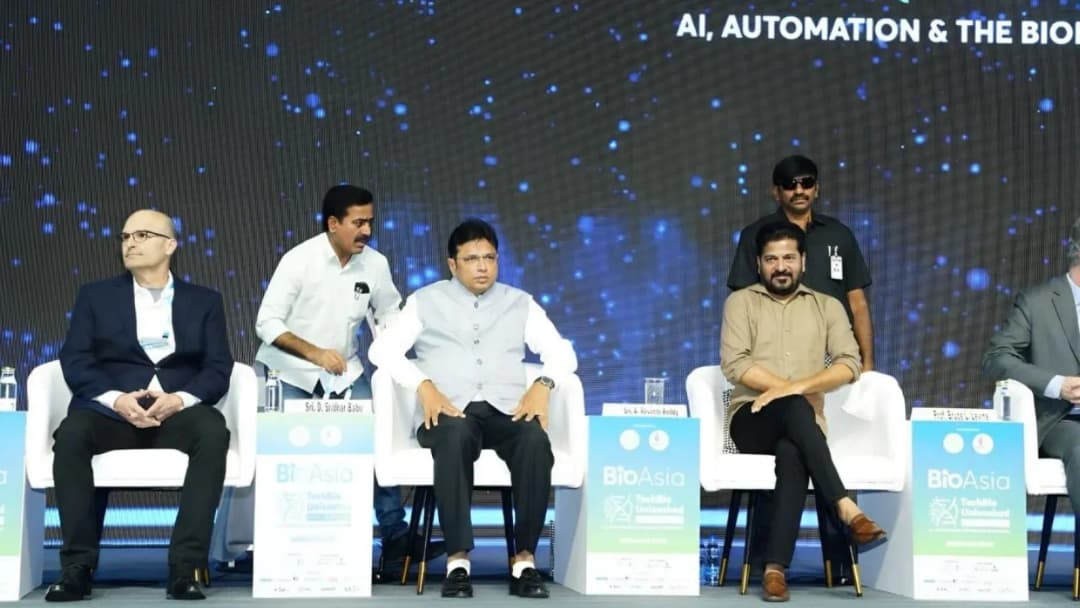
“The centre will function like T-Hub—incubating ideas, supporting startups, and helping convert concepts into products.”
View
The selloff ends NVIDIA’s investment in the chip technology company it tried to acquire in 2020 for $40 billion.
View

ST Telemedia Global Data Centres India has tapped Siruseri campus to support hyperscalers and enterprises.
View
OpenAI announced plans to launch new offices in two additional Indian cities later this year. This move will be part of the company's expansion beyond OpenAI's current base in New Delhi as it aims to strengthen its presence in the country. Additionally, OpenAI is partnering with the Tata Group to build AI-ready data centre capacity in the country. Under the partnership, OpenAI will serve as the first customer of Tata Consultancy Services' HyperVault data centre business, starting with 100 megawatts of capacity. OpenAI also plans to offer access to its OpenAI Certification programmes in India, beginning with TCS.
View

MakeMyTrip announced a collaboration with OpenAI on Wednesday, which is claimed to increase the use of artificial intelligence in travel planning and booking. As part of the partnership, OpenAI's APIs will be integrated into the company's app to power new features within Myra, its trip planning assistant. The company said the update will help address conversational travel queries and provide structured booking options for flights, hotels, and related services. MakeMyTrip also highlighted the growing adoption of Myra across multiple languages and Tier-2 and smaller cities.
View

Google DeepMind on Wednesday announced Lyria 3, its latest artificial intelligence (AI) music generation model. As per the Mountain View-based tech giant, the new model is integrated into the Gemini app for Android and iOS, and is designed to help users generate high-quality music tracks using simple text prompts, leveraging multimodal generative AI. Lyria 3 is positioned as a creator-focused tool aimed at simplifying music production for social media, video, and digital storytelling.
View

Indian streaming platform JioHotstar announced a partnership with Sam Altman-led OpenAI on the sidelines of the India AI Impact Summit on Thursday. As part of the move, a ChatGPT-powered voice and text assistant will be integrated directly into the JioHotstar app. As per the AI chatbot maker, the new multilingual discovery tool can help users find content through natural language conversations. It is positioned to replace traditional keyword search and endless scrolling with contextual, personalised recommendations.
View

Pine Labs, the Indian digital payment gateway company, announced that it is collaborating with the Sam Altman-led OpenAI on Thursday. The company will embed OpenAI's APIs into its digital payments infrastructure to enable agentic commerce in the country. The new collaboration was announced on the sidelines of India's AI Impact Summit 2026, which was kicked off by the government on February 16, and is scheduled to conclude on February 21. This is set to be OpenAI's second collaboration with a digital payments company after the AI giant entered into a partnership with Razorpay.
View

Adobe has announced a new plan for students enrolled at accredited higher education institutions across India, as part of which they will be given free access to the US-based tech giant's multiple productivity and creativity apps. Additionally, the company is partnering with NASSCOM FutureSkills Prime to offer “AI-first learning” and certifications to students. The announcement was made at the ongoing AI Impact Summit 2026, which is taking place at Bharat Mandapam in New Delhi. Currently, Adobe offers a subscription package to students in India, which includes Photoshop, Illustrator, Premiere, and Acrobat Pro.
View
View

