🚀 Zaprep: Your Socials on Steroids. 免费开始 — 每月自动发送 1,000 条私信,将互动转化为潜在客户。 ,每月 1,000 条自动私信。

QNu Labs CEO believes the world is heading towards a hybrid scenario of AI and quantum, in which quantum machines are becoming as readily available as AI agents.
View

The offering combines Cisco's Secure Access platform with LTM's managed cybersecurity services as enterprises look to strengthen security around generative AI deployments and hybrid work environments.
View

The other companies selected are Cactus Technology Solutions Pvt Ltd (CTSPL), CoRover Pvt Ltd and Innefu Labs Ltd.
View

The survey states that 77% of enterprise leaders consider artificial intelligence a board-level priority. However, 65% of these enterprises operate on legacy or developing infrastructure.
View

The study shows that users in India watch videos daily, driving commerce and discovery of products across the nation now.
View
The report’s findings suggest that AI is rapidly transforming jobs in India, with nearly all frontline AI users reporting changes in the skills required for their roles.
View

While announcing the new Gemma 4 12B, Google also said Gemma 4 models have now surpassed 150 million downloads across the developer community.
View

Businesses can set up the agent within minutes or integrate it with existing enterprise systems.
View

As tech layoffs mount, AI leaders are increasingly divided on whether the technology will eliminate jobs, create new ones, or simply change the nature of work.
View

Lovable and Googleannouncedan expanded multiyear collaboration on Wednesday. Lovable, the fast-growing Stockholm vibe-coding startup, has long been a Google Cloud user. Under the new agreement, it will be a much bigger one. While the companies did not disclose the dollar figure, a person with knowledge of the deal tells TechCrunch it involves a fivefold increase in Lovable’s footprint on Google Cloud, including AI usage. As part of the deal, this individual tells us, Lovable will gain expanded access to both Anthropic’s Claude — the AI model widely used for coding tasks — and Google’s own Gemini models. The Anthropic piece in particular is interesting. Google invested $10 billion in Anthropic in cash and compute credits in April, promising another $30 billion if Anthropic hits certain performance targets. It made that investment at a $350 billion valuation — just one month before Anthropic raised a staggering$65 billion roundthat valued the company at nearly $1 trillion. This deal stands to help Anthropic hit those targets, because Lovable is one of Europe’s fastest-growing startups on record. According to Lovable, it crossed $400 million inannualized revenue in February, having added $100 million in a single month with just 146 employees. The company claims that more than half of Fortune 500 companies use its product in some fashion. The deal also plugs Lovable into several other parts of Google’s ecosystem. Lovable’s new agent will be available through Google Cloud’s enterprise agent marketplace, the Gemini Enterprise Agent Gallery — an arrangement the two companiesfirst telegraphedat Google’s major U.S. cloud conference in April. And to help secure the code that both humans and agents write, Lovable will integrate with Wiz, Google’s biggest ever acquisition at $32 billion, whichofficially closedin March, a year after it wasannounced. The integration will allow Wiz to identify and remediate security problems in real time. By selling Lovable’s agents through Google’s marketplace, the cloud giant says enterprise procurement and billing will be simplified, making it easier for Lovable to land more enterprise customers. The calculus for Google is simple enough. If it can keep both Lovable and Anthropic growing by attracting deep-pocketed enterprises, the revenue helps fund the $180 billion to $190 billion in capital expenditures Google plans to spend this year. The company is already in the process ofselling a record-breaking $85 billion in equityto cover some of that, so only another $100 billion or so to go.
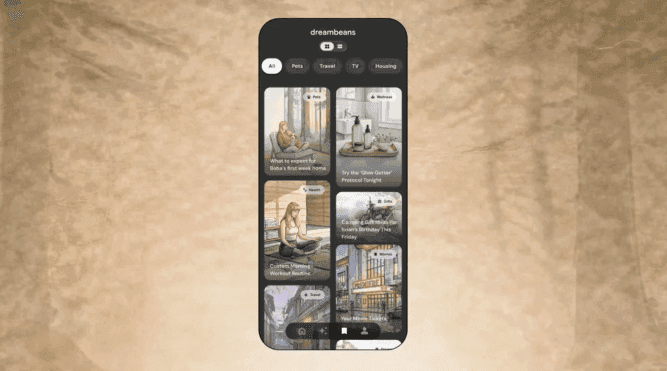
Google Labs, the tech giant’s team devoted to experimental product design, has launched a new AI-fueled app for iOS and Android that will quite literally animate your life. Behold,Dreambeans. Why is it called that? We’ll get to that later. First, what is it? Gozde Oznur, the product lead behind the new app, told TechCrunch that the idea is to use data culled from across your various Google services to generate a curated list of AI-illustrated “stories.” These stories come in a variety of different shapes and forms, although — in general — they seem to be lifestyle suggestions. Oznur describes them as “places to visit, topics to explore, things to try, upcoming trips, events that you should be aware of.” Dreambeans generates these ideas based on a user’s Google data. “With your permission, Dreambeans uses Personal Intelligence to connect information from Google apps like Gmail, Calendar, Photos, YouTube and Search History, to curate a finite collection of daily stories designed to spark new ideas,” the company says. So for instance, some stories may be geographical recommendations — like suggesting a new coffee shop near where the user lives that they might be interested in. Or, as is the case in thismarketing video, if you’re getting a new dog and that event has been marked in your Google Calendar, Dreambeans might deliver some insights about what it’s like to live with a new puppy. Still other stories may simply be news articles curated from the web, based on a user’s past interests. Oznur said the app has also been built as a doomscrolling antidote, in that it only provides users with a limited number of stories per day — typically 10 to 14. The idea is to get a few inspirational ideas and then go out and live your life, she said. A lot of companies are currently trying to court the user that is sick of phone addiction. I recentlyreviewed a startup, Bond,which also uses AI to auto-generate lifestyle suggestions for the user. What about privacy protections? According to Oznur, they are pretty solid. The only person with access to the app’s stories is the user, she said. Users can also delete their data whenever they want, and can choose which Google services they want to connect to the tool. Finally, where did the name “Dreambeans” come from? The idea for the name was generated, in part, by the way the system works while you are asleep, she said. “The dream part is literal, because while you sleep, the app is working through everything across your connected apps, because, as you can imagine, it’s a lot of data that it is distilling,” Oznur said. “The beans part is about how you kind of start your day with a freshly brewed cup of coffee. It has processed everything overnight and hands you a concentrated drop of inspiration in the morning.” Dreambeans is currently only available for eligible U.S.-based Google AI Ultra subscribers on Android and iOS. However, there is also awaitlistthat is available to users with a personal Google account.

If Alphabet’s record-breaking $85 billion stock sale signals investor appetite for AI-related offerings — and it does — we can safely say that investors are voracious. Google’s parent company had initially intended to sell a first tranche of $40 billion worth of various equity instruments — two different classes of shares, plus smaller “depositary shares” priced to be accessible to a broader range of investors. But the offering was so oversubscribed that it raised $45 billion instead, CEO Sundar Pichai said in apost on Xon Monday. Among the buyers: Berkshire Hathaway, still known for its love of value investing, picked up $10 billion worth. Alphabet plans to sell another $40 billion worth next quarter, for $85 billion total. Even $80 billion would have topped the record for equity offerings previously set by Brazilian oil producer Petroleo Brasileiro SA, which raised $70 billion in 2010,Bloomberg reports. Now, it’s true that these investors are buying shares of Alphabet, not shares in a younger, possibly debt-riddled AI startup. Alphabet is a very healthy business: $110 billion in revenue (with high profit margins) in Q1 alone, up 22% year-over-year. Still, the money from this stock sale is earmarked for AI. “Part of our multi-year investment strategy to meet the AI opportunity ahead and support the demand we’re seeing from enterprises and consumers,” as Pichai described it. At Google I/O last month, hesaidthe company expects to spend between $180 billion and $190 billion on capital expenditures — largely on AI infrastructure and data centers — before the year is out. The timing matters beyond Alphabet itself. As Anthropicgets ready to go public, this enormously successful stock sale is a very good sign for the broader AI IPO pipeline. It indicates that public investors, particularly the deep-pocketed institutional ones, are ready to pony up. The upcoming SpaceX IPO is expected to smash records for cash raised and valuation, and Anthropic’s deal is expected to do the same, possibly surpassing SpaceX. OpenAI is also waiting in the wings. But all of this rests on public investors’ appetite — not just private VCs — remaining strong, and then staying that way. An unprecedentednearly $8 trillion in AI spendinghas been committed over the next five years. That money has to come from somewhere — and that somewhere includes individual company revenues, loans, and capital raised through stock sales. Whether public markets have the stomach to absorb that much, for that long, is the question that every AI company eyeing an IPO should be thinking about right now.
View
View
View

