🚀 Zaprep: Your Socials on Steroids. 免费开始 — 每月自动发送 1,000 条私信,将互动转化为潜在客户。 ,每月 1,000 条自动私信。
AI NewsGeneral Intuition’s $2.3B bet that video games can train AI agents for the real world
General Intuition’s $2.3B bet that video games can train AI agents for the real world
5:41 AM IST · June 26, 2026
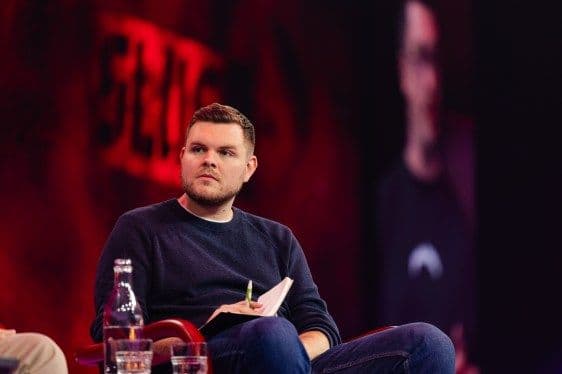
As soon as I entered General Intuition’s R&D floor at its New York office, the company’s 31-year-old co-founder and CEO Pim de Witte directed my attention to a monitor perched on a standing desk. Someone appeared to be playing something like Fortnite. It wasn’t a person. “Our agent has been playing for 100 hours straight,” Kent Rollins, the company’s chief product officer, said, beaming. Before I could get absorbed in the spectacle of an AI navigating the game’s virtual environment, I heard the electronic footsteps of a large quadrupedal robot approaching. “The same brain powering the agent playing the game is powering the robot,” de Witte told me. Josh Duplantis, a data analyst carrying a laptop streaming a live feed from the robot’s single camera, piped up to explain that the bot’s default mode was “exploration.” Relying on that camera, its singular eye, the giant buglike bot walked up to me, circled around me, and continued into the office. It occasionally clipped the legs of chairs or bumped into an errant trash bin, much like a toddler who hasn’t yet learned how her body relates to the world around it. Duplantis said it took just eight minutes of real-world robotics data to fine-tune an AI model for the quadruped. What’s more, that data was collected on the street, not inside the office where the bot was currently navigating itself. An agentic model that can generalize from gameplay to simulation to embodiment is General Intuition’s raison d’être. And that model’s ability to figure out its place in the world has secured the backing of some heavy hitters. On Thursday, General Intuition said it raised $320 million at a $2.3 billion valuation, confirmingTechCrunch’s previous reporting. The round brings General Intuition’s total disclosed funding to $454 million, after the$134 million roundit raised at launch last October. The startup was spun out of de Witte’s other company, Medal, which allows gamers to upload and share video game clips. The hundreds of millions of hours of uploaded gameplay provided the initial dataset to train General Intuition’s model in spatial-temporal reasoning — or understanding how to move through space and time. But the key ingredient wasn’t the gameplay footage; it was the action labels embedded in those clips: records of exactly what buttons a player pressed and when. Most competitors, de Witte says, are trying to infer actions from video alone, which he argues is insufficient. “We view this as just the next stage of future pre-training,” de Witte said. “We have a single model that can respond to Fortnite information on the screen and take action, but also to real-world dynamics in a way that an LLM could never.” At one point, de Witte set me up with a laptop running General Intuition’s world model, a simulated environment generated frame-by-frame rather than rendered by a traditional game engine.As I often dowhentesting world models, I walked straight into a series of walls. In other demos I’ve tried, the agents you control sometimes pass right through, but this one didn’t. From the millions of hours of gameplay, it somehow learned that walls are walls, ladders are for scaling, and shadows lengthen as the sun moves. For General Intuition, thisworld modelisn’t the product; it’s the training environment (referred to as “the gym” internally). The company ultimately wants to sell the agentic model itself, and de Witte argues that the action data embedded in gameplay helps the model discern the “self” from the “environment” in a way that gives it a richer understanding of causality. Impressive though General Intuition’s technology appears in demos, the company isn’t the only one trying to crack this problem. Moreover, getting such a model to hold up in the physical world, at scale, hasn’t yet been done. Most approaches of this kind require enormous amounts of real-world data that’s gathered slowly and expensively. General Intuition’s bet is that gameplay is a scalable shortcut. Its investors are okay with that bet, too. General Intuition’s latest round was led by Khosla Ventures, with participation from General Catalyst, Jeff Bezos, Eric Schmidt, Nico Rosberg, and researchers at Google DeepMind and MIT. The vast majority of the round will go toward scaling compute capacity. General Intuition has a deal with CoreWeave and plans to focus on pre-training the next version of the model. A slice has been earmarked for making its API more broadly available by the end of summer. Vinod Khosla, whose firm led the round, says he was drawn to de Witte’s vision and the company’s proprietary data position. “If you look at LLMs, when reasoning emerged, it was a quantum leap,” Khosla told me in a phone interview. “In world models, I think the quantum leap is the emergence of intuition in the AI, a human intuition-like capability. The human action data and reaction data you have in games is the key part to the emergence of intuition.” General Intuition isn’t the only company to notice that Medal’s human action data is a key piece of the puzzle of building dynamic world models and general agents. Brianna Martin, the startup’s chief of staff, said the company was born, in part, after Medal turned down an acquisition offer from a major lab. There have been other offers since, too. De Witte and his co-founders, Eloi Alonso, Adam Jelley, and Vincent Micheli, aren’t interested in being acquired, and neither are the startup’s investors looking for an exit just yet. The amount and quality of proprietary data General Intuition has via Medal is one of the reasons Khosla is convinced the startup is a generational bet, not an M&A target; that it could become the backbone for generalized agents and world models in simulation and the real world. “At this point, it would be a data acquisition, which is sort of uninteresting,” Khosla said. Part of that bet also involves trusting de Witte’s values. The entrepreneur spent three years working in the humanitarian space, including with Doctors Without Borders. As such, he has drawn a clear line for how General Intuition’s tech will be used: No agents will be employed to harm humans. “We don’t want to be an escalatory part of the system,” de Witte said. “Let’s say I were to come out and say, ‘We’re doing lethal autonomy.’ What do you think would happen in other countries?” That limit on military use cases comes as Silicon Valley is growing ever more bullish on war, though de Witte says he’s happy for his models to be used for search and rescue missions. De Witte is Dutch, and much of his team is European, which shapes the company’s identity. He says he brought on Martin in part due to her decision topublicly quit Palantirover its work with the United States Immigration and Customs Enforcement. “I don’t know why Silicon Valley does what it does,” he said. “There’s a reason I’m not there.” De Witte’s ethics don’t simply limit what the models won’t do. As a gamer who made $1.5 million by building and hosting a private RuneScape server in his teens, de Witte is also thinking about what happens to the people who get left behind by what AI models can do. General Intuition recently launched a platform called Nerve, a jobs marketplace that lets gamers earn money using their existing setups. Those who sign up start with data labeling and can eventually move toward robot teleoperation and other tasks. Medal’s user base, de Witte noted, is precisely the generation most exposed to AI-driven displacement, and he wants them to have a stake in what’s coming next. De Witte wants General Intuition to be an ecosystem enabler, like Anthropic or OpenAI — a model provider that enables others to build on top of its technology. Today, the startup has a handful of customers in gaming, simulation, and robotics. “We’re not gonna build a self-driving car company,” de Witte said. “We’re gonna make it 10 times easier for the next person to build a self-driving car company.” The company says once it gets its API into more customers’ hands, it would be able to test its mettle with a variety of use cases — like testing a robot in a digital twin of a factory floor, powering a humanlike bot inside a gaming studio, or sending a quadruped to navigate hazardous environments. While a quadruped is the first physical embodiment that General Intuition has tried in the real world, it has also tried drones and other devices, including testing the model in driving games. “It works on anything that you can control using a game controller or a keyboard mouse,” de Witte said. The possibility to build a data flywheel is one of the goals. “We’ll pick customers where we can diversify the embodiments that this generalized foundation model is serving as the backbone for,” de Witte said. “So we’re going to prioritize picking customers on whether they can offer real-world data that’s going to be interesting and useful to move the needle on research. And if they’d have an agile internal team where we can be real embedded partners and learn from each other.” Khosla said that General Intuition’s proprietary data is what got it this far, and its ability to continue collecting data that no one else has will be essential. Especially because, despite impressive demos, whether the simulation-to-real-world transfer can hold at scale is an open question that nobody has fully answered yet. Correction: The headline previously misstated how much General Intuition raised in this round. The error has been fixed.
read more