

Is this your AI tool? Claim it today.
Verify ownership, manage your profile, and unlock growth features.
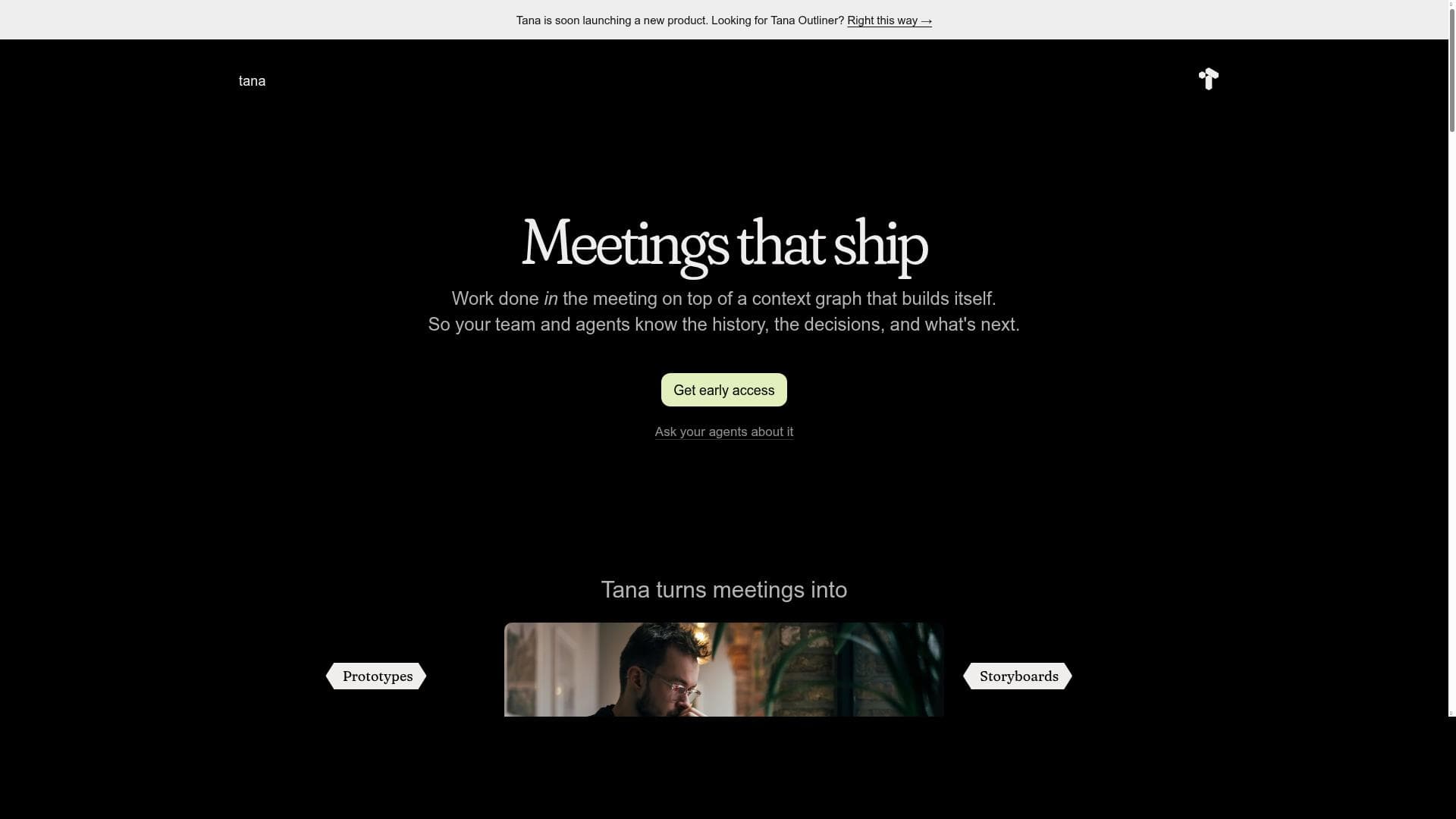
Tana is an AI-native workspace that transforms how tech professionals capture, organize, and act on information in real time. By building a dynamic context graph and enabling AI agents to execute tasks during meetings, it helps teams reduce busywork and stay aligned effortlessly.

Description
An AI-native workspace for tech-savvy professionals who want to stay on top of everything—without the busywork. Tana helps you connect and organize information so you get it where you need it, in a super flexible format.
Detailed Description
Tana is an AI-native workspace designed specifically for tech-savvy professionals who need to stay organized and efficient without getting bogged down by administrative busywork. Its core purpose is to streamline the way users capture, connect, and manage information, especially during dynamic work scenarios such as meetings and collaborative projects. Unlike traditional note-taking or project management tools, Tana builds a self-updating context graph that dynamically maps relationships between ideas, tasks, and decisions in real time. This approach allows users to access and manipulate information in a highly flexible format tailored to their workflow needs. One of Tana's standout features is its ability to build a self-updating context graph during meetings. As discussions unfold, the tool automatically captures and organizes relevant information, creating a living map of the conversation's key points and their interconnections. This context graph enables users to see how different elements relate to each other, making it easier to track progress and understand the bigger picture. Additionally, Tana empowers AI agents to execute work in real time while discussions are ongoing. This means that as teams brainstorm or make decisions, AI agents can immediately begin transforming those ideas into actionable outputs such as prototypes, storyboards, pull requests (PRs), feature specifications, and more. Tana also excels at capturing organizational memory, including decisions made and historical context, which reduces the need for repeated meetings and follow-ups. By tracking what was decided and outlining next steps clearly, it ensures continuity and accountability. Collaboration is further enhanced through AI agents that assist users in completing tasks, providing a seamless blend of human and artificial intelligence working together. This makes Tana particularly useful for teams that rely heavily on iterative development, product management, and complex project coordination. The tool is best suited for professionals in technology, product development, and knowledge work who require a sophisticated yet intuitive system to manage complex information flows. Use cases include transforming meeting discussions into detailed project artifacts, maintaining a comprehensive organizational knowledge base, and enabling real-time task execution during collaborative sessions. Its flexible format supports a wide range of workflows, from agile product teams to research groups and beyond. Tana offers a freemium pricing model, allowing users to get started with core functionalities at no cost and upgrade for access to advanced features and greater capacity. This approach makes it accessible for individuals and small teams while scaling to meet the needs of larger organizations. Compared to alternatives like traditional project management tools or static note-taking apps, Tana’s AI-native context graph and real-time execution capabilities provide a more dynamic and integrated experience. While many tools focus on either capturing information or managing tasks, Tana bridges these aspects by enabling live collaboration and automatic transformation of ideas into deliverables. However, users should consider that its advanced features may have a learning curve and that optimal use requires some familiarity with AI-driven workflows and technical collaboration environments. In summary, Tana stands out as a cutting-edge workspace that leverages AI to reduce busywork, enhance collaboration, and keep tech-savvy professionals on top of their complex projects. Its unique combination of a self-updating context graph, real-time AI agents, and flexible information organization makes it a powerful tool for anyone looking to streamline their productivity and decision-making processes.
Tool Features
- Builds a self-updating context graph during meetings
- Enables agents to execute work in real-time while discussing
- Captures organizational memory including decisions and history
- Transforms meeting discussions into prototypes, storyboards, PRs, feature specs, and more
- Reduces repeated meetings by tracking what was decided and next steps
- Supports collaboration with AI agents that assist in task completion
Description
Tana is an AI-native workspace that transforms how tech professionals capture, organize, and act on information in real time. By building a dynamic context graph and enabling AI agents to execute tasks during meetings, it helps teams reduce busywork and stay aligned effortlessly.
An AI-native workspace for tech-savvy professionals who want to stay on top of everything—without the busywork. Tana helps you connect and organize information so you get it where you need it, in a super flexible format.
Detailed Description
Tana is an AI-native workspace designed specifically for tech-savvy professionals who need to stay organized and efficient without getting bogged down by administrative busywork. Its core purpose is to streamline the way users capture, connect, and manage information, especially during dynamic work scenarios such as meetings and collaborative projects. Unlike traditional note-taking or project management tools, Tana builds a self-updating context graph that dynamically maps relationships between ideas, tasks, and decisions in real time. This approach allows users to access and manipulate information in a highly flexible format tailored to their workflow needs. One of Tana's standout features is its ability to build a self-updating context graph during meetings. As discussions unfold, the tool automatically captures and organizes relevant information, creating a living map of the conversation's key points and their interconnections. This context graph enables users to see how different elements relate to each other, making it easier to track progress and understand the bigger picture. Additionally, Tana empowers AI agents to execute work in real time while discussions are ongoing. This means that as teams brainstorm or make decisions, AI agents can immediately begin transforming those ideas into actionable outputs such as prototypes, storyboards, pull requests (PRs), feature specifications, and more. Tana also excels at capturing organizational memory, including decisions made and historical context, which reduces the need for repeated meetings and follow-ups. By tracking what was decided and outlining next steps clearly, it ensures continuity and accountability. Collaboration is further enhanced through AI agents that assist users in completing tasks, providing a seamless blend of human and artificial intelligence working together. This makes Tana particularly useful for teams that rely heavily on iterative development, product management, and complex project coordination. The tool is best suited for professionals in technology, product development, and knowledge work who require a sophisticated yet intuitive system to manage complex information flows. Use cases include transforming meeting discussions into detailed project artifacts, maintaining a comprehensive organizational knowledge base, and enabling real-time task execution during collaborative sessions. Its flexible format supports a wide range of workflows, from agile product teams to research groups and beyond. Tana offers a freemium pricing model, allowing users to get started with core functionalities at no cost and upgrade for access to advanced features and greater capacity. This approach makes it accessible for individuals and small teams while scaling to meet the needs of larger organizations. Compared to alternatives like traditional project management tools or static note-taking apps, Tana’s AI-native context graph and real-time execution capabilities provide a more dynamic and integrated experience. While many tools focus on either capturing information or managing tasks, Tana bridges these aspects by enabling live collaboration and automatic transformation of ideas into deliverables. However, users should consider that its advanced features may have a learning curve and that optimal use requires some familiarity with AI-driven workflows and technical collaboration environments. In summary, Tana stands out as a cutting-edge workspace that leverages AI to reduce busywork, enhance collaboration, and keep tech-savvy professionals on top of their complex projects. Its unique combination of a self-updating context graph, real-time AI agents, and flexible information organization makes it a powerful tool for anyone looking to streamline their productivity and decision-making processes.
Frequently Asked Questions
What is Tana?
Tana is an AI-native workspace designed to help tech-savvy professionals organize information, capture decisions, and execute tasks in real time through a dynamic context graph and AI-assisted collaboration.
How much does Tana cost?
Tana offers a freemium pricing model, allowing users to access basic features for free with options to upgrade for advanced capabilities and increased usage limits.
Who is Tana best for?
Tana is ideal for technology professionals, product managers, and knowledge workers who need to manage complex information flows, collaborate in real time, and reduce repetitive meetings.
What are the main features of Tana?
Key features include a self-updating context graph during meetings, AI agents that execute work in real time, capturing organizational memory, transforming discussions into prototypes and specs, reducing repeated meetings, and AI-assisted collaboration.
Does Tana offer a free trial?
Yes, Tana’s freemium plan allows users to try core features for free without a time limit, enabling them to explore the platform before deciding to upgrade.
What integrations does Tana support?
While specific integrations are evolving, Tana supports AI agents that can interact with various workflows and tools to help execute tasks and organize information seamlessly within its workspace.
How does Tana work?
Tana works by building a live context graph that maps relationships between information during meetings and discussions. AI agents assist by executing tasks in real time, transforming conversations into actionable outputs and maintaining organizational memory.
Socials
Use ToolReviews
No reviews yet. Be the first to share your experience.