🚀 Zaprep: Your Socials on Steroids. Start free — automate 1,000 DMs/month & turn engagement into leads. with 1,000 automated DMs/month.
Digma Preemptive Observability


Is this your AI tool? Claim it today.
Verify ownership, manage your profile, and unlock growth features.
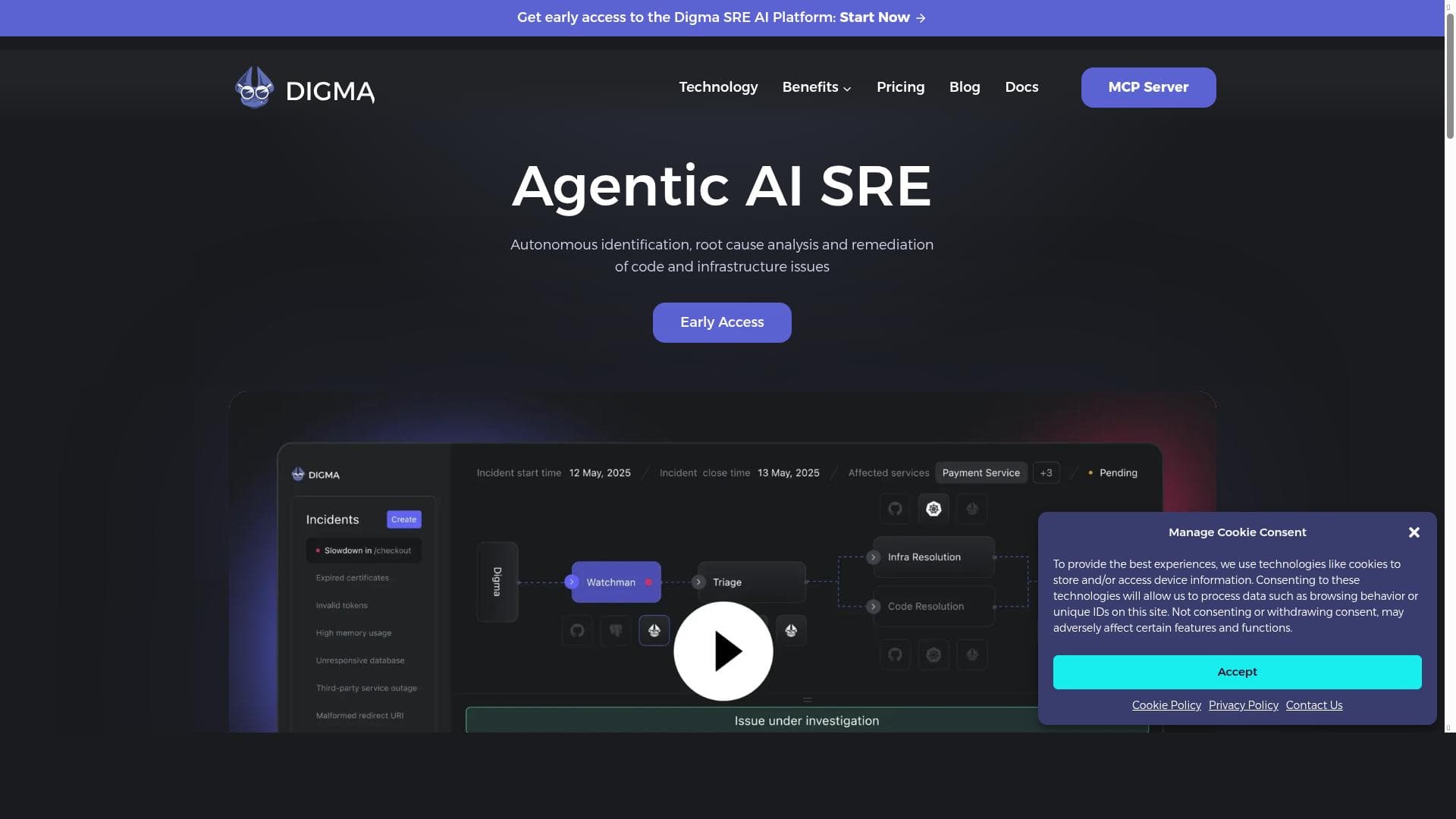
Digma Preemptive Observability is a cutting-edge AI-powered tool that autonomously detects and diagnoses performance and scaling issues in pre-production environments, providing code-level root causes and severity assessments. Ideal for development and SRE teams, it not only identifies problems early but also suggests automated remediation, streamlining the path to reliable software releases.

Description
Digma is a Preemptive Observability product that identifies performance and scaling issues in pre-production environments and provides a code-level root cause and the severity of the issues, all done automatically and continuously.
Detailed Description
Digma Preemptive Observability is an advanced AI-driven solution designed to proactively identify and resolve performance and scaling issues in software applications before they reach production environments. Its core purpose is to empower development and operations teams with deep, actionable insights into the health and efficiency of their code and infrastructure during the pre-production phase. By continuously monitoring and analyzing application behavior, Digma helps prevent costly downtime and performance bottlenecks, ensuring smoother deployments and more reliable software delivery. At the heart of Digma is a fully autonomous AI Site Reliability Engineering (SRE) agent that operates without manual intervention. This agent continuously scans the pre-production environment to detect anomalies, performance degradations, and scaling challenges at both the code and infrastructure levels. Unlike traditional monitoring tools that react to issues post-deployment, Digma’s preemptive approach allows teams to identify root causes early, significantly reducing the time and effort required for troubleshooting. The platform not only pinpoints the exact code segments or infrastructure components responsible for problems but also assesses the severity of each issue, enabling prioritization based on impact. One of Digma’s standout capabilities is its ability to propose concrete remediation actions. Upon detecting an issue, it can automatically suggest pull requests or change requests tailored to resolve the identified problems. This feature streamlines the developer workflow by integrating diagnostics and fixes, reducing the back-and-forth typically involved in debugging and patching. Additionally, Digma’s continuous and automated nature ensures that observability is maintained throughout the development lifecycle, offering persistent insights as code evolves. Digma Preemptive Observability is particularly well-suited for software development teams, DevOps engineers, and SREs who prioritize reliability and performance in their release pipelines. Organizations deploying complex microservices architectures or operating at scale will find Digma invaluable for managing the intricacies of distributed systems and preventing cascading failures. Use cases include early detection of memory leaks, inefficient database queries, scaling bottlenecks, and other performance-related issues that can degrade user experience or increase operational costs. Regarding pricing, Digma offers a freemium model, making it accessible to startups and small teams looking to enhance their observability capabilities without upfront investment. The freemium tier provides essential features sufficient for many use cases, while advanced functionalities and enterprise-grade support are likely available through paid plans, though specific pricing details would need to be obtained directly from Digma’s sales team or website. Compared to alternative observability tools, Digma’s unique selling point lies in its preemptive, AI-powered approach combined with automated remediation suggestions. While many observability platforms focus on reactive monitoring and alerting post-deployment, Digma shifts the paradigm by embedding observability into the development process itself. This proactive stance can lead to faster release cycles and higher software quality. However, teams should consider integration complexity and the learning curve associated with adopting AI-driven observability solutions, especially if their current workflows rely heavily on manual monitoring and incident management. Potential limitations include the dependency on accurate instrumentation and the need for compatibility with existing CI/CD pipelines and development environments. Organizations must ensure that their pre-production environments are sufficiently representative of production to maximize Digma’s effectiveness. Additionally, as with any AI-based system, there may be occasional false positives or recommendations that require human validation. Despite these considerations, Digma Preemptive Observability represents a significant advancement in the field of software reliability engineering by automating and enhancing the detection and resolution of critical issues before they impact end users.
Tool Features
- Fully autonomous AI SRE agent
- Identifies issues at code and infrastructure levels
- Pinpoints root cause of problems
- Proposes remediation such as pull requests or change requests
Description
Digma Preemptive Observability is a cutting-edge AI-powered tool that autonomously detects and diagnoses performance and scaling issues in pre-production environments, providing code-level root causes and severity assessments. Ideal for development and SRE teams, it not only identifies problems early but also suggests automated remediation, streamlining the path to reliable software releases.
Digma is a Preemptive Observability product that identifies performance and scaling issues in pre-production environments and provides a code-level root cause and the severity of the issues, all done automatically and continuously.
Detailed Description
Digma Preemptive Observability is an advanced AI-driven solution designed to proactively identify and resolve performance and scaling issues in software applications before they reach production environments. Its core purpose is to empower development and operations teams with deep, actionable insights into the health and efficiency of their code and infrastructure during the pre-production phase. By continuously monitoring and analyzing application behavior, Digma helps prevent costly downtime and performance bottlenecks, ensuring smoother deployments and more reliable software delivery. At the heart of Digma is a fully autonomous AI Site Reliability Engineering (SRE) agent that operates without manual intervention. This agent continuously scans the pre-production environment to detect anomalies, performance degradations, and scaling challenges at both the code and infrastructure levels. Unlike traditional monitoring tools that react to issues post-deployment, Digma’s preemptive approach allows teams to identify root causes early, significantly reducing the time and effort required for troubleshooting. The platform not only pinpoints the exact code segments or infrastructure components responsible for problems but also assesses the severity of each issue, enabling prioritization based on impact. One of Digma’s standout capabilities is its ability to propose concrete remediation actions. Upon detecting an issue, it can automatically suggest pull requests or change requests tailored to resolve the identified problems. This feature streamlines the developer workflow by integrating diagnostics and fixes, reducing the back-and-forth typically involved in debugging and patching. Additionally, Digma’s continuous and automated nature ensures that observability is maintained throughout the development lifecycle, offering persistent insights as code evolves. Digma Preemptive Observability is particularly well-suited for software development teams, DevOps engineers, and SREs who prioritize reliability and performance in their release pipelines. Organizations deploying complex microservices architectures or operating at scale will find Digma invaluable for managing the intricacies of distributed systems and preventing cascading failures. Use cases include early detection of memory leaks, inefficient database queries, scaling bottlenecks, and other performance-related issues that can degrade user experience or increase operational costs. Regarding pricing, Digma offers a freemium model, making it accessible to startups and small teams looking to enhance their observability capabilities without upfront investment. The freemium tier provides essential features sufficient for many use cases, while advanced functionalities and enterprise-grade support are likely available through paid plans, though specific pricing details would need to be obtained directly from Digma’s sales team or website. Compared to alternative observability tools, Digma’s unique selling point lies in its preemptive, AI-powered approach combined with automated remediation suggestions. While many observability platforms focus on reactive monitoring and alerting post-deployment, Digma shifts the paradigm by embedding observability into the development process itself. This proactive stance can lead to faster release cycles and higher software quality. However, teams should consider integration complexity and the learning curve associated with adopting AI-driven observability solutions, especially if their current workflows rely heavily on manual monitoring and incident management. Potential limitations include the dependency on accurate instrumentation and the need for compatibility with existing CI/CD pipelines and development environments. Organizations must ensure that their pre-production environments are sufficiently representative of production to maximize Digma’s effectiveness. Additionally, as with any AI-based system, there may be occasional false positives or recommendations that require human validation. Despite these considerations, Digma Preemptive Observability represents a significant advancement in the field of software reliability engineering by automating and enhancing the detection and resolution of critical issues before they impact end users.
Frequently Asked Questions
What is Digma Preemptive Observability ?
Digma Preemptive Observability is an AI-driven platform that proactively identifies performance and scaling issues in pre-production environments. It provides detailed root cause analysis at the code and infrastructure levels and continuously monitors applications to prevent problems before they reach production.
How much does Digma Preemptive Observability cost?
Digma offers a freemium pricing model, allowing users to access core features for free. For advanced capabilities and enterprise-level support, paid plans are available. Specific pricing details can be obtained by contacting Digma directly or visiting their website.
Who is Digma Preemptive Observability best for?
Digma is best suited for software development teams, DevOps engineers, and Site Reliability Engineers (SREs) who need to ensure high performance and scalability of applications before deployment. It is especially valuable for organizations managing complex, distributed systems or microservices architectures.
What are the main features of Digma Preemptive Observability ?
Key features include a fully autonomous AI SRE agent, identification of issues at both code and infrastructure levels, precise root cause pinpointing, severity assessment of detected problems, and automated remediation proposals such as pull requests or change requests.
Does Digma Preemptive Observability offer a free trial?
Yes, Digma provides a freemium version that allows users to try essential features at no cost. This enables teams to evaluate the platform’s capabilities before committing to paid plans.
What integrations does Digma Preemptive Observability support?
While specific integrations are not detailed here, Digma typically integrates with common development and CI/CD tools to embed observability into existing workflows. For precise integration options, users should refer to Digma’s official documentation or contact their support.
How does Digma Preemptive Observability work?
Digma continuously monitors pre-production environments using its AI SRE agent to detect performance and scaling issues. It analyzes data at the code and infrastructure levels, identifies root causes, assesses issue severity, and automatically suggests remediation actions, enabling teams to fix problems before deployment.
Socials
Use ToolReviews
No reviews yet. Be the first to share your experience.
Sponsored Tools
































Recommended Tools
Stay updated on latest Ai tools
Get the latest insights, Join our newsletter
Read and trusted by 50,000+ readers
Join the biggest AI Community
Our community and staff are here to help!
Your feedback will help Alice AI improve in future versions.








Submit your Tool


PoweredByAI.app is an AI Tools Directory helping individuals, businesses, and creators discover the best AI tools for writing, coding, design, productivity, and more.
© 2026 , Product of011BQ. All rights reserved.