🚀 Zaprep: i tuoi social a pieno regime. Inizia gratis — automatizza 1.000 DM/mese e trasforma l'engagement in lead. con 1.000 DM automatizzati al mese.
BlogAI in DevSecOps: Automating Vulnerability Testing From Pull Request to Production
AI in DevSecOps: Automating Vulnerability Testing From Pull Request to Production
 Shashank Jain
26 ott 2026
5 min di lettura
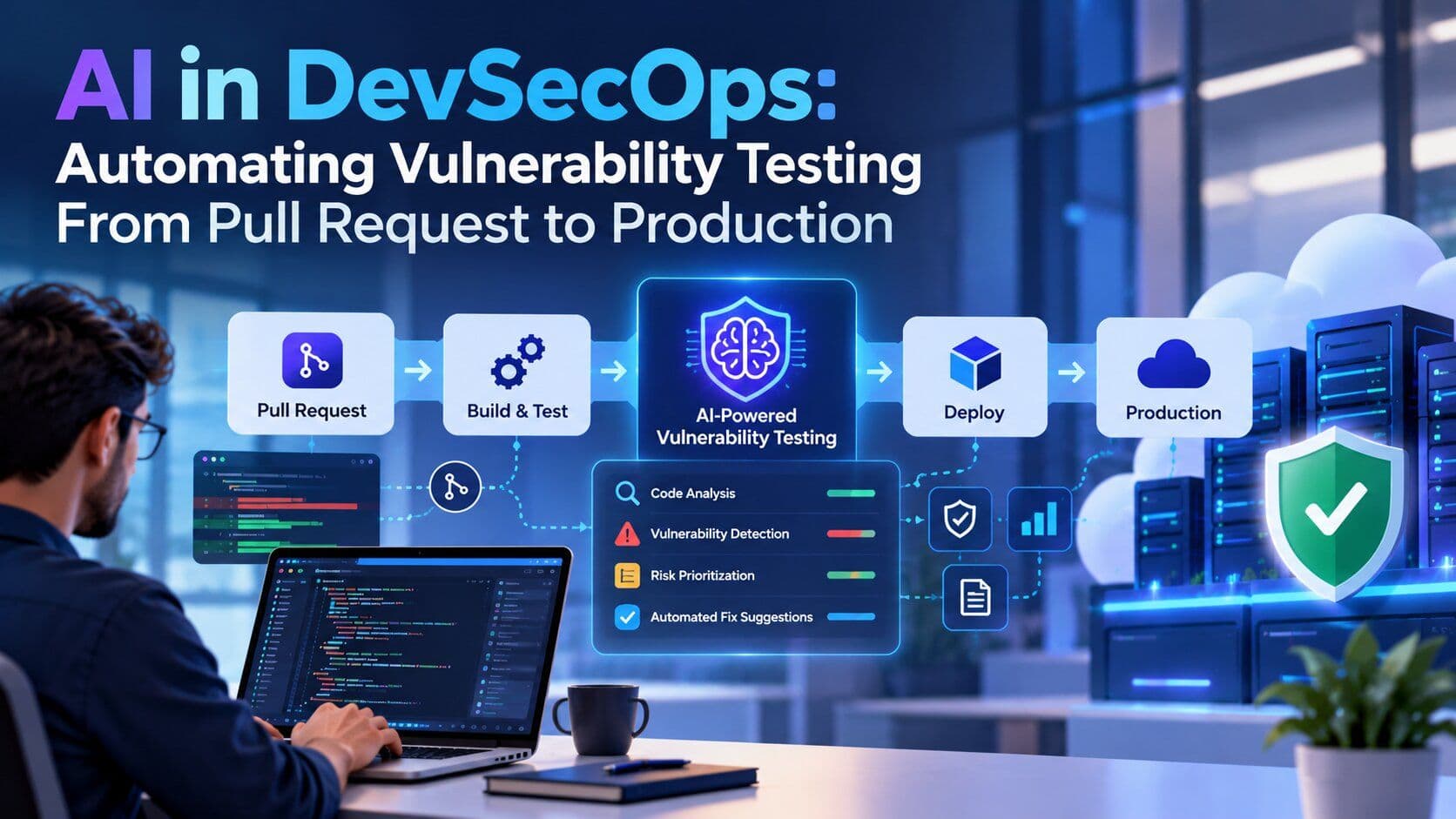
AI in DevSecOps: Automating Vulnerability Testing From Pull Request to Production
A developer opens a pull request on Thursday afternoon, a reviewer skims the diff for logic errors, and the change merges before anyone considers whether it opened a new path for an attacker. Multiply that by dozens of merges a day and security becomes a gap that widens with every release. Traditional models put testing at the end, where fixes are slow and expensive. AI-assisted tooling is changing that by moving checks into the places developers already work. The sections below cover why late testing fails, how to build checks into the pull request, what AI adds to the pipeline, how to keep findings trustworthy, and how to carry testing through to production.
Why Late-Stage Testing Falls Short
Security reviews that happen before a major release or once a year create a backlog by design. By the time a penetration test reports a flaw, the code has often been rewritten, the author has moved on, and the fix competes with feature work. Remediation cost rises the further a defect travels from the commit that introduced it.
Release speed makes this worse. Teams that deploy several times a day cannot wait for a manual review cycle without becoming the bottleneck, so reviews get skipped or shortened. Developers also context-switch poorly. A finding delivered weeks later forces them to reload a change they have forgotten, while feedback delivered within minutes of the commit lets them fix it while the logic is fresh. Shifting testing earlier is not about adding work. It is about delivering the same information at a moment when it is cheap to act on.
Building Checks Into the Pull Request
The pull request is the natural gate, because every change passes through it and reviewers already expect feedback there. Teams that run security testing on every pull request catch issues before code reaches the main branch, and results appear as comments on the diff instead of in a separate dashboard nobody opens. A practical baseline includes these layers:
- Static analysis to flag insecure patterns in the changed code
- Dependency and software composition scanning for known vulnerable libraries
- Secret detection to block committed credentials and keys
- Infrastructure-as-code checks for risky cloud or container configuration
- Dynamic or behavior-based tests against a preview environment where feasible
Keep the feedback fast. If checks take twenty minutes, developers will learn to ignore them or merge around them. Run lightweight scans synchronously, and push heavier tests to run in parallel or on a schedule. Decide in advance which severities block a merge and which only warn, and document the rule so it feels predictable instead of arbitrary.
What AI Adds to the Pipeline
Rule-based scanners are good at known patterns and weak at context. AI can help with the parts that consume the most human time. It can summarize a finding in plain language, explain why a code path is exploitable, and suggest a fix aligned with the project’s own conventions. It can also help triage by grouping duplicate alerts and estimating which are reachable from real inputs instead of merely present in the code.
Some tools go further and generate test cases, probing an application’s behavior the way an attacker might. Platforms built around security testing on every pull request aim to make that probing continuous instead of occasional, so new code is exercised as it changes. The benefit is coverage that keeps pace with delivery speed. The limits matter too. AI output can be wrong, and a confident explanation is not proof, so treat suggestions as input for a human decision, not an automatic verdict.
Keeping Findings Trustworthy and Manageable
Noise is the fastest way to kill a security program. A scanner that floods every pull request with low-value alerts trains developers to dismiss all of them. Tune rules to your stack, suppress confirmed false positives with a recorded reason, and track the ratio of findings that lead to real fixes.
Ownership helps. Route each finding to the team that owns the code, set response targets by severity, and review overdue items regularly. Measure outcomes that reflect risk, such as time to remediate and the number of high-severity issues reaching production, rather than raw alert counts. Be careful about what you send to external AI services. Source code and configuration can be sensitive, so check how a vendor handles retention, training, and access before connecting repositories. Where policy requires it, choose options that keep code within your environment.
Carrying Testing Through to Production
Security does not end at merge. After a change passes review, run integration and end-to-end tests in staging, and scan container images and deployment manifests before release. Gate promotion on results that matter, and keep a fast path for emergency fixes so safety does not become a reason to bypass the process.
In production, shift from preventing to detecting. Monitor runtime behavior, watch for newly disclosed vulnerabilities in deployed dependencies, and rescan on a schedule, since a library that was safe last month may not be today. Feed what you learn back into the pipeline. If an incident traces to a missed pattern, add a check for it. Teams that treat testing as a loop, from commit to runtime and back, improve with each release instead of repeating the same mistakes. Continuous approaches, including security testing on every pull request, work best when production findings sharpen the earlier gates.
Key Takeaways
Late security testing creates backlogs and expensive fixes, and moving checks into the pull request delivers feedback while it is still cheap to act on. Layer static analysis, dependency scanning, secret detection, and configuration checks, then use AI to explain, triage, and extend coverage without trusting it blindly. Tune for signal, assign ownership, and protect sensitive code when using external tools. Carry testing into staging and production so lessons feed back into the pipeline. Fast, trustworthy feedback is what makes security part of delivery instead of an obstacle to it.
Tag correlati
AI ToolsCategorie correlate
Strumenti IAMetti in evidenza il tuo strumento IA in articoli come questo
Raggiungi utenti che stanno già scoprendo strumenti di IA su PoweredbyAI e costruisci backlink SEO che migliorano la tua visibilità su Google.
Scelto da 25,000+ strumenti IA e startup in crescita
Metti in evidenza il tuo strumento IA in blog e articoli ad alto traffico
Compari su PoweredByAI e raggiungi utenti che stanno già scoprendo strumenti come il tuo. Costruisci backlink SEO potenti che ti aiutano a posizionarti su Google e a portare traffico organico costante.
Feature sponsorizzate sul blog con reach mirato
Articoli guest con backlink do-follow
Inserimenti di link contestuali per un boost SEO
Scelto da 25,000+ strumenti IA e startup in crescita
Enjoyed this? Talk AI tools with other founders and builders.
Join our Slack communityBlog recenti

Invia il tuo strumento


PoweredByAI.app è un catalogo di strumenti IA che aiuta persone, aziende e creator a scoprire i migliori strumenti di IA per scrittura, coding, design, produttività e altro.
© 2026 , Prodotto di011BQ. Tutti i diritti riservati.