BlogPersonalised Gift Songs with the Suno V6 API: We Measured Names, Length, Tempo and Loudness Across 38 Clips
Personalised Gift Songs with the Suno V6 API: We Measured Names, Length, Tempo and Loudness Across 38 Clips
 Shashank Jain
4 Nov 2026
15 mnt baca
Personalised Gift Songs with the Suno V6 API: We Measured Names, Length, Tempo and Loudness Across 38 Clips
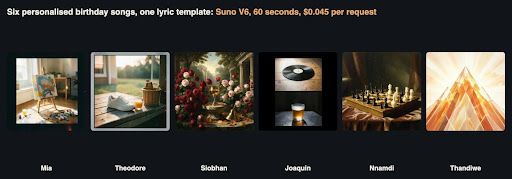
Six birthday songs from one lyric template. Each request cost $0.045 and returned two takes.
Personalised songs have become a popular gift. A customer types a name, the occasion and a few details, and a minute later receives a song written for one person. AI music models make this look easy. The hard part is getting the right song every time: the name sung so that the person recognises it, the details included, the length predictable, and a file that plays at a sensible volume on a phone.
We tested those requirements with a concrete scenario. We imagined a small gift-song app, which we will call Encore Notes, that sells 60-second songs for birthdays, retirements, anniversaries and graduations, and built its core pipeline on the Suno V6 API. All names, people and businesses in this article are fictional.
We sent 22 API requests: 17 song generations, 2 section replacements and 3 lyric requests, which produced 38 audio clips. We checked every clip with speech recognition (Whisper), measured loudness to the EBU R128 standard, estimated tempo and key from the audio, and timed every request. Generation cost $0.88 in total. Eight of the songs can be played below, and a three-minute walkthrough video near the end shows the charts with short excerpts.
How the pipeline works
The simplest design, and the one most gift apps start with, is a fixed lyric template with slots for the name and one or two personal details, plus a short style menu. Our template was deliberately short, about 60 words, with the name appearing five times:
[Verse]
Wake up, {NAME}, the sun is at your door
{DETAIL 1}
Every year you shine a little more
So we wrote this song for you
[Chorus]
Happy birthday, {NAME}, raise your glass up high
Happy birthday, {NAME}, we're all by your side
{DETAIL 2}
Happy birthday to you
[Outro]
Happy birthday, {NAME}
Each request goes to the music generation endpoint in custom mode, with the filled-in lyric as the prompt, a style string, the vocal gender and a target duration. You submit the job, receive a task ID and poll until it completes. A completed task returns two takes, each with an audio URL, a cover image and a duration.
import time, requests
BASE = "https://api.apimart.ai/v1/music"
H = {"Authorization": "Bearer YOUR_KEY"}
STYLE = ("warm acoustic pop birthday song, strummed acoustic guitar, handclaps, "
"glockenspiel, cheerful female vocal, 100 bpm")
def birthday_song(name, detail1, detail2, style=STYLE):
lyric = TEMPLATE.format(NAME=name, D1=detail1, D2=detail2)
tid = requests.post(f"{BASE}/generations", headers=H, json={
"custom": True, "version": "v6", "title": f"Happy Birthday {name}",
"prompt": lyric, "style": style, "vocal_gender": "female", "duration": 60,
}).json()["data"][0]["task_id"]
while True:
d = requests.get(f"{BASE}/tasks/{tid}", headers=H).json()["data"]
if d["status"] in ("completed", "failed"):
return d # d["result"]["music"] holds two takes
time.sleep(6)
For measurement, Whisper transcribed every clip with word timestamps, and we compared each transcript with the lyric sheet. We used ffmpeg's EBU R128 meter for loudness and true peak, an onset-autocorrelation estimator for tempo and a chroma-profile estimator for musical key. None of these tools is perfect, and we note their limits where they matter.
Test 1: one template, six names
We filled the template for six customers with a range of difficulty for an English-singing model: two common English names (Mia and Theodore), two names whose spelling does not match their sound (Siobhan, roughly "shi-VAWN", and Joaquin, roughly "wah-KEEN"), and two names that are less common in English-language material (Nnamdi and Thandiwe). Each had two personal details, such as "Paint on your fingers and a canvas on the floor" for Mia.
All six requests were submitted at once, completed in 30 to 41 seconds and cost $0.045 each. The question was simple: when you play the song, do you hear the name? We looked at what Whisper transcribed in the name position.
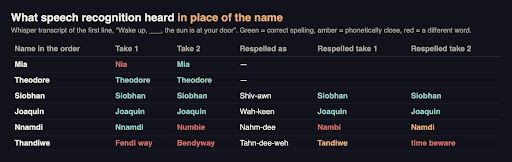
What speech recognition heard in the name slot. Each take sang the name the same way all five times.
Eight of the 12 takes came through cleanly. Theodore, Siobhan and Joaquin were correct in both takes. Mia was correct in one take and heard as "Nia" in the other, and Nnamdi was correct once and heard as "Numbie" once. Thandiwe failed in both takes, heard as "Fendi way" and "Bendyway". For that customer, neither take could have been delivered.
One pattern was useful. Within a take, the name was always sung the same way: if the first line said "Fendi way", so did every chorus. A quality check therefore only needs the first four or five seconds, which contain "Wake up, {NAME}". At Whisper's rate of $0.006 per minute, that check costs well under a tenth of a cent per take.
Thandiwe, original spelling, take 1. Speech recognition heard "Fendi way".
A caution about this method: Whisper knows common names, so a correct "Siobhan" means the sung sound was close enough for Whisper to map it to the name, not that an Irish listener would be satisfied. "Nia" for Mia may be partly Whisper's fault, since M and N blur in a sung vowel. The test measures intelligibility to a strong general listener, not pronunciation quality, but a failed transcription is still a good reason to regenerate.
Test 2: does phonetic respelling help?
The usual fix for a mispronounced name is to write it the way it sounds. We sent the four difficult names again as "Shiv-awn", "Wah-keen", "Nahm-dee" and "Tahn-dee-weh", with everything else unchanged. The four requests took 30 to 41 seconds and cost $0.18.
The results were mixed. Siobhan and Joaquin were correct in all four respelled takes, but they had already been correct in all four original takes. Nnamdi got worse in the strict sense: the respelled takes were heard as "Nambi" and "Namdi", compared with one correct "Nnamdi" before ("Namdi" is close to the real sound, so one take was usable). Thandiwe improved: one take was heard as "Tandiwe", close to the correct sound, while the other became "time beware".
Thandiwe, respelled as "Tahn-dee-weh", take 1. Speech recognition heard "Tandiwe".
Respelling seems to help when the model has no idea how to say a name and can hurt when it already does. Use the real spelling first and switch to a respelling only after a failed check. Also generate the delivered lyric sheet from the original spelling, not the prompt, or the customer will see "Tahn-dee-weh" in the captions.
Test 3: lyric accuracy beyond the name
If names are the weak point, how accurate is everything else? We had 28 template takes: 12 from Test 1, 8 from Test 2 and 8 from the style test below, containing 1,706 lyric-sheet words.
Share of lyric words heard correctly in each take. Red bars include a misheard name.
Outside the name slot, Whisper misheard 14 of 1,706 words, or 99.2 percent accuracy. The errors were small: "planted" heard as "plant it" in three Siobhan takes, "chess" as "chest" in two Nnamdi takes, "every worry" as "everywhere you" in two more, and single slips such as "paint" as "hang". 19 of the 28 takes had no errors outside the name. The name accounted for 40 of the 54 misheard words, nearly three quarters of all errors.
We left insertions out of the accuracy number. Suno often added an extra "Happy birthday, {NAME}" at the end, and one Nnamdi take added a scat line. For a birthday song that is harmless, but if your product shows a lyric sheet next to the audio, you may want to add the repeated line.
Test 4: did the 60-second request hold?
A fixed length sets customer expectations and keeps previews and video versions consistent. Every request in this test asked for 60 seconds.
Measured length of 34 takes. Short template lyrics stayed close to 60 seconds; long lyrics ignored the target.
With the short template, the duration control was reliable. All 20 takes from Tests 1 and 2 were between 54.3 and 60.0 seconds, and 19 were within 1.4 seconds of the target. Style variations ran a little longer: synth-pop and swing came back at 62 to 64 seconds, and one lullaby take ran to 74.8 seconds, probably because a slow tempo needs more time for the same words.
The duration field did not shorten long lyrics. With full-length lyrics from the lyrics endpoint (Test 6), the six takes ran from 87.6 to 190.0 seconds. The model sang every word it was given. In practice, lyric length controls song length more than the duration field does, and a 60-second product needs a lyric of about 60 to 70 words.
Test 5: four gift styles, one lyric
We kept Mia's lyric and changed only the style prompt, with an explicit tempo in each:
lullaby: "gentle acoustic lullaby birthday song, fingerpicked guitar, soft female vocal, 72 bpm"
country: "upbeat country birthday song, banjo, fiddle, stomping drums, female vocal, 108 bpm"
synthpop: "1980s synth-pop birthday song, gated drums, analog synth bass, bright female vocal, 120 bpm"
swing: "big band swing birthday song, brass section, walking bass, brushed drums, female jazz vocal, 140 bpm"
Three requests finished in 30 or 31 seconds; the lullaby took 94 seconds, the slowest template request in the test. All four cost $0.045.
The BPM written in the style prompt compared with the tempo measured from the audio.
Tempo followed the prompt closely for most styles. The 20 acoustic pop takes, asked for 100 BPM, measured 98.0 to 100.0. The lullaby measured 71 and 70 against 72, and country 106 and 107.75 against 108. Synth-pop came back at 125 against 120, about 4 percent fast. Swing was the outlier: 138 on one take but 128 on the other, a 9 percent miss, although a shuffle feel is also where tempo estimators are most easily confused.
Style did not hurt intelligibility much. Country, lullaby and swing each had at least one take with every lyric word heard correctly. The two takes where Mia became "Nia" were the first swing and first synth-pop takes, the styles with the busiest mix around the voice. Two takes per style is too few for a firm conclusion, but it is a reason to run the name check on every style.
Mia, lullaby style, take 1 (asked 72 BPM, measured 71).
Mia, big band swing, take 2 (asked 140 BPM, measured 128).
Test 6: lyrics written from an order form
Templates are reliable but generic. The more interesting product lets the customer describe the person and has the model write the lyric. We sent three order forms to the lyrics endpoint:
Retirement: "a 60-second retirement song for a school librarian named Margaret who worked
31 years at Oakfield Elementary, loves crossword puzzles and her greyhound
Pepper, warm and funny"
Anniversary: "a 60-second tenth anniversary song for Priya and Tom, who met at a bus stop
in the rain, love hiking and burn the pancakes every Sunday, romantic acoustic"
Graduation: "a 60-second graduation song for Lucas who just finished nursing school after
two years of night shifts, cheered on by his little sister Ava, proud and upbeat"
Each lyric request took 10 to 16 seconds, cost $0.0072 and returned two lyrics with titles. The writing was good: the retirement song opened with "Thirty-one years in the hall / At Oakfield Elementary / You knew every kid by name / And every book by the ending". We then generated a song from the first lyric of each order, with a fitting style (folk-pop, acoustic ballad, pop rock). The three requests cost $0.135 and took 39, 53 and 151 seconds.
Which order details reached the lyric, and which were heard in each sung take.
Two problems appeared. The first was length. Although every order said "60-second", the lyrics were full songs of 150 to 175 words, and the songs ran 88 to 190 seconds. For a one-minute product, trim the lyric or set a word count in the prompt.
The second was missing facts. The retirement lyric included all five details we checked, and the anniversary lyric five of six (it turned "hiking" into "up the hill you wander"). The graduation lyric, however, never mentioned nursing in either variant, only night shifts and a "white coat". Check the most important detail in the lyric text before generating music; it is a free text search.
Names caused trouble again: Whisper heard Margaret as "Marvy" in one take and Priya as "Preah". The second anniversary take could not be measured, because Whisper returned invented spoken text about "turning right to Session Road", a known failure of speech recognition on long music. We counted that as a failed measurement, not a failed song.
"Margaret at Oakfield", take 2 (asked for 60 seconds, received 128).
Whether a song comes from a template or a written lyric, the music request costs the same, so the main difference is the extra lyric call at under one cent. If you are planning margins for a product like this, model them against the current Suno API pricing per operation, because retries for failed names, not the first request, are what move the cost per order.
Test 7: fixing a name with section replacement
Regenerating a whole song to fix one word feels wasteful and changes the melody. Suno's section replacement operation takes a time range and new lyrics for it, which looks like the ideal tool for a misheard name. We tried it on the two weakest takes, Thandiwe ("Fendi way") and Mia ("Nia").
Whisper's word timestamps placed the first chorus at 19.5 to 34.5 seconds in the Thandiwe take and 19.0 to 34.3 seconds in the Mia take. We sent the same chorus as replacement lyrics, with the names written "Tan-DEE-way" and "Mee-ah". Each request took 22 to 30 seconds and cost $0.045.
The original take and the two clips returned by the replacement request. Neither clip sang the new spelling.
This did not work in our test. Instead of a 15-second patch, each request returned two clips of 64.6 to 67.3 seconds. They matched the original arrangement (the Thandiwe clips estimated in A major, like the original), but the new lyrics were not sung. One Thandiwe clip repeated "Happy birthday to you", the other sang "Bendyway", the error from the original request's second take. Both Mia clips were almost wordless. None of the four clips contained the respelled name.
Replacement clip 1 for the Thandiwe take. The requested chorus with "Tan-DEE-way" is not sung.
The clips did sound like the same song, but for correcting a word, replacement was not reliable, and it cost the same as a fresh generation that returns two new chances. For names, regenerate.
Test 8: same lyric, same style, same song?
A gift brand might want a signature tune. The template and style prompt were identical for all six customers in Test 1, so we checked whether the results were musically the same.
Estimated key, tempo and length of the 12 takes from Test 1.
They were not. Tempo was consistent at 98 to 100 BPM, but the 12 takes landed in eight different estimated keys, and the two takes of each request differed in key in all six cases. Our estimator can confuse a major key with its relative minor, but even allowing for that, these were different melodies sharing a lyric and a groove.
For most gift apps that is an advantage, because every customer gets an original song. A house melody would need a reference-based feature, such as covering an existing track or a stored voice persona, which we did not test here.
Test 9: delivery, loudness and previews
Gift songs are played on phone speakers, in messaging apps and in social videos, so the files need consistent loudness and no clipping. We measured all 34 raw song takes first.
Integrated loudness was already consistent, between -15.1 and -13.4 LUFS, close to the -14 LUFS reference most streaming platforms use. True peak was the problem: 29 of 34 takes peaked above -1 dBTP, and 19 above 0 dBTP, which means clipping when the file is decoded or converted again.
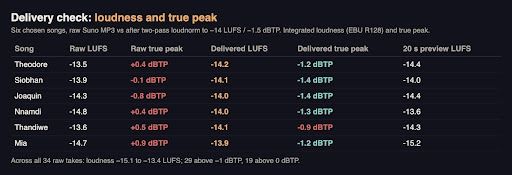
Six chosen songs before and after normalisation to -14 LUFS with a -1.5 dBTP ceiling.
We picked one take per customer (the respelled Thandiwe take, the only one with a recognisable name) and ran a two-pass ffmpeg loudnorm to -14 LUFS with a -1.5 dBTP ceiling. All six then measured -14.2 to -13.9 LUFS. Five measured -1.2 dBTP or lower; the sixth measured -0.9 dBTP after MP3 encoding, which is why the ceiling should sit below your real target. We also cut a 20-second preview of each song from the first chorus, with short fades, for an order confirmation page. Each preview was 321 KB at 128 kbps.
Theodore, full song after normalisation. Both Theodore takes had no lyric errors.
Joaquin, 20-second preview cut from the first chorus.
How we would wire this into an app
A reliable order flow follows from these results. For written lyrics, call the lyrics endpoint, check that the name and the key details appear, and trim to about 60 to 70 words. Submit the music request and wait; most finished in 30 to 60 seconds, but our slowest took 151, so do not promise an exact time. Transcribe the first five seconds of both takes and compare the name with the expected spelling and accepted variants. Keep a passing take; if neither passes, regenerate once with the real spelling and once with a respelling. Then normalise with a true-peak limit, cut the preview and deliver. In our run, five of six customers would have passed on the first request and the sixth on the second, about 1.2 music requests per order.
The walkthrough video
The video below summarises the tests, with the charts and short excerpts of the songs.
Walkthrough: personalised gift songs with the Suno V6 API (about 3 minutes).
What it cost
Step | Requests | Time per request | Cost |
Template songs, six names (Test 1) | 6 | 30–41 s | $0.270 |
Respelled names (Test 2) | 4 | 30–41 s | $0.180 |
Four styles (Test 5) | 4 | 30–94 s | $0.180 |
Lyrics from order forms (Test 6) | 3 | 10–16 s | $0.022 |
Songs from those lyrics (Test 6) | 3 | 39–151 s | $0.135 |
Section replacement (Test 7) | 2 | 22–30 s | $0.090 |
Total | 22 |
| $0.88 |
The six delivered birthday songs took ten requests, including the respelled retries, and cost $0.45. The whole test cost 88 cents. Transcribing all 38 clips added about 28 cents, but that was measurement for this article; a five-second name check in production costs a fraction of a cent. With about 1.2 music requests per order, generation cost per delivered one-minute song is five to six cents.
Checklist for personalised song apps
- Keep the lyric short. About 60 to 70 words gave songs within 1.4 seconds of 60 seconds in 19 of 20 takes. Long lyrics ignored the duration target.
- Check the name in every take. Names caused 40 of 54 lyric errors. The first line is enough, because each take sang the name consistently.
- Use the real spelling first. Respelling helped one unfamiliar name and made a recognised one worse.
- Use both takes. In two of six requests, one take had the name right and the other did not.
- Search the lyric for key facts before generating music. The graduation lyric left out "nursing" in both variants.
- Regenerate rather than patch. Section replacement did not sing the corrected name in any of four clips and cost the same as a new request.
- Do not expect a house melody from text prompts. Twelve takes of one template landed in eight different keys.
- Limit the true peak before delivery. 19 of 34 raw takes peaked above 0 dBTP; normalise to -14 LUFS with a ceiling below -1 dBTP.
The bottom line
The Suno V6 API is a capable engine for personalised gift songs. With a short template, it sang 99.2 percent of the non-name lyrics correctly, held the requested length within about a second, followed explicit tempos in most styles and returned two takes in roughly 30 to 40 seconds for $0.045. The weak spot is exactly where a gift song cannot afford one: unusual names. Three of six names failed in at least one take and one failed in both, while the apparent fixes, respelling and section replacement, were unreliable or did not work. The answer is to build the check into the pipeline: transcribe the name, keep the better take, retry when needed and normalise the file. If you want to try a similar workflow, or combine music generation with voice, image and video models under a single key, you can find them on APIMart.
Tag Terkait
AI ToolsKategori Terkait
Alat AITampilkan alat AImu di artikel seperti ini
Jangkau pengguna yang aktif menemukan alat AI di PoweredbyAI dan bangun backlink SEO yang meningkatkan visibilitasmu di Google.
Dipercaya 25,000+ alat AI dan startup yang sedang berkembang
Tampilkan Alat AImu di Blog & Artikel Traffic Tinggi
Tampil di PoweredByAI dan jangkau pengguna yang aktif mencari alat seperti milikmu. Bangun backlink SEO kuat yang membantu ranking di Google dan mendatangkan traffic organik yang konsisten.
Fitur blog tersponsor dengan jangkauan tertarget
Artikel tamu dengan backlink do-follow
Penempatan tautan kontekstual untuk dorongan SEO
Dipercaya 25,000+ alat AI dan startup yang sedang berkembang
Enjoyed this? Talk AI tools with other founders and builders.
Join our Slack community