



BlogWhy Your AI Hire Should Understand Data Pipelines as Well as Models
Why Your AI Hire Should Understand Data Pipelines as Well as Models
 Shashank Jain
20 Nov 2026
6 mnt baca
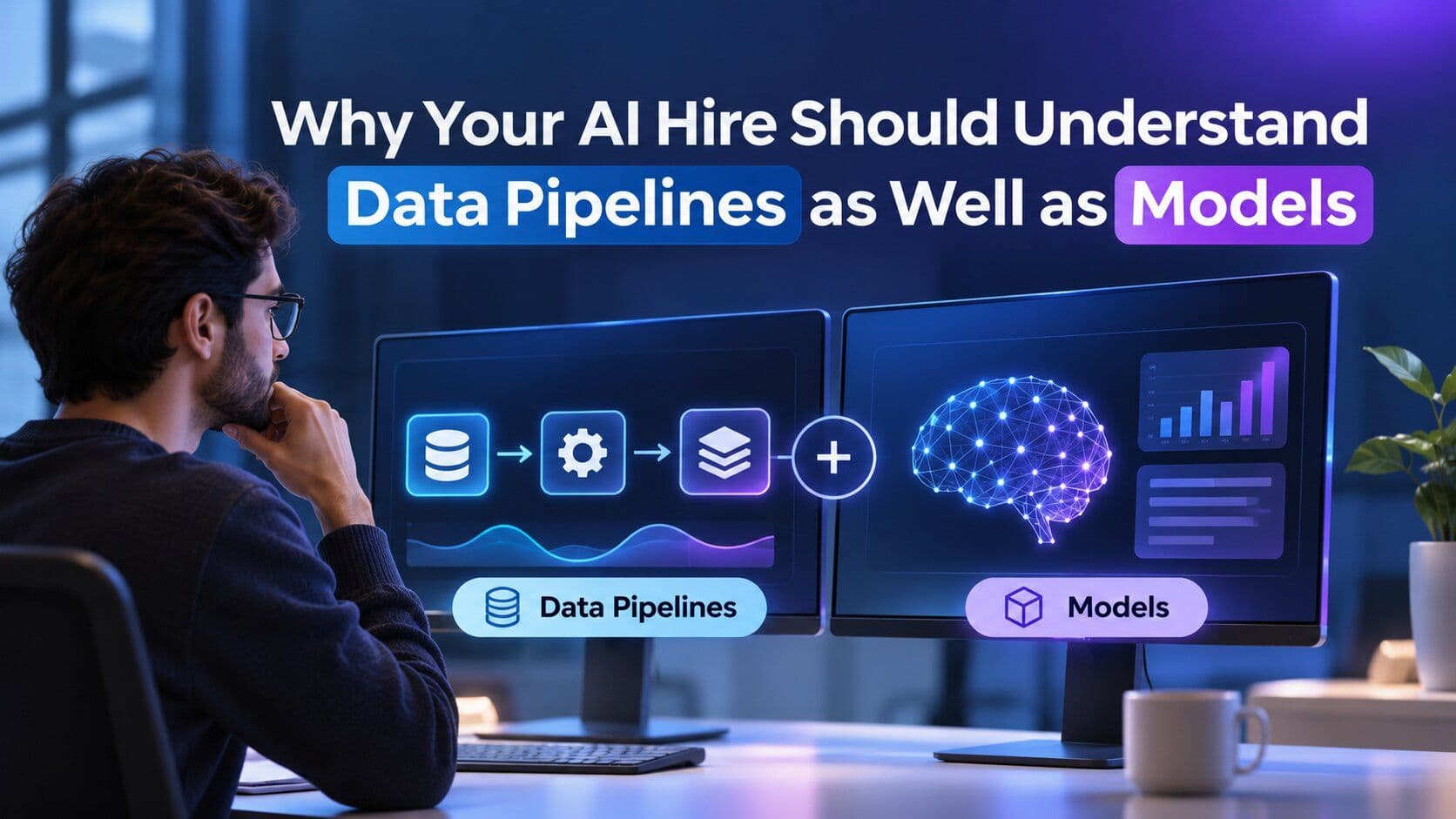
Why Your AI Hire Should Understand Data Pipelines as Well as Models
A customer support assistant can give a tidy, confident answer and still quote last month’s refund policy. The model may be working exactly as designed. The thing is, the fault often sits further upstream: someone changed the policy, but the search index never caught up. In a forecasting tool, the same sort of gap might start with a late file or a customer record that arrived half empty.
When you hire for AI work, then, it pays to ask who can trace information from its source to the point where software uses it. Many teams need AI developers with data engineering skills for that reason. They need people who can work on a model as well as follow the plumbing around it, even if another engineer owns some of the pieces.
The model is one part of a larger system
A model learns patterns from examples or uses supplied context to produce an answer. It cannot tell on its own whether those examples are fresh, representative, or useful for the decision a business is making. That judgment starts before the model runs.
The work varies with the product. In a forecasting system, feature engineering can turn raw transactions into signals, perhaps weekly sales totals or the number of days since a customer last ordered. A document assistant has a different problem. It may use retrieval-augmented generation, or RAG, which finds useful passages in company files and gives them to a language model along with the user’s question.
That setup still depends on someone selecting and preparing model training data. And once a tool is live, new records or documents have to reach the surrounding software in a usable form. Training and live use are different stages. A candidate should know where they meet, as well as what happens when they drift apart.
The pipeline determines what the model can use
On the engineering side, data pipelines move information between systems and transform it in order to make it usable for a particular job. They might pull from a database, process a spreadsheet, or index a folder of documents. Apache Airflow, for instance, can schedule and coordinate work; dbt is often used to manage transformations inside a data warehouse. Those tools solve different parts of the problem. A team does not need both just because AI is involved.
Pipelines also have to keep up with change. If a policy file gets revised, a document assistant needs some way to notice, remove or replace the old version, and refresh the search index. A forecasting service may take new events on a schedule, transform them, and make the resulting figures available to a model. Some jobs need minute-by-minute updates. Plenty do not.
When an update fails, the model can keep answering from stale material. Or it may get no input at all. The symptom looks like a model problem, which sends the team tuning prompts or switching models while the actual fault sits in a broken transfer or a missed refresh.
Data quality turns into product behavior
At that point, data quality is visible to the person using the product. A duplicated sale can push a forecast upward. A missing date may put an event in the wrong week. An old policy can lead a support assistant to give a customer an answer the company no longer stands behind. These are not edge cases if the system depends on those fields every day.
Checks should fit the job. A team might reject a record with no customer ID, flag a number outside a plausible range, or notice that yesterday’s data has not arrived. For documents, it helps to know who owns a file and when it was updated. Search systems also need to drop the obsolete copy when a new one replaces it; otherwise both versions may surface.
All the same, checks do not make data perfect. A tidy dataset can leave out a group of customers or encode a bad business rule. People need to decide what the application may infer, when a human should review its output, and how an employee can correct a wrong answer. More checks add work and can delay updates. If anything, that delay may matter more for systems that rely on fresh data. The cost is real, so, in order to focus effort where it counts, start with mistakes that could change a decision or harm a customer.
Hire for the handoffs
Some companies need one engineer to get a prototype off the ground. Others already have data engineers and want an ML specialist to work with them, plus product engineers who connect the feature to existing software. The right mix depends on the system, the staff already in place, as well as how costly an error would be. There is no prize for hiring a universal expert when two clear owners can work together.
One avoidable source of AI project failure is a handoff nobody owns. The model developer expects a clean input. The data team assumes the application can tolerate missing values. Then the product team finds out that no one was watching whether the data had arrived. A strong candidate can spot that seam and explain who should own it, even when they will not write every line themselves.
Job descriptions often blur several roles together. A smaller product group may need a generalist who can build the first version and tell when specialist help is needed. An established platform team may divide model work from ingestion and application code. If you bring in outside help, including from SysGears, decide who owns each handoff before the work starts.
Ask candidates to follow one change
For an interview, skip the tour of model names. Give the candidate a short scenario: a refund policy has changed, and the support assistant must use the new version. Ask how that update would get from the document store to a customer’s answer. Then ask how the team would notice if the old wording still showed up.
The candidate might talk about file versions, indexing, access rules, or a simple alert when a refresh fails. Listen for whether they ask who owns the source document. That is easy to miss. They should also distinguish a quick prototype from a system handling sensitive records; the latter needs more care around permissions and review.
Try a parallel scenario for forecasting, but keep it concrete: the newest batch is late. What does the product show while it waits? How will anyone know the delay happened? If historical outcomes are involved, ask how the candidate would keep information from leaking into the model before it would have existed in real life. Data leakage can make a model appear more accurate in development than it will be in use.
Match the role to the stakes
A small internal experiment may be fine with a managed model service and a basic import process. Building an elaborate data platform before anyone knows whether the feature is useful can burn time and budget. But a customer-facing system that influences lending, medical care, or hiring calls for tighter controls and human review from the outset.
A useful hire can explain what the model needs, where that information comes from, and how the team will spot a failure. They need not know every tool in the catalog. Ask them to walk through the likely weak point in your own workflow.
Tag Terkait
AI Tools→
Kategori Terkait
Alat AI→
Penempatan Unggulan
Tampilkan alat AImu di artikel seperti ini
Jangkau pengguna yang aktif menemukan alat AI di PoweredbyAI dan bangun backlink SEO yang meningkatkan visibilitasmu di Google.
Traffic berniat tinggiBacklink SEOVisibilitas jangka panjang
Tampil UnggulanDipercaya 25,000+ alat AI dan startup yang sedang berkembang
Tampilkan Alat AImu di Blog & Artikel Traffic Tinggi
Tampil di PoweredByAI dan jangkau pengguna yang aktif mencari alat seperti milikmu. Bangun backlink SEO kuat yang membantu ranking di Google dan mendatangkan traffic organik yang konsisten.
✔
Fitur blog tersponsor dengan jangkauan tertarget
✔
Artikel tamu dengan backlink do-follow
✔
Penempatan tautan kontekstual untuk dorongan SEO
Dipercaya 25,000+ alat AI dan startup yang sedang berkembang
Enjoyed this? Talk AI tools with other founders and builders.
Join our Slack communityBlog Terbaru
→



 , Produk dari