🚀 Zaprep: Tus redes sociales al máximo. Empezar gratis — automatiza 1,000 DMs/mes y convierte el engagement en leads. con 1,000 DMs automatizados/mes.
Enviar tu herramienta
PoweredByAI.app es un directorio de herramientas de IA que ayuda a personas, empresas y creadores a descubrir las mejores herramientas de IA para escritura, programación, diseño, productividad y más.
© 2026 , Producto de011BQ. Todos los derechos reservados.

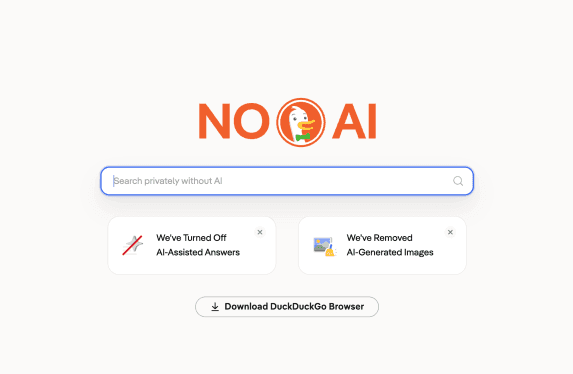
As its traffic continues to climb, alternative search engineDuckDuckGois leaning into anti-AI sentiment with the launch of new browser extensions that allow users to set its no-AI search experience,noai.duckduckgo.com, as their default search engine. Once enabled, users will be directed to DuckDuckGo’s AI-free search page, where there are no AI-assisted answers, no chat prompts, and fewer AI images in the search results, the company claims. The extensions are currently available forChromeandFirefoxusers. Meanwhile, people who have switched to the DuckDuckGo web browser already have their AI settings preserved, even if they clear their browser history. The company says the extensions are meant to help people have a consistent AI-free search experience — something that’s harder to come by these days, especially after Googleannouncedits AI-first revamp of its search engine at its developer conference earlier in May. Since then, traffic to DuckDuckGohas been booming. Last week, the company noted that web visits to its no-AI search page were up nearly 30% week-over-week, and its U.S. app installs were also up 18.1% week-over-week, with U.S. iOS app installs peaking at 69.9% week-over-week growth. Those trends followed news that Google wasoverhaulingits search box in the biggest change to its search engine in more than 25 years. Now, instead of returning links at the top of the page, Google will favor sending users into AI-generated search overviews, which are becoming more interactive experiences capable of creating visualizations, charts, graphs, or even mini apps, as needed. Follow-up questions from AI Overviews will push users into an AI Mode chat experience. The traditional “10 blue links” that defined Google in its earlier days are more of an afterthought, appearing below all this AI-fueled productivity. But not everyone is on board with having AI made the default, which is why some are making the move toalternative search engines like DuckDuckGo, Kagi, and others. DuckDuckGo says traffic to itsno-AI search pagewas up threefold on Thursday, May 28, 2026 — a new high-water mark since Google’s search announcement — and the numbers are still climbing. The growth is not coming in spurts either, the company points out. Instead, visits are averaging roughly 84% above the baseline, suggesting a more sustained shift. In addition to the new “no AI” search Chrome and Firefox extensions, DuckDuckGo will soon update its original DuckDuckGo Privacy Essentials extensions for Chrome, Firefox, Edge, and Opera to offer controls for AI search settings, as well. It’s worth noting that DuckDuckGo isn’t an anti-AI company. The company still offers its own AI chatbot with access to many popular models,and a subscription planthat provides access to the latest models and other tools, like a VPN service, identity theft restoration, and personal information removal services.
View

A new AI weather forecasting tool released today by the startupWindBorne Systemsoffers more frequent and accurate predictions on key variables than the world-leading system developed by European governments, thanks to advancements in how sensor readings are fed into deep learning models. Founded by agroup of Stanford studentsin 2019, WindBorne began by building a better weather balloon, with the idea of selling weather data. But the arrival of the weather-forecasting deep learning models in 2022, the team realized they could capture more value by building their own model as well. WindBorne says the new version of its model offers a more accurate forecast than the ECMWF’s traditional and AI systems across several variables. One simple way to understand it, WindBorne’s chief product officer Kai Marshland says, is that WeatherMesh 6 “is as accurate five days out as a traditional forecast is the day before,” particularly on surface temperature measurements. Today marks the release of the sixth version of that model, WeatherMesh, which the company says is more accurate than traditional and AI forecasts produced by the European Centre for Medium-Range Weather Forecasting (ECMWF), the European intergovernmental organization seen by meteorologists as the leading provider of accurate weather prediction today. WeatherMesh 6 produces a forecast every hour, as opposed to every six hours, as traditional models do. Its resolution is now down to 3 km in Europe and the continental US, where the quality of data is highest. Traditional weather forecasts are generated by complex physics models that require expensive super computers to run, and take a long time to do it. AI models — being built by startups and major labs like Google DeepMind—tend to move faster than physics models, but for now don’t have as high a resolution, as many variables and or predict as accurately over longer time horizons. Still, weather AI is improving rapidly and already being used at major government agencies around the world. Researchers are working to integrate it into the systems used to aggregate weather data and produce public forecasts. WindBorne’s benefits from its unique combination of model-building and data collection. The company now has about 400 balloons in flight gathering sensor readings at any given time, launched from 15 sites around the globe. The advances in its current model come from improvements in how the data collected by the balloons is fed into the models. “I don’t understand, personally, the business model of being [an] AI based weather company without a data set advantage,” WindBorne CEO John Dean told TechCrunch. The ECMWF’s superiority is attributed to the organization’s skills at “data assimilation,” the work of turning disparate sensor readings into a comprehensive, machine-readable picture of the world. For now, AI weather models depend on data sets produced by the ECMWF and the US National Oceanic and Atmospheric Administration. But WindBorne and other organizations are working to feed data directly into the models, and the company’s head of AI, Joan Creus-Costa, says the direct ingestion of data from their balloons and other sources is the key reason for improvement in the new version of WeatherMesh. It’s taken a year of tuning and re-architecting the transformer-based model for the model to deliver these forecasts without losing stability. “When we started doing [data assimilation] we were still very heavily reliant on ECMWF,” Dean said. “I predict today, if we removed ECMWF’s initial conditions, we would actually still do pretty good.” The company suffered a scare last year when a United Airlines jetliner ran into one of its balloons. While the plane suffered minor damage, no one was hurt, in part because WindBorne followed US regulations about how large its sensor package could be. Now, however, the company has added transponders to its balloons that report their location through the global aviation surveillance system, ADS-B, in an effort to reduce the odds of another crash. WindBorne, which has raised $25 million venture funding with a reported valuation of $85 million in 2024, sells its balloon data to NOAA, where it is used in the American weather forecasting enterprise, and the U.S. Air Force and Navy. The company also sells its forecasts to investors and commodity traders, but Dean says the company remains focused on building out its model and data infrastructure over commercial products, in part because of the changing nature of the information environment. “I’m not trying to invest a massive team into building a SaaS product, if the way people want consumer information two years from now is through an agent, right?” Dean said.

Anthropic, the AI lab behind Claude, has filed confidentially for an initial public offering, the company said in ablog postMonday. The company, which is valued at close to $1 trillion, submitted a draft registration statement to the U.S. Securities and Exchange Commission for a proposed initial public offering. Anthropic has yet to list the number of shares or set the price. Anthropic said the proposed initial public offering will depend on market conditions and other factors. The filing comes less than a week after Anthropicraised $65 billionin a Series H funding round that pushed its valuation to $965 billion. The round, which was co-led by Altimeter Capital, Dragoneer, Greenoaks, Sequoia Capital, Capital Group, Coatue, and D1 Capital Partners, attracted a bevy of institutional and strategic investors in anticipation of an IPO. Anthropic’s confidential filing landed in an already white-hot IPO season that includesSpaceX’s initial public offeringthat is targeting a $2 trillion valuation. SpaceX is seeking to raise more than $75 billion. A confidential IPO filing allows a company to begin preparing for a potential public offering without publicly disclosing detailed financial information, risks, or other internal business details. Anthropic will evaluate the IPO privately and without the critical eye of the public. If it follows through, Anthropic will file an S-1 registration document that will contain detailed information of the company’s financials, legal matters, risks, and a breakdown of who holds the most voting power. Anthropic’s filing also comes as its rival OpenAI continues to raise funding, notably a$122 billion roundin March at an $852 billion post-money valuation, and prepares for its own IPO. OpenAI is expected to file for an initial public offering, setting the stage for an IPO season that will pit the two largest AI labs against each other and test the market’s resolve and interest in artificial intelligence. Anthropic, now an AI powerhouse that has landed top-tier enterprise customers, was once considered an underdog in the emerging world of large language models. The startup was founded in 2021 by former OpenAI employees and was seen for years as a distant competitor to OpenAI and its AI chatbot, ChatGPT. The company has drawn in investors and customers with growing capabilities and a focus on enterprise services. That has translated to eye-popping revenue growth. The company said recently that its revenue run-rate had surpassed $47 billion, up from $9 billion at the end of 2025. That revenue growth rate could accelerate as Anthropic makes its Mythos model more widely available. Anthropicpreviewed Mythos in Aprilbut has kept access restricted — warning software developers that the model had discovered thousands of high-severity bugs that would need to be fixed before it could be made public. The generative AI lab is poised to give the European Union’s cybersecurity agency access to Mythos,Bloomberg reportedMonday morning, citing anonymous sources.

The chip-making companies of the world are facing a strange conundrum currently. While they cannot ignore the financial incentive to provide their best memory components and processors to artificial intelligence (AI) companies, they also cannot overlook the consumer market, which has been their primary source of revenue for decades. There are challenges, but the AI era has also led to new opportunities for companies, provided they can build use-case-specific products and scale them effectively.
View

As of June 1, GitHub has moved Copilot to a usage-based billing model, replacing its traditional system with a new token-consumption model.
View

Tech sector openings have dropped to 93,000, marking the steepest monthly decline in a year amid US uncertainty, according to Xpheno.
View

New Figma Make update lets teams edit production code and collaborate without leaving the platform.
View

As AI coding stacks begin costing as much as junior engineers, software companies are quietly restructuring around token economics instead of headcount.
View

Cosmos 3 combines physical reasoning, world modelling and action generation in a single architecture.
View

The company partnered with MediaTek to develop the Arm-based CPU powering RTX Spark.
View

The company plans to strengthen its presence in Asia-Pacific by adding 200 employees and expanding operations in Singapore, Japan, Australia and India, while also launching a new office in London.
View

The selected firms were recognised for creating environments in which innovation, collaboration, and employee growth are deeply embedded in their cultures.
View
View
View