🚀 Zaprep: Tus redes sociales al máximo. Empezar gratis — automatiza 1,000 DMs/mes y convierte el engagement en leads. con 1,000 DMs automatizados/mes.
Enviar tu herramienta
Últimas Noticias de IA

Does India’s Data Centre Boom Have a Measurement Problem?
Equinix, one of the world’s largest data centre providers, believes power capacity might be the wrong way to quantify colocation data centres.
View

Beyond Bengaluru Becomes Karnataka’s Only Scalable Tech Strategy
KDEM’s cluster strategy gains urgency as GCC expansion, AI demand, and cost pressures push tech growth beyond Bengaluru.
View

US Federal Court Rules Against Anthropic, Barring it from Working with the Pentagon
Anthropic alleges that the Pentagon's designation stems from ideological differences over product usage restrictions.
View

IICT Unveils ‘AI Skills House’ Foundational Programme to Bridge India’s AI Skills Gap
From students to creators, the programme promises hands-on AI experience to build real-world skills.
View

Intel, SambaNova Unveil Agentic AI Infra Blueprint Combining GPUs, RDUs, CPUs
The companies said this new design will be available in the second half of 2026 for enterprises, cloud providers, and sovereign AI programmes.
View

Bengaluru Startup Turiyam AI Deploys Indigenous AI Stack on C-DAC Servers
With this, Turiyam has validated a full Indian AI pipeline using a domestic model, inference engine, and compute infrastructure.
View

Bengaluru Deeptech Startup Nava Raises $22 Mn to Build Full-Stack AI Cloud
Nava’s approach combines AI-optimised data centres, high-performance GPU compute, AI-native orchestration and inferencing layers, and tooling.
View

AI agent Poke makes setting up automations as easy as sending a text
IsPokean OpenClaw for the rest of us? That’s the idea coming from a new startup offering an AI agent that you can access via iMessage, SMS, Telegram, and, in some markets, WhatsApp. The AI agent Pokelaunchedpublicly in March, allowing consumers to access a personal assistant that can take action on their behalf through a familiar interface. Today, Poke can help with everyday needs, like daily planning, managing your calendar, tracking your health and fitness, controlling your smart home, editing your photos, and more, all via text message. While you may still interact with a general-purpose AI chatbot like ChatGPT or Claude when you have questions or want to do research, you’d turn to Poke when you want to get something done quickly, or when you want to automate some task to save you time. For instance, you could ask Poke to alert you to specific emails (like those from your family or your boss), or remind you in the morning if you need to take an umbrella with you. It could help you track your health and fitness goals, or let you know the score to last night’s game. Poke could send daily medication reminders, or catch you up on the day’s news, and more, since users can write their own automations in plain text and then share them with friends. Backed by Spark Capital, General Catalyst, and other angels, the 10-person startup has more recently added another $10 million to its coffers, on top of last year’s $15 million seed round. It’s now valued at $300 million, post-money. Starting today, personal superintelligence is just one tap away.No download, no signup.Text Poke for free now:https://t.co/VIWYU64dUI🌴—0:00 – What's Poke?0:50 – Introducing Poke Recipes1:25 – Create a Recipe in 10 seconds1:43 – Earn on Poke2:44 – Build with npx…pic.twitter.com/LHLFRVgahk The tool arrives as demand for agentic AI systems is spiking, leading OpenAI tosnap up OpenClaw’s creator, and Nvidia’s CEO Jensen Huang to warn thatevery company needs its own OpenClaw strategywhen announcing Nvidia’s enterprise-grade alternative. But for those less technically inclined, the prospect of having to install software through the terminal, manage dependencies, and troubleshoot errors is daunting. Plus, systems like OpenClaw raise security concerns due to its deep system access. For many people, then, OpenClaw and other agentic systems still feel out of reach. The team behind Poke wants to change that. Marvin von Hagen, co-founder ofThe Interaction Company of California, the Palo Alto-based startup behind the new AI agent, tells TechCrunch that Poke emerged from watching how beta testers were using the company’s earlier product, an AI assistant for email, built around a year ago. “What we noticed there was that people wanted to use Poke for everything… Even though it was only meant for email, people started asking Poke to remind them to take their medication. They asked Poke about sports results — ‘Hey Poke, tell me every morning if I need a jacket or not,’” explains von Hagen. “And at that time, we didn’t have a lot of this functionality, but we noticed how we needed to become general-purpose much more quickly, because people just like the personality and the humanness of it so much.” The team then partially pivoted and focused on making Poke more useful, proactive, and more personable. Unlike OpenClaw, getting started with Poke is easy. You simply visit Poke.com, click “Get Started,” and enter your phone number. There’s no app to install as the assistant operates over text messaging. Under the hood, Poke turns to the AI model that best fits the task, whether that’s a model from one of the big AI providers or an open source model. “I think this is also one of our main strengths in the long run: that almost all of our competitors are just big tech and labs that are bound to a specific provider. Like Meta AI will only ever be able to use Meta models, and ChatGPT will only ever be able to use OpenAI models,” von Hagen points out. To work over messaging platforms like iMessage, Poke alsoleverages Linq, a solution that enables AI assistants to live within messaging apps. The app can run through SMS and Telegram, too, but WhatsApp support is currently limited asMeta barred other general-purpose chatbotslast fall. That could change, however.Regulators from the EU, Italy, andBrazilopened antitrust probesto fight this decision, which has brought Poke back to Brazil. It will hopefully also allow Poke to work on WhatsApp in the EU when Meta brings the costs down. (Meta has seen pushback over the high fees it’s charging — von Hagen says it’s a form of “malicious compliance” that he believes will soon be addressed.) At launch, Poke offers a variety of “recipes” — or pre-made tools that help you automate various aspects of your life or work. These span categories like health and wellness, productivity, finance, scheduling, travel, home, school, email, community, and, for those who are technical, developer tools. Installing them requires a click of a button and then a standard authorization process, if needed. These recipes are designed to work with apps and services you already know, like Gmail, Google Calendar, Outlook, Notion, Linear, Granola, and others. There are health and fitness “recipes” that work with Strava, Withings, Oura, Fitbit, and more, as well as those that work with smart home devices from companies like Philips Hue and Sonos. Developers using Poke can also automate parts of their workflow via integrations with tools like PostHog, Webflow, Supabase, Vercel, Devin, Sentry, GitHub, Cursor Cloud Agents, and others. Poke’s security model is multi-layered and includes regular penetration testing, security checks, various tools, and limiting permissions for both agents and human employees. By default, the team can’t see anything inside the tokens, unless the user manually opts to provide access to a log file or analytics by flipping a switch in their settings to opt to share this information. (TechCrunch has not performed its own security audit, to be clear.) Over the past couple of weeks,Poke’s usershave created thousands more recipes and automations, which the company plans to add to its recipes directory for discovery in the near future. It’s also encouraging creators to build these shareable recipes by offering to pay somewhere between 10 cents and a dollar (based on geography) for every user who signs up for Poke via the recipe. The cost to use Poke is surprisingly affordable: it’s free to start, then pricing is flexible. During the beta tests, users actually had to negotiate with the AI agent what price they’d pay per month, which ranged between $10-$30 — or so Poke told us in response to this question. Von Hagen says that, now, pricing is based on how the AI agent is being used. If you’re asking for things that don’t require real-time data, you could probably use Poke for free. What costs Poke money is real-time inference, like automations that run on every incoming email or real-time flight check-ins. To set prices, the company gave Poke guidance on how expensive things are, which allows it to determine personalized pricing. While the company has managed to make Poke more efficient to reduce costs, the goal right now isn’t profitability, von Hagen notes. “We really don’t want to make money, but we really want to grow. We want to build a product for a billion people and monetization is really secondary,” he says. “The goal for the next weeks and months now is to bring Poke into everyday life.” To do so, it will look to creators and influencers to showcase how they’re using Poke. I built "tastebuds", an MCP server on@interaction’s Poke Recipes to crowdsource opinions on food.When you’re looking for a place to eat, Poke recommends food spots in your area that other Poke users have enjoyed before by storing their reviews, all running quietly in the… The company, co-founded byFelix Schlegel, isn’t sharing how many customers have signed up, beyond noting that the figure has 10x’ed over the past couple of months. (However, we did spot Poke at the top ofVercel’s AI Gateway leaderboard, for whatever that’s worth.) In addition to its main institutional investors, Spark Capital and General Catalyst, the startup has attracted the attention of a number of angels, including John and Patrick Collison (Stripe founders), Jake and Logan Paul, Logan Kilpatrick from DeepMind,Joanne Jangof OpenAI, and Scott Wu and Walden Yan (Cognition founders). It also included Vercel co-founder Guillermo Rauch, PayPal co-founder Ken Howery, Dropbox co-founder Arash Ferdowsi, Mercor co-founder Brendan Foody, Hugging Face co-founder Thomas Wolf, Flapping Airplanes co-founder Ben Spector, and several others.
View

Why Snowflake is no longer just a data warehouse
Loading the player… Snowflake is betting that the future of AIisn’t just analyzing data, it’s acting on it. That means a shift away from chatbots and toward autonomous agents that can actually get work done. And Snowflake is reorganizing fast to keep up, from shipping hundreds of AI features to restructuring teams along the way. On this episode of TechCrunch’s Equity podcast, Rebecca Bellan sits down with Snowflake CEO Sridhar Ramaswamy to unpack the company’s transformation and what it signals about where AI is headed next. Listen to the full episode to hear: Subscribe to Equity onYouTube,Apple Podcasts,Overcast,Spotify, and all the casts. You also can follow Equity on Xand Threads, at @EquityPod.
View

Snowflake’s transition from storing data to shipping with it
Snowflake is betting that the future of AIisn’t just analyzing data, it’s acting on it. That means a shift away from chatbots and toward autonomous agents that can actually get work done. And Snowflake is reorganizing fast to keep up, from shipping hundreds of AI features to restructuring teams along the way. On this episode of TechCrunch’s Equity podcast, Rebecca Bellan sits down with Snowflake CEO Sridhar Ramaswamy to unpack the company’s transformation and what it signals about where AI is headed next. Listen to the full episode to hear: Subscribe to Equity onYouTube,Apple Podcasts,Overcast,Spotify, and all the casts. You also can follow Equity on Xand Threads, at @EquityPod.
View
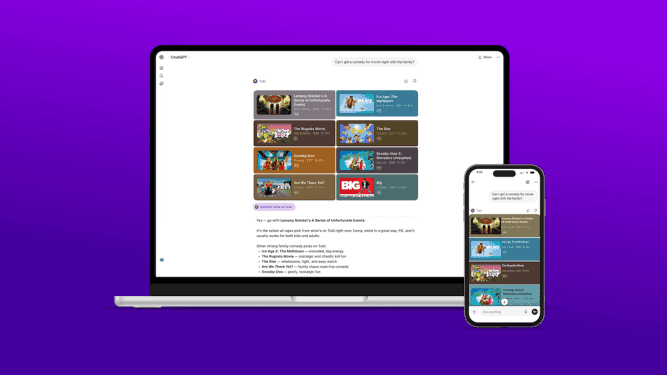
Tubi is the first streamer to launch a native app within ChatGPT
Tubi, the Fox-owned streaming service,announcedTuesday the launch of its native app within ChatGPT, giving viewers an easier way to discover its large library of more than 300,000 movies and TV episodes. While competitors likeNetflixandAmazon Prime Videohave experimented with AI-powered recommendations within their own platforms, Tubi is the first major streaming service to build a dedicated experience directly inside ChatGPT. To access the integration, users can install the Tubi app from theChatGPT app storeand begin by typing “@Tubi” in a prompt. From there, they can make natural-language requests like “a thriller for girls’ night” or “something funny,” and instantly receive curated recommendations tailored to their preferences, all linked back to titles available on Tubi. The launch comes as competition across the streaming industry intensifies. With endless entertainment options, discovery has become a challenge for all platforms vying for limited viewer attention. Many streamers have even begun incorporating features inspired by social media platforms to keep users engaged, reflecting broader shifts in how audiences consume content. Tubi’s move builds on earlier experiments with AI. In 2023, the company introduced “Rabbit AI,” a feature within its mobile app powered by ChatGPT that allowed users to ask specific questions and receive personalized recommendations. However, the tool was discontinued the following year. The new ChatGPT integration suggests a strategic pivot: Instead of trying to replicate AI experiences in-house, Tubi is now meeting users where they’re already turning for answers. ChatGPT reached900 million weekly active usersin February. Tubi reports more than 100 million monthly active users. In separate news, Tubirecently launchedthe “Creatorverse Incubator,” a new initiative aimed at supporting emerging content creators. The program offers promotional backing and potential funding opportunities for original shows that will debut exclusively on the platform. OpenAI firstintroduceda way for developers to build apps inside of ChatGPT back in October. Now, dozens of companies have launched integrations, such as Booking.com, Canva, DoorDash, Expedia, Spotify, Figma, and Zillow.SeatGeekwas the most recent to launch a native app.
View

AWS boss explains why investing billions in both Anthropic and OpenAI is an OK conflict
AWS CEO Matt Garman said Amazon’s recent$50 billion investment in OpenAI, after its long partnership including$8 billion of investment inAnthropic, is the type of conflict of interest the cloud giant is used to handling. Garman has worked at Amazon since he was a business school intern in 2005, before the launch of AWS in 2006, he told the audience of theHumanXconference taking place this week in San Francisco. When asked about the inherent conflict of working closely with two AI model companies that are fierce (and, arguably,sometimes petty) competitors, he said it’s not a problem. Because AWS itself often competes with its partners, it has a lot of direct experience with such competition, he explained. In AWS’s earliest years, it knew it couldn’t build every cloud offering itself, so the unit partnered with others. “We also knew that we would have to compete with our partners, because technology is interconnected,” Garman recounted. “So, for a very long time, we’ve built this muscle up of how we go to market with our partners,” he continued. “But we also may even have first party products that compete with them, and that’s okay, and we’ve promised them we won’t give ourselves unfair competitive advantage.” Today, the world is used to Amazon competing with those who sell on its cloud. Even one of AWS’s biggest rivals, Oracle,sells its databaseand other services on AWS. But it was a radical idea back in 2006, when technology partners took pains never to compete with the partners that helped them succeed. Still, Amazon is hardly a trailblazer in discarding investor loyalty and conflict-of-interest commitments in the wild, money-grabbing world of AI. When Anthropic announced its latest $30 billion round in February, it includedat least a dozen investorswho were also backing OpenAI. This included OpenAI’s main cloud partner, Microsoft. For AWS, making a huge investment in OpenAI to gain its model for its customers (and as a technology development partner), was almost a matter of life and death. Both models were already available on Microsoft’s cloud, AWS’s biggest rival. The cloud giants are also working to keep themselves front and center by offering AI model-routing services. Those services allow their customers to automatically use different models for various tasks as a way to maximize performance and reduce costs. As Garman explained, one model might be ideal for planning, another for reasoning and a cheaper model for easier tasks, like code completion. “I think that is where the world will go,” Garman said. That is also how Amazon, and Microsoft for that matter, will slip their own homegrown models into usage — that old competing-with-your-partners situation, again. All’s fair in love and AI these days.
View
Enviar tu herramienta


PoweredByAI.app es un directorio de herramientas de IA que ayuda a personas, empresas y creadores a descubrir las mejores herramientas de IA para escritura, programación, diseño, productividad y más.
© 2026 , Producto de011BQ. Todos los derechos reservados.