🚀 Zaprep: Your Socials on Steroids. Start free — automate 1,000 DMs/month & turn engagement into leads. with 1,000 automated DMs/month.
Latest AI News

ITC Infotech, Happiest Minds Merger to Birth a ₹7,000 Cr Company
ITC Infotech will acquire a 22.1% stake in Happiest Minds from its promoters for ₹1,330 crore before merging the two companies through a share swap.
View

Cypher 2025 Asked if India’s IT Giants Would Survive AI. 10 Months Later, the Market Has Answered
About ₹15 lakh crore of market value has left five companies whose revenues are, for the most part, still growing. This is what it looks like when a debate gets settled by results rather than argument.
View

Deeptech Startup Alteon Raises $2.5 Mn Led By Lachy Groom to Make Perpetual flights a Reality
Founded in 2025 by 20-year-old Samay Sanghvi, Bengaluru-based Alteon is working on building high-endurance airplanes.
View

Kepler Aerospace Raises $8 Mn to Deploy Swarming ISR Satellites
Bengaluru-based company will use the funding to launch six satellites and expand its mission operations and avionics businesses.
View

Instagram Renames AI Creator Label, Limits Reach of Undisclosed Profiles
Instagram is updating its approach to AI-generated profiles, with a new label for accounts featuring AI-generated people and restrictions for profiles that do not disclose their use of AI. The platform is renaming its existing AI creator label to AI-generated profile and will not penalise accounts that use the new disclosure. The change is said to make it easier for people to recognise when a profile represents an AI-generated person rather than a real human.
View
Anthropic Inks $35 Bn Compute Deal with Lambda: Report
The deal covers about 350 MW of capacity at a Texas data centre being developed by Hut 8, with NVIDIA leasing the underlying facility and Lambda providing compute capacity to Anthropic.
View

To Lure India’s Scarce AI Talent, Govt is Ready to Outpay the Vice President
The government hopes that high-value project rates, public-sector scale, and access to consequential technology problems can pull private-sector AI talent.
View

Apple shares ‘shocking evidence’ against former employee accused of stealing company data for OpenAI
In its lawsuit against OpenAI, Apple filed what it calls “shocking evidence” to bolster its allegations that former employeesstole trade secrets for OpenAI’s benefit. These new details emerged after the legal counsel for former Apple employee Chang Liu — who now works at OpenAI — handed over Liu’s old Apple work laptop for investigation earlier this month. Apple nowallegesthat Liu used a confidential Apple circuit schematic in his work at OpenAI, as well as a tool that shares a name with an internal Apple engineering application. The company claims that OpenAI was “well-aware” of Liu’s access to Apple data, and that Liu enlisted OpenAI colleague Yu-Ting Peng to help destroy evidence in June when he learned that Apple was investigating him. “The MacBook represents the very limited information Defendants provided so far (and only after weeks of delay), and shows Apple is not conducting ‘fishing expeditions’ but that its trade secrets are being used and evidence is being destroyed,” thefilingreads. While this new evidence is redacted from public view, past filings from Apple have includedtext messages from Liu— which he punctuated with “crying laughing” emojis — showing he was aware that he still had access to Apple files. OpenAI has previouslydefended Liuby saying that he only accessed Apple files after he stopped working there in order to help former colleagues who asked for his assistance. “Apple now tries to shift the blame to ‘residual access,’ but they also don’t disclose that this is a common issue with Apple which is caused by them failing to properly manage system access when people leave,” OpenAI wrote in ablog postearlier this month. But Appleclaimsthat Liu had continued access because he “exploited a rare, previously unknown authentication bug.” TechCrunch has requested comment from OpenAI on Apple’s newest allegations. Apple is seeking a preliminary injunction — a court order that would block OpenAI from working on hardware based on Apple’s technology while the case is ongoing — as well as expedited discovery, a fast-tracked process for gathering evidence, since the company alleges that more former employees may also be implicated. According to Apple’s initial filing, more than 400 former Apple employees now work at OpenAI.
View
Harvard Law dropout raises $6M for Blue Voice to build a ‘Harvey for police officers’
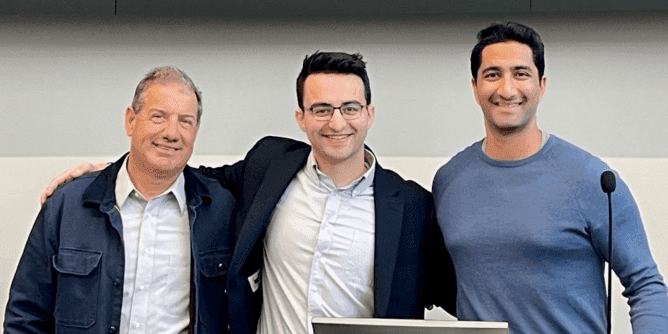
David Lawrence was a Harvard Law student when an on-campus shooting involving a police officer sparked intense controversy over police conduct. Realizing that most policing errors occur when officers lack instant access to department rules, Lawrence dropped out to tackle the problem with AI. He teamed up with co-founders Amit Patankar, a Harvard MBA and former Google engineer, and Michael Gropman, a retired Boston police deputy chief, to launchBlue Voice— a Boston-based AI startup that provides real-time policy guidance to officers in the field. Three years later, Blue Voice is coming out of stealth with $6 million in funding led by SignalFire and Las Olas VC. Officers at 225 county agencies across 25 states now rely on the tool daily to ensure their actions follow department protocol — a platform Lawrence likens to Harvey, the AI tool widely used by lawyers, or OpenEvidence, which is a similar tool for doctors. “When an officer makes a decision, they do so from memory or best guess, based on thousands of pages of law, policy, municipal ordinances, and state laws that they’ve internalized and keep in their head,” Lawrence told TechCrunch. Before Blue Voice, an officer who couldn’t recall a specific protocol — like the exact seventh step required at a crime scene — had few good options: Flip through a 15,000-page manual, wake up a supervisor in the middle of the night, or search generic tools like Google or ChatGPT that lack police-specific training. The problem was that traditional methods took too much time, while consumer AI models delivered incorrect answers up to 30% of the time, Lawrence said. Blue Voice says it solves this issue because it is trained on department-specific laws, local ordinances, protocols, and guidelines that general-purpose AI tools can’t access on the public internet. The platform also gives officers instant access to detailed school maps on their phones during active-shooter emergencies. Today, Blue Voice answers a question every minute. Lawrence says that officers feel confident relying on the tool because it always points them directly to original regulations rather than just generating an answer on its own the way ChatGPT would. Rather than dictating actions, the tool simply provides the laws, leaving the final decision to the officers, who combine it with their own field experience. Over the last year, says Lawrence, Blue Voice grew its customer base elevenfold because police departments see concrete results, including reduced crime and fewer operational controversies. Blue Voice recently helped prevent a kidnapping after a rookie officer spotted a man pressuring a young girl to enter his vehicle, according to Lawrence. Unsure whether he had legal grounds to intervene, the officer consulted Blue Voice on his phone. The app instantly confirmed that the situation met the legal criteria for “child enticement” — an offense covering attempts to lure a minor for the purpose of committing a crime against them — giving him the immediate authority to act. In another instance, Blue Voice reminded a department chief that he couldn’t return an officer to active-duty following a shooting without first obtaining a third-party mental health evaluation. The startup, which competes with PE-backed Lexipol, also recently developed functionality to help detectives solve cold cases. At a time when police use of AI — such as Flock Safety’s license plate surveillance systems — drawsgrowing criticism, Lawrence hopes Blue Voice proves that properly deployed AI can deliver public safety benefits without sacrificing civil rights. Lawrence, who previously worked for Connecticut governor Ned Lamont, developed a deep passion for public service and says he has no regrets about leaving law school behind. “This is the best thing I could do with my career and the most impact I could potentially make,” he said. Above, left to right: Michael Gropman, David Lawrence, and Amit Patankar.
View
Instagram puts new limits on undisclosed AI profiles
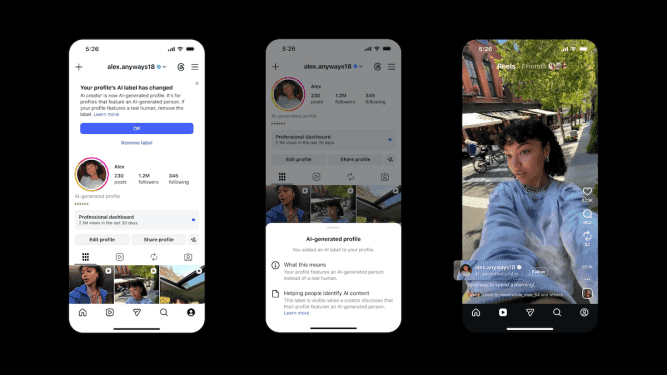
InstagramannouncedMonday that it’s changing how it labels AI-generated profiles and will start limiting the reach of accounts that feature AI-generated people without saying so. The platform says it’s renaming its existing “AI creator” label to “AI-generated profile,” which Instagram says should make the disclosure easier to understand. The new label is meant to tell users that the person featured on a profile was generated or substantially created with AI. Under the new policy, creators who don’t properly label an AI-generated profile could see their reach reduced. Creators who use the new label, on the other hand, won’t be penalized simply for having an AI-generated person as their profile subject. The label also isn’t meant for every use of AI. Instagram says people who use AI to edit photos, polish captions, create graphics, or make other creative tweaks don’t need to use the AI-generated profile label. Instagram says the change comes partly in response to users who have stumbled across profiles that looked like they belonged to real people, only to find out later that the person was completely AI-generated. “As generative AI becomes a bigger part of how people create, we’ve heard that people don’t like seeing a profile that seems human, only to find out later that the person featured is AI-generated,” Instagram wrote. “They want to know when a profile features an AI-generated person.” The timing is notable. Frustration over AI-generated content has been growing as AI influencers become more common across social media platforms. For instance, earlier this year, the gay dating app Goose became the subject of aWired investigationafter a network of apparently AI-generated male influencers promoted the app on Instagram. Wired found more than two dozen accounts that appeared to feature AI influencers, some of which reportedly reached out to potential users through direct messages to get them to sign up. Health and wellness content is another particularly worrying example.The New York Timesreported in July it found hundreds of AI-generated doctors, healers, and wellness personalities on social media promoting supplements or making health claims to users. The announcement comes after Instagram facedbacklashover an AI tool that allowed users to generate images using other people’s likenesses. Users objected to having their public Instagram content used without an explicit opt-in. Meta thenremovedthe feature. Last week, Meta reached an$18 billion settlementwith U.S. states over allegations concerning the effects of Facebook and Instagram on children and teenagers. As part of the agreement, Meta willintroducea default two-hour daily usage limit for teens across Facebook and Instagram, a “Night Mode” block, muted notifications during school hours, and other restrictions.
View
The Pentagon now has its own version of ChatGPT and Grok
The Pentagon has launched versions of OpenAI’s ChatGPT and xAI’s Grok, giving 3 million civilian and military personnel access to generative AI tools that have been tailored to “warfighter needs.” ChatGPT Mil and Grok for Government — custom versions of the popular consumer generative AI tools — are now part of GenAI.mil, a centralized, secure portal launched last year. GenAI.mil, which offered Google Gemini when it first launched, is designed to give Department of Defense employees access to commercial frontier AI models without sending sensitive government data through ordinary consumer channels. In particular, the official military version is exempt from the data collection that is difficult to avoid in consumer tech products. And according to the Department of Defense, the generative AI portal has proven popular. GenAI.mil has already onboarded more than 1.7 million unique users out of the department’s 3 million personnel,according to the department. These latest additions are part of the Pentagon’s broader effort to use AI tools to accelerate work and give the Department of Defense an edge without sacrificing security. They also highlight the absence of Anthropic’s Claude model and the Pentagon’s effort to work with other companies following itsdispute with the frontier lab. Anthropic was labeled a supply-chain risk by the Trump administration — a designation that it is currently fighting in court — after it refused to give the Pentagon unrestricted use of its AI tools and instead insisted on certain safety guardrails. ChatGPT Mil, which came out of the company’sOpenAI for Governmentprogram, will offer an experience familiar to commercial ChatGPT users. The tool will focus on chat, files, projects, and custom GPTs, according to the Defense Department. The tool will also support document-heavy, routine unclassified work such as administrative tasks, logistics, planning, and policy. Other features will be added over time. The Pentagon positioned Grok’s capabilities and potential uses in much broader and more militaristic terms. “Starshield AI’s Grok for Government will provide the warfighter with immediate productivity gains, stronger knowledge continuity and more secure and efficient collaboration,” according to the Defense Department’s press release. (SpaceX’sStarshield AIis a secure satellite network that uses the company’s existing Starlink tech) The department added that Grok would allow its military “to execute missions faster and with greater precision across numerous operational contexts, ranging from market research analysis for acquisition professionals to supply chain management for logisticians.” The Pentagon has struck deals with a number ofother tech companiesin a bid to boost its AI capabilities, including Amazon Web Services, Microsoft, Nvidia, and Reflection AI.
View

ChatGPT Ads Hit $1 Billion ARR in Under 200 Days
“The platform is now used by tens of thousands of advertisers and continues to expand globally,” said OpenAI.
View
Submit your Tool


PoweredByAI.app is an AI Tools Directory helping individuals, businesses, and creators discover the best AI tools for writing, coding, design, productivity, and more.
© 2026 , Product of011BQ. All rights reserved.