🚀 Zaprep: Your Socials on Steroids. Start free — automate 1,000 DMs/month & turn engagement into leads. with 1,000 automated DMs/month.
Latest AI News

Claude Artifacts Found in Google Search, Raising Fresh Privacy Concerns
Claude users are facing renewed privacy concerns after publicly shared Artifacts created with the AI chatbot were found through Google Search, raising questions about how the platform handles content shared using public links. Reports indicate that while shared conversations have largely disappeared from Google's search results, some publicly shared apps, documents, spreadsheets, dashboards, and other AI-generated content remain searchable. The development has drawn attention to how publicly shared AI content can become more widely accessible than some users may expect.
View

Recursive Superintelligence signs $410 compute deal with Amazon
On Tuesday, the AI companyRecursive Superintelligenceannounced a $400 million compute deal with Amazon Web Services. The company, which emerged from stealth in May with $650 million in funding, is focused on building open-ended self-improving systems, a potentially compute-intensive approach to AI research. This multi-year deal is meant to provide flexibility as the company looks to scale up those systems. Recursive’s $410 million outlay represents the bulk of the company’s fundraising to date— but on a call with TechCrunch, Socher emphasized that he expected it to be the first of many such deals. Today’s announcement is “likely going to be one of the smallest compute deals we’re going to sign in the next few years,” Socher said. Recursive’s emphasis on self-improving AI systems means much of the budget that would traditionally go towards headcount and operations is put straight into compute, as the company seeks to automate its own product development process. “For us, it’s less about headcount and more about agent count,” Socher said. There’s no investment component to Amazon’s involvement, in contrast to major labs’ habit of hybrid investment arrangements. But the sheer scale of the commitment allows AWS to commit significant resources to supporting Recursive’s unique needs, which may help to draw in other foundation-level AI companies going forward. “Part of the agreement is that we’re going to co-develop infrastructure purpose-built for these types of company,” said Jason Bennett, VP for startups and venture capital at AWS. Recursive self-improvement (RSI) has long been seen as an inflection point for AI, with some expecting an explosion of progress once AI can be improved without human involvement. But as more labs and companies pursue the idea,the specific requirements have become ambiguous, with some predicting an imminent breakthrough while others characterize self-improvement as more of a continuum. But in Recursive’s case, the goal is to use the powers of RSI to develop actual products — and Socher expects to be releasing the earliest examples before the end of the year. “We are excited to build like really amazing products that people can use, and you will see those within a few months, not within a few quarters or years,” Socher says. “In October or so, you’ll see some actually tangible, useful things that you’ll be able to play around with.”
View

Fish Audio raises $52M seed to build AI voice models for creators and enterprises
The market for AI-generated voice models is massive. Creative use cases require AI voice models to be more expressive, while enterprises looking to automate customer support and sales ops need them to be more steerable. Palo Alto-based Fish Audio wants to cater to all of those use cases with its library of more than 15,000 natural language controls. Since launching last year, the startup now has more than 8 million people using the open-source or hosted versions of its models, and generates annual recurring revenue of $21 million. To continue building on that traction, the startup on Tuesday said it has raised $52 million in a seed round that was led by Coreline Ventures and Capital Today. The funding also saw participation from 359 Capital, Parable, Play Time, Alphalist Partners, Bayhouse Ventures, Carya Venture Partners, and HF0. Fish Audio started as a small project by former NVIDIA researcher Shijia Liao, who, frustrated by non-expressive synthetic voices available on the market, trained a voice generation model on a single GPU, which he then open-sourced. The Fish Speech repository on GitHub now has more than 31,000 stars and is used by indie developers, video game designers, and creators. The company has launched five models in the last year: four speech generation models and one speech-to-text model. It has open-sourced three of its speech generation models, but its latest S2.1 Pro model is available only through its paid API. Fish Audio offers paid monthly plans suited for creators and teams that unlock a set number of minutes of generation plus voice cloning features. The company also offers an enterprise version of its APIs and platform, and says organizations like HeyGen and Sanas are already using it. “Every enterprise has different use cases and different preferences. For example, companies like HeyGen, which use our voices to power AI avatars, want realism in voices; a gaming studio would want expressive voices for their characters; and voice agent companies like LiveKit want more natural-sounding and low-latency voices that are expressive enough for calls,” Cao said. One way the startup has built its library of voices is by asking users to submit their own voices for training its models, and compensating them if their voices are used. That resulted in some trouble a few months ago, however, assomecreatorsallegedthat their voices were uploaded to Fish Audio without their consent. The startup had a DMCA takedown process in place to address such concerns, but the takedowns themselves took a long time. Fish Audio’s CEO and co-founder Rissa Cao told TechCrunch that the company has now automated the takedown process. Creators can submit a short voice sample or a contract to prove that an uploaded voice belongs to them, and their voice will be taken off the startup’s platform in less than three minutes, she said. Still, that doesn’t prevent anyone from uploading an artist’s voice without their knowledge. And until the artist finds out, their voice will continue to be used on the platform unless they file for its removal. Osuke Honda, a partner at Coreline Ventures, said a community-driven model only works when creators trust the platform. “A community-centric approach can only become a durable advantage if creators trust the platform. That means consent, transparency, and attribution must be built into the product rather than treated as afterthoughts. I believe the industry needs to move toward verified voice ownership, clear licensing terms, easy reporting and takedown processes, and eventually revenue-sharing models where creators benefit financially when their voices are licensed or used commercially,” he said. Cao said when the startup was only offering its product as an open-source project with plans for creators, it was running efficiently and didn’t need outside capital. But it wanted to develop more advanced models, and also wanted to accommodate enterprises as investor interest was ramping up, which led it to seek capital. Looking ahead, Fish Audio plans to release an audio understanding model this year. It’s also building a speech-to-speech model. The speech generation market is crowded, with companies likeElevenLabs,WellSaid, Cartesia, Speechify,Async (previously Podcastle), andKrispcompeting for creators and enterprises’ budgets. According to Rico Mallozzi, a partner at 359 Capital, fine-grained controls for developers and cost-efficient model training will help Fish Audio compete better with big AI labs. “I think what they’ve been able to build, state-of-the-art models, with the team they have, compared to some of these other well-funded AI labs or companies, is incredible. It shows their technical acumen in closing the gap between artificial-sounding and human-like voices,” Mallozzi told TechCrunch over a call. The story has been updated to reflect that the company raised $52 million in the seed round.
View

The Forward-Deployed AI Engineer: The Multi-Hat Career Built for Enterprise AI
Building an AI prototype is easier than ever. Turning it into a secure, reliable, and adopted enterprise solution is still the hardest part.
View

Can India’s AI Data Centre Boom Keep Pace with the Tropics?
As AI infrastructure scales across India, industry leaders warn that imported technologies alone are not enough. The next breakthrough will depend on homegrown R&D tailored to India’s climate.
View

Why Japan May Be India’s Most Important Semiconductor Partner Yet
“No country is 100% self-sufficient, and it will not happen because of the complexity.”
View

How AMD Won Over OpenAI, Meta & Anthropic
AMD’s GPU always made the noise on paper, but in 2026, the company finally got the ecosystem endorsement it has long yearned for.
View
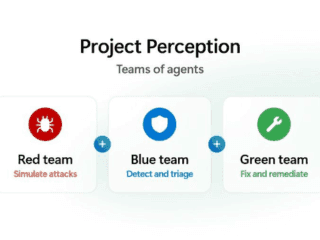
Microsoft Introduces Project Perception as a New Agentic Security System to Protect Against AI-Powered Cyberattacks
Microsoft has introduced a new cyber stack that brings together multiple AI agents to work together and offer enhanced security against cyberattacks. Dubbed Project Perception, the cyber stack primarily aims to protect organisations against AI-powered cyber threats by using multiple AI agents that continuously learn system defences, bringing together signals, context, AI models, and specialised agents. The new Project Perception enables three classes of AI agents to work in coordination to identify and investigate threats from AI-powered attacks, while also taking corrective action against them. The cyber stack itself comprises multiple layers, including the specialised agents and AI models, with specified capabilities.
View

Coforge Grows Q1 Profit Even as Encora Dents Costs; AI Engineering Dominates Quarter
One-off acquisition, integration, and legal expenses weighed on Coforge's June-quarter earnings, pulling profit down 15.3% from the previous quarter.
View

AI Now Makes Up 8% of Infosys’ Revenue. But Is That Enough?
The company wants investors to focus on AI’s growing contribution to revenue. But a guidance cut, slowing demand and pricing pressure suggest its broader growth trajectory still depends far more on its legacy business than its fast-growing AI practice.
View

EXL Certified as a Best Firm for AI Professionals
The global data and AI company earned AIM's certification based on employee feedback highlighting enterprise-scale AI work, learning opportunities, and a collaborative culture.
View

Cognizant Expands Anthropic Partnership, Embeds Claude AI Across Enterprise Platforms
Cognizant will integrate Anthropic’s Claude models into its AI platforms, train more than 40,000 employees on frontier AI technologies and deepen deployments across manufacturing, life sciences and financial services.
View
Submit your Tool


PoweredByAI.app is an AI Tools Directory helping individuals, businesses, and creators discover the best AI tools for writing, coding, design, productivity, and more.
© 2026 , Product of011BQ. All rights reserved.