










Is dit jouw AI-tool? Claim hem vandaag.
Verifieer eigenaarschap, beheer je profiel en ontgrendel groeifeatures.
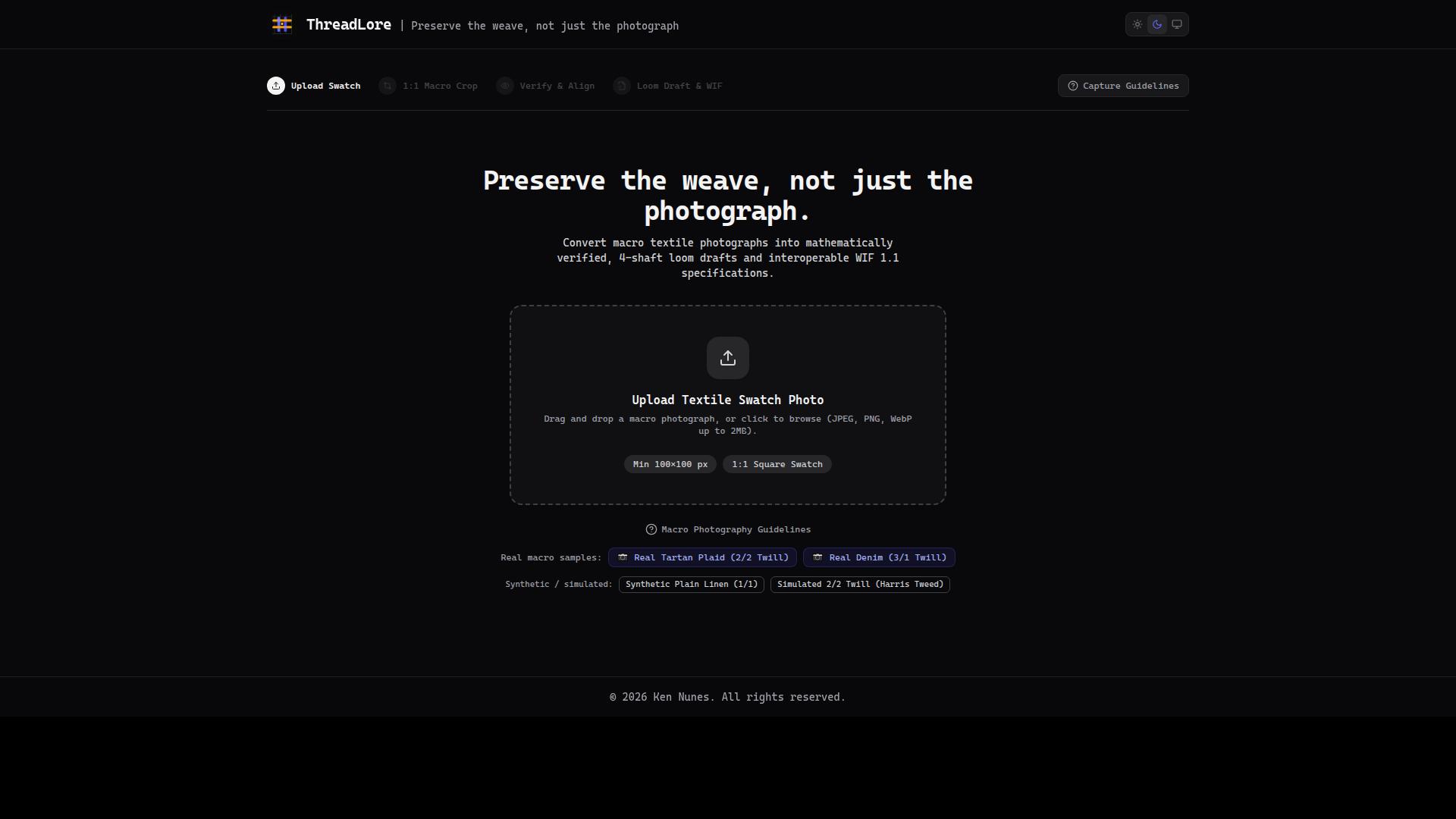
ThreadLore uniquely converts macro textile photographs into mathematically verified 4-shaft loom drafts and interoperable WIF 1.1 specifications, enabling precise textile-to-loom reconstruction. It is ideal for textile artists, weavers, and researchers who want to preserve and replicate weave structures beyond just images.

Beschrijving
When a textile’s weaving instructions are lost, a photograph still holds clues. ThreadLore helps handweavers inspect a fabric photo, check a suggested weave against the yarn crossings, and turn the pattern they approve into a printable loom card or WIF file.
Gedetailleerde beschrijving
ThreadLore is a highly specialized AI-powered tool designed to bridge the gap between textile photography and loom-based textile production. Its core purpose is to transform macro photographs of textile swatches into mathematically verified, 4-shaft loom drafts along with interoperable WIF 1.1 (Weaving Information Format) specifications. This capability allows textile designers, weavers, and researchers to preserve the structural integrity of woven fabrics beyond mere visual representation, enabling accurate textile-to-loom reconstruction. By converting detailed images into precise weaving instructions, ThreadLore empowers users to replicate or analyze textile patterns with a high degree of fidelity. At the heart of ThreadLore’s functionality is its ability to process macro textile photographs in popular image formats such as JPEG, PNG, and WebP. Users can upload images that meet a minimum resolution requirement of 100×100 pixels with a 1:1 aspect ratio, ensuring that the tool receives clear and detailed swatch images for accurate analysis. The interface supports both drag-and-drop and traditional browsing methods for image upload, making it accessible and user-friendly. Once an image is uploaded, ThreadLore applies advanced mathematical verification techniques to generate loom drafts specifically tailored for 4-shaft looms, a common type of loom used in handweaving and small-scale textile production. Additionally, the tool outputs weaving data in the WIF 1.1 format, an interoperable standard that facilitates seamless data exchange between different weaving software and hardware. ThreadLore also provides comprehensive macro photography guidelines, helping users capture optimal images that maximize the accuracy of the loom draft conversion. This guidance is crucial because the quality and clarity of the input image directly impact the precision of the generated weaving instructions. By educating users on best practices for textile macro photography, ThreadLore ensures that even those new to textile digitization can achieve professional-grade results. This tool is particularly valuable for textile artists, handweavers, fabric designers, and researchers who require precise documentation and reproduction of woven patterns. It is ideal for those working in small-scale or artisanal weaving contexts who want to digitize and archive textile patterns or recreate historical fabrics. Textile educators and students can also benefit from ThreadLore by using it as a teaching aid to understand weave structures and loom setups. Moreover, museums and conservationists may find it useful for preserving the weave patterns of culturally significant textiles in a digital format that supports physical reconstruction. Regarding pricing, ThreadLore’s website does not explicitly list subscription plans or fees, suggesting it may currently be offered as a free or open-access tool, or pricing details may be provided upon inquiry. Users interested in advanced features or commercial use should check the official website for the latest information on pricing and licensing. Compared to alternative textile digitization tools, ThreadLore stands out due to its focus on mathematically verified loom drafts and adherence to the WIF 1.1 standard, which ensures interoperability with other weaving software and hardware. Many other tools may offer image-based textile analysis but lack the precision or standardized output necessary for direct loom programming. ThreadLore’s niche focus on 4-shaft loom drafts makes it uniquely suited for handweavers and small-scale textile producers rather than industrial textile manufacturing. However, there are some limitations to consider. The tool requires high-quality macro photographs with specific resolution and aspect ratio constraints, which may necessitate specialized photography equipment or skills. It currently supports only 4-shaft loom drafts, so users working with more complex looms or different weaving technologies may find it insufficient. Additionally, the absence of detailed pricing or commercial licensing information could be a barrier for enterprise users. Finally, as a highly specialized tool, ThreadLore’s user base is somewhat niche, limiting its applicability outside textile arts and weaving communities. In summary, ThreadLore is an innovative AI tool that transforms textile photography into actionable weaving data, preserving the weave structure in a mathematically rigorous and interoperable format. Its detailed features and focus on 4-shaft loom drafts make it an indispensable resource for textile designers, weavers, educators, and conservators seeking to digitize and reproduce woven fabrics with precision.
Toolfeatures
- Convert macro textile photographs into loom drafts
- Mathematically verified 4-shaft loom drafts
- Interoperable WIF 1.1 specifications
- Upload macro photographs in JPEG, PNG, WebP formats
- Supports minimum 100×100 px 1:1 square swatch images
- Drag and drop or browse to upload textile swatch photos
- Provides macro photography guidelines
Beschrijving
ThreadLore uniquely converts macro textile photographs into mathematically verified 4-shaft loom drafts and interoperable WIF 1.1 specifications, enabling precise textile-to-loom reconstruction. It is ideal for textile artists, weavers, and researchers who want to preserve and replicate weave structures beyond just images.
When a textile’s weaving instructions are lost, a photograph still holds clues. ThreadLore helps handweavers inspect a fabric photo, check a suggested weave against the yarn crossings, and turn the pattern they approve into a printable loom card or WIF file.
Gedetailleerde beschrijving
ThreadLore is a highly specialized AI-powered tool designed to bridge the gap between textile photography and loom-based textile production. Its core purpose is to transform macro photographs of textile swatches into mathematically verified, 4-shaft loom drafts along with interoperable WIF 1.1 (Weaving Information Format) specifications. This capability allows textile designers, weavers, and researchers to preserve the structural integrity of woven fabrics beyond mere visual representation, enabling accurate textile-to-loom reconstruction. By converting detailed images into precise weaving instructions, ThreadLore empowers users to replicate or analyze textile patterns with a high degree of fidelity. At the heart of ThreadLore’s functionality is its ability to process macro textile photographs in popular image formats such as JPEG, PNG, and WebP. Users can upload images that meet a minimum resolution requirement of 100×100 pixels with a 1:1 aspect ratio, ensuring that the tool receives clear and detailed swatch images for accurate analysis. The interface supports both drag-and-drop and traditional browsing methods for image upload, making it accessible and user-friendly. Once an image is uploaded, ThreadLore applies advanced mathematical verification techniques to generate loom drafts specifically tailored for 4-shaft looms, a common type of loom used in handweaving and small-scale textile production. Additionally, the tool outputs weaving data in the WIF 1.1 format, an interoperable standard that facilitates seamless data exchange between different weaving software and hardware. ThreadLore also provides comprehensive macro photography guidelines, helping users capture optimal images that maximize the accuracy of the loom draft conversion. This guidance is crucial because the quality and clarity of the input image directly impact the precision of the generated weaving instructions. By educating users on best practices for textile macro photography, ThreadLore ensures that even those new to textile digitization can achieve professional-grade results. This tool is particularly valuable for textile artists, handweavers, fabric designers, and researchers who require precise documentation and reproduction of woven patterns. It is ideal for those working in small-scale or artisanal weaving contexts who want to digitize and archive textile patterns or recreate historical fabrics. Textile educators and students can also benefit from ThreadLore by using it as a teaching aid to understand weave structures and loom setups. Moreover, museums and conservationists may find it useful for preserving the weave patterns of culturally significant textiles in a digital format that supports physical reconstruction. Regarding pricing, ThreadLore’s website does not explicitly list subscription plans or fees, suggesting it may currently be offered as a free or open-access tool, or pricing details may be provided upon inquiry. Users interested in advanced features or commercial use should check the official website for the latest information on pricing and licensing. Compared to alternative textile digitization tools, ThreadLore stands out due to its focus on mathematically verified loom drafts and adherence to the WIF 1.1 standard, which ensures interoperability with other weaving software and hardware. Many other tools may offer image-based textile analysis but lack the precision or standardized output necessary for direct loom programming. ThreadLore’s niche focus on 4-shaft loom drafts makes it uniquely suited for handweavers and small-scale textile producers rather than industrial textile manufacturing. However, there are some limitations to consider. The tool requires high-quality macro photographs with specific resolution and aspect ratio constraints, which may necessitate specialized photography equipment or skills. It currently supports only 4-shaft loom drafts, so users working with more complex looms or different weaving technologies may find it insufficient. Additionally, the absence of detailed pricing or commercial licensing information could be a barrier for enterprise users. Finally, as a highly specialized tool, ThreadLore’s user base is somewhat niche, limiting its applicability outside textile arts and weaving communities. In summary, ThreadLore is an innovative AI tool that transforms textile photography into actionable weaving data, preserving the weave structure in a mathematically rigorous and interoperable format. Its detailed features and focus on 4-shaft loom drafts make it an indispensable resource for textile designers, weavers, educators, and conservators seeking to digitize and reproduce woven fabrics with precision.
Veelgestelde vragen
What is ThreadLore?
ThreadLore is an AI-powered tool that converts macro photographs of textiles into mathematically verified 4-shaft loom drafts and interoperable WIF 1.1 specifications, enabling accurate reconstruction of textile weave structures on looms.
How much does ThreadLore cost?
ThreadLore's website does not currently provide explicit pricing details. Interested users should visit the official site or contact the developers for the latest information on pricing and licensing.
Who is ThreadLore best for?
ThreadLore is best suited for textile artists, handweavers, fabric designers, educators, researchers, and conservators who need to digitize, analyze, or replicate woven textile patterns with high precision.
What are the main features of ThreadLore?
Key features include converting macro textile photographs into loom drafts, generating mathematically verified 4-shaft loom drafts, exporting interoperable WIF 1.1 specifications, supporting JPEG, PNG, and WebP image uploads, and providing macro photography guidelines.
Does ThreadLore offer a free trial?
There is no explicit mention of a free trial on the ThreadLore website. Users can upload images and use the tool directly, suggesting it may be freely accessible or have a demo mode.
What integrations does ThreadLore support?
ThreadLore outputs weaving data in the WIF 1.1 format, which is an interoperable standard supported by various weaving software and hardware, facilitating integration with other textile design and production tools.
How does ThreadLore work?
ThreadLore processes uploaded macro photographs of textile swatches, analyzes the weave pattern using mathematical verification, and generates precise 4-shaft loom drafts and WIF 1.1 specifications to enable accurate textile-to-loom reconstruction.
Socials
Tool gebruikenReviews
Nog geen reviews. Wees de eerste die je ervaring deelt.









































 , Een product van