










Is dit jouw AI-tool? Claim hem vandaag.
Verifieer eigenaarschap, beheer je profiel en ontgrendel groeifeatures.
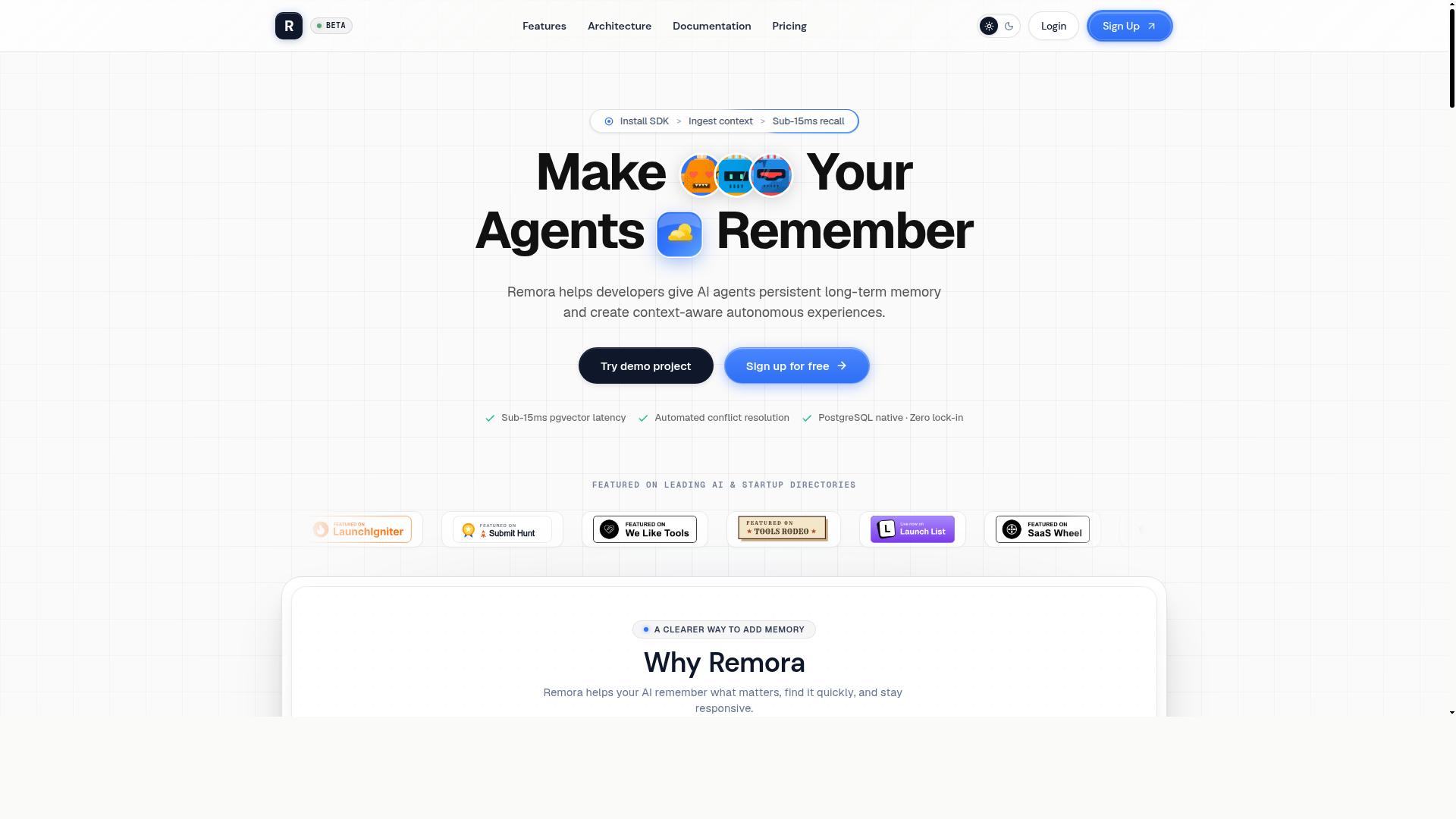
Remora is an enterprise-grade memory infrastructure that empowers AI applications with zero latency, stateful, vector-indexed long-term memory. Ideal for developers and enterprises building advanced AI agents, it enables persistent knowledge storage and dynamic evolution of information, ensuring AI systems remain contextually aware and responsive over time.

Beschrijving
Remora is continuous memory infrastructure for AI agents. Ingest conversations, deduplicate facts, and recall relevant context in under 15ms. Powered by PostgreSQL + pgvector with native Python & TypeScript SDKs. Stop re-inventing memory tables.
Gedetailleerde beschrijving
Remora is a cutting-edge enterprise memory infrastructure specifically designed to enhance AI applications by providing a robust, stateful memory layer for large language models (LLMs) and AI agents. Its core purpose is to enable AI systems to maintain long-term memory capabilities with zero latency, allowing them to recall and evolve knowledge efficiently over time. This capability is crucial for building AI agents that require persistent context awareness and continuous learning from interactions, making Remora an essential tool for developers and enterprises working with advanced AI models. At the heart of Remora's offering is its stateful, vector-indexed knowledge storage system. Unlike traditional memory systems, Remora indexes data in vector form, which allows for highly efficient similarity searches and recall operations. This vector-based approach supports evolving knowledge bases, meaning that the stored information can be updated and expanded dynamically as the AI interacts with new data or learns from ongoing processes. The zero latency recall feature ensures that AI agents can access relevant information instantly, which is critical for real-time applications where response speed and accuracy are paramount. Remora also provides an SDK that simplifies installation and integration, enabling developers to quickly embed its memory infrastructure into their AI workflows. This ease of integration supports a wide range of use cases, from conversational AI and virtual assistants to complex decision-making systems and knowledge management platforms. By supporting long-term memory, Remora allows AI agents to retain context over extended periods, improving their ability to provide coherent, contextually relevant responses and actions. This tool is best suited for enterprises and developers who require scalable, high-performance memory solutions for AI applications. Use cases include customer support bots that remember previous interactions, AI-driven research assistants that accumulate knowledge over time, and autonomous agents in industries such as finance, healthcare, and logistics that rely on historical data for decision-making. Organizations looking to build sophisticated AI systems with persistent memory will find Remora's infrastructure highly valuable. Regarding pricing, Remora offers tiered plans tailored to different enterprise needs, including options for startups and larger organizations. While specific pricing details are available on their website, the platform typically provides a free tier or trial period to allow users to evaluate its capabilities before committing to a paid plan. This approach ensures accessibility for a broad range of users while scaling to meet enterprise demands. Compared to alternatives, Remora stands out due to its unique combination of stateful memory, vector indexing, and zero latency recall. Many competing solutions either lack the ability to evolve knowledge dynamically or suffer from higher latency in retrieving information. Remora's SDK and focus on long-term memory for AI agents provide a more seamless and efficient experience, making it a preferred choice for developers aiming to build next-generation AI systems with persistent contextual awareness. However, potential users should consider that as a specialized enterprise-grade solution, Remora may require a certain level of technical expertise to implement effectively. Additionally, while the platform is in public beta, some features may still be under development or subject to change. Enterprises should evaluate their specific requirements and test the platform thoroughly to ensure it aligns with their AI infrastructure needs. In summary, Remora offers a powerful, scalable memory infrastructure that significantly enhances the capabilities of AI agents by providing fast, evolving, and persistent knowledge storage. Its advanced vector-indexed system, zero latency recall, and developer-friendly SDK make it an excellent choice for enterprises looking to build intelligent applications with long-term memory capabilities.
Toolfeatures
- Enterprise memory infrastructure for AI applications
- Stateful and vector-indexed knowledge storage
- Evolving knowledge for large language models
- Zero latency recall
- SDK for easy installation and integration
- Supports long-term memory for AI agents
Beschrijving
Remora is an enterprise-grade memory infrastructure that empowers AI applications with zero latency, stateful, vector-indexed long-term memory. Ideal for developers and enterprises building advanced AI agents, it enables persistent knowledge storage and dynamic evolution of information, ensuring AI systems remain contextually aware and responsive over time.
Remora is continuous memory infrastructure for AI agents. Ingest conversations, deduplicate facts, and recall relevant context in under 15ms. Powered by PostgreSQL + pgvector with native Python & TypeScript SDKs. Stop re-inventing memory tables.
Gedetailleerde beschrijving
Remora is a cutting-edge enterprise memory infrastructure specifically designed to enhance AI applications by providing a robust, stateful memory layer for large language models (LLMs) and AI agents. Its core purpose is to enable AI systems to maintain long-term memory capabilities with zero latency, allowing them to recall and evolve knowledge efficiently over time. This capability is crucial for building AI agents that require persistent context awareness and continuous learning from interactions, making Remora an essential tool for developers and enterprises working with advanced AI models. At the heart of Remora's offering is its stateful, vector-indexed knowledge storage system. Unlike traditional memory systems, Remora indexes data in vector form, which allows for highly efficient similarity searches and recall operations. This vector-based approach supports evolving knowledge bases, meaning that the stored information can be updated and expanded dynamically as the AI interacts with new data or learns from ongoing processes. The zero latency recall feature ensures that AI agents can access relevant information instantly, which is critical for real-time applications where response speed and accuracy are paramount. Remora also provides an SDK that simplifies installation and integration, enabling developers to quickly embed its memory infrastructure into their AI workflows. This ease of integration supports a wide range of use cases, from conversational AI and virtual assistants to complex decision-making systems and knowledge management platforms. By supporting long-term memory, Remora allows AI agents to retain context over extended periods, improving their ability to provide coherent, contextually relevant responses and actions. This tool is best suited for enterprises and developers who require scalable, high-performance memory solutions for AI applications. Use cases include customer support bots that remember previous interactions, AI-driven research assistants that accumulate knowledge over time, and autonomous agents in industries such as finance, healthcare, and logistics that rely on historical data for decision-making. Organizations looking to build sophisticated AI systems with persistent memory will find Remora's infrastructure highly valuable. Regarding pricing, Remora offers tiered plans tailored to different enterprise needs, including options for startups and larger organizations. While specific pricing details are available on their website, the platform typically provides a free tier or trial period to allow users to evaluate its capabilities before committing to a paid plan. This approach ensures accessibility for a broad range of users while scaling to meet enterprise demands. Compared to alternatives, Remora stands out due to its unique combination of stateful memory, vector indexing, and zero latency recall. Many competing solutions either lack the ability to evolve knowledge dynamically or suffer from higher latency in retrieving information. Remora's SDK and focus on long-term memory for AI agents provide a more seamless and efficient experience, making it a preferred choice for developers aiming to build next-generation AI systems with persistent contextual awareness. However, potential users should consider that as a specialized enterprise-grade solution, Remora may require a certain level of technical expertise to implement effectively. Additionally, while the platform is in public beta, some features may still be under development or subject to change. Enterprises should evaluate their specific requirements and test the platform thoroughly to ensure it aligns with their AI infrastructure needs. In summary, Remora offers a powerful, scalable memory infrastructure that significantly enhances the capabilities of AI agents by providing fast, evolving, and persistent knowledge storage. Its advanced vector-indexed system, zero latency recall, and developer-friendly SDK make it an excellent choice for enterprises looking to build intelligent applications with long-term memory capabilities.
Veelgestelde vragen
What is Remora?
Remora is an enterprise memory infrastructure designed to provide AI applications, especially large language models and AI agents, with stateful, vector-indexed, and evolving knowledge storage that enables zero latency recall and long-term memory capabilities.
How much does Remora cost?
Remora offers tiered pricing plans tailored to different enterprise needs, including options for startups and larger organizations. Detailed pricing information and any available free trials can be found on their official website.
Who is Remora best for?
Remora is best suited for enterprises, AI developers, and organizations building advanced AI agents or applications that require persistent, fast, and evolving memory capabilities, such as conversational AI, virtual assistants, and autonomous decision-making systems.
What are the main features of Remora?
Key features include stateful and vector-indexed knowledge storage, evolving knowledge bases for large language models, zero latency recall for instant access, an SDK for easy installation and integration, and support for long-term memory in AI agents.
Does Remora offer a free trial?
Remora typically provides a free tier or trial period to allow users to evaluate its capabilities before committing to a paid plan. Specific details about free trials are available on their website.
What integrations does Remora support?
Remora offers an SDK designed for easy installation and integration with various AI workflows and applications, enabling seamless embedding of its memory infrastructure into existing AI systems.
How does Remora work?
Remora works by storing AI knowledge in a stateful, vector-indexed format that allows for efficient similarity searches and instant recall. It supports evolving knowledge bases that update dynamically as AI agents learn, enabling long-term memory with zero latency access.
Reviews
Nog geen reviews. Wees de eerste die je ervaring deelt.

























 , Een product van