

Is dit jouw AI-tool? Claim hem vandaag.
Verifieer eigenaarschap, beheer je profiel en ontgrendel groeifeatures.
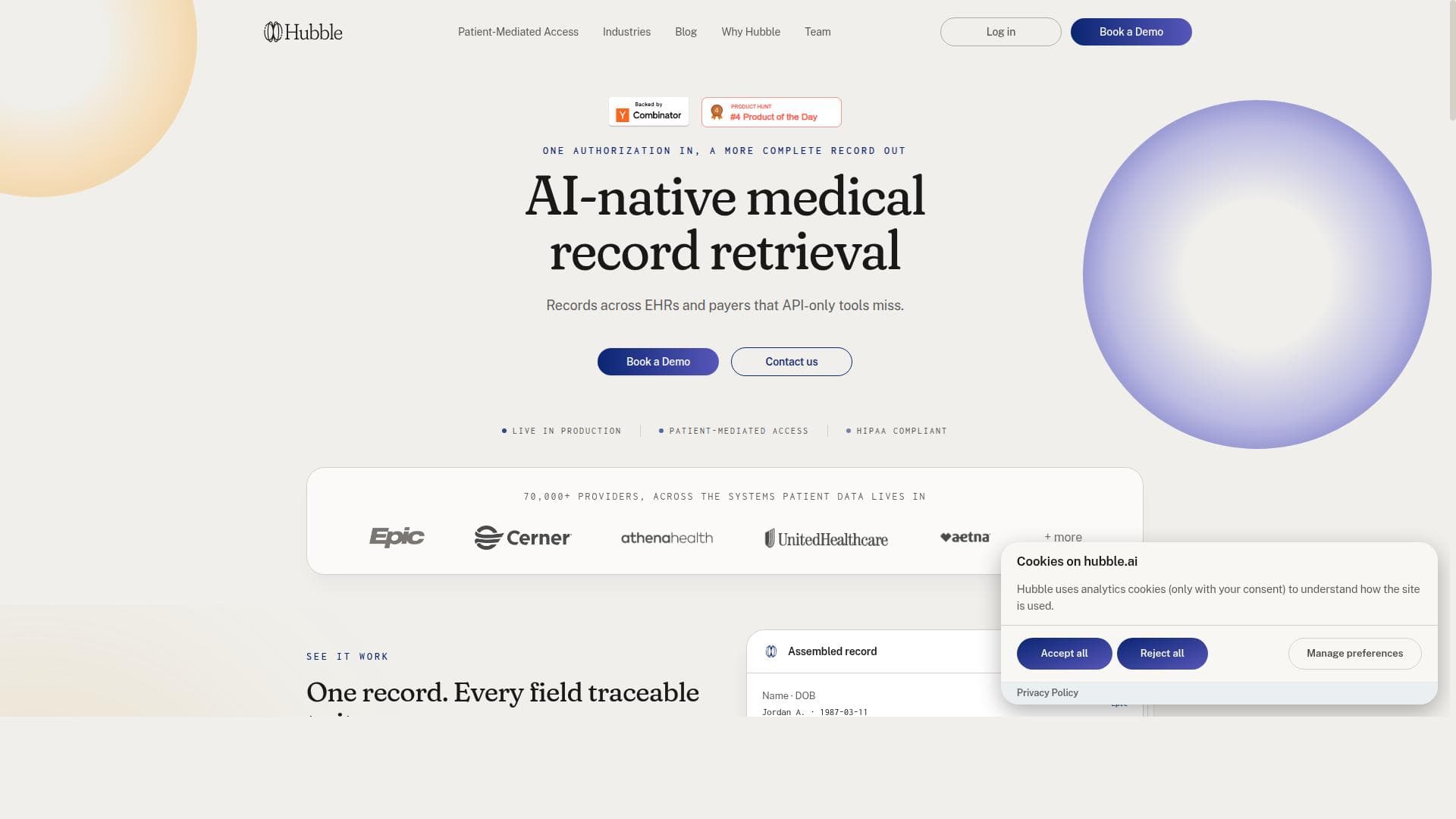
Hubble is an AI-native platform that revolutionizes medical record retrieval by providing a unified, normalized patient record across multiple EHRs and payers. Ideal for healthcare providers, payers, and AI developers, it combines direct APIs with voice and browser agents to ensure comprehensive, HIPAA-compliant access to patient data.

Beschrijving
Medical records still live behind fax lines, phone trees, and portal logins nobody remembers. A patient verifies their identity once, and Hubble assembles their records from across their providers and returns them through one API, for your AI agent to use.
Gedetailleerde beschrijving
Hubble is an AI-native medical record retrieval platform designed to provide healthcare providers and organizations with a more comprehensive and unified view of patient records. Its core purpose is to streamline the retrieval of patient data across multiple electronic health records (EHRs) and payer systems, overcoming the fragmentation that often plagues healthcare data access. By leveraging advanced AI technologies alongside direct API connections, health information exchange (HIE) networks, and innovative voice and browser agents, Hubble ensures that healthcare professionals can access a complete and normalized patient record efficiently and securely. This holistic approach supports better clinical decision-making, reduces administrative burden, and enhances patient care coordination. At the heart of Hubble’s capabilities is its seamless integration with major healthcare systems including Epic, Oracle Health Cerner, athenahealth, UnitedHealthcare, and Aetna. These integrations enable direct API access to patient records, but Hubble goes beyond traditional API limitations by employing voice and browser agents to navigate release-of-information portals and extract data that might otherwise be inaccessible. This multi-modal data retrieval strategy ensures that even when APIs return incomplete or sparse data, Hubble can still deliver a more complete patient record. The platform also normalizes data from disparate sources into a unified format, simplifying downstream processing and analysis. Additionally, Hubble maintains HIPAA-compliant audit trails and scoped permissions, providing compliance teams with the necessary oversight and security controls without adding operational complexity. Hubble is ideally suited for healthcare providers, payers, health information management teams, and AI developers working in the healthcare space. Providers benefit from faster, more reliable access to comprehensive patient records, which supports improved clinical workflows and patient outcomes. Payers can leverage Hubble to streamline claims processing and member data retrieval. AI developers and health IT teams can utilize Hubble’s unified API and Model Context Protocol (MCP) interface to build intelligent agents that access normalized patient data across multiple systems, enabling advanced analytics, clinical decision support, and automation. Use cases include patient-mediated record access, care coordination, prior authorization, clinical research, and population health management. Regarding pricing, Hubble does not publicly disclose detailed pricing plans on its website, suggesting a tailored approach based on customer needs and scale. Interested organizations typically engage with Hubble’s sales team to discuss integration scope, volume, and compliance requirements to receive a customized quote. This approach is common in healthcare IT solutions where implementation complexity and regulatory compliance drive pricing variability. Compared to alternative solutions such as standalone FHIR APIs or patient portal data aggregators, Hubble distinguishes itself by its comprehensive data retrieval methods and normalization capabilities. While standard FHIR APIs often provide limited subsets of patient data and vary widely in coverage across health systems, Hubble’s use of voice and browser agents complements API access to fill in gaps. Its unified API and MCP interface also enable AI agents to interact with patient data in a standardized manner, which is a significant advantage for developers building AI-powered healthcare applications. Furthermore, Hubble’s built-in HIPAA-compliant audit trails and scoped permissions simplify compliance management, a critical consideration often overlooked by competitors. However, potential limitations include the complexity of integrating with multiple healthcare systems and the reliance on patient-mediated access for some data retrieval scenarios. While patient-mediated access allows immediate live retrieval, it may require patient engagement and consent workflows that add operational steps. Additionally, as a relatively new platform founded in 2026 and backed by Y Combinator, Hubble’s ecosystem and third-party integrations may still be expanding compared to more established incumbents. Prospective users should evaluate their specific integration needs and compliance requirements when considering Hubble. In summary, Hubble offers a powerful, AI-driven solution for medical record retrieval that addresses key challenges in healthcare data fragmentation and accessibility. Its multi-source integration, normalization, and compliance features make it a valuable tool for healthcare providers, payers, and AI developers seeking to unlock the full potential of patient data across diverse systems.
Toolfeatures
- Epic EHR integration
- Oracle Health Cerner integration
- athenahealth integration
- UnitedHealthcare payer integration
- Aetna payer integration
- HIPAA-compliant audit trails
- Voice and browser agents for release-of-information portals
- Cross-source record normalization
Beschrijving
Hubble is an AI-native platform that revolutionizes medical record retrieval by providing a unified, normalized patient record across multiple EHRs and payers. Ideal for healthcare providers, payers, and AI developers, it combines direct APIs with voice and browser agents to ensure comprehensive, HIPAA-compliant access to patient data.
Medical records still live behind fax lines, phone trees, and portal logins nobody remembers. A patient verifies their identity once, and Hubble assembles their records from across their providers and returns them through one API, for your AI agent to use.
Gedetailleerde beschrijving
Hubble is an AI-native medical record retrieval platform designed to provide healthcare providers and organizations with a more comprehensive and unified view of patient records. Its core purpose is to streamline the retrieval of patient data across multiple electronic health records (EHRs) and payer systems, overcoming the fragmentation that often plagues healthcare data access. By leveraging advanced AI technologies alongside direct API connections, health information exchange (HIE) networks, and innovative voice and browser agents, Hubble ensures that healthcare professionals can access a complete and normalized patient record efficiently and securely. This holistic approach supports better clinical decision-making, reduces administrative burden, and enhances patient care coordination. At the heart of Hubble’s capabilities is its seamless integration with major healthcare systems including Epic, Oracle Health Cerner, athenahealth, UnitedHealthcare, and Aetna. These integrations enable direct API access to patient records, but Hubble goes beyond traditional API limitations by employing voice and browser agents to navigate release-of-information portals and extract data that might otherwise be inaccessible. This multi-modal data retrieval strategy ensures that even when APIs return incomplete or sparse data, Hubble can still deliver a more complete patient record. The platform also normalizes data from disparate sources into a unified format, simplifying downstream processing and analysis. Additionally, Hubble maintains HIPAA-compliant audit trails and scoped permissions, providing compliance teams with the necessary oversight and security controls without adding operational complexity. Hubble is ideally suited for healthcare providers, payers, health information management teams, and AI developers working in the healthcare space. Providers benefit from faster, more reliable access to comprehensive patient records, which supports improved clinical workflows and patient outcomes. Payers can leverage Hubble to streamline claims processing and member data retrieval. AI developers and health IT teams can utilize Hubble’s unified API and Model Context Protocol (MCP) interface to build intelligent agents that access normalized patient data across multiple systems, enabling advanced analytics, clinical decision support, and automation. Use cases include patient-mediated record access, care coordination, prior authorization, clinical research, and population health management. Regarding pricing, Hubble does not publicly disclose detailed pricing plans on its website, suggesting a tailored approach based on customer needs and scale. Interested organizations typically engage with Hubble’s sales team to discuss integration scope, volume, and compliance requirements to receive a customized quote. This approach is common in healthcare IT solutions where implementation complexity and regulatory compliance drive pricing variability. Compared to alternative solutions such as standalone FHIR APIs or patient portal data aggregators, Hubble distinguishes itself by its comprehensive data retrieval methods and normalization capabilities. While standard FHIR APIs often provide limited subsets of patient data and vary widely in coverage across health systems, Hubble’s use of voice and browser agents complements API access to fill in gaps. Its unified API and MCP interface also enable AI agents to interact with patient data in a standardized manner, which is a significant advantage for developers building AI-powered healthcare applications. Furthermore, Hubble’s built-in HIPAA-compliant audit trails and scoped permissions simplify compliance management, a critical consideration often overlooked by competitors. However, potential limitations include the complexity of integrating with multiple healthcare systems and the reliance on patient-mediated access for some data retrieval scenarios. While patient-mediated access allows immediate live retrieval, it may require patient engagement and consent workflows that add operational steps. Additionally, as a relatively new platform founded in 2026 and backed by Y Combinator, Hubble’s ecosystem and third-party integrations may still be expanding compared to more established incumbents. Prospective users should evaluate their specific integration needs and compliance requirements when considering Hubble. In summary, Hubble offers a powerful, AI-driven solution for medical record retrieval that addresses key challenges in healthcare data fragmentation and accessibility. Its multi-source integration, normalization, and compliance features make it a valuable tool for healthcare providers, payers, and AI developers seeking to unlock the full potential of patient data across diverse systems.
Veelgestelde vragen
What is Hubble?
Hubble is an AI-native medical record retrieval platform that aggregates patient data across electronic health records (EHRs) and payer systems to provide a more complete and normalized patient record. It uses direct APIs, health information exchange networks, and voice and browser agents to access data securely and compliantly.
How much does Hubble cost?
Hubble does not publicly disclose pricing information. Pricing is typically customized based on the customer's integration needs, volume, and compliance requirements. Interested organizations should contact Hubble's sales team for a tailored quote.
Who is Hubble best for?
Hubble is best suited for healthcare providers, payers, health information management teams, and AI developers who need comprehensive, normalized patient data from multiple sources. It supports use cases such as clinical decision-making, care coordination, claims processing, and AI-powered healthcare applications.
What are the main features of Hubble?
Key features include integration with major EHRs like Epic, Oracle Health Cerner, and athenahealth; payer integrations with UnitedHealthcare and Aetna; HIPAA-compliant audit trails and scoped permissions; voice and browser agents for accessing release-of-information portals; and cross-source record normalization through a unified API and MCP interface.
Does Hubble offer a free trial?
There is no public information indicating that Hubble offers a free trial. Organizations interested in evaluating the platform should contact Hubble directly to discuss potential pilot programs or demonstrations.
What integrations does Hubble support?
Hubble supports integrations with major healthcare systems including Epic, Oracle Health Cerner, athenahealth, as well as payer systems like UnitedHealthcare and Aetna. The platform continuously adds new system integrations to expand its coverage.
How does Hubble work?
Hubble works by connecting to multiple healthcare data sources using direct APIs, health information exchange networks, and voice and browser agents that navigate release-of-information portals. It aggregates and normalizes patient data into a unified format accessible via a single API and MCP interface, ensuring comprehensive and compliant access to medical records.
Reviews
Nog geen reviews. Wees de eerste die je ervaring deelt.