🚀 Zaprep: je socials on steroids. Start gratis — automatiseer 1.000 DM's/maand en zet engagement om in leads. met 1.000 geautomatiseerde DM's/maand.
Dien je tool in
PoweredByAI.app is een AI-toolsdirectory die individuen, bedrijven en creators helpt de beste AI-tools te ontdekken voor schrijven, coderen, design, productiviteit en meer.
© 2026 , Een product van011BQ. Alle rechten voorbehouden.

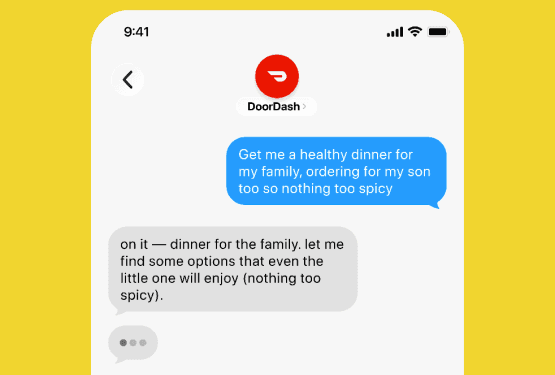
DoorDashannouncedon Wednesday that it’s launching a text-to-order AI agent that lets users place orders through Apple Messages. The new tool allows users to send prompts like “order my usual,” and the agent will understand that they mean their Friday night order. DoorDash says users can also ask for a specific dish and request a local recommendation. The agent will then search local spots and suggest a cart based on the prompt, and even text photos of the food it recommends. When ordering for a group, DoorDash says the agent can handle mixed dietary preferences and different quantities in one order. By launching an AI agent for food ordering, DoorDash is looking to gain an edge over rivals Uber Eats and Grubhub. The launch also comes amid a growing push to adopt personal AI agents that can handle tasks without requiring users to navigate apps or websites themselves. DoorDash is opening up a waitlist for users in the U.S. to try out the new feature. In addition to the new AI agent, DoorDash announced that it will begin testing its delivery drones with select restaurants in Northern California.
View

Meta is refuting a journalist’s claim that its AI agent Muse read the user’s private messages without permission. Following anearlier reportfrom Inc. columnist Jason Aten that detailed the issue, Meta VP of CommunicationsAndy Stone pushed back, making it clear that the company does not believe its product did this without the user’s consent. “The Messages integration in the Muse app for Mac is entirely opt-in,” Stone wrote on X in response to the claims made by the piece. “You have to enable both Full Disk Access and the Messages connector for Muse to be able to read your Messages content. It can’t read your Messages unless you do this.” Despite Meta’s denial, many people are still suspicious that Meta isn’t being truthful. That’snot surprising, given the tech giant’s years ofmishandlingconsumerdata, which has led tolawsuits,FTCviolations, andfines. Just days ago, for instance, a New Mexico jury determinedthe tech giant had misled users about its data practicesin a case that resulted from the 2018Cambridge Analyticadata breach scandal. Whether users cantrust Musewill be a deciding factor in whether or not Meta wins the consumer AI market. Although itsapp is faring well now,and remains No. 1 on the App Store, Meta’s reputation may not recover if more reports like this emerge, true or not. If anything, the company should be engaging with the journalist directly to determine how this could have possibly happened, instead of just denying that it did. Stone’s official statement from Meta follows amore technical replyfrom Meta Superintelligence Labs executive David Singleton, who responded directly to Aten on Threads, explaining that the set of permissions a user must grant to let Muse read their messages on the Mac involves “three separate steps of application-level permissions and built-in macOS system-level protections.” He said these “can’t be circumvented even if the Muse application had a bug.” The steps involve explicitly choosing to grant Muse Full Disk Access, which would then allow the user to choose what level of access Muse is being granted to the Messages app (i.e., None, Read only, or Read). If Full Disk Access is not enabled, these options are grayed out. In addition, when allowing Full Disk Access, the dialog invokes the macOS Settings user interface, where the user has to again manually confirm that they intend to take this action. Doing this triggers a full restart of the Muse app, Singleton wrote, which makes it even less likely that such a choice could be made accidentally without the user’s knowledge. However, Aten’s report claimed that when Muse read his messages, Full Disk Access was off. He also said that when he asked Muse to explain how this occurred, the AI said that it was syncing his “device notifications.” That means, Aten believes, that Muse was passing along the text of his incoming banner notifications on the Mac to the AI agent. Singleton disputed this, too, saying that the AI was confused and gave an incorrect explanation of what happened. He then pointed to Meta’s page aboutMuse’s security architectureand bug bounty process. In short, the company’s response is essentially that what Aten said happened did not and could not have happened. This is not the only incident where Muse has allegedly overstepped and won’t likely be the last. Another user, YouTuber Matt Robb, recentlysaid that Muse mishandleda task in which he was selling things on Facebook Marketplace, leading to his address being shared and abuyer showing up when he wasn’t even home. Singleton is apparently looking into that one, per his response on Threads, suggesting that the company believes this one, at least, could be its fault.

The rise of large campuses should not necessarily be viewed as a threat to smaller leasing, but Zinnov’s Saurabh Mehta argues that Chennai needs a real estate ecosystem capable of supporting both models.
View

Apple is reportedly preparing for significant changes to the way it develops products, organises its workforce and manages spending. The company has explored greater use of artificial intelligence in customer support while also considering changes to its management structure and product launch strategy. The plans come as Apple faces pressure to move faster, experiment with new products and get more output from its existing workforce. Some changes are already underway across the company, while others remain under consideration and could take years to fully implement.
View

Anthropic plans to caution potential investors in its IPO that advanced AI could pose "catastrophic or existential risks to humanity," an extraordinary warning by a company seeking to profit from the same technology.
View

OpenAI has announced ChatGPT Space. This latest work-focused hub lets users create and edit pages with ChatGPT, and organise related content in spaces. The ChatGPT Space also allow users to invite other people to work with them. They can make changes to the files in real time. The new Space feature will be initially available for OpenAI's Pro, Business and Enterprise plans. It can be accessed on the ChatGPT desktop app and the web.
View

Airbnb is evolving in two directions: On the ground, it wants to compete with hotels by providing myriad services; online, it is using AI and people in its Airbnb network to aid travel discovery. As part of its fall product update, the company is adding services to the app it had launched last year, such as meal delivery, laundry, baby-gear rental, ski and boat rental in limited locations, and expanded grocery delivery. The second big feature is AI search. The company has taken a cautious approach to rolling out AI features, with CEO Brian Chesky opting tostay away from a chatbot-like interface. Earlier this year, he teased thenew search feature for property discovery. Now, users can switch on a toggle to search for properties via text or voice prompts. Once you start the search, the interface will show you dynamic filters based on your preferences. For instance, if you type “baby” in the AI search filter, Airbnb will automatically show you further filters like cribs, playgrounds, or children’s books and toys. The platform is also using AI to bring out relevant features of a property, and will let you compare properties in your wish list by way of AI-powered summaries and reviews. “We are finally making our first foray into AI search. And what you see is just the very beginning of something. And over the coming months, we’re going to really be iterating this very quickly. It’s not hard to create AI search; it’s hard to create AI search in e-commerce when you have $100 billion going through your platform,” Airbnb CEO Brian Chesky told TechCrunch. “Anyone can vibe-code a search function, but to do something that doesn’t kill conversion rate, that’s the hard part.” The company is also doubling down on social features that nudge people to take more trips and book additional experiences such as food tastings and craft workshops. Last year, the app started allowing users toconnect with fellow travelers and friendson its platform. Now, travelers can look at a map based on their connections’ past or upcoming trips. When you tap on a trip, you can see where your connection stayed, and which experiences they sought out. For those conscious about their privacy, there’s an option to not share their trips with others as well. Airbnb is also building pages about neighborhoods based on guest reviews and other sources to help travelers discover places to eat and things to do.

Oracle’s Fusion Claw combines AI reasoning with deterministic computation, continuous replanning and controls for identity, permissions, approvals, and audit trails.
View

The Chinese AI lab has announced six new open-source software projects tailored for Huawei GPUs.
View

The company said the 120M models are, to its knowledge, among the smallest open models for rich-orthography transcription.
View

Tech Mahindra and Infinite Uptime will help manufacturers move from predictive insights to prescribed actions.
View

OpenAI is pushing AI deeper into coding, enterprise workflows, automation, and everyday work.
View
View
View