🚀 Zaprep: je socials on steroids. Start gratis — automatiseer 1.000 DM's/maand en zet engagement om in leads. met 1.000 geautomatiseerde DM's/maand.
Dien je tool in
PoweredByAI.app is een AI-toolsdirectory die individuen, bedrijven en creators helpt de beste AI-tools te ontdekken voor schrijven, coderen, design, productiviteit en meer.
© 2026 , Een product van011BQ. Alle rechten voorbehouden.

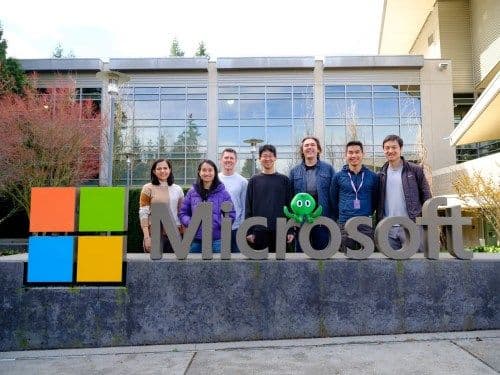
The team behindCove, a Sequioa-backed startup that was working on an AI-powered collaboration board, has joined Microsoft, according to an email sent to customers informing them that Cove’s service is shutting down. Cove was founded in late 2023 by Stephen Chau, Andy Szybalski, and Mike Chu, who worked on Google Maps features like Street View. The startupraised $6 million in a seed roundfrom Sequoia Capital, Elad Gil, Homebrew, Adverb, Scott Belsky, and Lenny Rachitsky in 2024. Its tool was an infinite whiteboard that let users use AI to generate different blocks for tasks like trip planning. The founders felt that the chat interface for AI was not editable, and a canvas provided more flexibility when going in different directions with prompts. Cove also allowed users to use a built-in browser, PDFs, and images to give more context to its AI, which could create new cards, tables, and lists. The startup competed with the likes ofMiro,TLDraw, andKosmik. The company said in an email to customers that the entire Cove team is joining Microsoft and the product will shut down on April 1, and all user data will be deleted. Cove mentioned that it has refunded all subscriptions for March and is offering adata export process. “When we started Cove, we set out to reimagine how people collaborate with AI. As model capabilities have accelerated, our conviction in that mission has only grown stronger. We’re thrilled to continue this work at Microsoft AI, where we’ll have the opportunity to pursue an even bigger vision,” the companysaid in a blog post on its site. In addition, the company said that “the ideas behind it [Cove] will live on” within Microsoft. Notably, Microsoft added Copilot to its own collaboration product,Whiteboard, in 2023. TechCrunch reached out to Microsoft to understand how it plans to integrate Cove’s technology within its ecosystem, but did not immediately hear back.

View

Mumbai and Navi Mumbai account for the largest share at 790 MW, followed by Chennai at 305 MW.
View

‘Blue Machines is not a foundation model company.’
View

The role involves partnering with startup customers to take AI products from ideation to production.
View

Project SnowWork is being rolled out to a limited set of customers.
View

The latest development stems from the $50 billion deal with Amazon that could undermine OpenAI’s exclusive API agreements with Microsoft.
View

OpenAI introduced two new artificial intelligence (AI) models in the GPT-5.4 family on Tuesday. Dubbed GPT-5.4 mini and GPT-5.4 nano, the two smaller AI models are faster compared to the larger models in the family, and are aimed at low-latency workloads. Some of the key strengths of these models include coding proficiency, computer use, multimodal understanding, and subagent handling. For developers, these models will also be cost-efficient, given the lower cost of input and output tokens.
View

Google is now expanding Personal Intelligence to more users in the US. The feature, which allows the chatbot to connect to various Google apps and draw context to generate personalised responses, was first introduced in January. At the time, it was only available to US-based paying users. Now, the capability is available inside the Gemini app, Gemini assistant in Google Chrome, and via AI Mode in Search to those on the free tier. Notably, the Mountain View-based tech giant is yet to expand the feature outside of the US.
View

Multi-year pact to combine AI learning, assessment and cloud to help enterprises build future-ready talent at scale.
View

Founded in 2024, the startup distinguishes itself with a hybrid AI architecture and a per-bed subscription model, targeting large real estate operators.
View

Users can assign tasks remotely and return later to completed outputs, which are processed on their computer using locally available files, connectors and plugins.
View

Companies can restrict the browser from answering queries without taking actions or limit automated actions to approved domains.
View