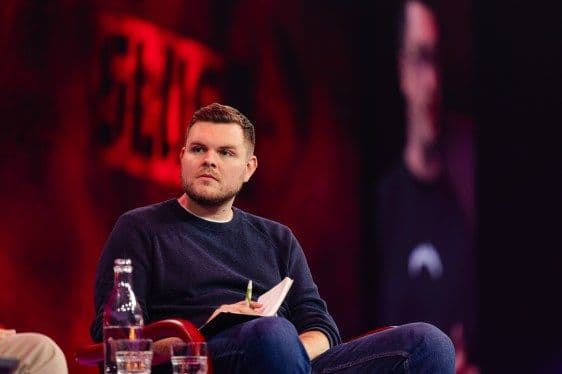
This startup thinks robotics is about to have its ChatGPT moment
Loading the player… Before OpenAI’s GPT-3 ushered in the era of foundation models, companies built specialized natural language processing models from scratch, training each on large amounts of task-specific data. Today, most organizations start with a general-purpose model like OpenAI’s GPT series, Claude, or Llama and then fine-tune or prompt it to solve their specific needs. Pim de Witte, CEO ofGeneral Intuition, thinks embodied AI will follow a similar pattern. Rather than collecting huge real-world datasets to build specialized robot models, he argues the industry should focus on better quality datasets that can produce foundation models capable of transferring intuition about movement and interaction across many environments. “A lot of companies right now are doing lots of specialized work focused on individual embodiments, individual environments, and individual robots,” de Witte told TechCrunch on arecent episode of Equity. Much of that work will become redundant soon, he argues, with the emergence of general models like the one General Intuition has been developing and deploying. “The generalization of the model itself is the product,” he said. “The fact that it has a base level of reasoning about space and time is going to be the reason why people stop collecting hundreds of thousands or millions of hours of real-world data. Because the reality is, you only need a few minutes.” General Intuition built its own such foundation model after training on millions of hours of video game data, including information like what buttons on a controller a human pushed and when. Both de Witte and General Intuition’s lead investor, Vinod Khosla, argue the action data is the key to developing a human-like intuition for spatial-temporal reasoning. The startup last monthraised $320 million at a $2.3 billionvaluation on the back of that thesis. The company has demonstrated that its current model is capable of both playing a video game for hours and powering a quadrupedal robot — the latter after fine-tuning it on just eight minutes of real-world robotics data. “The fact that [the robot] was actually able to zero-shot on just the front camera, with no other sensors, in the office with dynamic objects being introduced and people walking by was a very big surprise to us,” de Witte says. “I think it’s a sign of what’s to come.” The end game for General Intuition isn’t to build robots itself, but to become the foundation model of physical AI, a base model for other robotics companies to build upon for their own machines. Or, as de Witte put it: “We’re not gonna build a self-driving car company. We’re gonna make it 10 times easier for the next person to build a self-driving car company.”