

Questo è il tuo strumento IA? Reclama oggi.
Verifica la titolarità, gestisci il profilo e sblocca funzioni di crescita.
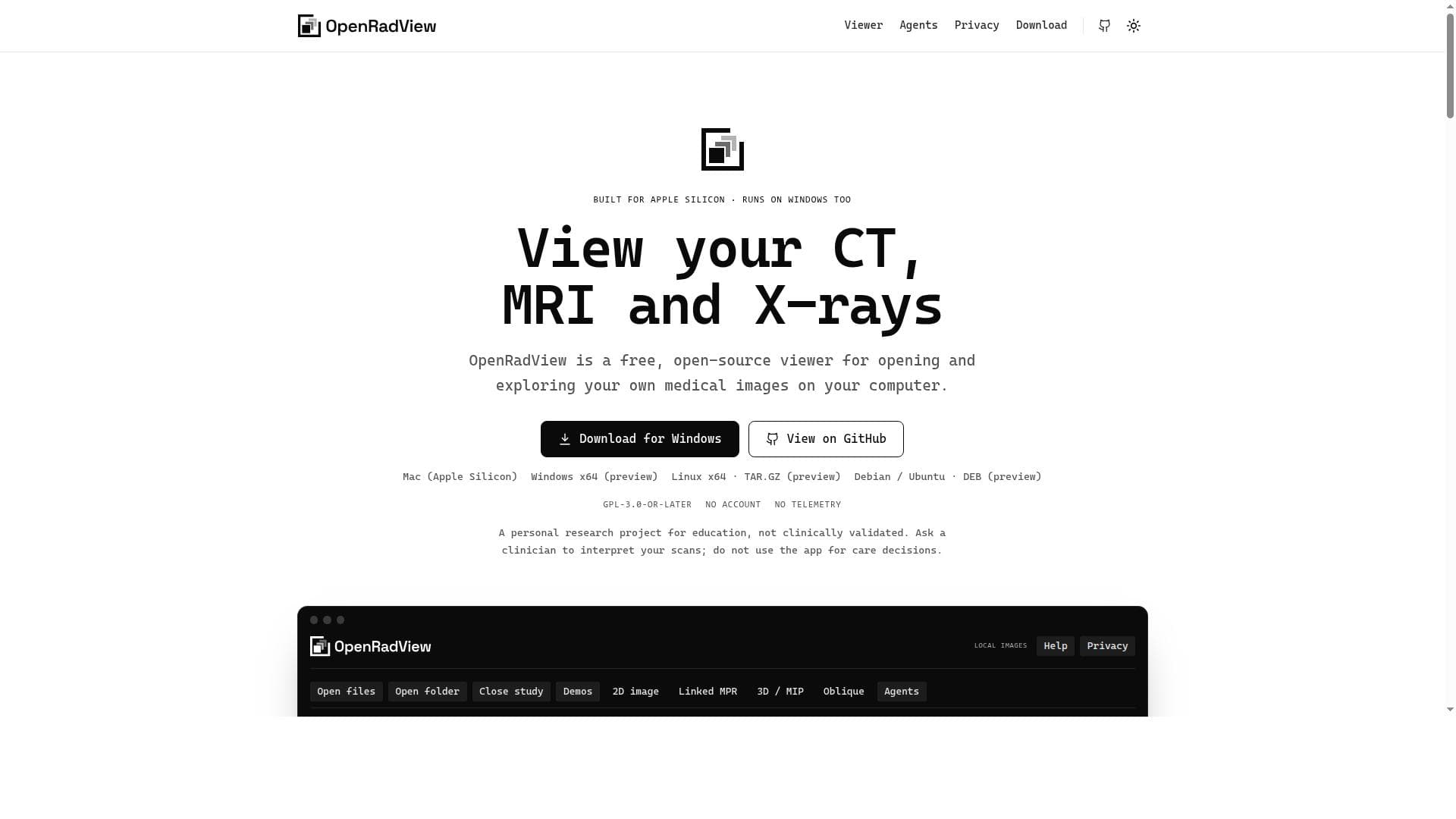
OpenRadView is a free, open-source DICOM and NIfTI medical image viewer that runs locally on your computer without requiring an account. Designed for educational and research purposes, it offers advanced visualization features like linked multi-planar views, 3D rendering, and measurement tools, making it ideal for students, educators, and imaging enthusiasts seeking a privacy-focused, versatile viewer.

Descrizione
OpenRadView opens the DICOM and NIfTI files from your scan CD or zip on your own computer: linked axial, coronal and sagittal views, experimental 3D and measurements. Optional MCP access for your own AI agent. It is a personal research project for education and has not been clinically validated. Ask a qualified clinician to interpret your scans; do not use the app for decisions about care.
Descrizione dettagliata
OpenRadView is a free, open-source medical image viewer designed to enable users to open, view, and explore their own CT, MRI, and X-ray images directly on their local computers. Unlike many cloud-based or subscription services, OpenRadView runs entirely locally without requiring any user account or internet connection, ensuring privacy and security of sensitive medical data. The tool is primarily intended for educational and personal research purposes and is explicitly not clinically validated for diagnostic use or medical decision-making. It offers a robust platform for medical students, educators, researchers, and enthusiasts to interact with medical imaging data in a versatile and user-friendly environment. One of the core strengths of OpenRadView lies in its comprehensive support for multiple medical imaging file formats. It can open local DICOM files, which are the standard format for medical imaging, as well as NIfTI-1 and NIfTI-2 files commonly used in neuroimaging research. Users can load individual files, entire folders, or ZIP archives containing these images, providing great flexibility in handling datasets. The viewer supports advanced image compression formats such as JPEG 2000 and JPEG-LS, and can handle deflated DICOM files, 8-bit and 16-bit RGB/YBR color spaces, palettes, and embedded ICC profiles for accurate color conversion. OpenRadView offers a rich set of image manipulation and visualization features. Users can adjust grayscale window and level settings to enhance image contrast, pan and zoom to examine details, invert colors for better visualization, and fit images to the viewing window. A standout feature is the ability to display linked axial, coronal, and sagittal views simultaneously from scalar or color volumes, maintaining consistent geometry across views. This multi-planar reconstruction capability is essential for comprehensive anatomical exploration. The tool also supports oblique plane views and experimental 3D and maximum intensity projection (MIP) renderings of supported volumes, providing advanced visualization options. Measurement tools are integrated, allowing users to measure distances and angles with known physical geometry, which is crucial for educational demonstrations and research annotations. Additionally, OpenRadView includes a local source-grid label brush for manual labeling, scalar thresholding, undo functionality, and import/export compatibility with matching NIfTI label files, facilitating segmentation and annotation workflows. OpenRadView is best suited for medical students, educators, researchers, and imaging enthusiasts who need a reliable, privacy-conscious viewer for personal study and teaching. It is ideal for those who want to explore medical imaging data without relying on cloud services or commercial software. Researchers working with neuroimaging data in NIfTI format will find its support particularly valuable. Since it is not clinically validated, healthcare professionals should not use it for diagnosis but may find it useful for educational demonstrations. The tool is completely free to use under the GNU General Public License v3.0, with no paid plans or subscriptions. It is available for macOS 13 or later on Apple Silicon, with Windows and Linux builds in preview. Users can download the latest releases from its GitHub repository. Compared to commercial DICOM viewers, OpenRadView’s open-source nature and local operation offer unmatched transparency and data privacy. While commercial tools may provide clinical validation, advanced reporting, and integration with hospital systems, OpenRadView focuses on accessibility and educational utility. Its support for both DICOM and NIfTI formats distinguishes it from many viewers that specialize in only one format. However, it lacks clinical certifications and advanced diagnostic features found in professional PACS systems. Notable limitations include its non-clinical validation status, meaning it should not be used for diagnostic or treatment decisions. The Windows and Linux versions are still in preview, so users on those platforms may encounter stability or feature limitations. Also, while it supports many advanced visualization features, some experimental 3D rendering capabilities may not be as polished as specialized commercial software. Users should be aware that OpenRadView is a personal research and educational tool rather than a clinical-grade application.
Funzioni dello strumento
- Open local DICOM and NIfTI-1/2 files, folders and ZIP archives
- Supports JPEG 2000, JPEG-LS, deflated DICOM, 8/16-bit RGB/YBR, palettes and embedded ICC conversion
- Grayscale window and level adjustments; pan, zoom, invert and fit
- Linked axial, coronal and sagittal views from scalar or color volumes with consistent geometry
- Oblique planes and experimental 3D and MIP rendering of supported scalar and color volumes
- Distance and angle measurements with known physical geometry; scalar or separate RGB-code rectangle statistics
- Local source-grid label brush, scalar threshold, undo and matching NIfTI label import/export
- Runs locally on your computer with no account needed
Descrizione
OpenRadView is a free, open-source DICOM and NIfTI medical image viewer that runs locally on your computer without requiring an account. Designed for educational and research purposes, it offers advanced visualization features like linked multi-planar views, 3D rendering, and measurement tools, making it ideal for students, educators, and imaging enthusiasts seeking a privacy-focused, versatile viewer.
OpenRadView opens the DICOM and NIfTI files from your scan CD or zip on your own computer: linked axial, coronal and sagittal views, experimental 3D and measurements. Optional MCP access for your own AI agent. It is a personal research project for education and has not been clinically validated. Ask a qualified clinician to interpret your scans; do not use the app for decisions about care.
Descrizione dettagliata
OpenRadView is a free, open-source medical image viewer designed to enable users to open, view, and explore their own CT, MRI, and X-ray images directly on their local computers. Unlike many cloud-based or subscription services, OpenRadView runs entirely locally without requiring any user account or internet connection, ensuring privacy and security of sensitive medical data. The tool is primarily intended for educational and personal research purposes and is explicitly not clinically validated for diagnostic use or medical decision-making. It offers a robust platform for medical students, educators, researchers, and enthusiasts to interact with medical imaging data in a versatile and user-friendly environment. One of the core strengths of OpenRadView lies in its comprehensive support for multiple medical imaging file formats. It can open local DICOM files, which are the standard format for medical imaging, as well as NIfTI-1 and NIfTI-2 files commonly used in neuroimaging research. Users can load individual files, entire folders, or ZIP archives containing these images, providing great flexibility in handling datasets. The viewer supports advanced image compression formats such as JPEG 2000 and JPEG-LS, and can handle deflated DICOM files, 8-bit and 16-bit RGB/YBR color spaces, palettes, and embedded ICC profiles for accurate color conversion. OpenRadView offers a rich set of image manipulation and visualization features. Users can adjust grayscale window and level settings to enhance image contrast, pan and zoom to examine details, invert colors for better visualization, and fit images to the viewing window. A standout feature is the ability to display linked axial, coronal, and sagittal views simultaneously from scalar or color volumes, maintaining consistent geometry across views. This multi-planar reconstruction capability is essential for comprehensive anatomical exploration. The tool also supports oblique plane views and experimental 3D and maximum intensity projection (MIP) renderings of supported volumes, providing advanced visualization options. Measurement tools are integrated, allowing users to measure distances and angles with known physical geometry, which is crucial for educational demonstrations and research annotations. Additionally, OpenRadView includes a local source-grid label brush for manual labeling, scalar thresholding, undo functionality, and import/export compatibility with matching NIfTI label files, facilitating segmentation and annotation workflows. OpenRadView is best suited for medical students, educators, researchers, and imaging enthusiasts who need a reliable, privacy-conscious viewer for personal study and teaching. It is ideal for those who want to explore medical imaging data without relying on cloud services or commercial software. Researchers working with neuroimaging data in NIfTI format will find its support particularly valuable. Since it is not clinically validated, healthcare professionals should not use it for diagnosis but may find it useful for educational demonstrations. The tool is completely free to use under the GNU General Public License v3.0, with no paid plans or subscriptions. It is available for macOS 13 or later on Apple Silicon, with Windows and Linux builds in preview. Users can download the latest releases from its GitHub repository. Compared to commercial DICOM viewers, OpenRadView’s open-source nature and local operation offer unmatched transparency and data privacy. While commercial tools may provide clinical validation, advanced reporting, and integration with hospital systems, OpenRadView focuses on accessibility and educational utility. Its support for both DICOM and NIfTI formats distinguishes it from many viewers that specialize in only one format. However, it lacks clinical certifications and advanced diagnostic features found in professional PACS systems. Notable limitations include its non-clinical validation status, meaning it should not be used for diagnostic or treatment decisions. The Windows and Linux versions are still in preview, so users on those platforms may encounter stability or feature limitations. Also, while it supports many advanced visualization features, some experimental 3D rendering capabilities may not be as polished as specialized commercial software. Users should be aware that OpenRadView is a personal research and educational tool rather than a clinical-grade application.
Domande frequenti
What is OpenRadView?
OpenRadView is a free, open-source medical image viewer that allows users to open and explore their own CT, MRI, and X-ray images locally on their computers. It supports DICOM and NIfTI file formats and is intended for educational and research use, not for clinical diagnosis.
How much does OpenRadView cost?
OpenRadView is completely free to use under the GNU General Public License v3.0. There are no paid plans or subscription fees.
Who is OpenRadView best for?
OpenRadView is best suited for medical students, educators, researchers, and imaging enthusiasts who want to study and explore medical imaging data privately and without clinical use. It is ideal for personal education and research but not for clinical diagnosis.
What are the main features of OpenRadView?
Key features include support for local DICOM and NIfTI-1/2 files, folders, and ZIP archives; advanced image format support like JPEG 2000 and JPEG-LS; grayscale window and level adjustments; linked axial, coronal, and sagittal views; oblique plane views; experimental 3D and maximum intensity projection rendering; distance and angle measurements; and local labeling tools with NIfTI label import/export.
Does OpenRadView offer a free trial?
OpenRadView is fully free and open-source, so there is no need for a trial period. Users can download and use the software at no cost.
What integrations does OpenRadView support?
OpenRadView runs locally and does not require integrations with external services or accounts. It supports file formats like DICOM and NIfTI and can import/export matching NIfTI label files for segmentation workflows.
How does OpenRadView work?
OpenRadView works by running locally on your computer, allowing you to open medical imaging files directly from your local storage. It processes and displays images with advanced visualization and measurement tools, all without uploading data to the cloud or requiring user accounts.
Social
Usa lo strumentoRecensioni
Ancora nessuna recensione. Sii il primo a condividere la tua esperienza.