🚀 Zaprep: i tuoi social a pieno regime. Inizia gratis — automatizza 1.000 DM/mese e trasforma l'engagement in lead. con 1.000 DM automatizzati al mese.
Invia il tuo strumento


Questo è il tuo strumento IA? Reclama oggi.
Verifica la titolarità, gestisci il profilo e sblocca funzioni di crescita.
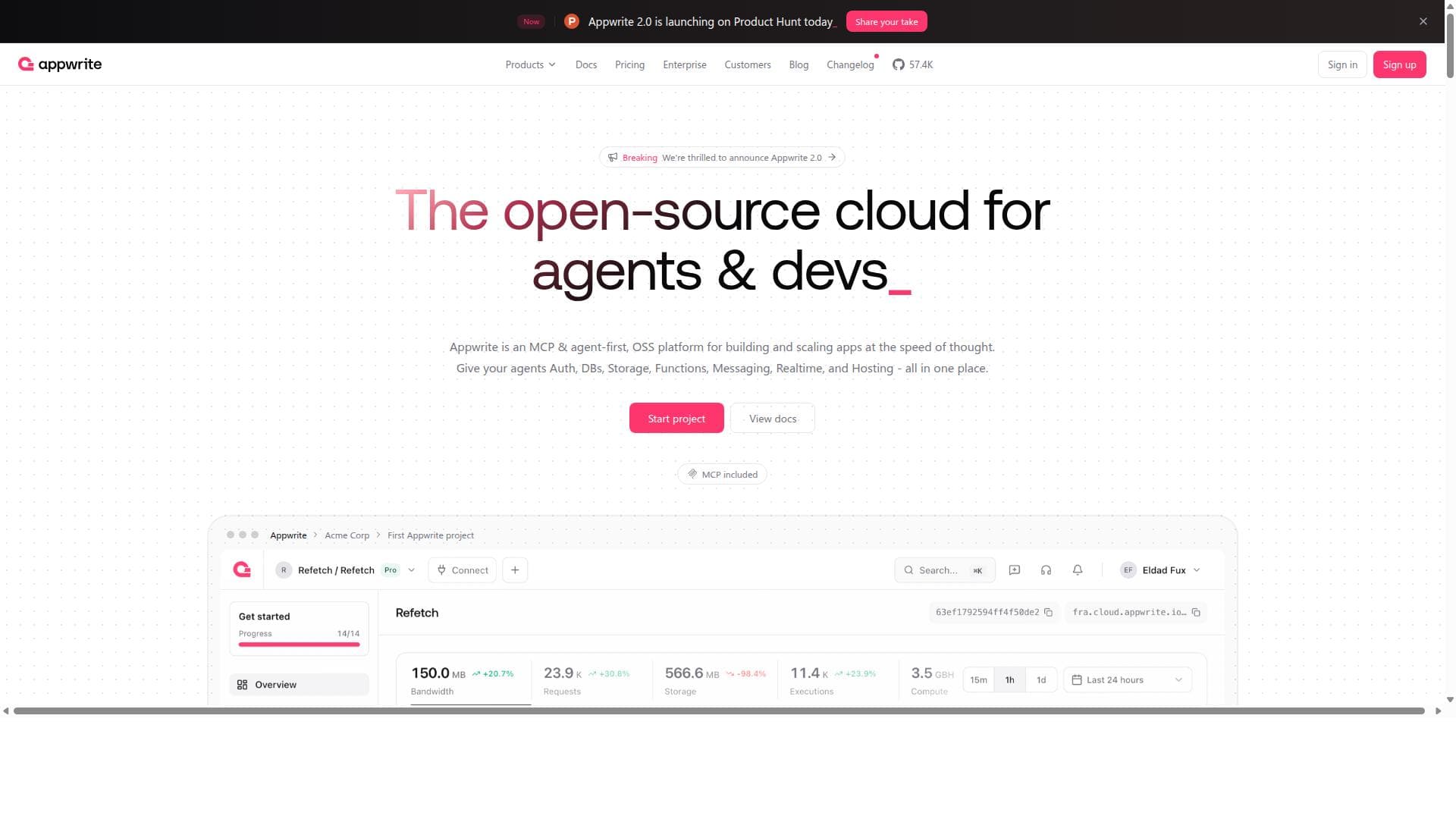
Appwrite is a powerful open-source backend platform that consolidates authentication, databases, storage, cloud functions, messaging, and site hosting into one developer-friendly solution. Perfect for developers seeking full control and flexibility, it enables rapid app development without vendor lock-in or hefty costs.

Descrizione
Appwrite 2.0 is the second major generation of the platform. It replaces the engine underneath, rebuilds the Console on top, and expands what a project can hold: relational and schemaless and vector data, native PostgreSQL and MySQL engines, S3-addressable storage, a standards-compliant identity provider, and the network layer in front of all of it.
Descrizione dettagliata
Appwrite is an open-source developer platform designed to provide essential backend services that simplify and accelerate the process of building modern applications. Its core purpose is to offer developers a unified cloud infrastructure that handles common backend functionalities such as authentication, database management, file storage, cloud functions, messaging, and site hosting. By consolidating these services into a single platform, Appwrite enables developers to focus more on frontend development and business logic rather than managing complex backend infrastructure. This makes it an ideal solution for startups, indie developers, and enterprises looking to streamline app development workflows while maintaining full control over their backend environment. One of Appwrite's standout features is its comprehensive authentication system, which supports multiple sign-in methods including email/password, OAuth providers, anonymous login, and custom JWT tokens. This flexibility ensures secure and scalable user management for any application. Its database service offers a NoSQL document-oriented database that supports real-time data synchronization, complex queries, and indexing, enabling developers to build dynamic and responsive apps. The file storage system allows secure uploading, storage, and delivery of files with built-in permissions and CDN support, making media management seamless. Appwrite also includes cloud functions, which let developers run server-side code triggered by HTTP requests or events within the platform, supporting multiple programming languages. This feature is crucial for extending app capabilities without managing separate server infrastructure. The messaging system facilitates real-time communication through WebSocket-based protocols, supporting chat apps, notifications, and other interactive features. Additionally, Appwrite offers site hosting capabilities, allowing developers to deploy static websites or frontend applications directly through the platform, simplifying the deployment pipeline. This platform is best suited for developers and teams who want a self-hosted, open-source alternative to proprietary Backend-as-a-Service (BaaS) solutions. It caters well to mobile and web app developers, SaaS startups, and agencies building client projects that require customizable backend services. Use cases include building social networks, e-commerce platforms, real-time collaboration tools, content management systems, and IoT applications. Its open-source nature also appeals to organizations with strict data privacy requirements or those wanting to avoid vendor lock-in. Regarding pricing, Appwrite is free to use as an open-source project, allowing anyone to download, self-host, and modify the platform without cost. This makes it highly cost-effective compared to commercial BaaS providers that charge based on usage or user count. However, users need to manage their own hosting infrastructure, which may incur cloud or server costs depending on scale and provider. The community edition is fully featured, and enterprise support or managed hosting options may be available through third-party vendors or future offerings. When compared to alternatives like Firebase, Supabase, or AWS Amplify, Appwrite stands out by being fully open-source and self-hosted, giving developers complete control over their data and backend environment. While Firebase offers extensive managed services with tight Google Cloud integration, it is proprietary and can become costly at scale. Supabase is also open-source but focuses primarily on PostgreSQL databases, whereas Appwrite provides a broader suite of backend services in one platform. AWS Amplify integrates deeply with AWS services but requires familiarity with the AWS ecosystem. Appwrite’s ease of deployment and comprehensive feature set make it a compelling choice for developers seeking flexibility and ownership. Notable limitations include the need for users to manage their own infrastructure, which requires DevOps knowledge and can introduce maintenance overhead. While the platform is robust, it may lack some advanced features or integrations available in mature commercial BaaS platforms. Additionally, the community and ecosystem, while growing, are smaller compared to giants like Firebase, which may affect the availability of third-party plugins or support. However, its open-source nature encourages community contributions and rapid iteration. Overall, Appwrite is a powerful backend platform ideal for developers who want an all-in-one open-source solution to build scalable, secure, and feature-rich applications without vendor lock-in.
Funzioni dello strumento
- Authentication services
- Database management
- File storage
- Cloud functions
- Messaging system
- Site hosting
Descrizione
Appwrite is a powerful open-source backend platform that consolidates authentication, databases, storage, cloud functions, messaging, and site hosting into one developer-friendly solution. Perfect for developers seeking full control and flexibility, it enables rapid app development without vendor lock-in or hefty costs.
Appwrite 2.0 is the second major generation of the platform. It replaces the engine underneath, rebuilds the Console on top, and expands what a project can hold: relational and schemaless and vector data, native PostgreSQL and MySQL engines, S3-addressable storage, a standards-compliant identity provider, and the network layer in front of all of it.
Descrizione dettagliata
Appwrite is an open-source developer platform designed to provide essential backend services that simplify and accelerate the process of building modern applications. Its core purpose is to offer developers a unified cloud infrastructure that handles common backend functionalities such as authentication, database management, file storage, cloud functions, messaging, and site hosting. By consolidating these services into a single platform, Appwrite enables developers to focus more on frontend development and business logic rather than managing complex backend infrastructure. This makes it an ideal solution for startups, indie developers, and enterprises looking to streamline app development workflows while maintaining full control over their backend environment. One of Appwrite's standout features is its comprehensive authentication system, which supports multiple sign-in methods including email/password, OAuth providers, anonymous login, and custom JWT tokens. This flexibility ensures secure and scalable user management for any application. Its database service offers a NoSQL document-oriented database that supports real-time data synchronization, complex queries, and indexing, enabling developers to build dynamic and responsive apps. The file storage system allows secure uploading, storage, and delivery of files with built-in permissions and CDN support, making media management seamless. Appwrite also includes cloud functions, which let developers run server-side code triggered by HTTP requests or events within the platform, supporting multiple programming languages. This feature is crucial for extending app capabilities without managing separate server infrastructure. The messaging system facilitates real-time communication through WebSocket-based protocols, supporting chat apps, notifications, and other interactive features. Additionally, Appwrite offers site hosting capabilities, allowing developers to deploy static websites or frontend applications directly through the platform, simplifying the deployment pipeline. This platform is best suited for developers and teams who want a self-hosted, open-source alternative to proprietary Backend-as-a-Service (BaaS) solutions. It caters well to mobile and web app developers, SaaS startups, and agencies building client projects that require customizable backend services. Use cases include building social networks, e-commerce platforms, real-time collaboration tools, content management systems, and IoT applications. Its open-source nature also appeals to organizations with strict data privacy requirements or those wanting to avoid vendor lock-in. Regarding pricing, Appwrite is free to use as an open-source project, allowing anyone to download, self-host, and modify the platform without cost. This makes it highly cost-effective compared to commercial BaaS providers that charge based on usage or user count. However, users need to manage their own hosting infrastructure, which may incur cloud or server costs depending on scale and provider. The community edition is fully featured, and enterprise support or managed hosting options may be available through third-party vendors or future offerings. When compared to alternatives like Firebase, Supabase, or AWS Amplify, Appwrite stands out by being fully open-source and self-hosted, giving developers complete control over their data and backend environment. While Firebase offers extensive managed services with tight Google Cloud integration, it is proprietary and can become costly at scale. Supabase is also open-source but focuses primarily on PostgreSQL databases, whereas Appwrite provides a broader suite of backend services in one platform. AWS Amplify integrates deeply with AWS services but requires familiarity with the AWS ecosystem. Appwrite’s ease of deployment and comprehensive feature set make it a compelling choice for developers seeking flexibility and ownership. Notable limitations include the need for users to manage their own infrastructure, which requires DevOps knowledge and can introduce maintenance overhead. While the platform is robust, it may lack some advanced features or integrations available in mature commercial BaaS platforms. Additionally, the community and ecosystem, while growing, are smaller compared to giants like Firebase, which may affect the availability of third-party plugins or support. However, its open-source nature encourages community contributions and rapid iteration. Overall, Appwrite is a powerful backend platform ideal for developers who want an all-in-one open-source solution to build scalable, secure, and feature-rich applications without vendor lock-in.
Domande frequenti
What is Appwrite?
Appwrite is an open-source developer platform that provides essential backend services such as authentication, database management, file storage, cloud functions, messaging, and site hosting. It serves as a unified cloud infrastructure designed to help developers build and scale applications efficiently.
How much does Appwrite cost?
Appwrite is free to use as an open-source platform. You can download, self-host, and modify it without any licensing fees. However, you may incur costs related to the hosting infrastructure you choose to deploy it on.
Who is Appwrite best for?
Appwrite is ideal for developers, startups, and agencies who want a self-hosted, open-source backend solution. It suits mobile and web app developers, SaaS companies, and organizations requiring full control over their backend and data privacy.
What are the main features of Appwrite?
Key features include flexible authentication services, a NoSQL database with real-time capabilities, secure file storage, cloud functions supporting multiple languages, a real-time messaging system, and static site hosting.
Does Appwrite offer a free trial?
Since Appwrite is open-source and free to use, there is no need for a trial. You can immediately download and deploy it to evaluate its capabilities.
What integrations does Appwrite support?
Appwrite supports integration with various frontend frameworks and platforms including React, Vue, Next.js, Svelte, Flutter, Android, and iOS. It also supports OAuth providers for authentication and can be extended via cloud functions.
How does Appwrite work?
Appwrite works by providing a backend server that developers can self-host. It exposes APIs for authentication, database operations, file storage, cloud functions, messaging, and site hosting, allowing frontend applications to interact with these services securely and efficiently.
Social
Usa lo strumentoRecensioni
Ancora nessuna recensione. Sii il primo a condividere la tua esperienza.
Strumenti sponsorizzati































Strumenti consigliati
Resta aggiornato sui nuovi strumenti IA
Ricevi gli ultimi insight, iscriviti alla newsletter
Letta e scelta da 50,000+ lettori
Unisciti alla più grande community IA
La nostra community e lo staff sono qui per aiutarti!
Il tuo feedback aiuterà Alice AI a migliorare nelle versioni future.







Invia il tuo strumento


PoweredByAI.app è un catalogo di strumenti IA che aiuta persone, aziende e creator a scoprire i migliori strumenti di IA per scrittura, coding, design, produttività e altro.
© 2026 , Prodotto di011BQ. Tutti i diritti riservati.