🚀 Zaprep: i tuoi social a pieno regime. Inizia gratis — automatizza 1.000 DM/mese e trasforma l'engagement in lead. con 1.000 DM automatizzati al mese.
Invia il tuo strumento
PoweredByAI.app è un catalogo di strumenti IA che aiuta persone, aziende e creator a scoprire i migliori strumenti di IA per scrittura, coding, design, produttività e altro.
© 2026 , Prodotto di011BQ. Tutti i diritti riservati.

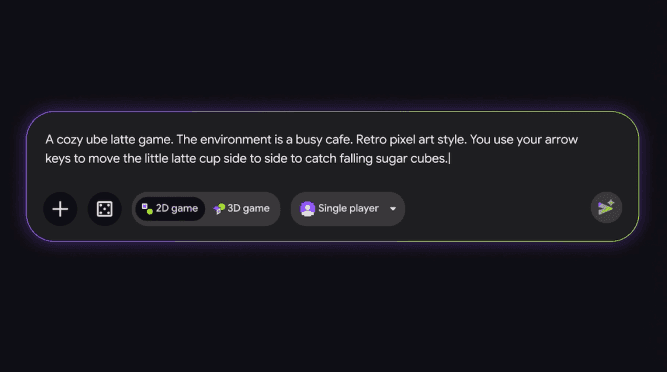
The barriers to entry for game creation are rapidly diminishing as AI makes game development more accessible to people without traditional programming, design, or illustration skills. The latest example is an experiment from Google Labs. On Wednesday, the tech giant’s public incubator and experimental platformlauncheda new AI-powered game-creation platform called Playground, which allows users to build browser-based games using simple text prompts, eliminating the need for coding expertise. With Playground, creators can select a genre, such as trivia or racing, or start a project from scratch. They can specify whether they want a 2D or 3D game and choose between single-player and multiplayer experiences before describing the desired mechanics, gameplay, and visual style. Playground also allows users to upload visuals that its AI can transform into game assets tailored to the game’s overall art style. Once created, games can be played on both mobile devices and computers. Projects can remain private, be shared through a link, or be published to Playground’s Explore gallery. Published games can support features such as leaderboards, while creators can continue modifying their projects even after they have been released. Google also indicated that it plans to add Unity Spark integration in a future update. The integration could give Playground users access to additional 3D capabilities and “professional-level” game mechanics through Unity’s technology, further expanding what can be created through the platform. Playground is initially available to users aged 18 and older in the U.S., with Google planning to expand availability to additional countries. Browsing and playing games in the catalog is free, while game generation relies on a weekly token system. The free tier provides a limited number of tokens, while Google One AI subscribers receive higher usage limits. Google’s launch places Playground within a growing market of AI-assisted game-development tools.Roblox,for example, announced its own Build feature in July, enabling users to create games through natural-language prompts. The initiative also builds on Google’s broader interest in gaming. The company previously explored cloud gaming throughStadiaback in 2022, and later on continued incorporating games into other platforms, includingYouTube Playables, a dedicated hub offering a selection of instantly playable web-based games.
View

When Tony Fadell takes the stage at the inauguralMIT Future Fest, he projects a slide with three images of once-hyped AI devices that have already been discontinued: the Rabbit R1, the Humane Ai pin, and the Limitless pendant. “These were kind of the ‘Gen 1’ AI products, and because of my background, these companies called me and asked me to help them,” Fadell said. “I didn’t.” It’s no surprise that these companies want Fadell’s advice. He’s credited as the “father of the iPod,” a co-creator of the iPhone, and the founder of Nest, the smart thermostat company acquired by Google. “You have to really understand what you’re trying to do, what pain you’re trying to solve,” he said. “In each of these cases, each one of them didn’t meet any kind of need — it was just interesting technology for geeks, and you’re like, ‘Okay, that’s neat, but it doesn’t really apply to my life.’” These early AI devices promised the convenience of having a personal assistant, but didn’t actually work that well. Even if they did, most people have never had an assistant and know how they would use — or grow to trust — a personal robot helper. “It’s less than 0.01% of the world population that has ever had a human [assistant] do anything, and so when [companies] say, ‘Oh, we want an assistant,’ that’s a bunch of people who have assistants saying it,” he said. “Most consumers don’t even know what an assistant is.” Fadell goes on to explain to those of us in the 99.99% that hiring a trustworthy personal assistant isn’t as straightforward as pulling the most promising resume out of a pile of applications. “It took me a couple of years first to understand how best to utilize [an assistant], and then to trust them with the most sensitive data, and have them be an agent where they’re setting up meetings with people and working with my bank,” he said. “I understand we have this vision of the future, but there’s a lot of steps to get the general consumer and even the general business on this path.” It’s hard to talk about the struggles of building trust in your personal assistant without sounding a bit entitled, but Fadell has a point. When you hire a human assistant, you’re not giving them your bank account login on day one. We’re heading into a world where anyone can have a personal AI assistant, but these tools are only valuable if we can trust them to be completely secure. At this point, establishing trust with an AI assistant seems even harder than relying on a human. Metarecently launched Muse, its all-purpose AI assistant, but users have reason to be wary. A security researcher quickly found a seriousvulnerabilityin Muse after launch, and a recent404 Media reportstates that some Meta employees discovered security issues that prompted multiple teams to embark upon a “mad dash” to fix these problems before launch, working overtime. “Trust and safety are going to be paramount with anything that we turn over to some kind of intelligence,” Fadell said. “The only company I could see right now — maybe one other — is Apple who could do this. Apple has all the hardware, they have all the chips, they have all the pieces, but they don’t have all the AI stuff.” Even if it’s not Apple that ultimately produces the stickiest AI agent, Fadell predicts that a successful agent will have to operate on-device only, both for the sake of privacy and to keep the tech lightweight. “When you’re hearing all of these things about, ‘Oh, data centers are going to conquer the world,’ … I don’t believe it,” he said. “I’ve seen this before. I’ve seen this play out in the internet days and what have you. We have so much power on the device now, and even more compute, and they’re still battery operated.” By keeping sensitive data on-device, rather than transmitting it through the cloud, Apple has garnered trust from users to share their biometric data through features like Face ID. As Fadell notes, Apple seems to have more goodwill with consumers than its competitors when it comes to privacy, but unlike other top tech companies, Apple doesn’t have a world-class AI model of its own — the new Siri AI runs on custom-built versions of Google’s Gemini. While Apple lags in proprietary AI, it is leaps ahead in hardware. Fadell theorizes that companies likeMetaandOpenAIare turning their attention toward gadgets because they don’t have billions of devices in circulation like Apple does. “It’s because they don’t have access to the sensors on your phone. They’re like, ‘Oh, we’ll need video,’ and you have to check, ‘Yes, I’ll give you video.’ Then they say, ‘Well, we need audio.’ Check. ‘We need your GPS location.’ Check. And before you know it, it becomes a list of 20 things or more than you have then allowed them to have,” he said. “So what do they do? They go and make a device with all that stuff in it without a screen… and then they just Bluetooth or Wi-Fi into your phone and then back up to the web, or into a 5G network, so they can get all the sensor data.” Given his history creating the iPhone and iPod, it might seem like Fadell is still looking at his former employer through rose-colored glasses. While he may give Apple credit where due, he hasn’t been shy tocall Apple outwhen he thinks they’re messing up. When an audience member asks about the luck involved in finding product-market fit, Fadell points out that it’s more difficult for startups to manufacture that luck, since a failed product can spell the end of the company. “Because it’s a startup, you get one shot,” he quipped. “It’s not like Apple with the Vision Pro.”

Healthleap, a startup building an AI platform that reads patient records to identify patients at risk of undiagnosed illnesses, has raised $38 million in seed and Series A funding, TechCrunch has exclusively learned. The financing includes an $8 million seed round co-led by Sequoia Capital and First Round Capital, and a $30 million Series A led by Hummingbird Ventures. The company is not disclosing its valuation. Founded inSouth Africa in 2022by siblings Jemima and Josiah Meyer (pictured above), the startup initially offered a clinical nutrition tool Jemima had built for dietitians. But the company later pivoted and built a more general-purpose platform that aims to identify patients admitted to hospitals who may be suffering from conditions like malnutrition or delirium that aren’t often identified early enough, CEO and co-founder Josiah Meyer told TechCrunch. “A patient’s chart holds two kinds of data. Labs, weights, and vital signs sit in structured fields, but the most telling signs sit in clinicians’ written notes: poor appetite, recent weight loss, muscle loss, trouble swallowing. Our developing approach is extracting affirmative or negated mentions of these clinical concepts in an easily extensible and scalable way,” Josiah said. The company’s platform is currently deployed in more than 50 hospitals, where it screens patients for conditions such as malnutrition and delirium, he said. The startup has also built programs to identify aspiration pneumonia, pressure ulcers, and risk of readmission for congestive heart failure, which Josiah said are undergoing further clinical validation. To find patients that may be at risk of an illness or were undiagnosed, Healthleap plugs into a hospital’s electronic health record system and uses language models to pull information from written notes, such as references to recent weight loss or difficulty swallowing. That analysis is then fed into its risk models, alongside structured information such as lab reports and vitals to surface patients who may need a closer look. The company notes that its software doesn’t diagnose patients, only highlights items for additional review. “Each night, we analyze every adult inpatient’s record: lab results, vital signs, weights, medications, diet orders, diagnoses, clinicians’ notes, and more,” Josiah explained. “Each morning, we write a risk score into the care team’s existing workflow with a dashboard accessible that holds additional information about the patients’ trends.” Malnutrition likely served as a useful starting point for Healthleap, as it’s a condition thatoften goes undiagnosedand can adversely impact patient recovery in a variety of ways. Researchsuggests20% to 50% of hospital inpatients are malnourished, and somestudieshave linked malnutrition with longer stays, impaired wound healing, infections, and other complications, as well as higher morbidity and mortality. Josiah said Healthleap has grown from three hospital partners to more than 50 over the past year, and its customers now include Penn Medicine, Cedars-Sinai, Intermountain, Houston Methodist, and Emory Healthcare. Revenue has grown more than 10x over the same period, he said, though he didn’t disclose specifics. The startup sells three-year contracts priced according to a hospital’s licensed bed count, and also uses an outcome-based pricing model. “We use the hard ROI that the hospital finance team validates and attributes to us as the measurable ROI. Based on that, we contractually ensure that we deliver multiples of the contract price. To date, every customer has seen a 5x hard ROI or more, in some cases over 20x annual total ROI,” Josiah said. At the Hospital of the University of Pennsylvania, Healthleap says its malnutrition program resulted in $23.8 million in annualized financial impact, of which $6.3 million came from additional reimbursement and $17.5 million from shorter hospital stays. Healthleap plans to spend the fresh cash on engineering, product, sales, and customer success as it adds support for identifying more conditions. Meyer said the company ultimately wants to cover more than 40 major health conditions and expand into outpatient and home care.

MetaannouncedWednesday that it took action against 33.2 million pieces of child sexual exploitation content on Facebook and Instagram in the first half of 2026. At the same time, the company is rolling out new AI tools to find ads and accounts that may be used to secretly direct people to illegal child abuse material. More than 97% of the content Meta acted on was found by its systems before users reported it, the company said. In India, Meta acted on 5.3 million pieces of child sexual exploitation content during the same period, with more than 98% detected before users reported it. Meta said its latest AI tools are aimed at people using ads that look harmless to send users to illegal content outside Meta’s platforms. The company has introduced a new large language model (LLM) system to detect what it calls “signposting.” This refers to ads that may look normal but are suspected of directing users to illegal content or other harmful activity elsewhere online. Meta says this is a tactic it has recently seen bad actors use as they continue to change their methods to avoid detection. While the ads themselves may not contain illegal material, they can still act as a gateway to websites hosting child sexual abuse material. Because of this, Meta said it’s now looking at where an ad sends users, and not just what the ad contains. The company can use this information to block websites or other destinations that break its rules and take action against the accounts behind them. Meta is also using additional AI-driven scans to find child exploitation content that earlier systems may have missed. The company said it will continue adding new signals as it learns more about how these networks operate. Another new tool is a “red-teaming AI agent” that tests Meta’s own safety measures. It looks for weaknesses that bad actors could use to get around the company’s protections. Meta said this could help it find new methods of abuse before they become more common. Additionally, the company is improving its systems for finding people who return to its platforms with new accounts after their previous accounts have been removed. The new measures come as Meta continues to face pressure over the safety of children on its platforms. The company has faced lawsuits and criticism from lawmakers over the risks its social media services may pose to young users. In August, Meta reached an agreement to payup to $18 billionto settle a child safety lawsuit involving 29 U.S. states, addressing concerns regarding the protection of children online. Meta has introduced several child-safety features this year, includingparental controls for Meta AI,pre-teen accountson WhatsApp, andalertsfor parents when children search Instagram for self-harm content. In September, WhatsApp addedmore controlsfor parents. They can limit how teenagers use Channels, control who can see their status updates, and decide who can add their children to groups. Parents can also choose to receive notifications about certain group activity.

Mistral said that Large 4 is built for coding, cybersecurity, agentic workflows and multimodal tasks, with weights set to be released by the end of October.
View

OpenAI introduced age prediction in ChatGPT earlier this year. The system helps the AI chatbot determine whether an account may belong to someone under the age of 18. The San Francisco-based AI company has now detailed how its age prediction functionality works. As per OpenAI, it adds an extra layer of protection beyond the date of birth provided when an account is created. Instead of only relying on a user's stated age, it looks at behavioural and account-level signals.
View

Google has announced the expansion of Gemini in Chrome in India. As part of the move, the Mountain View-based tech giant is bringing its AI browsing assistant to Android users. Google says Gemini in Chrome can summarise lengthy webpages, answer questions about content, work with Google apps, and generate or edit images using Nano Banana. Apart from this, Auto Browse, which is Google's agentic feature, is rolling out on both desktop and Android.
View

The company is training a 26-billion-parameter model that it plans to release as open source, along with its dataset and training stack.
View

Vijay Shekhar Sharma offered personal funding to AI model builders, a Cast AI workshop showed the cost of model routing, and Tech Mahindra questioned whether humans can remain in the loop for every AI decision.
View

Enterprises need to govern AI at the infrastructure layer by tracking spending, controlling access, managing risk, and matching tasks to the right models, says Kunal Das, core contributor to Kimchi.
View

Google has announced EmbeddingGemma 2. This latest lightweight embedding model is designed to process text, code, images, audio, and video in a single, unified embedding space. The new model is built on the Gemma 4 architecture, and Google claims EmbeddingGemma 2 is optimal for on-device inference. EmbeddingGemma 2 has 740 million parameters. It is available on Hugging Face and Kaggle and will soon be available on the Gemini Enterprise Agent Platform Model Garden. Google has also released Nano Banana 2.1, an image generation and editing model. It is based on Gemini 3.6 Flash.
View

Wikimedia Foundation has reportedly found activity from AI agents it believes were operated by OpenAI across its platforms. The agents made unauthorised edits to Wikimedia wikis, tried to use its public Etherpad service to access other websites and generated millions of automated requests to Wikimedia's services. The Foundation said there is no evidence that its systems or data were compromised. However, it warned that this kind of activity can put extra pressure on its infrastructure and the volunteers who maintain it.
View
View
View
View